Black diamonds are among the most mysterious and misunderstood gemstones on the planet. Unlike their transparent white counterparts, these opaque stones carry billions of years of geological — and possibly extraterrestrial — history within their polycrystalline structure. Whether you are drawn to the dramatic contrast of a black diamond set in solid gold, fascinated by the science behind carbonado, or searching for a bold engagement ring that defies convention, this guide covers everything you need to know before buying.
At GOLDZENN, our Miami workshop with 50+ years of combined experience works with natural black diamonds to create handcrafted solid gold pieces through our custom jewelry program. Every piece is XRF-verified for gold purity and backed by a 1-year limited warranty against manufacturing defects, with wear repairs assessed case-by-case by our workshop. Call us at 321-521-4651 to discuss your black diamond vision.
What Are Black Diamonds?
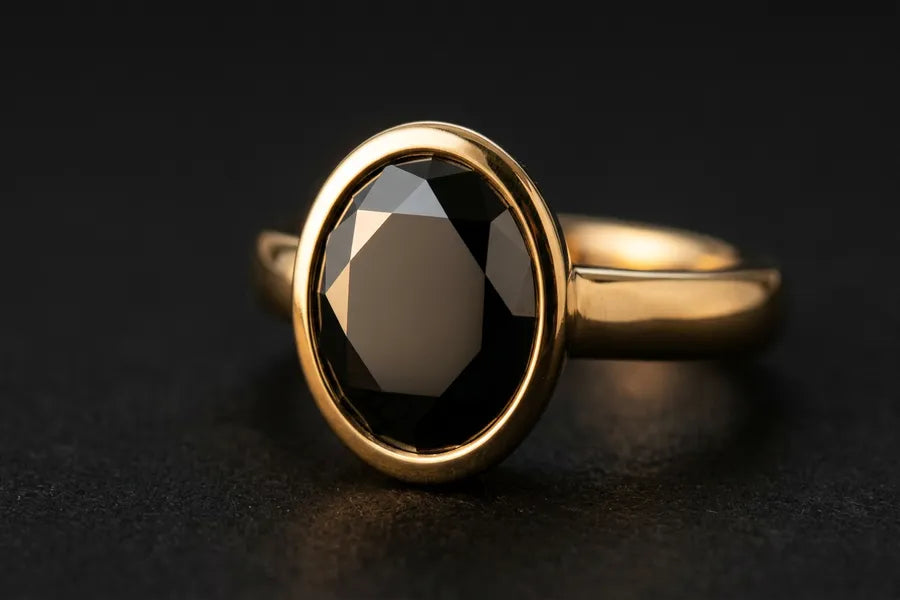
Black diamonds are real diamonds — full stop. They share the same carbon composition and rank 10 on the Mohs hardness scale alongside white (colorless) diamonds. The defining difference is their opacity: while white diamonds allow light to pass through and create brilliance, black diamonds absorb virtually all light, producing a deep, metallic luster that appears almost liquid under certain lighting conditions.
What gives them that darkness? The answer lies in their internal structure. Black diamonds contain dense concentrations of graphite, hematite, and pyrite inclusions distributed throughout the crystal. These mineral inclusions are so numerous and tightly packed that no light passes through the stone. The result is not the sparkling fire you associate with a traditional white diamond — instead, you get an adamantine-to-submetallic surface sheen that is visually striking in an entirely different way.
How Black Diamonds Get Their Color
The coloring mechanism in black diamonds is fundamentally different from other fancy colored diamonds. Blue diamonds get their color from boron, yellow from nitrogen, and pink from structural distortions in the crystal lattice. Black diamonds, however, owe their color to sheer density of inclusions — primarily graphite and other dark minerals scattered throughout the stone in concentrations high enough to render the entire crystal opaque.
This is important for buyers to understand because it means the "quality" of a black diamond's color depends on uniformity. The most desirable natural black diamonds display an even, consistent jet-black appearance with no visible gray patches, streaks, or translucent zones when examined under strong light.
Black Diamond vs. Carbonado: Understanding the Terms
You will encounter the term "carbonado" frequently in black diamond discussions, and the distinction matters. A carbonado is a specific type of natural black diamond — a polycrystalline aggregate composed of diamond, graphite, and amorphous carbon fused together without the single-crystal structure of a conventional diamond. All carbonados are black diamonds, but not all black diamonds are carbonados. A heavily included single-crystal diamond that appears black is technically a black diamond but not a carbonado. Learn more in our marquise cut diamonds.
Carbonados are found exclusively in alluvial (river) deposits in Brazil and the Central African Republic. They have never been found in kimberlite pipes — the volcanic structures where virtually all other diamonds on Earth originate. This geographic and geological anomaly is one of the strongest pieces of evidence for a non-traditional origin, including the possibility that carbonados are literally older than our solar system.
Are Black Diamonds Real Diamonds?
Yes. Both the GIA (Gemological Institute of America) and IGI (International Gemological Institute) confirm that natural black diamonds are genuine diamonds. They are composed of carbon, crystallized under extreme heat and pressure, and register 10 on the Mohs hardness scale. The GIA issues a Colored Diamond Identification and Origin Report specifically for black diamonds, classifying them as "Fancy Black."
In fact, natural black diamonds (carbonados) are actually tougher than white diamonds. While white diamonds are monocrystalline with natural cleavage planes — directions along which they can split cleanly if struck at the right angle — carbonados have a random polycrystalline structure that eliminates these cleavage planes entirely. This makes them more resistant to chipping and fracture during everyday wear, an advantage that anyone shopping for men's rings or active-lifestyle jewelry should appreciate.
The Mysterious Origins of Black Diamonds
No gemstone on Earth has a more debated origin story than the carbonado. While we know precisely how white diamonds form — carbon compressed deep in the Earth's mantle at temperatures exceeding 1,000 degrees Celsius, then transported to the surface via kimberlite eruptions — the formation of carbonados remains one of geology's unsolved puzzles. Multiple theories compete, and the evidence points in directions that challenge our understanding of planetary geology.
The Extraterrestrial Theory
The most dramatic and widely discussed hypothesis proposes that carbonados formed inside a dying star — a supernova — approximately 3.8 billion years ago, then traveled through interstellar space as part of a large meteorite or asteroid before impacting the surface of Earth roughly 2.3 billion years ago, when the supercontinent Pangaea still held Brazil and Central Africa as a single landmass.
Dr. Stephen Haggerty of Florida International University is the leading proponent of this theory, which he published in the journal Astrophysical Journal Letters. His research team identified multiple lines of evidence supporting the extraterrestrial origin, building a case that no single alternative theory fully explains.
Evidence from Space: Hydrogen, Osbornite, and Isotopes
The extraterrestrial theory rests on several converging data points:
- Hydrogen: Carbonados contain detectable levels of hydrogen trapped within the crystal structure — a signature consistent with formation in a hydrogen-rich stellar environment, not the carbon-dominated conditions deep inside Earth.
- Osbornite: Trace amounts of titanium nitride (osbornite) have been found in carbonados. This mineral is extremely rare on Earth but has been identified in meteorites, including the Allende carbonaceous chondrite. Its presence in carbonados suggests formation in an extraterrestrial environment.
- Isotopic composition: The carbon isotope ratios in carbonados differ from Earth-sourced diamonds and more closely resemble those found in interstellar carbon.
- Age: Carbonados have been dated at 2.6 to 3.8 billion years old — older than many of Earth's geological formations and consistent with delivery from a pre-solar-system source.
- Geographic distribution: Natural carbonados are found exclusively in Brazil and the Central African Republic — two landmasses that were connected during the Pangaea supercontinent era, consistent with a single meteorite impact scattering fragments across what later became two separate continents.
Why Black Diamonds Are Only Found in Two Places on Earth
This geographic restriction is perhaps the most compelling evidence against conventional geological origin. If carbonados formed through normal mantle processes, we would expect to find them on multiple continents — just as white diamonds are found in South Africa, Russia, Canada, Australia, India, and dozens of other locations. The fact that every single known carbonado has come from either Brazil or the Central African Republic suggests a single-source origin event, perfectly consistent with a meteorite impact on the Pangaea supercontinent before it rifted apart roughly 180 million years ago.
Other proposed origin theories include deep mantle formation, meteorite impact shock metamorphism on Earth's surface, radiation-induced fission of uranium and thorium in sediment, and even formation within the carbon-rich mantles of exoplanets. The GIA's Gems & Gemology journal published a comprehensive review in Summer 2017 acknowledging that none of these theories has been universally accepted, and the true origin of carbonados remains one of gemology's great unsolved mysteries.
Natural vs. Treated vs. Lab-Grown Black Diamonds
Understanding the three categories of black diamonds is the single most important piece of knowledge for any buyer. The price difference between natural and treated black diamonds can be 10x or more, and the distinction is not always disclosed by sellers. Here is what you need to know before shopping for quality jewelry.
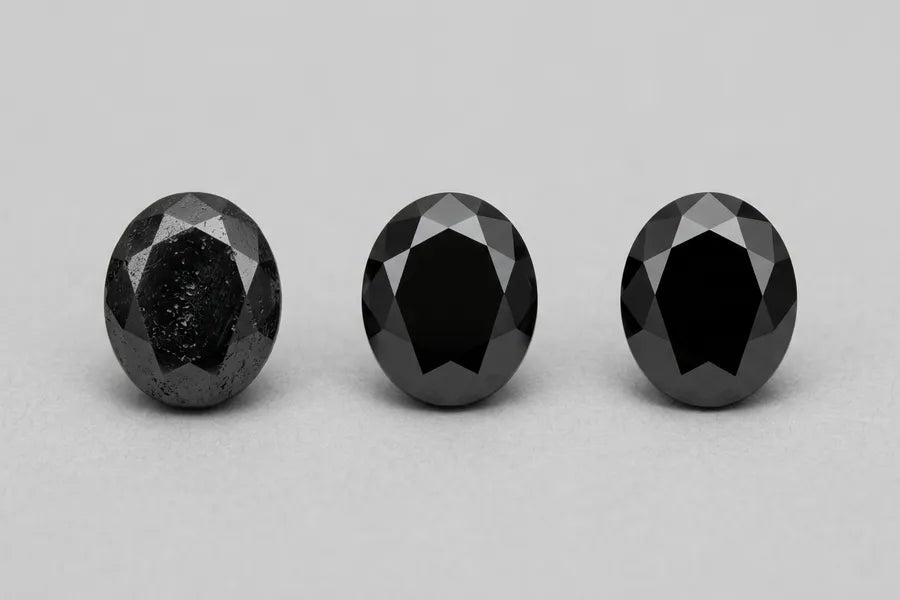
Natural Black Diamonds (True Carbonado)
Natural black diamonds formed over billions of years through geological (or extraterrestrial) processes. They are found in alluvial deposits in Brazil and the Central African Republic. Their color comes from natural graphite and mineral inclusions distributed throughout the polycrystalline structure. Natural carbonados are the rarest and most valuable category of black diamond.
How to identify: Natural black diamonds often exhibit a slightly rough or pitted surface texture at high magnification, with visible mineral inclusions under microscopy. They may show slight translucence at thin edges under intense fiber-optic light — a key diagnostic test gemologists use.
Treated / Enhanced Black Diamonds
Treated black diamonds start as low-quality white diamonds — heavily included, fractured, or industrial-grade stones that have little commercial value in their original state. Through high-temperature annealing (heating the diamond without pressure), graphite forms along internal fractures, turning the stone uniformly black. The result is a genuine diamond that has been color-enhanced to appear black. This treatment is permanent and stable. If you are interested in how different diamond types compare, our dedicated guide covers natural, lab-grown, and moissanite options side by side.
Other treatment methods include HPHT (high pressure, high temperature) processing at 1,900-2,500 degrees Celsius and 4-7 GPa, and neutron irradiation via nuclear reactor exposure. All three methods produce permanent black coloration. Treated black diamonds represent the vast majority of black diamond jewelry sold commercially.
Lab-Grown Black Diamonds
Lab-grown black diamonds are created using either CVD (Chemical Vapor Deposition) or HPHT processes, then treated to achieve black coloration. They are chemically identical to mined diamonds but lack the billions of years of natural history. For buyers who prioritize ethical sourcing and lower price points, lab-grown options provide an accessible entry point to black diamond ownership.
How to Tell the Difference
At home, you can perform a basic light test: hold the diamond up to a strong LED flashlight or fiber-optic light source. Natural carbonados may show very slight translucence or reddish-brown tones at the thinnest edges. Treated black diamonds typically appear uniformly black with no edge translucence. However, this test is not definitive — professional gemological examination is always recommended for high-value purchases.
A qualified gemologist can distinguish natural from treated black diamonds using advanced spectroscopy, microscopy, and inclusion analysis. This is why GIA certification matters: the GIA Colored Diamond Identification and Origin Report specifically states whether a black diamond is natural or treated, giving buyers certainty about what they are paying for. When you work with GOLDZENN, every diamond we source is verified and documented — call 321-521-4651 to discuss certification for your piece.
| Feature | Natural Carbonado | Treated Black Diamond | Lab-Grown Black Diamond |
|---|---|---|---|
| Origin | Brazil / Central African Republic (alluvial) | Any diamond mine (white diamonds treated) | Laboratory (CVD or HPHT) |
| Age | 2.6 - 3.8 billion years | Varies by source diamond | Weeks to months |
| Price Per Carat | $1,500 - $5,000+ | $100 - $300 | $200 - $400 |
| Color Source | Natural graphite/hematite/pyrite inclusions | Heat-induced graphitization of fractures | Treatment after growth |
| GIA Certification | Colored Diamond ID & Origin Report | States "Treated" on report | States "Laboratory-Grown" |
| Rarity | Very rare | Common | Readily available |
| Resale Value | Moderate — holds value best of three | Low | Very low |
| Surface Texture | May show slight pitting | Typically smooth/glassy | Smooth/uniform |
| Toughness | Superior (no cleavage planes) | Standard diamond toughness | Standard diamond toughness |
How Black Diamonds Are Graded
If you have ever shopped for a white diamond, you know the 4Cs: Cut, Color, Clarity, and Carat Weight. Black diamonds break nearly every one of those rules. Understanding how gemological laboratories evaluate black diamonds will help you make smarter purchasing decisions and avoid overpaying for characteristics that do not apply.
Why the Traditional 4Cs Do Not Fully Apply
Color: The GIA does not grade black diamonds on the D-to-Z color scale used for white diamonds. Instead, natural black diamonds receive a single classification: "Fancy Black." There is no gradient — a stone is either Fancy Black or it is not.
Clarity: Because black diamonds are completely opaque, internal inclusions are invisible to the naked eye (and largely invisible even under magnification). The GIA does not assign a clarity grade to black diamonds. What matters instead is surface quality — the presence or absence of pits, scratches, and blemishes on the polished surface.
Cut: The GIA does not assign a cut grade to black diamonds. However, cut quality still matters enormously for aesthetics. Because black diamonds do not refract light internally like white diamonds, the cut is evaluated for symmetry, proportions, and surface polish rather than brilliance and fire. A well-cut black diamond will have sharp edges, even facets, and a mirror-like surface polish that maximizes the metallic luster.
Carat Weight: This is the one "C" that applies normally. However, buyers should note that black diamonds are denser than white diamonds, meaning a 1-carat black diamond will appear slightly smaller than a 1-carat white diamond when viewed face-up. Plan for approximately 5-10% smaller face-up dimensions at equivalent carat weights.
GIA Colored Diamond Reports Explained
The GIA offers two types of reports relevant to black diamonds:
| Report Type | What It Covers | Best For | Approximate Cost |
|---|---|---|---|
| Colored Diamond Grading Report (full) | Color grade, color origin (natural vs. treated), carat weight, measurements, shape, cutting style, polish, symmetry, fluorescence | Natural black diamonds over 1 carat; high-value purchases; resale documentation | $150 - $300+ |
| Colored Diamond Identification & Origin Report (half) | Color origin (natural vs. treated vs. lab-grown), carat weight, measurements | Verifying natural vs. treated status; moderate-value purchases | $100 - $200 |
What to Look for on a GIA Certificate
When reviewing a GIA report for a black diamond, pay closest attention to these fields:
- Color Origin: Should state "Natural" for carbonado. If it says "Treated" or "HPHT Annealed," the stone has been enhanced.
- Color Grade: Should read "Fancy Black."
- Polish and Symmetry: These are the primary quality indicators for black diamonds since cut is not formally graded. Look for "Good" to "Excellent."
- Fluorescence: Most natural black diamonds show no fluorescence. The presence of fluorescence may indicate a treated stone.
You can verify any GIA report online at GIA's Report Check service using the report number. This is a critical step when purchasing from any seller. At GOLDZENN, we provide documentation for every stone we source — our team verifies each diamond's credentials before it enters our workshop. Reach out at contact@goldzenn.com for certification questions.
Black Diamond Pricing Guide
One of the most appealing aspects of black diamonds is their pricing. Compared to white diamonds, black diamonds offer dramatic visual impact at a fraction of the cost — particularly for buyers who appreciate bold, unconventional aesthetics over traditional sparkle. Understanding the pricing structure will help you allocate your budget effectively across the stone, setting, and gold karat selection.
Natural Black Diamond Prices Per Carat
Natural (carbonado) black diamonds with GIA certification typically range from $1,500 to $5,000+ per carat, depending on size, surface quality, cut symmetry, and the completeness of documentation. Exceptional specimens with provenance history or unusual size can exceed this range significantly.
Treated Black Diamond Prices Per Carat
Treated black diamonds — which represent the majority of commercial inventory — range from $100 to $300 per carat. These are genuine diamonds that have been color-enhanced, and they offer the most accessible price point for buyers who want the visual impact of a black diamond without the premium of a natural carbonado.
How Black Diamond Prices Compare to White Diamonds
The price gap between black and white diamonds is substantial and widens dramatically with carat weight. A 1-carat round brilliant white diamond in the G-H color, VS1-VS2 clarity range typically costs $4,400 to $7,600 per carat. A comparable 1-carat natural black diamond costs $1,500 to $3,000 per carat. But the real divergence happens at higher carat weights:
| Carat Weight | Natural Black Diamond | Treated Black Diamond | Lab-Grown Black Diamond | White Diamond (G-H, VS1-VS2) |
|---|---|---|---|---|
| 0.5 ct | $750 - $2,000 | $50 - $150 | $100 - $200 | $1,500 - $3,000 |
| 1.0 ct | $1,500 - $5,000 | $100 - $300 | $200 - $400 | $4,400 - $7,600 |
| 2.0 ct | $3,000 - $8,000 | $200 - $600 | $400 - $800 | $12,000 - $30,000 |
| 3.0 ct | $4,500 - $12,000 | $300 - $900 | $600 - $1,200 | $25,000 - $60,000 |
| 5.0 ct | $7,500 - $25,000 | $500 - $1,500 | $1,000 - $2,000 | $50,000 - $200,000+ |
Why Prices Do Not Scale Like White Diamonds
White diamond prices increase exponentially with carat weight because large, high-quality white diamonds are exponentially rarer. A 5-carat D-color flawless diamond is not 5x the price of a 1-carat — it can be 20x or more. Black diamond prices, by contrast, scale roughly linearly. A 5-carat natural black diamond costs approximately 5-6x what a 1-carat costs, not 20x. This makes larger black diamonds comparatively accessible for buyers who want visual presence without the exponential price curve.
For buyers considering black diamond jewelry at GOLDZENN, this pricing dynamic means you can invest more of your budget in the gold setting and chain or pendant style rather than spending the entire budget on the stone alone. Our custom jewelry program allows you to allocate your budget strategically across stone selection, metal choice, and design complexity. Call 321-521-4651 to discuss pricing for your custom black diamond piece.
Black Diamonds vs. White Diamonds
Choosing between a black diamond and a white diamond is not about "better" or "worse" — it is about what you want your jewelry to communicate. The two stones differ fundamentally in how they interact with light, how they are graded, and what they symbolize. This comparison will help you decide which serves your personal style and aesthetic goals.
| Attribute | Black Diamond | White Diamond |
|---|---|---|
| Appearance | Opaque, metallic/adamantine luster | Transparent, brilliance and fire |
| Light Interaction | Absorbs light — no sparkle, reflective surface sheen | Refracts and disperses light into spectral colors |
| Color Grading | "Fancy Black" (single grade) | D (colorless) to Z (light yellow) |
| Clarity Grading | Not graded (opaque) | FL to I3 (11 grades) |
| Cut Grading | Not formally graded by GIA | Excellent to Poor (5 grades) |
| Hardness | 10 Mohs | 10 Mohs |
| Toughness | Higher (no cleavage planes in carbonado) | Lower (cleavage planes present) |
| Price (1ct, natural) | $1,500 - $5,000 | $4,400 - $7,600 (G-H, VS) |
| Price Scaling | Roughly linear with carat weight | Exponential with carat weight |
| Symbolism | Power, mystery, resilience, unconventional | Purity, tradition, romance, status |
| Best For | Bold statements, men's jewelry, non-traditional engagement, urban luxury | Classic engagement, bridal, formal occasions |
| Resale Value | Moderate (natural); low (treated) | Strong (high-quality certified stones) |
The bottom line: if you want a stone that commands attention through depth and contrast rather than sparkle and brilliance, a black diamond delivers something no white diamond can. Paired with solid gold in 10K, 14K, or 18K, a black diamond creates one of the most visually striking combinations in modern jewelry.
Black Diamonds vs. Other Black Gemstones
Black diamonds are not the only dark-colored gemstone on the market. Buyers frequently compare them against black onyx, black sapphire, and black spinel. Each has distinct properties, price points, and suitability for different types of jewelry. The differences matter — especially when evaluating long-term durability and value retention.
| Property | Black Diamond | Black Onyx | Black Sapphire | Black Spinel |
|---|---|---|---|---|
| Mohs Hardness | 10 | 6.5 - 7 | 9 | 8 |
| Luster | Adamantine to submetallic | Waxy to vitreous | Vitreous | Vitreous |
| Durability | Excellent (hardest, toughest) | Fair (scratches easily) | Very good | Good |
| Price (1ct, natural) | $1,500 - $5,000 | $5 - $50 | $100 - $500 | $50 - $300 |
| Best Setting | Bezel, prong, halo | Bezel (needs protection) | Any | Bezel or prong |
| Daily Wear Suitable? | Yes — rings, earrings, pendants | Limited — earrings, pendants only | Yes — all jewelry types | Yes — most jewelry types |
| Rarity | Rare (natural carbonado) | Common | Uncommon | Moderately rare |
| Chemical Composition | Carbon (C) | Silicon dioxide (SiO2) | Aluminum oxide (Al2O3) | Magnesium aluminum oxide (MgAl2O4) |
Key takeaway: If you want a black stone for a ring that will be worn daily — especially a men's ring subjected to regular impact — black diamond and black sapphire are the only two options with adequate hardness. Black onyx, despite its popularity, is too soft for ring settings and will show wear within months of daily use. GOLDZENN works with all of these stones but recommends black diamonds for pieces intended for everyday wear.
Black Diamond Meaning and Symbolism
Beyond their physical properties, black diamonds carry rich symbolic significance across cultures and spiritual traditions. Their meaning has evolved over centuries, shifting from feared objects of bad luck to celebrated symbols of strength, individuality, and unconventional love.
Power, Strength, and Protection
Black diamonds have been associated with power and authority for centuries. In ancient Indian texts, they were linked to vajra — the thunderbolt — symbolizing indestructible force. Roman soldiers reportedly wore dark gemstones including black diamonds as protective talismans before battle, believing the stones could deflect negative energy and shield the wearer from harm.
Love and Unbreakable Bonds
In modern jewelry culture, black diamonds have become increasingly popular for engagement rings, symbolizing a love that is unconventional, resilient, and unbreakable. The diamond's opacity represents depth — a relationship with substance beyond surface-level sparkle. Couples who choose black diamond engagement rings are often signaling that their commitment exists outside the boundaries of tradition, defined by their own terms.
Transformation Through Adversity
The very nature of a black diamond — formed under extreme conditions, possibly originating from a supernova explosion, surviving billions of years of cosmic travel — makes it a natural symbol of transformation through hardship. In South American spiritual traditions, black diamonds represented the capacity for rebirth and renewal, emerging from darkness into a new form. This symbolism resonates deeply with anyone who has overcome significant challenges.
Spiritual and Metaphysical Properties
In contemporary crystal healing traditions, black diamonds are associated with the Root Chakra — the energy center at the base of the spine that governs feelings of safety, grounding, and connection to the physical world. Practitioners believe that wearing black diamonds can promote emotional stability, reduce anxiety, and enhance focus. While these properties are based in spiritual belief rather than scientific evidence, the tradition connects to the stone's ancient associations with protection and inner strength.
Black Diamonds Across Cultures and History
The cultural history of black diamonds spans thousands of years and multiple civilizations, from ancient temples in India to Renaissance courts in Italy. Understanding this history adds meaning to every black diamond piece and provides context that few other gemstones can match.
Ancient India — Vajra and Temple Guardians
The earliest recorded references to dark diamonds appear in ancient Indian texts, where they were associated with vajra (thunderbolt) and indrayudha (the weapon of Indra, king of the gods). Hindu temple statues were sometimes adorned with dark diamonds as symbols of divine protection. The Sanskrit word adamas — meaning "invincible" or "indivisible" — was applied to diamonds generally, but the black variety held particular reverence for its perceived connection to cosmic power.
Ancient Greece and Rome — Tears of the Gods
Greek mythology described diamonds as tears shed by the gods or splinters from falling stars. The Greeks adopted the Sanskrit term adamas, which became the root of the English word "diamond." Roman soldiers are documented wearing diamonds and other hard gemstones as protective amulets, believing the stones conveyed physical and spiritual invincibility in battle.
Renaissance Europe — Crowns of Power
During the Italian Renaissance, black diamonds were prized by nobility for their rarity and dramatic visual presence. They appeared in crowns, brooches, and ceremonial jewelry as symbols of authority, wealth, and political power. Unlike white diamonds, which signified purity and divine favor, black diamonds communicated earthly power and worldly dominance.
The Curse of the Black Orlov
Perhaps the most famous cultural narrative surrounding black diamonds is the alleged curse of the Black Orlov (also called the "Eye of Brahma"). According to legend, the original 195-carat stone was stolen from a Hindu temple statue in India, and the theft triggered a curse that led to the deaths of multiple owners, including two Russian princesses who reportedly leaped from buildings in the 1930s. The diamond was eventually recut to 67.50 carats — supposedly to break the curse. Today it is set in a brooch surrounded by 108 white diamonds and has changed hands without incident for decades. Whether the curse is genuine or an elaborate marketing narrative from the early 20th century remains debated.
Cultural Sensitivity: When Not to Gift Black Diamonds
One important consideration that most buying guides overlook: in several Asian cultures, black is traditionally associated with mourning, death, or bad fortune. In Chinese, Japanese, and some South Asian traditions, gifting black-colored items — including black gemstones — for celebratory occasions like engagements or weddings may be perceived as inauspicious. If you are purchasing a black diamond as a gift for someone from these cultural backgrounds, ensure they are comfortable with and enthusiastic about the choice. When in doubt, ask.
Famous Black Diamonds That Made History
A handful of extraordinary black diamonds have captured public attention over the centuries. These legendary stones demonstrate the geological wonder and cultural mystique that surrounds the world's rarest diamonds.
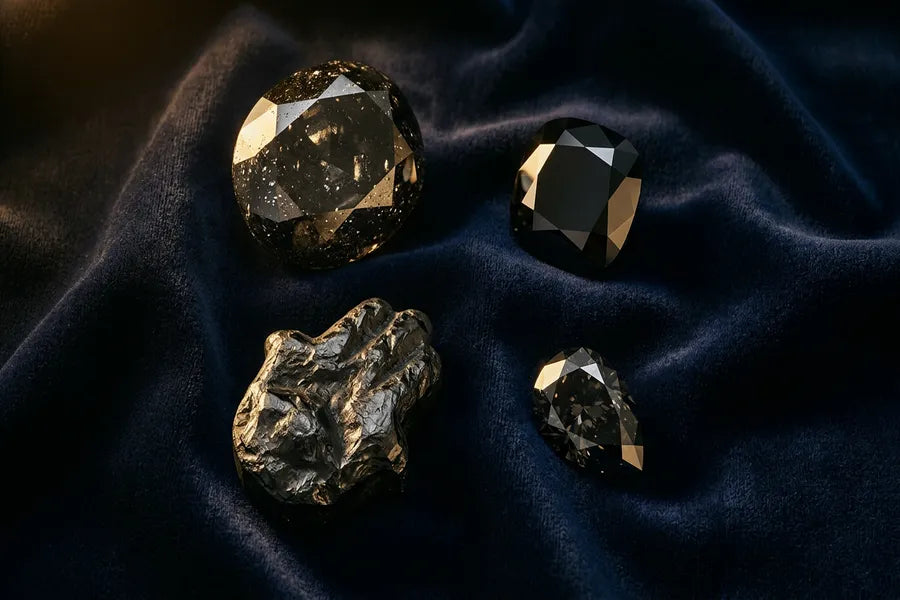
| Diamond | Cut Weight | Rough Weight | Shape | Origin | Notable Facts |
|---|---|---|---|---|---|
| Spirit of de Grisogono | 312.24 ct | 587 ct | Mogul cut | Central African Republic | World's largest cut black diamond. Set in white gold ring with 702 white diamonds (36.69 ct total). Sold to private buyer. |
| The Enigma | 555.55 ct | — | 55-facet hamsa hand | Unknown (carbonado) | Largest faceted diamond of any color ever auctioned. Sold at Sotheby's in 2022 for $4.3 million. Paid for in cryptocurrency. |
| The Gruosi Diamond | 115.34 ct | — | Heart shape | India | Largest heart-shaped black diamond in the world. Named after jeweler Fawaz Gruosi. |
| Korloff Noir | 88 ct | 421 ct | Round brilliant (57 facets) | Siberia, Russia | Insured for $37 million. Legend says it brings good luck to anyone who touches it. |
| Black Orlov (Eye of Brahma) | 67.50 ct | 195 ct | Cushion cut | India | Allegedly cursed after being stolen from Hindu statue. Recut to break curse. Now set in brooch with 108 white diamonds. |
| Amsterdam Diamond | 33.74 ct | 55.85 ct | Pear (145 facets) | South Africa | Sold in 2001 for $352,000 — highest auction price for a black diamond at the time. Rare monocrystalline black diamond. |
The Enigma deserves special attention: at 555.55 carats with exactly 55 facets, it was carved into the shape of a hamsa hand — a Near Eastern symbol of protection. It is a natural carbonado, consistent with the extraterrestrial origin theory, and was purchased via cryptocurrency, making it one of the first major gemstones sold through blockchain technology. Explore our extra-long gold chains guide.
Black Diamond Jewelry Types
Black diamonds work across virtually every jewelry category, from subtle accent stones to bold center pieces. The key is matching the stone's dramatic character to the right setting, metal, and design. Here is how black diamonds perform in each major jewelry type.
Engagement Rings — Why Couples Are Choosing Black
Black diamond engagement rings have surged in popularity, driven partly by celebrity adoption and partly by a broader cultural shift toward non-traditional engagement jewelry. The appeal is clear: a black diamond solitaire against white gold or platinum creates one of the most visually striking contrast combinations in fine jewelry, while the symbolism of strength, resilience, and depth resonates with couples who define love on their own terms.
GOLDZENN can create custom black diamond engagement rings in any style — solitaire, halo, three-stone, or vintage-inspired. Our workshop process includes CAD design, wax casting, hand setting, and final polishing, ensuring every piece meets our exacting standards. Browse our existing double halo engagement rings starting at $1,469 and oval solitaire engagement rings from $2,009 — any of these settings can be customized with a black diamond center stone.
Men's Rings and Urban Luxury
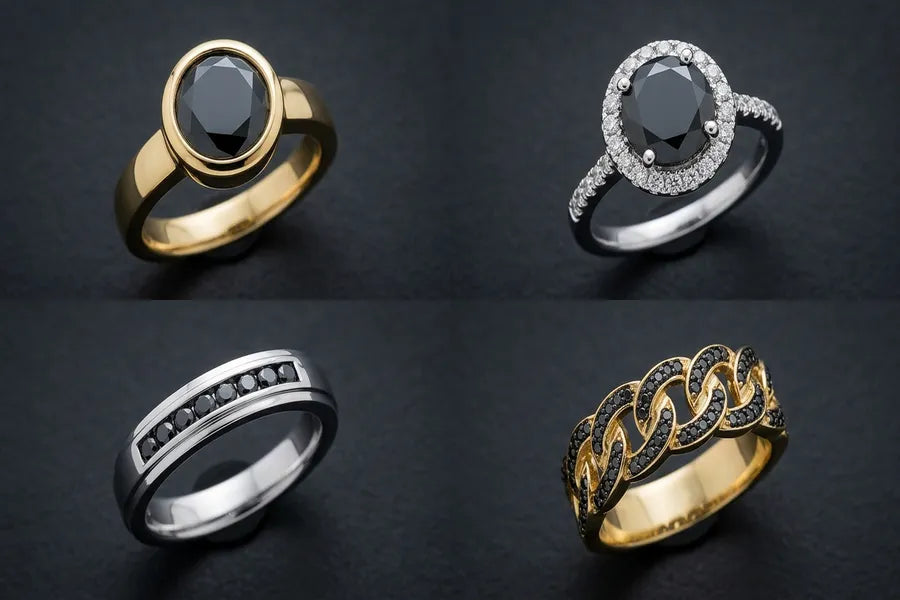
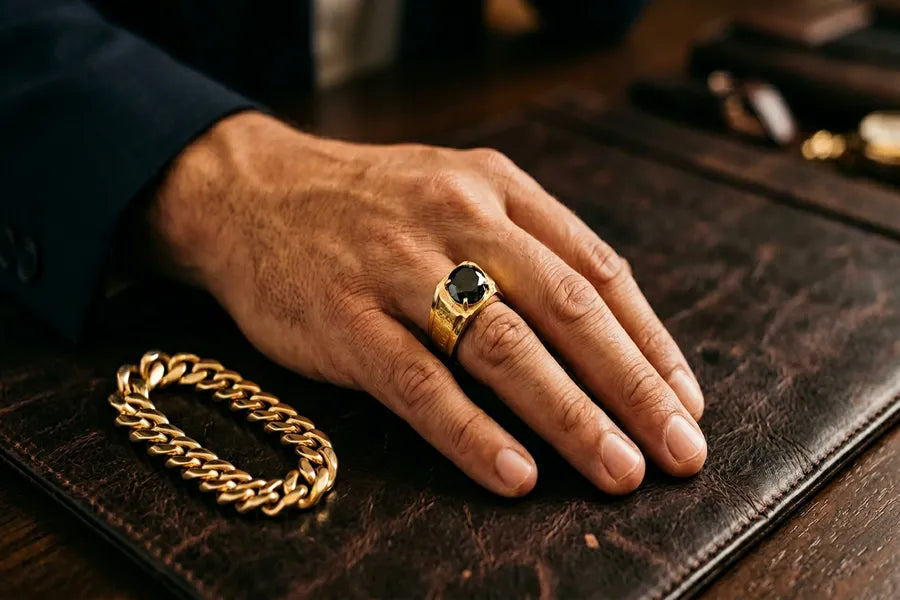
This is where black diamonds truly come into their own — and where most other guides fall completely silent. Black diamonds are perfectly suited for men's iced-out rings, Cuban link rings, signet rings, and statement bands. For inspiration, our complete diamond ring guide showcases the range of styles available. The stone's opaque, dark appearance reads as inherently masculine, and its superior toughness (especially in natural carbonado) makes it more forgiving of the daily abuse that men's rings endure.
Consider the visual impact: a 10K yellow gold Cuban link ring at $2,547 with the white diamonds swapped for black creates a completely different aesthetic — darker, bolder, and distinctly urban luxury. Our Lion Face diamond men's ring ($5,398) or "The World Is Yours" men's ring ($4,858) represent the kind of bold men's designs where black diamond accents would elevate the piece to a new level.
Earrings — Studs, Drops, and Hoops
Black diamond earrings are among the most versatile pieces in the category. For an immediate option, GOLDZENN's Black Diamond Honey Bee Earrings in 10K Yellow Gold at $1,200 feature 3/4 CTW of natural black diamonds in a distinctive bee motif design — a piece that stands alone in our catalog as a ready-to-wear black diamond offering.
For those seeking other styles, explore our broader earring collection including diamond stud earrings from $440 and unisex solitaire studs in 14K at $992 — any of which can be reimagined with black diamonds through our custom workshop. Email contact@goldzenn.com to explore custom black diamond earring options.
Pendants and Necklaces
Black diamond pendants make powerful standalone statements. The contrast of a black diamond against a solid gold chain — whether yellow gold or rose gold — is visually arresting. Our catalog includes diamond cross pendants from $750 and diamond heart pendants at $1,798, any of which can be customized with black diamond stones. For men's pendants, consider black diamond accents on pieces like our Lion Face diamond charm ($2,099) or Money & Family charm ($7,798) for a bold twist on classic designs. Pair any pendant with the right necklace chain or browse our pendant and chain pairing guide for styling inspiration.
Bracelets and Tennis Designs
A full black diamond tennis bracelet creates a sleek, understated elegance that reads differently from the typical white diamond version — less flashy, more architectural. For an even bolder statement, alternating black and white diamonds in a tennis chain design creates a checkerboard effect that draws attention without shouting. Learn about the history behind tennis chains to understand why this design endures, and browse our diamond bracelet options — any of which can be adapted with black diamond stones through our custom program.
Best Settings for Black Diamonds
Setting selection matters more for black diamonds than for white diamonds because the conventional logic does not apply. With a white diamond, prong settings are preferred because they allow maximum light entry for brilliance and fire. Since black diamonds are opaque and produce no internal light play, the setting choice becomes purely about aesthetics, security, and lifestyle compatibility.
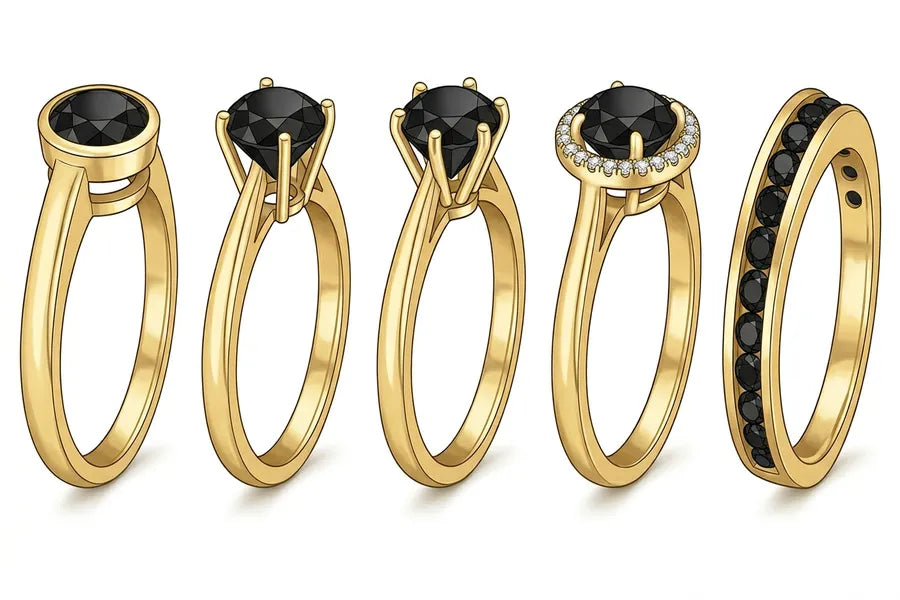
| Setting Type | Protection Level | Stone Visibility | Maintenance | Best For |
|---|---|---|---|---|
| Bezel | Highest — metal wraps entire perimeter | Full face-up view, clean edges | Low — dirt less likely to accumulate | Active lifestyles, men's rings, daily wear, modern aesthetic |
| 4-Prong | Moderate — four contact points | Maximum exposure — stone appears larger | Moderate — prongs need periodic checking | Engagement rings, solitaire designs, showcasing large stones |
| 6-Prong | High — six contact points | Slightly less exposure than 4-prong | Moderate — more prongs to inspect | Round brilliant cuts, extra security for valuable stones |
| Halo | Moderate-High — surround adds protection | Dramatic contrast with white diamond surround | Higher — small accent stones need checking | Maximum visual impact, engagement rings, black + white contrast |
| Channel | High — stones sit within metal rails | Flush, streamlined surface | Low — smooth profile reduces snagging | Wedding bands, accent rows, iced-out designs |
| Pave | Moderate — tiny prongs hold small stones | Full coverage, dramatic all-over effect | Higher — micro-prongs need professional inspection | Iced-out rings, tennis bracelets, full-coverage designs |
| Tension | Moderate — stone held by metal pressure | Dramatic floating appearance | Medium — tension calibration is critical | Contemporary/avant-garde designs, statement pieces |
Expert recommendation from our workshop: For black diamonds specifically, bezel settings offer the best value proposition because the primary advantage of prong settings — allowing light to enter the stone from the sides — is irrelevant for opaque stones. A bezel setting gives you maximum protection with zero visual trade-off. This is especially important for men's iced-out rings and any piece worn during physical activity.
Best Metal Pairings for Black Diamonds
The metal surrounding your black diamond defines at least half of the piece's visual character. Because black diamonds are opaque and absorb all light, they create high contrast against any metal — but the specific metal choice shifts the overall aesthetic dramatically. Here is how each option performs, with gold purity guidance specific to black diamond settings.
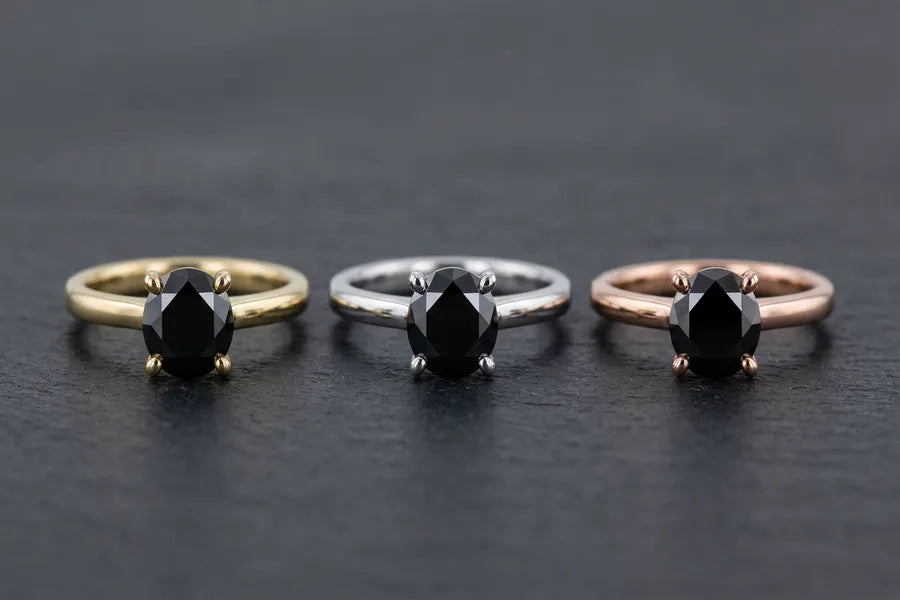
Yellow Gold — Bold Classic Statement
Yellow gold creates the most dramatic contrast with black diamonds. The warmth of gold against the cool depth of the black stone produces a look that is both classic and commanding. This pairing reads as inherently luxurious and works especially well in Cuban link and urban-inspired designs. For everyday wear, 10K and 14K yellow gold offer the best durability.
White Gold and Platinum — Sleek Modern Contrast
White metals against black diamonds create a sophisticated, high-fashion look. The monochromatic silver-and-black palette reads as architectural and contemporary. For white gold settings, consider rhodium plating to maintain the bright white finish that maximizes contrast with the black stone.
Rose Gold — Warm Vintage Aesthetic
The rose gold and black diamond combination has surged in popularity for engagement rings and fashion pieces. The pink-copper warmth of rose gold against the cool darkness of a black diamond creates a romantic, vintage-inspired aesthetic that photographs exceptionally well.
Why Solid Gold Matters for Black Diamond Settings
Regardless of metal color, we strongly recommend solid gold (10K or higher) for any black diamond setting — never plated or vermeil. Here is why:
| Gold Karat | Pure Gold % | Durability | Color Contrast with Black Diamond | Best For |
|---|---|---|---|---|
| 10K | 41.7% | Maximum — hardest alloy | Subtle, understated warmth | Everyday rings, men's jewelry, active lifestyles |
| 14K | 58.3% | Excellent — ideal balance | Rich, balanced warmth | Engagement rings, earrings, versatile wear |
| 18K | 75.0% | Good — softer, richer | Deep, saturated gold tone | Premium pieces, special occasions, luxury gifts |
| 22K | 91.7% | Fair — very soft | Intense, near-pure gold glow | Statement pieces, ceremonial jewelry (not daily wear) |
At GOLDZENN, every gold piece undergoes XRF testing to verify exact karat purity before it leaves our workshop. This is non-negotiable for us — when you buy a 14K gold black diamond ring from GOLDZENN, it is documented and verified as 14K. Our gold authentication guide explains why this matters. Call 321-521-4651 to discuss karat options for your custom black diamond piece.
How to Care for Black Diamond Jewelry
Black diamonds are the hardest gemstone available, but "hardest" does not mean "indestructible." Proper care will keep your black diamond jewelry looking its best for generations. The care protocol differs slightly from white diamond care because of the unique properties of carbonado and treated black diamonds. Pair these stone-specific instructions with our comprehensive gold jewelry care guide for complete maintenance coverage.
Step-by-Step Cleaning Guide
- Prepare a cleaning solution: Mix warm (not hot) water with a few drops of mild dish soap. For a deeper clean, use a diluted ammonia solution at a 1:4 ratio (one part ammonia to four parts water).
- Soak: Submerge the jewelry for 10-15 minutes to loosen oils, lotions, and surface residue.
- Gentle scrub: Using a soft-bristle toothbrush, gently scrub around and beneath the stone, paying attention to the setting where dirt accumulates.
- Rinse: Hold under warm running water. Ensure the drain is covered or work over a bowl.
- Dry: Pat dry with a soft, lint-free microfiber cloth. Do not use paper towels, which can leave fibers.
- Inspect: After cleaning, examine the setting under magnification if possible. Check that prongs are secure and no stones have shifted.
What to Avoid
| Do | Do Not |
|---|---|
| Clean with warm soapy water and soft brush | Use chlorine bleach or abrasive cleaners |
| Store separately from other jewelry | Wear during heavy physical activity or gym |
| Get professional inspection annually | Use ultrasonic cleaners (can loosen settings, especially treated stones) |
| Remove before showering, swimming, or gym | Expose to harsh chemicals, hairspray, or heavy lotions |
| Dry thoroughly with soft lint-free cloth | Hit against hard surfaces (can chip despite hardness) |
Storage Best Practices
Store black diamond jewelry in individual soft pouches or separate compartments in a lined jewelry box. Despite their hardness, black diamonds can scratch other gemstones and softer metals if stored together. Conversely, diamonds can be scratched by other diamonds — storing black and white diamond pieces in the same compartment can damage both stones. If you are building a collection, get each piece appraised and insured individually.
Professional Maintenance Schedule
We recommend professional inspection and cleaning every 6-12 months for black diamond pieces worn daily, and every 12-18 months for occasionally worn pieces. During inspection, a jeweler should check:
- Prong integrity and tightness
- Setting alignment
- Surface condition of the stone (chips, scratches)
- Gold wear on the setting (particularly for thinner bands)
GOLDZENN offers inspection and maintenance services for all pieces crafted in our workshop. Custom and diamond-set pieces carry a 1-year limited warranty against manufacturing defects — setting integrity, prong failure, and structural issues are assessed by our workshop upon inspection, and repairs from normal wear are honored. Contact us at contact@goldzenn.com or call 321-521-4651 to schedule.
Are Black Diamonds a Good Investment?
Transparency matters here. Unlike white diamonds with established resale markets and standardized pricing, black diamonds occupy a niche that requires honest assessment. Here is the investment reality, aligned with what we share in our gold jewelry investment guide and luxury jewelry investment analysis.
Resale Value Reality Check
Natural black diamonds (carbonados) hold their value better than treated or lab-grown stones, but they do not appreciate at the rates that high-quality white diamonds can achieve. The resale market for black diamonds is thinner — fewer dealers specialize in them, and buyer demand is concentrated in specific aesthetic niches. You should purchase a black diamond because you love the stone, not as a financial investment vehicle.
Natural vs. Treated Value Retention
There is a significant difference in value retention between natural and treated black diamonds. A GIA-certified natural carbonado will retain a meaningful percentage of its purchase price over time because the supply is genuinely limited and cannot be replicated. A treated black diamond, which can be produced from abundant low-grade white diamond rough, has minimal resale value — the raw material is common, and the treatment is inexpensive to replicate.
GIA Certification and Long-Term Value
For any black diamond purchase over 1 carat, a GIA Colored Diamond Grading Report is essential for documenting the stone's natural origin. This certification becomes the primary differentiator between a natural stone worth $3,000/carat and a treated stone worth $200/carat. Without certification, a future buyer or appraiser cannot verify origin, and the stone will be valued as treated by default.
Black Diamonds as Heirloom Pieces
Where black diamonds excel as "investments" is in the heirloom dimension. A natural black diamond set in solid high-karat gold is a piece that will last generations. The stone will not fade, change color, or degrade. The gold retains intrinsic metal value that tracks the daily 14K gold price per gram. And the story — a stone potentially billions of years old, possibly formed in a supernova, crafted by hand in a Miami workshop — is a story worth passing down.
Celebrity and Pop Culture Moments
Black diamonds have had several high-profile cultural moments that have driven awareness and demand. These moments span film, music, fashion, and celebrity engagement stories.
- 1996 — de Grisogono pioneer: The luxury house de Grisogono is widely credited with popularizing black diamonds in fine jewelry, commissioning the cutting of the Spirit of de Grisogono (312.24 ct) and launching black diamond collections that brought the stone mainstream attention in European and Middle Eastern markets.
- 2003 — Carrie Bradshaw (Sex and the City): The character Mr. Big proposed to Carrie Bradshaw with a 5-carat black diamond ring in the show's cultural zenith. The scene introduced millions of viewers to black diamond engagement rings and sparked a measurable increase in consumer interest.
- 2010s — Carmen Electra, Kat Von D, Fergie: Multiple celebrities chose black diamond engagement rings during this period, reinforcing the stone's association with non-traditional love and individual style.
- 2022 — The Enigma at Sotheby's: The 555.55-carat Enigma sold for $4.3 million at auction, purchased with cryptocurrency. The sale generated global media coverage and renewed public fascination with carbonados and their possible extraterrestrial origin.
- 2024 — Matty Healy proposal: Musician Matty Healy proposed to model Gabbriette Bechtel with a black diamond ring, sparking social media discussion and a documented spike in "black diamond engagement ring" searches.
- 2025-2026 trend: Gender-neutral and non-traditional engagement jewelry continues to gain market share, with black diamonds positioned as a leading choice for couples who reject conventional diamond aesthetics. Stacked bands combining black and white diamonds have become a notable style trend.
Custom Black Diamond Jewelry at GOLDZENN
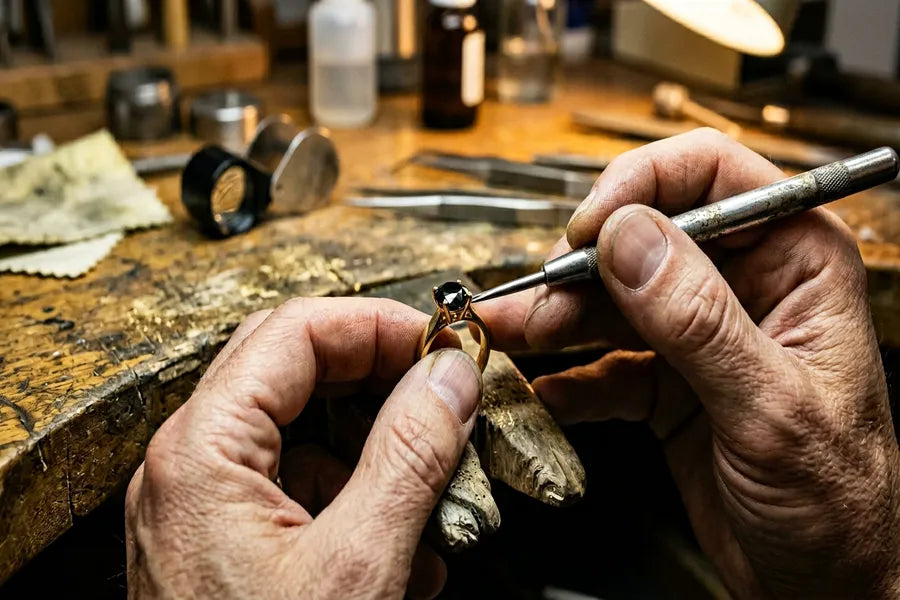
Here is where education meets action. GOLDZENN is not a mass-market retailer — we are a Miami-based jewelry workshop with 50+ years of combined experience and a custom jewelry program that can bring any black diamond vision to life. We are proud members of the Jewelers of America (Member #81868590), and our work is documented across 335+ videos on our YouTube channel @GOLDZENNJWL with 20K+ subscribers.
Black Diamonds Set in Cuban Links and Pendants
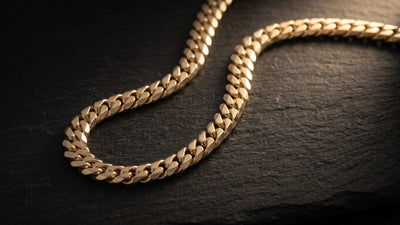
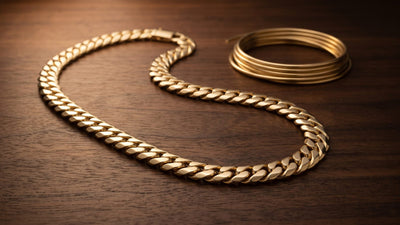
GOLDZENN is known for handcrafted Cuban link chains — and black diamond accents on a solid gold Cuban link represent the pinnacle of urban luxury jewelry. Imagine a diamond Cuban link chain where the traditional white diamond pave is replaced with — or alternated against — jet-black diamonds. The visual effect is striking: the warm gold of the links contrasting against the coal-dark stones, catching light differently at every angle.
Black diamond-accented pendants offer another avenue for self-expression — browse our solid gold pendant collection for current in-stock designs. Our Lion Face diamond charm at $2,099 and St. Jude diamond charm at $5,008 represent the caliber of custom pendant work our workshop produces — any of these designs can be adapted with black diamond stones.
Custom Rings and Engagement Pieces
From a simple black diamond solitaire in 14K yellow gold to an elaborate halo engagement ring with a black diamond center surrounded by white diamonds, our workshop handles every complexity level. We source both natural carbonados and treated black diamonds depending on your budget and preferences, and every stone is documented with certification details. Whether you are looking at our existing solitaire engagement ring designs from $1,108 or envisioning something entirely custom, the process starts with a consultation. Our iced-out luxury chain guide also demonstrates the range of stone-set custom work our workshop produces.
The GOLDZENN Custom Process
Our custom jewelry process follows a clear path from concept to finished piece:
- Consultation: Discuss your vision, budget, stone preferences, and timeline. Call 321-521-4651 or email contact@goldzenn.com.
- Design: CAD rendering of your piece, reviewed and revised until approved.
- Stone Sourcing: We source your black diamond — natural or treated, certified to your specifications.
- Fabrication: Wax casting in your chosen karat gold, hand-finished by our master jewelers.
- Stone Setting: Your black diamond is hand-set in the completed gold piece.
- XRF Verification: Final gold purity verification via X-ray fluorescence testing.
- Delivery: Your finished piece, backed by our 1-year limited warranty against manufacturing defects.
We also offer financing options through multiple providers including Shop Pay, Affirm, and Klarna — making custom black diamond jewelry accessible without compromising on quality or craftsmanship.
Why Solid Gold Settings Matter for Black Diamonds
A black diamond is a permanent stone — it will not fade, chip under normal wear, or degrade over time. The setting should match that permanence. Plated jewelry will wear through within months of daily wear, exposing base metal beneath. Gold vermeil will last longer but still degrades. Solid gold — 10K, 14K, or 18K — will last generations with proper care, honoring the stone it holds. This is why GOLDZENN works exclusively in solid gold and genuine precious metals.
Black Diamond Buying Checklist
Before you purchase a black diamond — whether loose or set in jewelry — verify each of these points. This checklist incorporates everything covered in this guide into an actionable framework you can bring to any jeweler. For those drawn to organic, textured gold aesthetics, explore our gold nugget jewelry guide.
- Determine type: Natural, treated, or lab-grown? This is the single most important factor affecting price and value.
- Request certification: For natural stones over 0.5 carats, request a GIA Colored Diamond Identification and Origin Report. For stones over 1 carat, request the full Colored Diamond Grading Report.
- Verify certification: Use GIA Report Check online to confirm the report is legitimate and matches the stone.
- Evaluate surface quality: Under magnification, examine for pits, scratches, chips, and surface blemishes. The surface is the primary quality indicator for black diamonds.
- Check color uniformity: Under strong directional light, look for gray patches, streaks, or uneven color distribution. The best black diamonds are uniformly jet-black.
- Assess the cut: Even though GIA does not formally grade cut for black diamonds, evaluate symmetry, edge sharpness, and surface polish. A well-cut black diamond has a mirror-like surface sheen.
- Choose your setting: Bezel for durability, prong for visibility, halo for drama. See our settings comparison table above.
- Select your metal: 10K for maximum durability, 14K for balance, 18K for luxury. Always solid gold — never plated.
- Request XRF verification: Confirm the gold purity of your setting with an XRF test. GOLDZENN performs this on every piece.
- Get an appraisal: For any piece valued over $1,000, get an independent appraisal for insurance and documentation purposes.
Why GOLDZENN for Black Diamond Jewelry
When investing in a piece as distinctive as a black diamond, the jeweler behind the stone matters as much as the stone itself. Here is why discerning buyers choose GOLDZENN:
- 50+ years of combined workshop experience — our master jewelers have crafted thousands of solid gold pieces by hand in our Miami studio.
- 334+ Google reviews at 4.9 stars — independently verified customer satisfaction across years of service.
- 3,920+ verified product reviews on Judge.me — real buyer feedback on our craftsmanship and quality.
- Jewelers of America Member #81868590 — certified membership in the industry's most respected trade organization.
- XRF-verified gold purity on every single piece — no guesswork, no misrepresentation.
- 1-year limited warranty against manufacturing defects — covering setting integrity, prong failure, and structural issues, with wear repairs assessed case-by-case.
- 335+ videos on @GOLDZENNJWL with 20K+ subscribers — transparent documentation of our craft, techniques, and finished pieces.
- Full custom capability — from CAD design through wax casting to hand finishing, we build your vision from the ground up.
- Financing available — Shop Pay, Affirm, Klarna, and other providers make premium jewelry accessible.
Ready to start? Call 321-521-4651, email contact@goldzenn.com, or submit a custom project request.
Frequently Asked Questions
Are black diamonds real diamonds?
Yes, black diamonds are real diamonds composed of carbon and ranking 10 on the Mohs hardness scale — the same hardness as white diamonds. The GIA (Gemological Institute of America) officially classifies them as diamonds, issuing Colored Diamond Identification and Origin Reports that grade them as "Fancy Black." Natural black diamonds (carbonados) are polycrystalline aggregates that are actually tougher than single-crystal white diamonds because their random structure eliminates cleavage planes.
How much does a 1-carat black diamond cost?
A 1-carat natural black diamond (carbonado) with GIA certification typically costs between $1,500 and $5,000, depending on surface quality, cut symmetry, and documentation. A 1-carat treated black diamond costs between $100 and $300, and a lab-grown 1-carat black diamond costs between $200 and $400. By comparison, a 1-carat white diamond in the G-H color and VS1-VS2 clarity range costs $4,400 to $7,600 — making natural black diamonds significantly more affordable than comparable white diamonds.
Are black diamonds good for engagement rings?
Absolutely. Black diamonds are excellent for engagement rings, offering a bold, non-traditional aesthetic that symbolizes strength, resilience, and unconventional love. Their 10-rating on the Mohs hardness scale makes them durable enough for daily wear, and natural carbonados are actually tougher than white diamonds. Celebrity adoptions — including Matty Healy's 2024 proposal and the iconic Carrie Bradshaw scene — have fueled growing demand for black diamond engagement rings among couples seeking something distinctive.
Do black diamonds sparkle like white diamonds?
No, and that is part of their appeal. Black diamonds are completely opaque, meaning they do not produce the internal light refraction (brilliance), spectral color dispersion (fire), or scintillation that white diamonds are known for. Instead, black diamonds display an adamantine-to-submetallic surface luster — a deep, reflective sheen that appears almost liquid under direct lighting. They command attention through contrast and depth rather than sparkle, creating a fundamentally different visual experience.
Can you tell if a black diamond is treated?
With certainty, only a qualified gemologist using advanced equipment (spectroscopy, microscopy, and inclusion analysis) can definitively distinguish natural from treated black diamonds. At home, you can perform a basic light test: hold the diamond against a strong fiber-optic light source and examine the edges. Natural carbonados may show very slight reddish-brown translucence at the thinnest edges, while treated stones typically appear uniformly black throughout. However, for any significant purchase, a GIA Colored Diamond Identification and Origin Report is the only reliable verification method.
Are black diamonds from outer space?
Possibly. The leading extraterrestrial theory, proposed by Dr. Stephen Haggerty of Florida International University, suggests that carbonados (natural black diamonds) formed inside a supernova approximately 3.8 billion years ago and reached Earth as a meteorite roughly 2.3 billion years ago. Supporting evidence includes the presence of hydrogen and osbornite (titanium nitride) — minerals consistent with stellar formation — plus anomalous carbon isotope ratios and the fact that carbonados are found only in Brazil and the Central African Republic, two regions connected during the Pangaea supercontinent.
What is the difference between black diamonds and carbonado?
Carbonado is a specific type of natural black diamond — a polycrystalline aggregate composed of diamond, graphite, and amorphous carbon that formed through geological or extraterrestrial processes over billions of years. Not all black diamonds are carbonados: a single-crystal diamond heavily included with graphite can also appear black. And treated black diamonds — white diamonds turned black through heat treatment — are never classified as carbonados regardless of appearance. The term "carbonado" specifically designates natural, polycrystalline formation.
Are black diamonds bad luck?
The "bad luck" association with black diamonds traces primarily to the legend of the Black Orlov (Eye of Brahma), a 195-carat diamond allegedly stolen from a Hindu temple statue, which supposedly cursed its subsequent owners. The stone was recut to 67.50 carats to "break" the curse and has since passed through multiple owners without incident. In reality, the curse narrative is likely a 20th-century marketing story. However, in some Asian cultures, black is associated with mourning or misfortune — so cultural context matters when gifting black diamond jewelry internationally.
What metal looks best with a black diamond?
This depends on the aesthetic you are targeting. Yellow gold creates the most dramatic contrast and reads as classic luxury — ideal for men's rings and bold statement pieces. White gold and platinum produce a sleek, modern monochromatic palette favored in contemporary engagement rings. Rose gold offers warm, romantic tones with a vintage-inspired feel. At GOLDZENN, we recommend 10K yellow gold for everyday men's jewelry (maximum durability) and 14K for engagement rings and earrings (best balance of purity and wearability). Every gold piece we create is XRF-verified for exact karat purity.
Can black diamonds be set in a Cuban link chain?
Yes, and the result is extraordinary. Black diamond pave or channel-set stones on a solid gold Cuban link chain create one of the most visually distinctive pieces in modern luxury jewelry. At GOLDZENN, our Cuban link specialization combined with our stone-setting expertise makes this a natural custom offering. The key is selecting the right stone size for the link width — smaller pave stones (0.01-0.03 ct each) work best on standard links, while larger stones can be featured on oversized or specialty links. Call 321-521-4651 to discuss custom diamond Cuban link options.
Do black diamonds fade or change color over time?
No. The black coloration in both natural carbonados and treated black diamonds is completely stable and permanent. Natural black diamonds get their color from physical inclusions (graphite, hematite, pyrite) that are permanently embedded in the crystal structure. Treated black diamonds receive their color through high-temperature annealing, HPHT processing, or irradiation — all of which produce irreversible structural changes. Your black diamond will look exactly the same in 50 years as it does today, assuming proper care and storage.
Are black diamonds durable enough for daily wear?
Yes. Black diamonds rate 10 on the Mohs hardness scale — the hardest known natural material. Natural carbonados are actually tougher than white diamonds because their polycrystalline structure lacks the cleavage planes that can cause white diamonds to split along specific crystallographic directions when struck at the right angle. However, "hardness" means scratch resistance, not impact resistance. Like all diamonds, black diamonds can chip or fracture from a sharp impact. For daily wear, choose a protective bezel setting and remove jewelry during heavy physical activities.
How are black diamonds graded by GIA?
The GIA grades black diamonds differently from white diamonds. Instead of the traditional 4Cs assessment, black diamonds receive a single color classification of "Fancy Black" on the GIA Colored Diamond Grading Report. The GIA does not assign clarity or cut grades because the stone's opacity makes internal inclusions invisible and light performance irrelevant. What the GIA does evaluate includes color origin (natural vs. treated), carat weight, measurements, shape, cutting style, polish, symmetry, and fluorescence. Polish and symmetry grades are the primary quality indicators on a black diamond GIA report.
Are black diamonds a good investment?
Black diamonds should be viewed primarily as lifestyle and aesthetic purchases rather than financial investment vehicles. Natural carbonados hold value reasonably well — they are genuinely rare, geographically restricted, and cannot be replicated — but the resale market is thinner than for white diamonds, with fewer specialized dealers and less standardized pricing. Treated and lab-grown black diamonds have minimal resale value. If investment potential is important to you, choose a GIA-certified natural carbonado set in solid gold, which combines the stone's modest appreciation potential with gold's proven value retention over time.
Can GOLDZENN create a custom black diamond piece?
Yes — custom black diamond jewelry is one of our workshop specialties. Our process starts with a consultation to discuss your vision, budget, and stone preferences (natural carbonado vs. treated). We handle everything from CAD design through stone sourcing, wax casting, hand fabrication in your chosen gold karat, stone setting, XRF verification, and final quality inspection. Every piece ships with a 1-year limited warranty against manufacturing defects. We have created custom diamond Cuban link chains, engagement rings, pendants, earrings, and men's statement rings — and black diamonds are a natural addition to any of these styles. Contact us at 321-521-4651 or contact@goldzenn.com to begin.