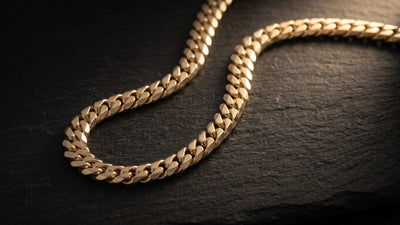
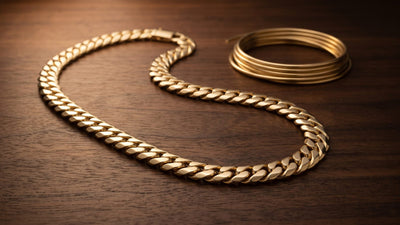
Gold vermeil sits at an interesting crossroads in the jewelry world — a step above basic gold plating, but still a long way from solid gold. If you have ever searched for gold chains, earrings, or bracelets online, you have almost certainly seen the term "gold vermeil" attached to pieces priced between $50 and $300. But what exactly is gold vermeil, how does it compare to other gold types, and is it actually worth your money? At GOLDZENN, we specialize in solid gold jewelry handcrafted in Miami — we do not sell vermeil, which means we have zero incentive to oversell it or downplay its limitations. This is the most honest, complete gold vermeil guide on the internet, written by a team with 50+ years of combined workshop experience. We are going to give you the facts, the math, and the expert perspective so you can make the right decision for your budget and lifestyle.
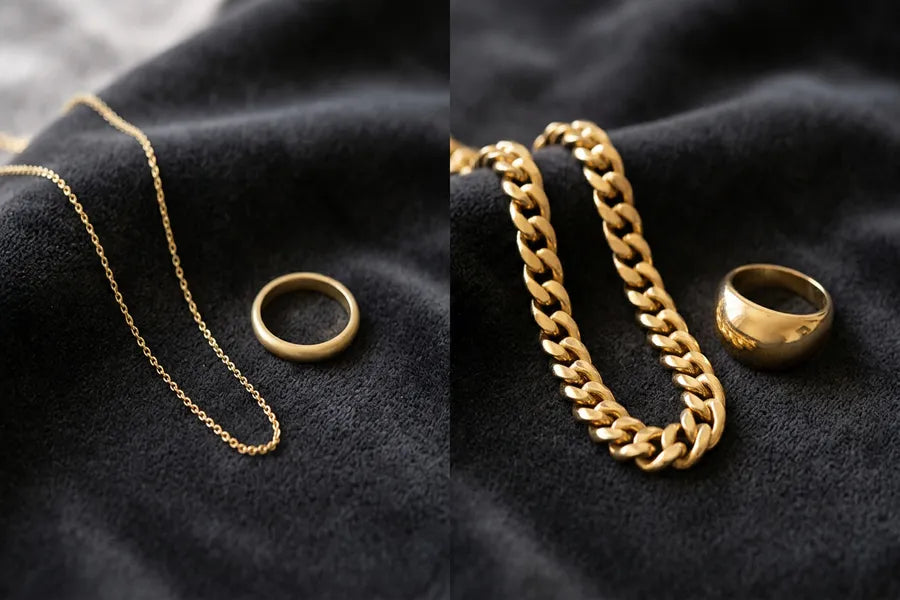 For a deeper look at this topic, see our women's necklace collection.
This guide covers everything: the legal definition of gold vermeil, how it is made, how it compares to gold plated, gold filled, gold bonded, and solid gold, how long it really lasts, the true 10-year ownership cost, care instructions, and an honest decision framework for when vermeil makes sense versus when solid gold is the smarter investment. Every claim is backed by FTC regulations, material science, and real prices from the GOLDZENN catalog. Bookmark this page — you will come back to it.
What Is Gold Vermeil? The Legal Definition
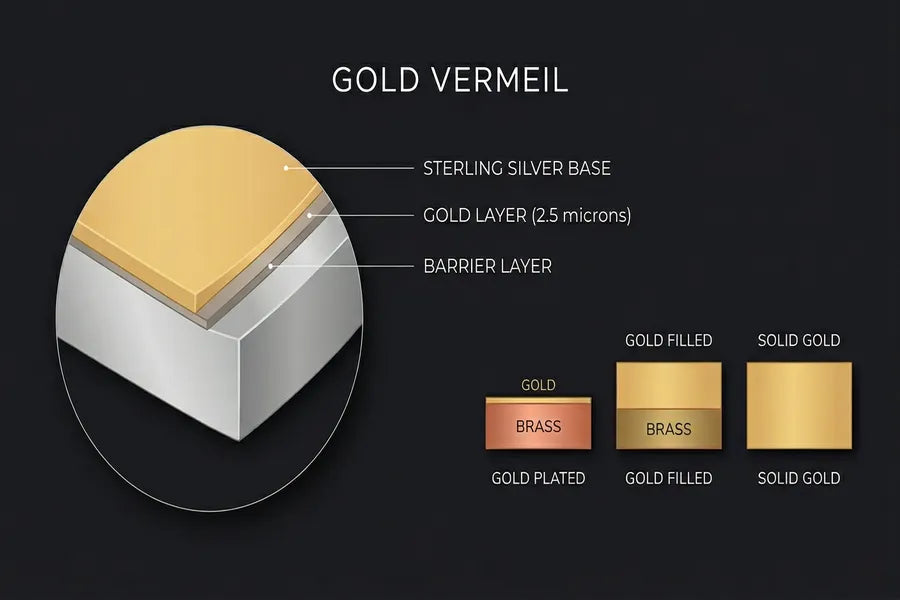
Gold vermeil (pronounced "ver-MAY") is a specific type of gold-coated jewelry that must meet three legal requirements established by the Federal Trade Commission in the United States under 16 CFR Part 23 (the Jewelry Guides):
- The base metal must be sterling silver — a minimum of 92.5% pure silver (marked 925)
- The gold layer must be at least 2.5 microns thick — that is 0.0025 millimeters
- The gold must be at least 10 karat purity — meaning at least 41.7% pure gold content in the plating layer
If any one of these three criteria is not met, the piece cannot legally be called "vermeil" in the United States. A gold-coated brass ring? That is gold plated — not vermeil. A 1-micron gold layer over sterling silver? Also not vermeil. The term is federally regulated, which is more than you can say for "gold plated," a term with no minimum thickness requirement at all.
The word "vermeil" comes from the French, derived from the Italian "vermiglio" (bright red), which originally described the warm reddish tone of mercury-gilded silver. Today, the term refers exclusively to the electroplating standard described above.
One critical clarification: gold vermeil is real gold — but only on the surface. The gold layer is genuine 10K, 14K, or 18K gold deposited through electroplating. Underneath that thin gold shell is sterling silver. This distinction matters because some sellers market vermeil as "real gold jewelry," which is technically true but misleading. It is real gold in the same way that a chocolate-dipped strawberry is "real chocolate" — the chocolate is real, but most of what you are eating is strawberry.
The History of Gold Vermeil: From Mercury Gilding to Modern Electroplating
The art of coating silver with gold is ancient. The earliest known examples of gilded silver date to the 4th century BC, found in Etruscan and Greek metalwork. But the technique that would eventually become known as "vermeil" developed primarily in France during the 18th century.
The Fire Gilding Era (Pre-1840)
Before modern electroplating existed, artisans used a process called fire gilding (also known as mercury gilding or "ormolu" for gold on bronze). The process worked like this: gold was dissolved in mercury to create an amalgam paste, which was applied to a silver object. The piece was then heated over an open flame, causing the mercury to vaporize and leaving behind a thin, bonded gold layer.
The results were stunning — fire-gilded pieces from the 1700s still retain their gold coating today, centuries later. But the process was lethal. Mercury vapor is severely toxic, and goldsmiths who practiced fire gilding regularly suffered mercury poisoning. Symptoms included tremors, cognitive decline, kidney failure, and premature death. The phrase "mad as a hatter" comes from a related industry — hat makers who used mercury in felt processing.
By 1830, France banned mercury fire gilding due to its devastating health effects on artisans. This created an urgent need for an alternative method of depositing gold onto silver.
The Electroplating Revolution (1840s)
The solution arrived in 1840 when the Elkington brothers in Birmingham, England patented the first commercial electroplating process. Using an electrical current to deposit gold ions from a chemical bath onto a conductive base metal, electroplating produced a uniform gold layer without any mercury. The process was safer, more consistent, and could be scaled for mass production.
By the mid-1800s, electroplated gold-over-silver jewelry became widely available across Europe and America. The FTC eventually standardized the term "vermeil" in the United States, establishing the 2.5-micron and sterling silver requirements that remain in effect today. A significant 2018 revision lowered the minimum gold karat from 22K to 10K, broadening the range of products that could legally qualify as vermeil.
How Gold Vermeil Is Made: The Electroplating Process
Modern gold vermeil production follows a precise sequence of steps. Understanding this process helps explain both the strengths and limitations of vermeil jewelry.
Step 1: Preparing the Sterling Silver Base
The sterling silver piece is thoroughly cleaned to remove oils, oxidation, and contaminants. This typically involves an ultrasonic bath followed by chemical cleaning agents. Any residue on the surface will prevent the gold from bonding properly, leading to premature peeling and flaking.
Step 2: Applying a Strike Layer
Many manufacturers apply a thin nickel or palladium "strike" layer between the silver and the gold. This barrier layer serves two purposes: it improves adhesion of the gold layer, and it prevents the silver and gold from inter-diffusing over time (a process that can cause the surface to darken). However, nickel strike layers are a concern for people with nickel allergies — a detail most vermeil brands conveniently omit.
Step 3: Electroplating the Gold Layer
The prepared piece is submerged in an electrolyte solution containing dissolved gold (typically gold potassium cyanide). An electrical current causes positively charged gold ions to migrate from the solution and deposit onto the negatively charged silver piece. The thickness of the gold layer depends on:
- Current density — higher current deposits gold faster but can create an uneven layer
- Time in the bath — longer immersion equals thicker gold
- Bath composition — the concentration and chemistry of the gold solution
- Temperature — typically maintained between 140-160 degrees Fahrenheit
For FTC-compliant vermeil, the gold layer must reach at least 2.5 microns. Premium vermeil manufacturers plate to 3-5 microns for improved durability. To put 2.5 microns in perspective: a single human hair is approximately 70 microns thick. The gold layer on vermeil is roughly 1/28th the width of a human hair.
Step 4: Finishing and Quality Control
After plating, the piece is rinsed, dried, and inspected. Quality manufacturers measure the gold thickness using X-ray fluorescence (XRF) testing to verify it meets the 2.5-micron minimum. The piece may also be polished to achieve the desired finish — high polish, matte, or satin.
From a master jeweler's perspective, this is where quality separates dramatically. A well-made vermeil piece from a reputable manufacturer will have even gold distribution, smooth edges, and consistent color. A cheap vermeil piece — and there are many — will show thin spots at edges and high-wear points from the moment it leaves the factory. If you have questions about identifying quality construction in any type of gold jewelry, our team at GOLDZENN is available at 321-521-4651 or contact@goldzenn.com.
Gold Vermeil vs Gold Plated: Key Differences
This is the most common comparison buyers search for, and the differences are significant. Gold plated jewelry and gold vermeil share the same basic concept — a thin gold layer over a base metal — but the regulations, materials, and durability are not the same.
| Factor | Gold Vermeil | Gold Plated |
|---|---|---|
| Base Metal | Sterling silver only (925) | Any metal — brass, copper, zinc, stainless steel |
| Gold Thickness | Minimum 2.5 microns (FTC regulated) | 0.5-1.0 microns typical (no legal minimum) |
| Gold Purity | Minimum 10K | No minimum requirement |
| Legal Protection | FTC regulated term (16 CFR Part 23) | Loosely defined, no strict enforcement |
| Hypoallergenic | Generally yes (silver base) | Often no (nickel, brass, copper in base) |
| Tarnish Resistance | Better — thicker gold layer delays tarnish | Worse — thin layer wears through faster |
| Lifespan | 1-3 years with care | 6-12 months with regular wear |
| When Gold Wears Off | Reveals sterling silver (still wearable) | Reveals brass or copper (green skin, discoloration) |
| Typical Price Range | $50-$300 | $10-$100 |
| Replating Viability | Good — silver base accepts replating well | Poor — base metal adhesion issues |
The most important practical difference is what happens when the gold wears off. With vermeil, the sterling silver underneath is still a precious metal — it will not turn your skin green, and you can still wear the piece as silver jewelry. With gold plated jewelry over brass or copper, once the gold layer is gone, the exposed base metal reacts with your skin's moisture and oils. That is where the infamous green discoloration comes from.
Think of it this way: vermeil has a safety net (sterling silver). Gold plated jewelry does not.
Gold Vermeil vs Gold Filled: Which Lasts Longer?
Gold filled jewelry is a step above vermeil in terms of gold content and durability, but the two are often confused. Here is how they differ.
Gold filled jewelry contains a layer of gold that represents at least 5% of the total weight of the piece, mechanically bonded (heat and pressure fused) to a base metal core — usually brass. In terms of actual thickness, this translates to approximately 50-100+ microns of gold, compared to vermeil's 2.5 microns. That is 20-40 times more gold on a gold filled piece than on vermeil.
| Factor | Gold Vermeil | Gold Filled |
|---|---|---|
| Gold Amount | 2.5+ micron coating | 5% of total weight (~50-100+ microns) |
| Base Metal | Sterling silver | Brass (typically) |
| Bonding Method | Electroplating (electrical deposition) | Mechanical bonding (heat + pressure) |
| Durability | 1-3 years | 10-30 years |
| Tarnish Resistance | Moderate — gold layer protects temporarily | High — thick gold layer resists tarnishing |
| Water Resistance | Poor — remove before showering | Moderate — tolerates occasional exposure |
| Typical Price Range | $50-$300 | $100-$500 |
| Replating Needed | Every 1-3 years | Rarely, if ever |
The mechanical bonding in gold filled jewelry is the key difference. Because the gold is physically fused to the base metal under heat and pressure rather than deposited electrically, the bond is dramatically stronger. Gold filled pieces from the 1950s are still being worn today with their original gold layer intact. You will never see a 70-year-old piece of vermeil in that condition.
However, gold filled jewelry has its own limitation: the base is typically brass, not silver. If the gold does eventually wear through (which is rare), you get brass exposure — similar to gold plated. Vermeil's sterling silver base provides a more hypoallergenic fallback.
Gold Vermeil vs Solid Gold: The Honest Comparison
This is the comparison that matters most — and the one that every vermeil-selling brand avoids making in detail. At GOLDZENN, we work with solid gold every day in our Miami workshop, and we have also seen hundreds of vermeil pieces come through our doors for repair or assessment. Here is the unvarnished truth.
| Factor | Gold Vermeil | Solid Gold (10K-18K) |
|---|---|---|
| Gold Content | Surface coating only (2.5 microns) | 100% through-and-through (entire cross-section) |
| Lifespan | 1-3 years before visible wear | Lifetime — passes to the next generation |
| Tarnish | Yes — both gold layer and silver base tarnish | No — 10K and above does not tarnish |
| Water Safe | No — remove before showering or swimming | Yes — wear 24/7 without concern |
| Resale / Melt Value | Essentially zero (gold too thin to recover) | Full melt value (tracks the gold spot price) |
| Investment Potential | None — depreciates from day one | Appreciates with gold market |
| Hypoallergenic | Usually (silver base), but nickel strike layer possible | Yes — pure gold alloys are non-reactive |
| Maintenance | Replating every 1-3 years | Occasional cleaning — that is it |
| Typical Chain Price | $50-$150 | $500-$50,000+ depending on weight and karat |
The price gap looks enormous at the point of purchase. A vermeil chain costs $100, while a solid gold 3mm Cuban link chain at GOLDZENN starts at $1,368. But price at the cash register is only half the equation. The other half — and the part that vermeil brands never discuss — is total cost of ownership over time.
The Complete Material Hierarchy: Gold Plated to Solid Gold
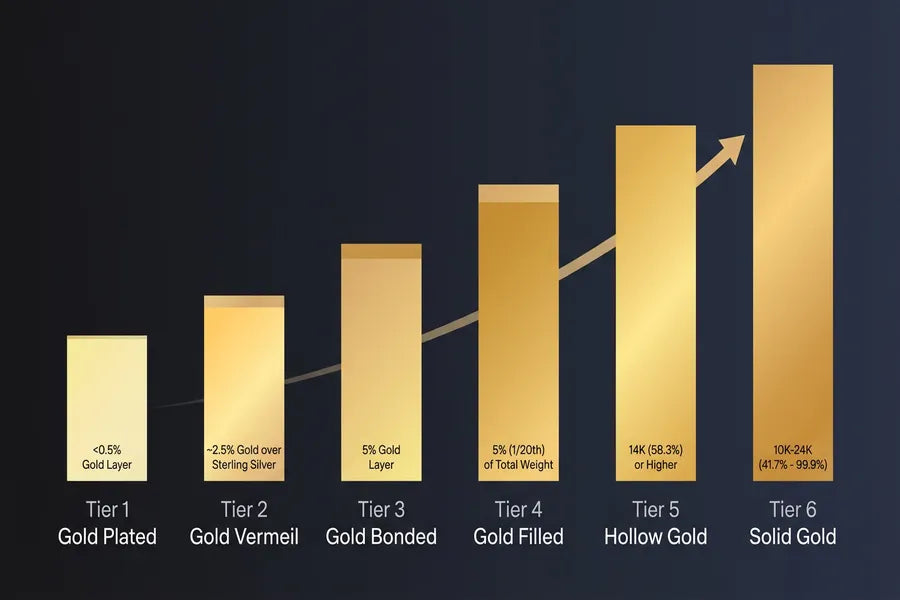
Understanding where gold vermeil sits in the broader landscape of gold jewelry types is essential for making an informed purchase. Here is the full spectrum, from least gold content to most, including GOLDZENN offerings at every tier where we participate.
| Tier | Type | Gold Content | Base Metal | Lifespan | GOLDZENN Price Range |
|---|---|---|---|---|---|
| 1 (Lowest) | Gold Plated | 0.5-1.0 microns | Brass, copper, zinc | 6-12 months | Not sold |
| 2 | Gold Vermeil | 2.5+ microns | Sterling silver | 1-3 years | Not sold |
| 3 | Gold Bonded | ~25-50 microns (14K layer) | 999 / 950 silver | 5-10 years | $77-$1,191 |
| 4 | Gold Filled | 5% of total weight (50-100+ microns) | Brass | 10-30 years | Not sold |
| 5 | Hollow Gold | 100% gold (10K-14K walls) | None — it IS gold | Lifetime (handle with care) | $556-$15,920 |
| 6 (Highest) | Solid Gold | 100% through-and-through | None | Lifetime+ (heirloom quality) | $120-$50,000+ |
Notice that GOLDZENN does not sell gold plated or gold vermeil jewelry. Our entry point is gold bonded — 14K gold bonded over 999 or 950 silver — which provides significantly more gold content than vermeil and a more durable bond. Our 2.5mm Gold Bonded Franco chain starts at $105, offering a meaningful step up from vermeil at a competitive price point. From there, our lineup moves through hollow gold (real gold at reduced weight) to solid gold — the category we have built our reputation on.
This matters because it gives you options. If vermeil is what your budget allows today, that is perfectly fine — but when you are ready to step up, GOLDZENN has you covered at every level above it. Call 321-521-4651 and our team will help you find the right tier for your budget and goals.
How Long Does Gold Vermeil Last? Honest Lifespan Data
This is where most vermeil guides get vague. Brands that sell vermeil will tell you it lasts "several years" or "with proper care, a long time." That is marketing, not data. Here is what actually happens, based on the type of jewelry and how you wear it.
| Jewelry Type | Daily Wear Lifespan | Occasional Wear Lifespan | Key Wear Factor |
|---|---|---|---|
| Rings | 3-6 months | 1-2 years | Constant friction from hands, surfaces, washing |
| Bracelets | 6-12 months | 1-3 years | Wrist movement, desk contact, fabric friction |
| Necklaces / Chains | 1-2 years | 2-4 years | Skin contact, perfume, clothing friction at clasp area |
| Earrings (Post) | 2-5 years | 5-10 years | Minimal friction, limited skin contact |
| Pendants | 1-3 years | 3-5 years | Moderate friction against chest, chain loop wear |
The lifespan variance is dramatic. A vermeil ring worn daily will show base metal within months because hands experience more friction, water exposure, and chemical contact than any other body part. A pair of vermeil stud earrings worn weekly could genuinely last years because they sit in a low-friction, low-exposure environment.
Factors That Accelerate Vermeil Wear
- Sweat: Human sweat is slightly acidic (pH 4.5-7.0), and the salt and acids chemically erode the gold layer. Active lifestyles and hot climates — Miami, for example — accelerate wear significantly.
- Perfume, lotion, and hand sanitizer: Alcohol-based products and chemical compounds in cosmetics dissolve the gold layer over time.
- Chlorine and salt water: Swimming pools and ocean water are particularly aggressive. A single summer of pool wear can strip a vermeil piece.
- Sleeping in jewelry: Friction from bedsheets and pillow contact wears the gold layer at pressure points, especially on necklaces and bracelets.
- Humidity: High-humidity environments accelerate tarnishing of both the gold layer and the sterling silver base.
Compare this to solid gold jewelry (or browse the complete GOLDZENN catalog). A solid gold chain does not degrade from sweat, chlorine, perfume, or humidity. You can wear it in the shower, the pool, the gym, and to bed. After 30 years, it looks the same as the day you bought it — or better, because gold develops a beautiful patina that many owners prefer. That is the fundamental difference between a surface treatment and a through-and-through material.
The 10-Year Ownership Cost Breakdown
This is the section no vermeil brand will ever publish, and it is the single most important analysis in this guide. Most buyers compare prices at the register and conclude that vermeil is "cheaper." But jewelry is not a one-time purchase — it is an ongoing relationship with a piece you wear on your body. Total cost of ownership tells the real story.
Scenario: Vermeil Chain vs Solid Gold Chain (10-Year Comparison)
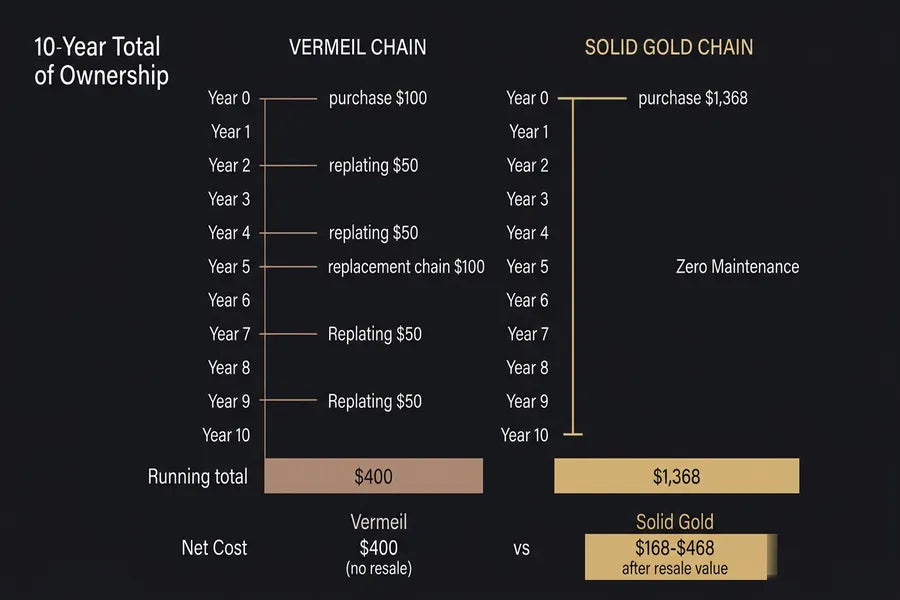
Vermeil chain: $100 purchase price
- Year 0: Purchase — $100
- Year 1-2: Gold layer showing wear, especially at clasp and contact points
- Year 2: First replating — $50
- Year 3-4: Replating wears again with daily use
- Year 4: Second replating — $50
- Year 5: Chain may need replacement (clasps weaken, links fatigue) — $100 for new chain + $0 replating on new piece
- Year 6-7: New chain starts showing wear
- Year 7: First replating on replacement chain — $50
- Year 9: Second replating on replacement — $50
10-year total: $400 (2 chains + 4 replatings)
Resale value after 10 years: approximately $0
GOLDZENN 10K solid gold 3mm Cuban link chain: $1,368 starting price
- Year 0: Purchase — $1,368
- Years 1-10: Zero maintenance cost. Occasional cleaning with warm water and mild soap. Wear it in the shower, to the gym, to bed. No replating, no replacement.
10-year total: $1,368 (one-time purchase)
Resale / melt value after 10 years: $900-$1,500+ (gold has averaged 8-10% annual appreciation over the past two decades)
The Real Math
| Metric | Vermeil Chain | Solid Gold 10K Chain |
|---|---|---|
| 10-Year Total Spend | $400 | $1,368 |
| Net Cost (Spend Minus Resale) | $400 (no resale value) | $168-$468 (retains $900-$1,200+ melt value) |
| Cost Per Day (10 years) | $0.11/day | $0.37/day (or $0.01-$0.13/day net of resale) |
| Hassle Factor | 4 replating visits + 1 replacement purchase | Zero maintenance visits |
| Condition at Year 10 | On second chain, recently replated | Original chain, beautiful patina, fully intact |
Read those net-cost numbers again. After accounting for gold's resale value, the solid gold chain can cost less over 10 years than the vermeil chain that seemed like such a bargain at the register. And the solid gold chain is still on your neck, still looking excellent, still gaining value every year gold prices climb.
For context, gold has risen from approximately $1,060 per ounce in 2016 to over $4,129.28 per ounce today — a gain of over 289% in a decade. See our 14K gold price per gram guide for the detailed breakdown. A solid gold chain purchased ten years ago is worth substantially more today than what the owner paid. A vermeil chain purchased ten years ago is in a landfill. Explore our extra-long gold chains guide.
Now, we are not saying vermeil is a scam — it is not. The math above applies specifically to daily-wear pieces. If you wear a vermeil necklace once a month to dinner, the cost calculation changes entirely. But for your everyday chain, your signature piece, the one you never take off? The math speaks for itself.
Does Gold Vermeil Tarnish? The Science Behind Discoloration
Yes, gold vermeil tarnishes — and understanding why requires looking at both layers of the jewelry.
The gold surface layer: Pure gold does not tarnish. However, the gold in vermeil is an alloy (10K-18K), meaning it contains copper, silver, and other metals mixed with the gold. These alloyed metals can react with sulfur compounds in the air, causing gradual darkening or dulling of the surface. Lower karat vermeil (10K) tarnishes faster than higher karat (18K) because it contains proportionally more reactive metals.
The sterling silver base: Sterling silver (92.5% silver, 7.5% copper) is highly susceptible to tarnishing. When the gold layer thins or wears through — which it inevitably does — the exposed sterling silver reacts with hydrogen sulfide in the air (from pollution, certain foods, rubber, and other common sources) to form silver sulfide, a dark compound. This is the black or dark gray discoloration you see on aged vermeil.
The good news: unlike gold plated jewelry over brass, vermeil does not typically cause green skin discoloration. The copper content in sterling silver (7.5%) is much lower than in brass (roughly 60-70% copper), so the green "patina transfer" effect is rare. If your vermeil is turning your skin green, the piece may not be genuine vermeil — it may be gold plated brass mislabeled as vermeil.
For comparison, solid gold in 10K and above does not tarnish under normal wearing conditions. The gold content is high enough that surface reactions do not occur at a visible level. This is one of the core reasons why solid gold has been the standard for fine jewelry and heirloom pieces for thousands of years.
Is Gold Vermeil Hypoallergenic?
Gold vermeil is generally hypoallergenic, but there is a caveat that most guides overlook.
The sterling silver base is a precious metal and is well-tolerated by most people. The gold surface layer is also non-reactive for the vast majority of wearers. So in theory, vermeil should be safe for sensitive skin.
The hidden issue is the nickel barrier layer. Many vermeil manufacturers apply a thin nickel strike between the silver and the gold to improve adhesion. Nickel is the single most common metal allergen — an estimated 10-20% of the population has some degree of nickel sensitivity. If your vermeil jewelry causes itching, redness, or a rash at the contact point, the nickel barrier layer is the likely culprit, not the gold or silver.
How to protect yourself:
- Ask the manufacturer whether they use a nickel barrier layer
- Look for "nickel-free" vermeil specifically
- Some premium manufacturers use palladium instead of nickel as the barrier — this is hypoallergenic
- If you have known nickel sensitivity, solid gold is the safest choice because there is no barrier layer and no base metal exposure
At GOLDZENN, our solid gold pieces and sterling silver pieces contain no nickel barrier layers. What you see is what you get — gold through and through, or silver through and through. If you have sensitive skin and need guidance choosing the right material, reach out to us at contact@goldzenn.com or call 321-521-4651.
How to Care for Gold Vermeil Jewelry
If you own vermeil jewelry or decide to purchase some, proper care can meaningfully extend its lifespan. These are the same care principles we recommend for any surface-treated jewelry.
The "Last On, First Off" Rule
Put your vermeil jewelry on last — after applying perfume, lotion, sunscreen, and hair products. Take it off first — before showering, washing hands, exercising, or sleeping. This single habit will do more for your vermeil's longevity than any other care practice.
Cleaning Vermeil Safely
- Use a soft, lint-free cloth (microfiber works well) to gently wipe the piece after each wear
- For deeper cleaning, use lukewarm water with a tiny drop of mild dish soap
- Gently rub with a soft cloth or your fingers — never use abrasive brushes or scrubbers
- Rinse with clean water and pat dry immediately with a soft cloth
- Allow to air dry completely before storing
What to Avoid
- Ultrasonic cleaners — the vibrations can damage or strip the gold layer
- Chemical jewelry cleaners — formulated for solid gold, too harsh for vermeil
- Polishing cloths with embedded compounds — these are abrasive and remove gold
- Toothpaste — a common "hack" that is actually abrasive and strips gold
- Chlorine, bleach, ammonia — destroy the gold layer rapidly
- Hand sanitizer — alcohol-based formulas degrade gold plating with repeated exposure
Storage
- Store each piece in its own soft pouch or compartment to prevent scratching
- Add anti-tarnish strips to your jewelry box to slow oxidation of the sterling silver base
- Keep away from direct sunlight and humidity
- Zip-lock bags work surprisingly well for travel — squeeze out the air before sealing
For a complete breakdown of jewelry cleaning techniques by metal type, including solid gold care that requires far less caution, see our dedicated guide.
Can Gold Vermeil Be Replated? Cost and Process
Yes — and this is actually one of vermeil's advantages over standard gold plated jewelry. Because the base is sterling silver (a precious metal that bonds well with gold), vermeil can be replated effectively.
The Replating Process
- Assessment: A jeweler examines the piece for structural integrity, broken clasps, bent prongs, or worn links
- Stripping: The remaining gold layer is chemically removed to create a clean silver surface
- Cleaning and polishing: The sterling silver base is cleaned and polished to remove tarnish and surface imperfections
- Electroplating: A new gold layer is deposited to the desired thickness (2.5+ microns)
- Finishing: The piece is rinsed, dried, and polished to match the original finish
Replating Costs
Professional replating in the United States typically costs $25-$75 per piece, depending on the item's size, complexity, and the gold karat used. Larger pieces (chains, bracelets) cost more than small items (earrings, thin rings). Some jewelers charge $100+ for complex pieces or rush service.
Over a 10-year period of regular wear, a single vermeil chain will likely need 3-5 replating sessions, adding $75-$375 to the original purchase price. This is the hidden cost that transforms vermeil from "affordable" to "surprisingly expensive over time."
When Replating No Longer Makes Sense
There comes a point where the replating cost approaches or exceeds the replacement cost — or where the base piece has structurally degraded to the point where replating is cosmetic repair on a failing foundation. When you reach that crossroads, it is worth considering whether your next investment should be a step up the material ladder.
GOLDZENN's gold bonded chains start at $77, and our solid gold earrings start at $152. For the cost of two or three replating sessions on a vermeil piece, you could own a solid gold piece that never needs replating again. When you are ready to make that transition, our team is here to help — call 321-521-4651 or email contact@goldzenn.com.
When Gold Vermeil Makes Sense (And When to Choose Solid Gold)
We promised you an honest guide, and honesty means acknowledging that vermeil has legitimate use cases. Not every piece of jewelry needs to be a lifetime investment. Here is our unbiased decision framework.
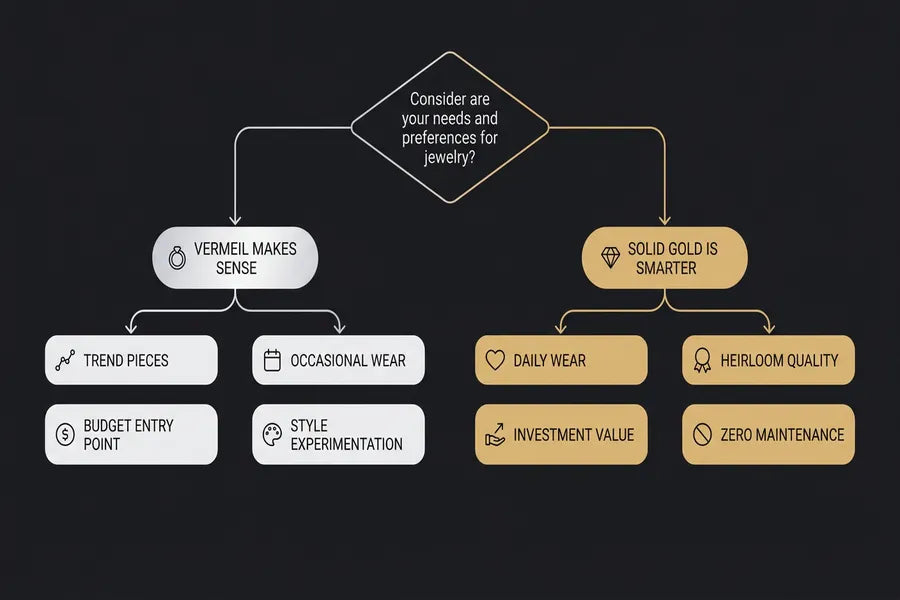
Choose Vermeil When:
- Testing a style before committing: Unsure if a 5mm rope chain or an 8mm Cuban link is your look? A vermeil version lets you try the style for a fraction of solid gold pricing. Once you know what you like, upgrade to the real thing.
- Following seasonal trends: Fashion trends change. If you want to wear a trendy chain style for one season without a long-term commitment, vermeil serves that purpose well.
- Building a rotation on a budget: If you want 5-6 different chains to layer and rotate but cannot invest in solid gold for each one, vermeil lets you build variety while you save toward solid gold signature pieces.
- Occasional or event-only wear: A piece you wear once a month to dinner or a few times a year for events will last significantly longer in vermeil because it experiences so little friction, chemical exposure, and wear.
- Gift for someone whose style preferences you are unsure of: A thoughtful vermeil piece makes a solid gift without the financial risk of choosing the wrong solid gold style.
Choose Solid Gold When:
- Daily wear: Any piece you plan to wear every day — or most days — should be solid gold. The math (covered in the 10-year cost section above) makes this clear.
- Your signature piece: The chain you are known for, the ring you never take off, the earrings that define your look — these should be solid gold because they represent who you are.
- Heirloom and legacy jewelry: If you want to pass a piece to your children or grandchildren, solid gold is the only option. Vermeil will not survive a generation.
- Investment and wealth preservation: Solid gold retains melt value and appreciates with the gold market. Gold is one of the oldest stores of value in human history.
- Active lifestyles and warm climates: Gym, pool, ocean, Miami heat — solid gold handles it all. Vermeil cannot.
- Sensitive skin with confirmed nickel allergy: Solid gold eliminates the barrier layer variable entirely.
- Zero-maintenance preference: If you want to put a chain on and never think about care routines, replating schedules, or storage protocols, solid gold is the answer.
The bottom line: buy vermeil with your eyes open. Know what it is, know what it is not, and make the choice that fits your situation today. And when the time comes to step up to solid gold, GOLDZENN has been handcrafting it in Miami for years — with 334+ Google reviews at 4.9 stars and 3,907+ verified product reviews on Judge.me backing every piece we make.
How to Spot Quality Gold Vermeil: A Buyer's Checklist
If you do decide to buy vermeil, here is how to ensure you are getting a quality piece — not a mislabeled gold-plated-over-brass knockoff. This is the checklist our team at GOLDZENN would use when evaluating any vermeil piece.
- Look for the 925 stamp: Genuine vermeil must have a sterling silver base. The 925 hallmark confirms this. If there is no 925 mark, question whether it is truly vermeil.
- Ask about micron thickness: The FTC minimum is 2.5 microns, but premium vermeil runs 3-5 microns. If the seller cannot tell you the thickness, that is a red flag.
- Verify the gold karat: 18K vermeil will have a richer, warmer gold color and slightly better longevity than 10K vermeil. 14K is the most common middle ground. If the listing does not specify the karat, assume it is the minimum (10K).
- Check the weight: Sterling silver is dense (approximately 10.3 g/cm3). A genuine vermeil piece should feel substantial in your hand, not lightweight like brass or hollow like aluminum. If it feels unusually light, it may not be real sterling.
- Evaluate the price: Genuine vermeil chains typically retail for $50-$300 depending on size and complexity. If a "vermeil" chain is selling for $15-$25, it is almost certainly gold plated over a non-silver base metal. The sterling silver alone costs more than that.
- Ask about the barrier layer: Does the manufacturer use a nickel barrier layer? If you have sensitive skin, this matters. Reputable brands will disclose this information or specifically advertise "nickel-free."
- Check return policy and authenticity guarantee: Reputable vermeil sellers offer returns and stand behind their material claims. If the return policy is vague or non-existent, proceed with caution.
Learning to identify authentic gold jewelry is a skill that protects you at every price point. Whether you are evaluating vermeil, gold filled, or solid gold, the same principles of skepticism, verification, and education apply. If you ever need help verifying a piece of jewelry — regardless of where you purchased it — our team is happy to assist. Call 321-521-4651.
International Vermeil Standards: US vs Canada vs Europe
If you shop internationally — including from online brands based outside the US — it is important to know that "gold vermeil" does not mean the same thing everywhere.
| Standard | United States | Canada | France | Other EU Countries |
|---|---|---|---|---|
| Minimum Thickness | 2.5 microns | 1.0 micron | 5.0 microns | Varies by country |
| Minimum Gold Karat | 10K (41.7% gold) | 10K | 18K (75% gold) | Varies |
| Base Metal Requirement | Sterling silver (925) | Sterling silver | Sterling silver (minimum 800) | Varies |
| Regulatory Body | FTC | Competition Bureau | Customs authorities | National standards bodies |
The key takeaway: French vermeil is the highest standard (5 microns of 18K gold), while Canadian vermeil can be as thin as 1 micron — less than half the US minimum. If you are buying from a brand based in Canada or another country with lower standards, their "vermeil" may not meet US FTC requirements. Always check the specifications, not just the label.
This is another area where solid gold eliminates complexity. A 10K gold chain is 10K gold whether it is made in the US, France, Canada, or anywhere else. The karat system is globally standardized. No micron measurements, no base metal variables, no country-specific regulations to decode. Gold is gold.
GOLDZENN's Approach: Honest Materials at Every Price Point
You have now read the most thorough gold vermeil guide available anywhere. We wrote it because education is the foundation of smart jewelry buying, and too many buyers are making decisions based on incomplete information from brands with a financial interest in steering them toward vermeil.
GOLDZENN's philosophy is straightforward: we sell what we believe in and represent every product honestly for what it is. Our lineup includes:
- 925 Sterling Silver — pure, durable, and beautiful on its own. Silver chains from $54, sterling silver moissanite earrings from $33.
- 14K Gold Bonded — a meaningful step above vermeil, with a thicker gold layer bonded over 999/950 silver. Starting at $77 for a Franco chain, up to $1,191 for a 12mm Cuban link.
- Hollow Gold (10K-14K) — real gold through the walls, lighter weight for comfort. Hollow Cuban links from $556.
- Solid Gold (10K-22K) — our core expertise. Earrings from $152, solid gold chains from $1,368, handcrafted Cuban links up to $50,000+.
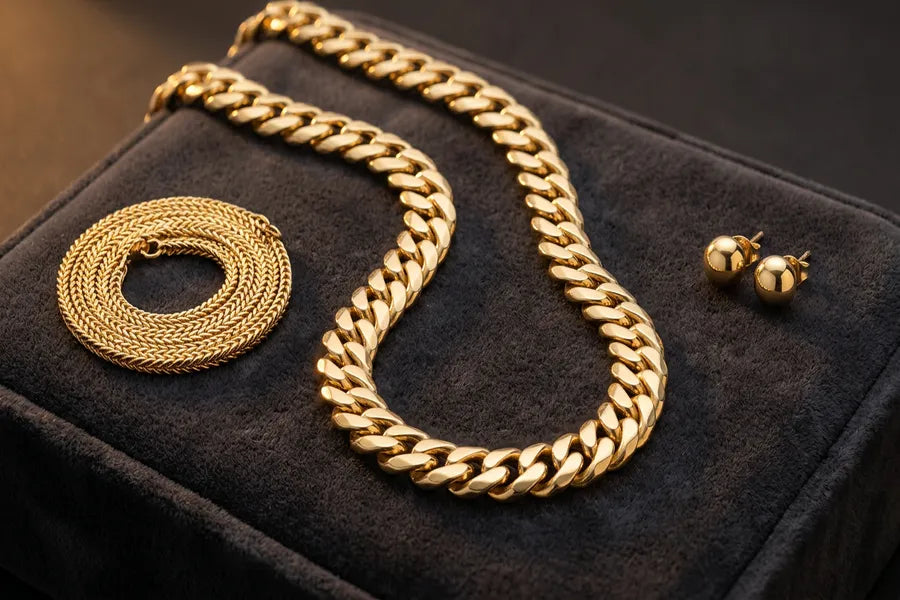
Every piece is backed by GOLDZENN's limited lifetime craftsmanship warranty on handmade Cuban chains and bracelets (includes two free repairs; 1-year limited warranty on all other pieces) and by our Miami workshop — 50+ years of combined experience in handcrafting gold jewelry. We are not a faceless online brand. We are real jewelers who take pride in every link, every clasp, and every stone setting that leaves our bench.
Whether you are exploring vermeil for the first time or ready to make the leap to solid gold, we are here to help. Browse our best-selling collection, explore our education hub for more guides like this one, or contact us directly:
- Phone: 321-521-4651
- Email: contact@goldzenn.com
- YouTube: @GOLDZENNJWL — 335+ videos on gold craftsmanship, market insights, and jewelry education
- Workshop: 1056 SW 67th Ave, Miami, FL 33144
Gold is earned. Not given. And when you decide to invest in the real thing, GOLDZENN will be here.
Frequently Asked Questions About Gold Vermeil
Is gold vermeil real gold?
Yes, the surface layer is real gold — typically 10K, 14K, or 18K gold applied through electroplating. However, the gold is only on the surface (minimum 2.5 microns thick by FTC standards). Underneath is sterling silver. So while vermeil contains real gold, it is fundamentally different from solid gold jewelry where the entire piece is gold from surface to core.
How do you pronounce vermeil?
Vermeil is pronounced "ver-MAY" — rhymes with "bouquet." The word comes from French, derived from the Italian "vermiglio" meaning bright red. In English-speaking countries, you may also hear "ver-MEAL," which is an accepted anglicized pronunciation, though "ver-MAY" is considered the correct French pronunciation.
Does gold vermeil tarnish?
Yes. Both the gold surface layer and the sterling silver base can tarnish over time. The gold layer delays tarnishing compared to bare silver, but once the gold wears thin — which happens within 1-3 years of regular wear — the underlying sterling silver is exposed to air and begins forming silver sulfide (the dark tarnish). Solid gold 10K and above does not tarnish under normal wearing conditions.
Does gold vermeil turn your skin green?
Rarely. Unlike cheap gold-plated brass jewelry, vermeil's sterling silver base contains relatively low copper content (7.5%), making green discoloration uncommon. If your vermeil jewelry is turning your skin green, the piece may not be genuine vermeil — it could be gold-plated brass or copper mislabeled as vermeil. Check for a 925 stamp to confirm the silver base.
Can you shower with gold vermeil?
It is not recommended. Water alone is not the primary issue — it is the soap, shampoo, and body wash chemicals that accelerate gold layer erosion. Chlorinated water (pools and treated tap water) is particularly damaging. For jewelry you want to shower in, solid gold is the appropriate material choice.
How long does gold vermeil last?
With daily wear, expect visible gold erosion within 6-12 months on high-friction items (rings, bracelets) and 1-2 years on lower-friction items (necklaces, earrings). With occasional wear and careful storage, vermeil can last 2-5 years before replating is needed. The biggest factors are sweat, chemicals, friction, and humidity exposure.
Is gold vermeil better than gold plated?
Yes, in virtually every measurable way. Vermeil has a thicker gold layer (2.5+ microns vs 0.5-1.0 microns), a higher-quality base metal (sterling silver vs brass/copper), better durability (1-3 years vs 6-12 months), and a safer fallback when the gold wears off (silver vs brass). Vermeil also carries FTC regulatory protection, while "gold plated" has no legally enforced minimum standard.
Is gold vermeil hypoallergenic?
Generally yes, but with a caveat. The sterling silver base and gold surface are both well-tolerated by most people. However, many manufacturers use a nickel barrier layer between the silver and gold for better adhesion. Since 10-20% of the population has nickel sensitivity, this hidden layer can cause reactions. If you have confirmed nickel allergies, ask the manufacturer about their barrier layer or choose solid gold to eliminate the variable entirely.
How much does it cost to replate gold vermeil?
Professional replating in the US typically costs $25-$75 per piece, depending on size and complexity. Chains and bracelets tend to cost more than earrings or thin rings. Over 10 years of regular wear, expect to spend $75-$375 on replating — a hidden cost that significantly closes the gap between vermeil and solid gold ownership.
Does gold vermeil have resale value?
Essentially no. The gold layer on vermeil is too thin (2.5 microns) to economically recover through refining. A jeweler cannot reclaim the gold from a vermeil piece in any cost-effective way. The sterling silver base has modest scrap value, but it is minimal. Solid gold, by contrast, retains full melt value based on weight, karat, and the current gold spot price.
Is gold vermeil considered fine jewelry?
In the traditional jewelry industry, fine jewelry refers to pieces made from precious metals (solid gold, platinum, palladium) and genuine gemstones. By this standard, vermeil is classified as fashion jewelry or bridge jewelry — it occupies the space between costume jewelry and fine jewelry. While vermeil contains precious materials (real gold and sterling silver), its thin gold layer and limited lifespan place it below the fine jewelry threshold that pieces from workshops like GOLDZENN are built to.
What is 18K vermeil vs 14K vermeil vs 10K vermeil?
The karat refers to the purity of the gold used in the plating layer. 18K vermeil uses gold that is 75% pure — it has the richest color and best tarnish resistance. 14K vermeil uses 58.3% pure gold — the most common middle ground with good color and moderate durability. 10K vermeil uses 41.7% pure gold — the FTC minimum, with a slightly lighter color and faster tarnishing. (For solid-gold pricing at these karats, see our 10K gold price per gram guide.) All three qualify as "vermeil" as long as the other criteria (sterling silver base, 2.5+ microns) are met.
Can you wear gold vermeil every day?
You can, but expect significantly reduced lifespan. Daily wear exposes vermeil to sweat, friction, water, cosmetics, and hand washing — all of which erode the gold layer. Rings and bracelets suffer the most from daily wear. If you want a piece for everyday use, solid gold is engineered for exactly that purpose. GOLDZENN carries solid gold earrings starting at $152 and solid gold chains starting at $1,368 — pieces built to be worn every single day without degradation.
How can you tell if jewelry is vermeil or gold plated?
Check for the 925 stamp — this indicates a sterling silver base, which is a requirement for vermeil. Gold plated jewelry over brass will not carry this mark. Weight is another indicator: sterling silver is denser than brass, so a vermeil piece will feel heavier than a gold-plated brass piece of similar size. Price is a clue too — genuine vermeil typically starts around $50 for small pieces, while gold plated items are often $10-$30. When in doubt, a qualified jeweler can test the base metal using acid testing or XRF analysis.
Is gold vermeil worth buying?
That depends entirely on your intended use. For trend-driven pieces, occasional wear, and style experimentation, vermeil offers genuine value — it looks like gold, uses a precious metal base, and meets regulated quality standards. For daily wear, signature pieces, and long-term investment, the 10-year cost analysis shows that solid gold often costs less when you factor in replating, replacement, and resale value. The honest answer is: buy vermeil for what it is good at, and invest in solid gold for what it is good at. Both have their place.