

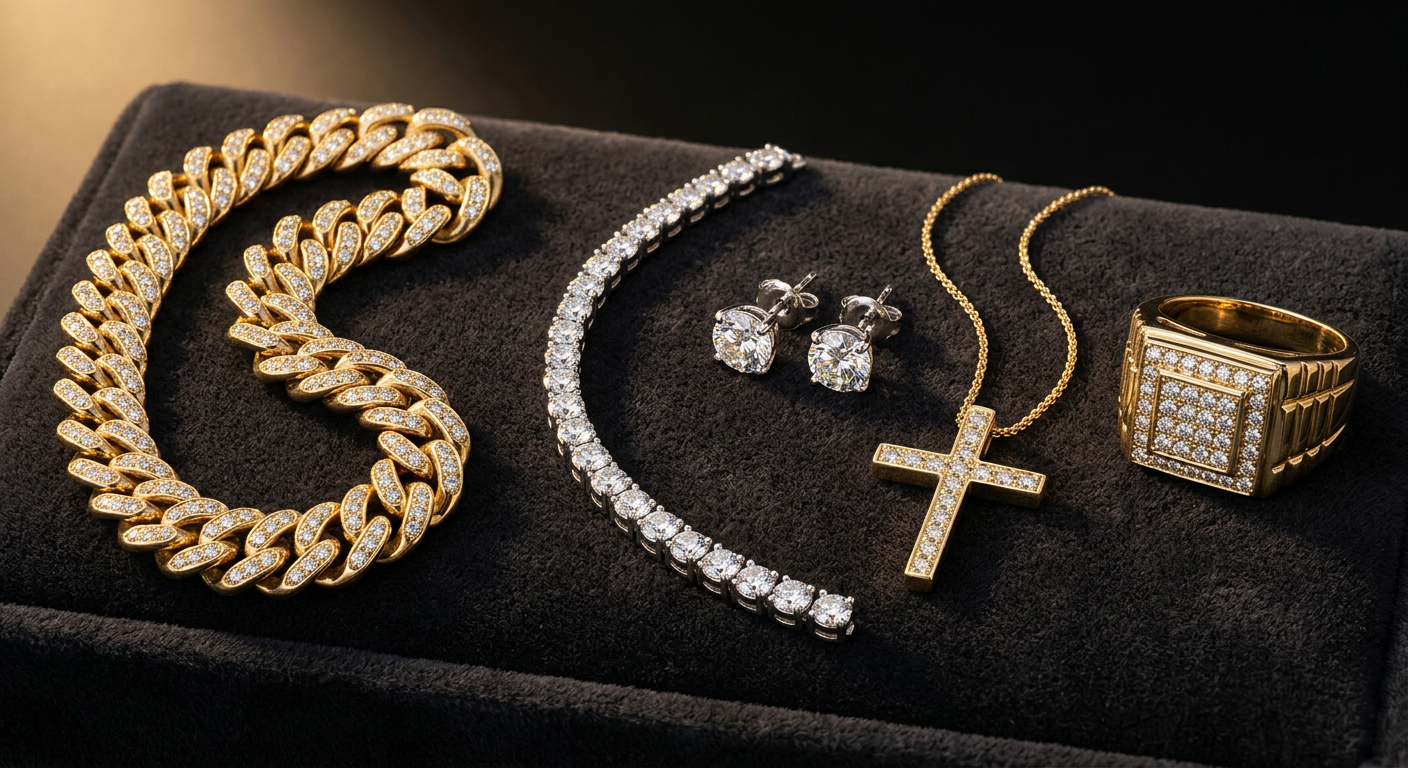
Diamond jewelry represents the pinnacle of personal adornment — a category where nature's hardest material meets master craftsmanship. Whether you are considering your first pair of diamond earrings, a statement diamond Cuban link chain, or a timeless tennis bracelet, understanding what separates exceptional diamond jewelry from everything else can save you thousands and ensure every dollar delivers real value. At GOLDZENN, we handcraft diamond jewelry in every category — from $71 sterling silver studs to six-figure solid gold diamond Cuban links — backed by 50+ years of combined workshop experience and a written warranty — limited lifetime craftsmanship coverage on handmade Cuban chains and bracelets, 1-year limited on all other pieces. This is the only guide you need.
 For a deeper look at this topic, see our women's diamond necklace guide.
This guide covers everything: the 4 Cs of diamond quality, how to choose the right stone type for your budget, every jewelry category GOLDZENN carries, real pricing from our catalog, and the care practices that keep diamond jewelry brilliant for decades. Bookmark it. You will come back to it.
Understanding Diamond Quality: The 4 Cs Explained
Every diamond purchase begins with the 4 Cs — Cut, Color, Clarity, and Carat. These four factors, established by the GIA grading system, determine both the beauty and the price of every diamond in every piece of jewelry. Understanding them is the single most important step in buying diamond jewelry intelligently.
Cut: The Number One Factor in Brilliance
Cut is the most important of the 4 Cs because it directly controls how a diamond interacts with light. A perfectly cut diamond reflects nearly all light that enters it, producing the fire and brilliance that make diamonds unmistakable. Cut grades from best to worst: Excellent (Ideal) > Very Good > Good > Fair > Poor.
The round brilliant cut, with its 57-58 precisely angled facets, is engineered for maximum light return. When all three sub-grades — cut, polish, and symmetry — receive Excellent ratings, the diamond earns the coveted Triple Excellent (3EX) designation. In an ideal-cut round brilliant, you can observe the Hearts and Arrows pattern — eight symmetrical hearts visible through the pavilion and eight arrows through the crown.
GOLDZENN recommendation: For solitaire pieces (studs, pendants, engagement rings), prioritize Excellent or Ideal cut over all other factors. For multi-stone pieces like tennis chains and pave rings, Very Good is the practical sweet spot — the collective brilliance of many stones makes individual cut differences negligible.
Color: What Grade Do You Actually Need?
The GIA color scale runs from D (completely colorless) through Z (light yellow or brown). Here is what matters in practice:
- D-F (Colorless): Premium pricing. The difference between D and F is virtually invisible outside a laboratory.
- G-J (Near-Colorless): The best value range. These diamonds face up white in any setting, and the savings over D-F are substantial — often 15-30% per carat.
- K-M (Faint): A visible warm tint appears. These work beautifully in yellow gold settings, which mask the warmth.
The metal matters: A J-color diamond in a yellow gold setting looks just as white as a G-color in white gold because the warm metal tone neutralizes the faint tint. This is one of the most effective ways to stretch your budget without sacrificing appearance.
Clarity: Smart Recommendations by Jewelry Type
Clarity grades measure internal inclusions and external blemishes under 10x magnification. The practical question is not "what clarity is the best?" but "what clarity do I actually need for this specific piece of jewelry?" The answer varies dramatically by category.
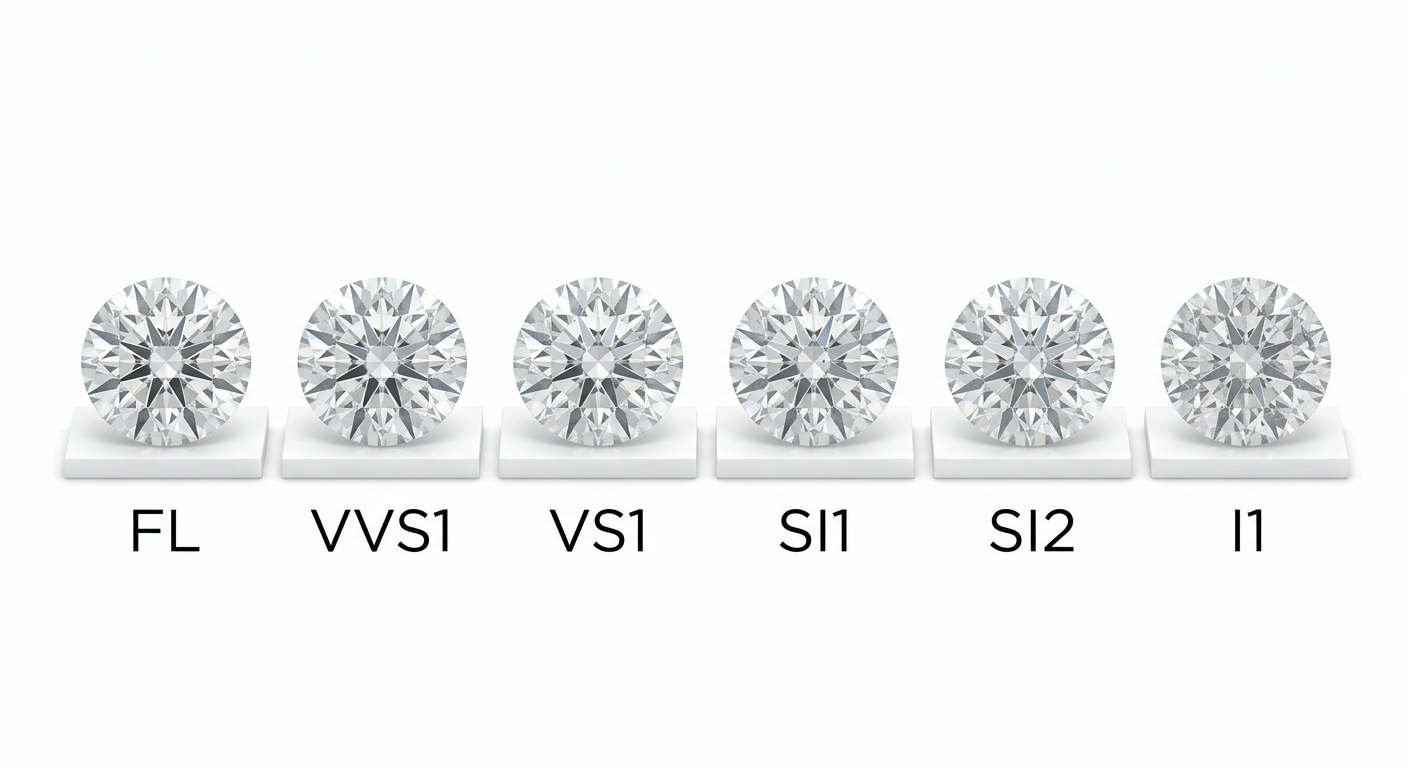
Here is the breakdown that no other guide provides — clarity recommendations by jewelry type:
| Jewelry Type | Recommended Clarity | Why This Grade Works |
|---|---|---|
| Solitaire Pendant | VS2 or better | Single focal stone viewed close-up; inclusions more noticeable |
| Diamond Stud Earrings | VS2-SI1 | Close to the face but viewed at arm's length; minor inclusions invisible |
| Engagement / Solitaire Ring | VS1 or better | High-scrutiny piece examined closely and frequently |
| Tennis Chain or Bracelet | SI1-VS2 | Many small stones; individual inclusions undetectable to the naked eye |
| Diamond Cuban Link Chain | SI1-SI2 | Pave-set stones are tiny; the setting design matters more than individual clarity |
| Cluster Ring or Pendant | SI1-SI2 | Multiple stones create collective brilliance; individual flaws disappear in the design |
| Diamond Band / Eternity Ring | VS2-SI1 | Stones are small and set closely together; moderate scrutiny |
The concept of "eye-clean" is critical. An eye-clean diamond has no inclusions visible to the unaided eye at normal viewing distance. Many SI1 and even some SI2 diamonds are eye-clean, and they cost 20-40% less than comparable VS grades. A skilled jeweler — like our team at GOLDZENN — can help you identify eye-clean stones that deliver maximum beauty at a smart price point. Call us at 321-521-4651 and we will walk you through the options.
Carat: Weight, Size, and Total Carat Weight
One carat equals 0.2 grams (200 milligrams). But carat measures weight, not visual size — a deep-cut 1-carat diamond can appear smaller than a well-cut 0.85-carat stone. This distinction matters.
Price jumps at milestone weights. Diamond prices do not increase linearly. They jump at psychological thresholds: 0.50ct, 0.75ct, 1.00ct, 1.50ct, and 2.00ct. A 0.95ct diamond can cost 10-15% less than a 1.00ct of identical quality, with a size difference invisible to the naked eye. These "magic sizes" represent one of the smartest strategies in diamond buying.
Per-carat pricing increases exponentially. A 2-carat diamond of a given quality does not cost twice as much as a 1-carat — it can cost three to four times as much because larger diamonds are exponentially rarer.
Understanding CTW (Carat Total Weight)
When shopping for multi-stone diamond jewelry — tennis chains, cluster rings, pave pieces — you will encounter CTW (Carat Total Weight). This represents the combined weight of ALL diamonds in the piece, not the size of any individual stone.
A tennis bracelet labeled "5 CTW" might contain 50 diamonds at 0.10ct each or 25 diamonds at 0.20ct each. Both total 5 carats, but they look different and cost different amounts. At GOLDZENN, we use CTW notation across our earring, pendant, and ring collections — for example, "1/4 CTW Diamond Cross Pendant" means the combined diamond weight is 0.25 carats.
Common fractional CTW values in jewelry: 1/20, 1/12, 1/10, 1/8, 1/6, 1/5, 1/4, 1/3, 1/2, 3/4, and 1 CTW.
Diamond Shapes: Which Cut Is Right for You?
Diamond shape — the outline of the stone when viewed from above — affects brilliance, apparent size, and price. Round brilliant commands the highest premium because it is the most technically demanding cut and produces the most light return. Every other shape offers savings and a distinct visual character. Learn more in our black diamonds guide.
| Shape | Brilliance / Character | Price vs Round | Best For |
|---|---|---|---|
| Round Brilliant | Maximum fire and brilliance (57-58 facets) | Baseline (highest) | Studs, solitaires, tennis jewelry |
| Princess | High brilliance, sharp corners | 20-30% less | Engagement rings, wedding sets |
| Emerald | Hall-of-mirrors step-cut effect | 30-40% less | Sophisticated engagement rings |
| Oval | High brilliance, appears larger for weight | 20-30% less | Elongated finger look, pendants |
| Pear | High brilliance, teardrop silhouette | 20-25% less | Pendants, drop earrings |
| Cushion | Soft, romantic brilliance | 25-35% less | Halo settings, vintage styles |
| Marquise | Appears largest for carat weight | 30-40% less | Statement rings |
| Radiant | High fire in rectangular outline | 25-35% less | Engagement rings |
| Asscher | Step-cut elegance with octagonal outline | 25-30% less | Vintage-style settings |
Pro tip: For tennis chains and bracelets, round brilliant is the standard because the uniform shape creates a seamless line of light. For pendants, pear and oval shapes maximize the visible face-up area. For men's rings, princess and round cuts dominate in both solitaire and cluster designs.
Natural vs Lab-Grown vs Moissanite: An Honest Comparison
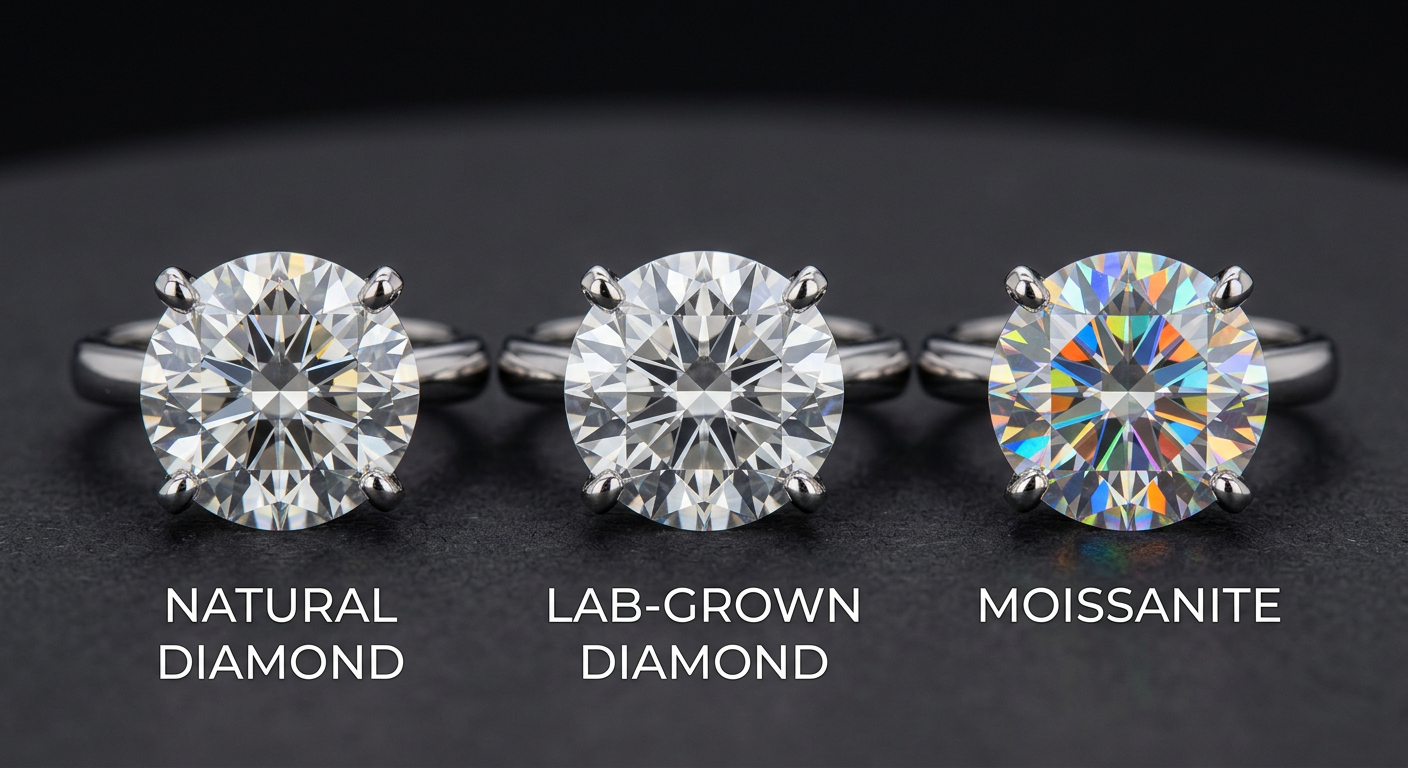
GOLDZENN carries all three stone types — natural diamonds, lab-grown diamonds, and moissanite — and we represent each honestly for what it is. Here is the comparison that matters:
| Property | Natural Diamond | Lab-Grown Diamond | Moissanite |
|---|---|---|---|
| Composition | Carbon (crystallized) | Carbon (identical) | Silicon Carbide (SiC) |
| Hardness (Mohs Scale) | 10 | 10 | 9.25-9.5 |
| Refractive Index | 2.42 | 2.42 | 2.65-2.69 |
| Brilliance | Exceptional white light return | Identical to natural | More fire (rainbow flashes) |
| Origin | Mined (formed over billions of years) | Lab-created (CVD/HPHT, weeks) | Lab-created (SiC synthesis) |
| Price vs Natural | 100% (baseline) | 60-85% less | 90%+ less |
| Resale Value | Highest long-term retention | Limited secondary market | Minimal resale value |
| Certification | GIA, AGS, IGI | IGI, GCAL, GIA | GRA |
| Best For | Investment pieces, heirlooms | Engagement rings, tennis jewelry | Iced-out Cuban links, fashion pieces |
When natural makes sense: If value retention, generational significance, or stone rarity matters to you, natural diamonds remain the standard. GOLDZENN's natural diamond tennis chains start at $8,238 and our 2 CTW natural diamond solitaire studs are $10,789.
When lab-grown makes sense: Lab diamonds are chemically, optically, and physically identical to mined diamonds. They are real diamonds — created through CVD (Chemical Vapor Deposition) or HPHT (High Pressure High Temperature) processes. The 60-85% price reduction means you can get a larger or higher-quality stone for the same budget. Our lab diamond tennis chains start at $1,600, making diamond tennis jewelry accessible at a price point that simply does not exist with natural stones.
When moissanite makes sense: With a hardness of 9.25-9.5 on the Mohs scale and even more fire than diamond, moissanite is an excellent choice for iced-out statement pieces where maximum visual impact is the goal. Our moissanite Cuban link chains deliver the fully iced look starting at $540 — a fraction of natural diamond pricing. Browse the full silver moissanite Cuban link collection for every piece GOLDZENN offers.
Diamond Setting Types and How They Affect Your Jewelry
The setting — how a diamond is mounted in metal — affects security, appearance, and suitability for different jewelry categories. Here is every major setting type and where it performs best: Learn more in our marquise diamond guide.
| Setting Type | How It Works | Security | Best Jewelry Applications |
|---|---|---|---|
| Prong (4 or 6) | Metal claws grip the stone, maximizing light exposure | Good (requires periodic inspection) | Solitaire studs, engagement rings, tennis jewelry |
| Bezel | Metal rim fully encircles the diamond's edge | Excellent (stone fully protected) | Active-lifestyle rings, men's rings, everyday wear |
| Channel | Diamonds seated between two parallel metal walls | Very Good (no exposed edges) | Wedding bands, eternity rings, diamond bands |
| Pave | Tiny diamonds set flush into surface with micro-prongs | Moderate (small stones can loosen) | Cuban link chains, cluster rings, iced-out pieces |
| Invisible | Diamonds set side-by-side with no visible metal between | Good (specialized repair needed) | Princess-cut clusters, some earrings |
| Halo | Central stone encircled by smaller diamonds | Good (enhances perceived size) | Engagement rings, statement pendants |
| Cluster | Multiple small stones grouped to appear as one large stone | Good (economical approach) | Cluster earrings, budget rings, pendants |
| Baguette | Rectangular step-cut diamonds in a row or mixed layout | Good (distinct geometric look) | Statement rings, men's rings, accent bands |
Setting and security: Prong settings allow maximum light into the diamond, which is why they dominate in tennis chains and bracelets. But prongs wear over time and need periodic inspection — a bent or thin prong is a lost diamond waiting to happen. Bezel settings sacrifice a small amount of brilliance for significantly greater stone security, making them ideal for men's rings and pieces worn during physical activity.
At GOLDZENN, we inspect every prong under magnification before a piece leaves our workshop. Diamond-set pieces are covered by our 1-year limited warranty against manufacturing defects, and repairs from normal wear are honored case-by-case.
Diamond Cuban Link Chains: The Ultimate Statement Piece
This is where GOLDZENN's expertise as a Cuban link specialist meets the world of diamond jewelry — and where no other buying guide goes. Diamond Cuban link chains combine the structural artistry of interlocking links with diamonds set into the link surfaces, creating a piece that catches light from every angle with every movement.
What Makes Diamond Cuban Links Special
Each link in a diamond Cuban chain is individually crafted with recessed seats for stones, which are then pave-set or prong-set into the gold surface. The result is a chain that maintains the signature flat, interlocking profile of a classic Cuban link while adding a blanket of diamond fire. The wider the chain, the more surface area for stones, and the more dramatic the effect.
GOLDZENN handcrafts diamond Cuban link chains in widths from 4mm to 17.5mm, in 14K yellow, white, and rose gold. Our workshop sets each stone by hand, ensuring consistent coverage and maximum security. Explore our extra-long gold chains guide.
Diamond Cuban Link Chain Pricing at GOLDZENN
| Width | Karat | Price Range | Ideal For |
|---|---|---|---|
| 4mm | 14K | $5,498-$9,788 | Everyday diamond chain, subtle iced look |
| 5mm | 14K | $9,617-$10,579 | Versatile — dress up or down |
| 6mm | 14K | $11,506-$20,999 | Statement piece with wrist presence |
| 7mm | 14K | $13,215-$24,406 | Bold but not overpowering |
| 9mm | 14K | $17,231-$31,950 | Serious statement chain |
| 10mm | 14K | $21,176-$39,595 | High-impact diamond chain |
| 11mm | 14K | $28,716-$55,290 | Premium statement piece |
| 8mm-17.5mm | 14K (Prong Set) | $98,831-$100,616 | Ultra-premium, fully iced-out solid gold |
Price ranges reflect length variations (typically 18"-26"). Every chain is available in yellow, white, and rose gold.
Want to see these in person? Call us at 321-521-4651 or visit our Miami showroom at 1056 SW 67th Ave. We will walk you through every width and help you choose the right combination of width, length, and metal color for your build and style. You can also browse the full diamond Cuban link collection online.
Natural Diamonds vs Moissanite in Cuban Links
For diamond Cuban links, you have two primary stone options at GOLDZENN:
- Natural/Lab Diamond Cuban Links: Starting at $5,498 in 14K gold. Maximum hardness (10 Mohs), highest prestige, best long-term value.
- Moissanite Cuban Links: Starting at $257 (925 silver) or $540 (sterling with wider widths). Maximum fire and visual impact at a fraction of the cost. Our moissanite collection includes Cuban chains from 8mm to 25mm.
Both deliver the iced-out aesthetic. The choice comes down to stone hardness preference, resale expectations, and budget. Read our full moissanite vs diamond Cuban link comparison for a deep dive.
Diamond Tennis Chains and Necklaces
The tennis chain — a continuous line of individually set diamonds — is one of the most versatile pieces of diamond jewelry you can own. It dresses up a plain T-shirt. It complements a suit. It layers perfectly with Cuban links. And at GOLDZENN, we offer tennis chains in natural diamond, lab-grown diamond, and moissanite at price points that cover every budget.
Tennis Chain Pricing at GOLDZENN
| Stone Type | Width | Starting Price | Premium | Notable Products |
|---|---|---|---|---|
| Lab Diamond | 2mm | $1,600 | $2,449 | Lab Diamond Tennis 2mm |
| Lab Diamond | 3mm | $1,600 | $5,616 | Lab Diamond Tennis 3mm |
| Lab Diamond | 4mm | $6,000 | $7,671 | Lab Diamond Tennis 4mm |
| Natural Diamond | Various | $7,050 | $13,459 | Natural Diamond Tennis Chain |
| Cluster (11mm) | 11mm | $16,142 | $32,106 | Cluster Tennis Chain 14K |
GOLDZENN also offers ready-to-ship (RTS) tennis chains — pre-made pieces with specific carat weights and gold purities available for immediate delivery. Examples include the 6.72ct Lab Diamond Tennis Chain in 14K Yellow Gold and the 17.42ct Lab Diamond Tennis Chain in 14K White Gold (live pricing on the product page — RTS inventory rotates).
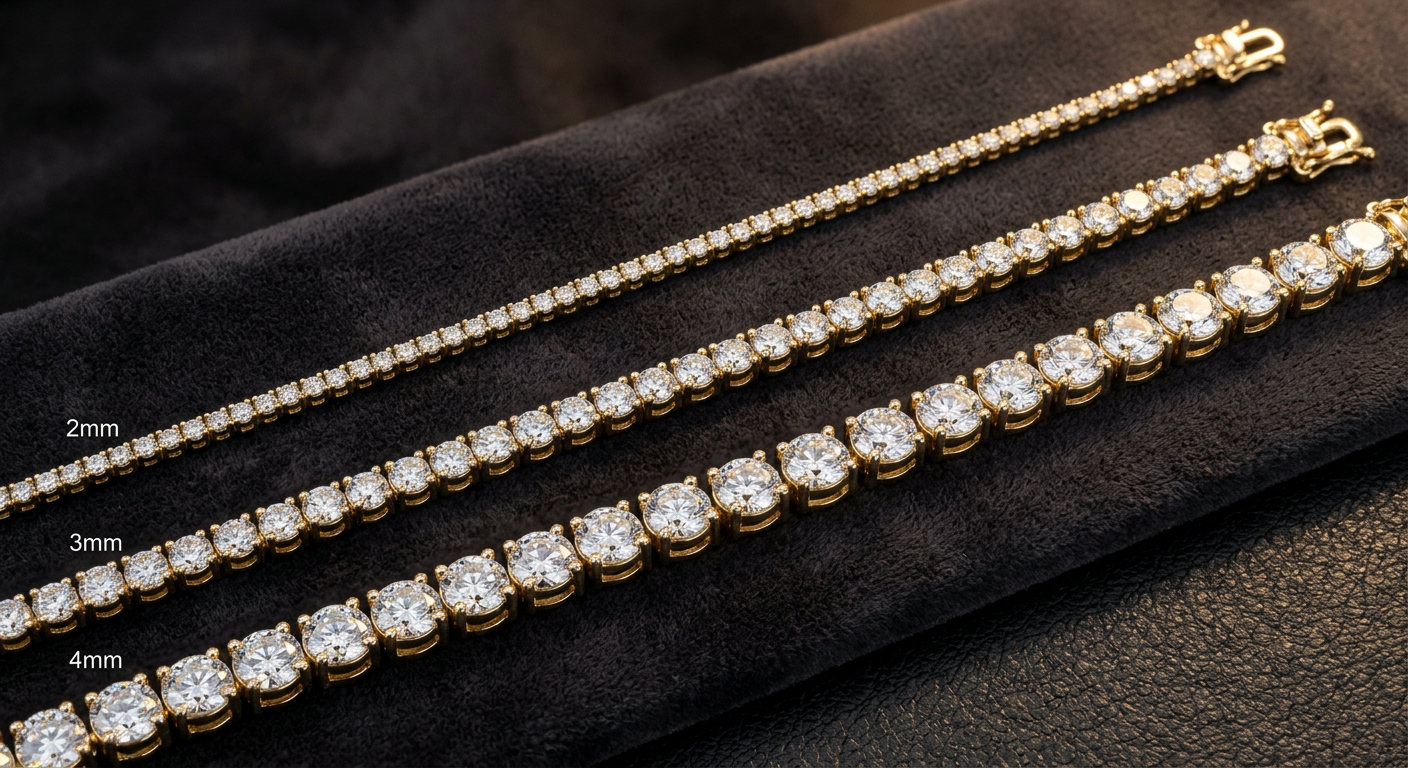
For maximum impact, pair a tennis chain with a diamond pendant or layer it with a Cuban link chain of a complementary width. A 3mm tennis chain under a 6mm Cuban link is one of GOLDZENN's most popular layering combinations.
Diamond Tennis Bracelets
The tennis bracelet is the wrist counterpart to the tennis chain — a continuous line of prong-set diamonds that wraps the wrist. GOLDZENN offers both lab-grown and natural diamond tennis bracelets:
- Lab-Grown Diamond Tennis Bracelet (14K Gold): $1,566-$6,477 with 90 variant options covering different carat weights, gold colors, and lengths.
- Natural Diamond Tennis Bracelet (14K Gold): $9,339-$10,047 with 72 variants.
When sizing a tennis bracelet, you want it to sit snugly enough that it will not slide over your hand, but loose enough to move freely on the wrist — typically your wrist measurement plus 1/2 to 1 inch. For step-by-step wrist-measuring methods and a full wrist-to-bracelet conversion chart, see our gold bracelet sizing guide. The clasp should include a safety latch for security.
Diamond Earrings: From Studs to Statement Pieces
Diamond earrings are the most accessible entry into diamond jewelry. At GOLDZENN, our earring collection spans from $71 sterling silver studs to $10,789 natural diamond solitaires in 14K gold — over 324 products covering every style and budget.
Diamond Stud Earrings: The Foundation
Diamond studs are the first piece of diamond jewelry most people buy, and for good reason — they complement every outfit, suit every occasion, and never go out of style. Here is what the investment looks like at GOLDZENN:
- 1/10 CTW Diamond Solitaire Studs (10K White Gold): $215 — entry-level natural diamond studs
- 1/2 CTW Diamond Solitaire Studs (14K Gold): $1,059 — the most popular size for daily wear
- 1 CTW Princess Diamond Solitaire Studs (14K White Gold): $3,517 — serious sparkle with visible presence
- 2 CTW Diamond Solitaire Studs (14K White Gold): $10,789 — statement-level diamonds
Diamond Hoop, Cluster, and Fashion Earrings
Beyond studs, GOLDZENN carries a wide range of diamond earring styles:. Discover more in our diamond nugget rings.
- Diamond Hoop Earrings: $172-$1,499. Hoops set with diamonds along the front face — a modern alternative to plain gold hoops.
- Diamond Cluster Earrings: $258-$2,608. Multiple small diamonds arranged to create the visual impact of a much larger stone — one of the best value strategies in diamond jewelry.
- Colored Diamond Earrings: $215-$799. Blue, brown, and cognac diamonds offer a distinctive look at accessible prices.
Men's Diamond Earrings
Men's diamond earrings have become one of the fastest-growing categories in jewelry. GOLDZENN's men's diamond earring selection ($299-$1,199) includes character studs, cluster designs, and statement pieces. The 1/4 CTW Diamond Lion Studs in 10K Gold at $646 are a standout — detailed sculptural design with diamond accents.
For diamond stud sizing on men, the most popular carat weights are 1/4 CTW to 1 CTW. Start on the smaller side if this is your first pair. You can always size up later.
Diamond Rings: Beyond the Engagement Ring
Diamond rings are far more than engagement rings. At GOLDZENN, our 176-product diamond ring collection spans fashion rings, men's statement rings, wedding bands, and pinky rings — from $178 to over $11,000.
Men's Diamond Rings
Men's diamond rings are a category that most buying guides completely ignore. At GOLDZENN, men's rings represent a significant portion of our catalog:
- Black Stone Men's Ring (10K Gold): $682 — bold character piece
- 2.43 CTW Cluster Lion Diamond Ring (14K Gold): $1,748 — iconic design with significant diamond weight
- Men's Praying Hands Diamond Ring (14K Gold): $1,830 — meaningful motif with diamond accents
- Ace of Spades Diamond Ring (6.08 CT Pave): $2,629-$4,709 — serious statement piece
- 14K Gold Natural Diamond Crocodile Men's Ring: $8,999 — premium craftsmanship with nearly 1 CTW of natural diamonds
For a deeper exploration of ring styles, sizing, and stacking, read our Ultimate Guide to Diamond Rings and the Cuban Link Rings guide.
Lab-Grown Diamond Engagement Rings
GOLDZENN carries 83+ lab-grown diamond rings starting at $1,048. The lab-grown advantage is simple math: identical stone quality at 60-85% less cost. A $3,000 budget that buys a 0.75ct natural diamond solitaire can buy a 1.5ct+ lab-grown diamond of equivalent quality.
Our lab-grown engagement ring categories include solitaires ($1,048-$3,754), halo designs ($1,671-$4,272), three-stone rings ($1,648-$3,568), and statement clusters ($3,526-$4,996).
Not sure about the right style? Email us at contact@goldzenn.com with your budget and preferences, and we will send you curated options. Planning a surprise proposal? Learn how to know your partner's ring size without giving the secret away.
Diamond Pendants and Crosses
Diamond pendants range from delicate accent pieces to bold statement charms. At GOLDZENN, we carry 199+ diamond pendants and crosses from $119 to $16,310.
Popular Diamond Pendant Styles
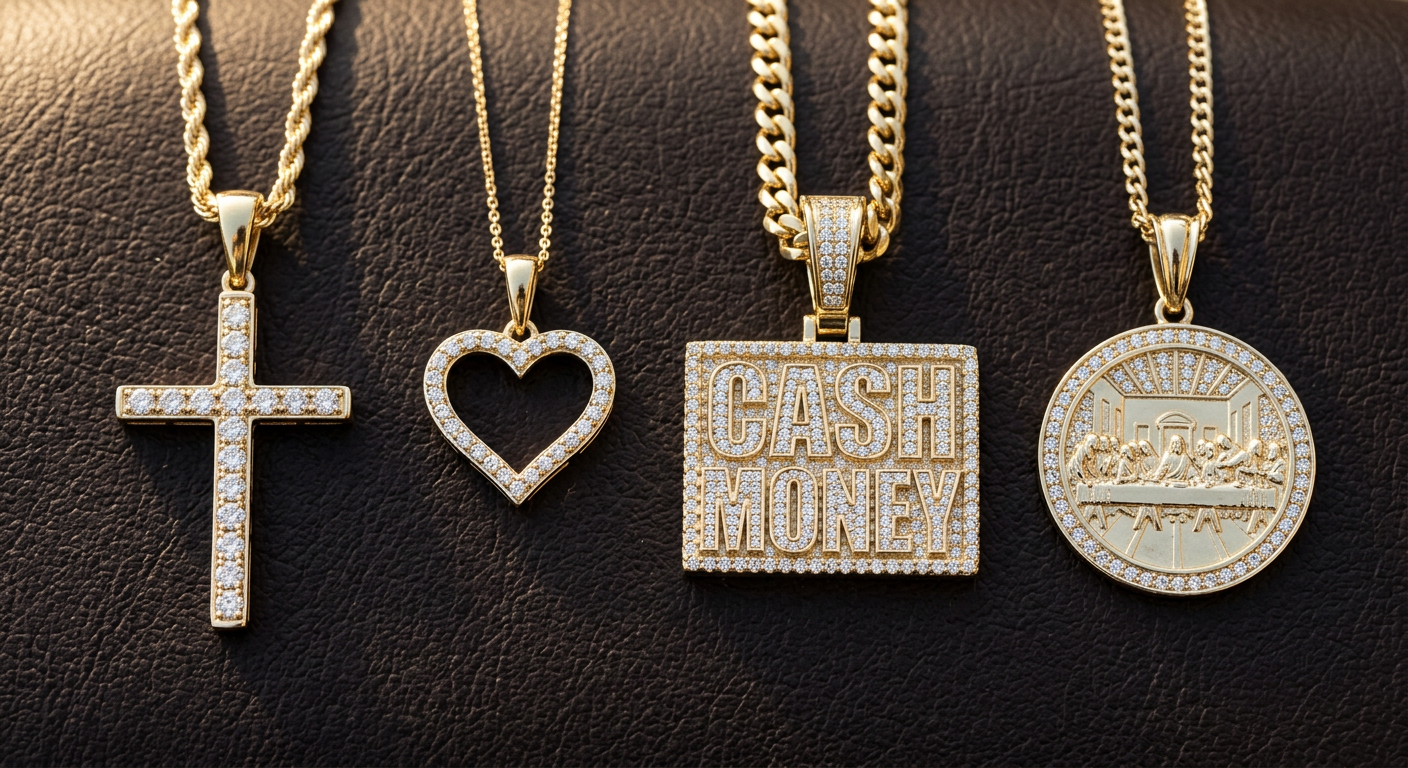
- 1/10 CT Diamond Heart Pendant (10K Gold): $316 — accessible gifting piece
- 1.5 CTW Diamond Cross Pendant (14K Gold): $1,300 — significant diamond weight in a meaningful design
- 1.42 CT "Cash Only" Diamond Pendant (14K Gold): $1,551 — character piece with personality
- 2 CTW Diamond Last Supper Men's Charm (10K Gold): $4,947 — museum-quality detail with substantial diamond coverage
- 1 3/4 CTW St. Jude Diamond Charm (10K Gold): $5,008 — religious motif with premium diamond weight
Chain Pairing for Diamond Pendants
The chain you pair with a diamond pendant matters as much as the pendant itself. The general rule: the chain width should not overpower the pendant, and the chain style should complement, not compete.
- For light pendants (under 5g): 2-3mm rope or box chain
- For mid-weight pendants (5-15g): 3-4mm Cuban link or Franco chain
- For heavy pendants (15g+): 4-5mm+ Cuban link chain for structural support
For a comprehensive pairing guide, see our chain pendants article and gold pendants for men buying guide.
Gold and Diamonds: Choosing the Right Metal
The metal your diamonds are set in affects both appearance and value. GOLDZENN works in 10K, 14K, and 18K solid gold, and here is how each performs with diamond jewelry.
10K vs 14K vs 18K for Diamond Settings
- 10K Gold (41.7% pure): The most durable and affordable gold option. Ideal for high-wear pieces like men's rings and everyday earrings. Slightly paler yellow tone. GOLDZENN diamond earrings in 10K start at $172.
- 14K Gold (58.3% pure): The most popular choice for diamond jewelry. Balances durability, color richness, and value. The standard for tennis chains, Cuban links, and engagement rings. GOLDZENN uses 14K for the majority of our diamond chain and ring offerings.
- 18K Gold (75% pure): Richest color saturation and highest gold content available in most jewelry. Softer than 14K, so best for pieces that receive moderate wear. GOLDZENN offers 18K options in our Cuban link ring collection.
How Metal Color Affects Diamond Appearance
Yellow gold warms the diamond's appearance and masks lower color grades (J-K look better). White gold creates maximum contrast and makes colorless (D-F) diamonds pop but can highlight warmth in lower-grade stones. Rose gold adds a romantic blush that complements both colorless and warm diamonds. Read our rose gold vs yellow gold comparison for a deeper look.
One practical strategy: if you are shopping for a diamond piece in yellow gold, you can safely choose a G-J color stone and save substantially — the yellow gold masks any trace of warmth. In white gold, aim for G or better for a clean look.
How to Read a Diamond Certificate
A diamond certificate (or grading report) is an independent assessment of a diamond's quality. It is the diamond equivalent of a vehicle history report — essential for any significant purchase. Here is how the major labs compare:
| Lab | Reputation | Grading Strictness | Primary Use |
|---|---|---|---|
| GIA (Gemological Institute of America) | Gold standard worldwide | Most stringent | Natural diamonds |
| AGS (American Gem Society) | Excellent, cut-focused | Very strict (0-10 cut scale) | Ideal-cut natural diamonds |
| IGI (International Gemological Institute) | Strong and growing | Moderate | Lab-grown diamonds |
| GCAL (Gem Certification & Assurance Lab) | Rising trust | Strict | Lab-grown diamonds |
| EGL | Lower tier | Lenient (may overgrade by 1-2 grades) | Budget market |
| GRA | Moissanite-specific | Moissanite grading system | Moissanite stones |
What to look for on a certificate: The report number (for verification), the 4 Cs grades, fluorescence rating, proportions diagram, and any comments about specific characteristics. For natural diamonds, a GIA report is the benchmark. For lab-grown diamonds, IGI is the industry standard. Avoid purchasing significant diamond jewelry without an independent grading report — it is your primary proof of quality and value.
At GOLDZENN, we stand behind every stone we sell. If you ever have questions about a specific diamond's grading, our team is available at 321-521-4651 or contact@goldzenn.com to walk you through the certificate details.
Diamond Jewelry Care and Maintenance
Diamonds are the hardest natural material on Earth, but diamond jewelry still requires proper care. The diamond itself is nearly indestructible — it is the setting, the metal, and the accumulated grime that need attention. Here is a complete care schedule:
Diamond Jewelry Care Schedule
| Frequency | Action | Details |
|---|---|---|
| Daily | Remove during physical activity | Gym, sports, manual labor — impact can bend prongs or loosen stones |
| Daily | Apply products FIRST | Lotions, perfume, hairspray, then jewelry. Residue dulls diamonds. |
| Weekly | Gentle wipe-down | Soft lint-free cloth to remove oils and surface grime |
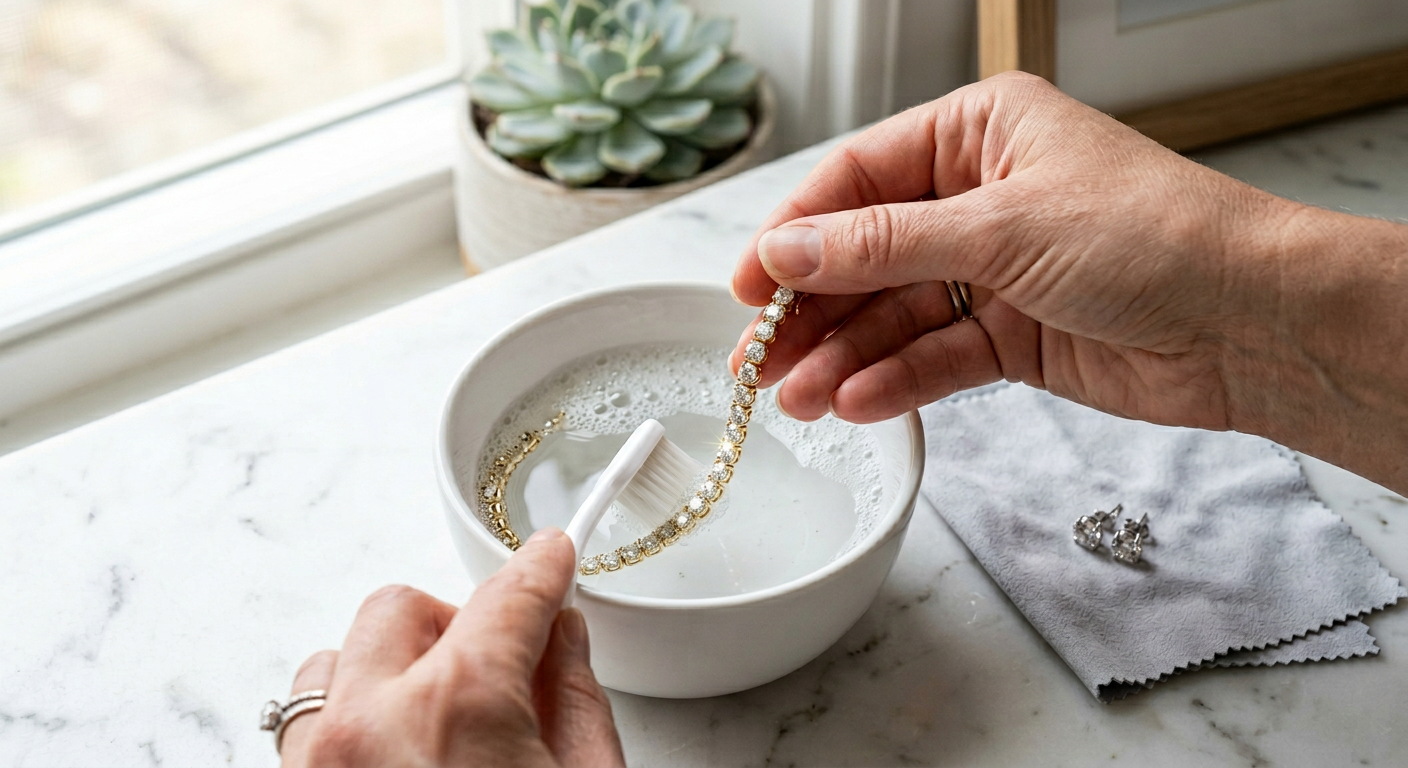
| Monthly | Deep clean at home | Warm water + mild dish soap. Soak 20-30 min. Soft toothbrush. Rinse. Pat dry. |
| Every 6-12 months | Professional inspection | Jeweler checks prong integrity, re-tips worn prongs, polishes metal |
| Every 1-2 years | Rhodium re-plating | White gold only. Restores bright white finish that wears over time. |
What to Avoid
- Chlorine: Pools and hot tubs attack gold alloys, weakening prongs and settings.
- Bleach and harsh chemicals: Damage the metal, not the diamond — but a damaged setting means a vulnerable stone.
- Ultrasonic cleaners: Safe for most diamond jewelry, but avoid for pieces with included stones (I1-I3 clarity) or fragile vintage settings where vibration could loosen stones.
- Storing diamonds together: Diamonds scratch other diamonds, and they absolutely scratch other gemstones and metals. Store each piece separately in a soft pouch or lined compartment.
For a complete gold care guide, read our How to Clean Gold Jewelry article.
Diamond Jewelry Price Guide: Real GOLDZENN Pricing
Transparency is one of GOLDZENN's core principles. While other guides say "it depends on your budget," we publish actual price ranges from our live catalog. Here is what diamond jewelry costs across every major category:
| Category | Entry Level | Mid-Range | Premium |
|---|---|---|---|
| Diamond Earrings (Sterling Silver) | $71 | $129 | $210 |
| Diamond Earrings (10K Gold) | $172 | $459 | $2,608 |
| Diamond Earrings (14K Gold) | $190 | $906 | $10,789 |
| Diamond Pendants (10K-14K) | $209 | $808 | $5,008 |
| Diamond Rings (10K Gold) | $538 | $1,708 | $7,739 |
| Diamond Rings (14K Gold) | $574 | $2,338 | $9,598 |
| Lab Diamond Engagement Rings | $1,048 | $1,821 | $4,996 |
| Lab Diamond Tennis Chains | $1,600 | $3,901 | $10,510 |
| Diamond Tennis Bracelets | $1,566 | $6,477 | $10,047 |
| Natural Diamond Tennis Chains | $7,050 | $10,863 | $32,106 |
| Diamond Cuban Link Chains (14K) | $5,498 | $21,176 | $100,616 |
| Moissanite Cuban Links | $257 | $1,374 | $104,934 |
| Moissanite Tennis Chains | $492 | $1,949 | $10,054 |
These are live catalog prices. They reflect actual GOLDZENN inventory — not theoretical ranges or competitor estimates. The range within each category reflects variations in carat weight, gold purity, chain length, and stone type.
Need help narrowing your options? Call 321-521-4651 and tell us your budget and style preferences. We will match you to the right piece — no pressure, no upselling.
How GOLDZENN Handcrafts Diamond Jewelry
At GOLDZENN, diamond jewelry is not pulled from a warehouse. It is handcrafted in our Miami workshop by a team with 50+ years of combined experience, led by Founder Julio Cruz.
The Workshop Process: From Design to Setting
Every diamond piece begins with CAD design or hand-drawn sketches, followed by wax carving or 3D printing for the mold. The piece is then cast in the appropriate gold alloy (10K, 14K, or 18K), hand-finished, and prepared for stone setting. Our setters work under magnification, placing and securing each diamond individually — whether that is a single solitaire in a pendant or hundreds of pave stones across a diamond Cuban link chain.
After setting, every piece undergoes final quality control: prong inspection under magnification, pressure testing, polish, and a final visual inspection under multiple light sources. Stones that are loose, misaligned, or improperly seated are corrected before the piece leaves the workshop.
Why Workshop Craftsmanship Matters for Diamond Jewelry
The difference between handcrafted and mass-produced diamond jewelry is in the setting. In mass production, speed overrides precision — prongs may be thin, stones may sit unevenly, and corners get cut in quality control. In a handcraft workshop, every stone is individually verified for seat depth, prong pressure, and alignment. This is why GOLDZENN covers diamond-set pieces with a written 1-year limited warranty against manufacturing defects — we are confident in every setting that leaves our bench.
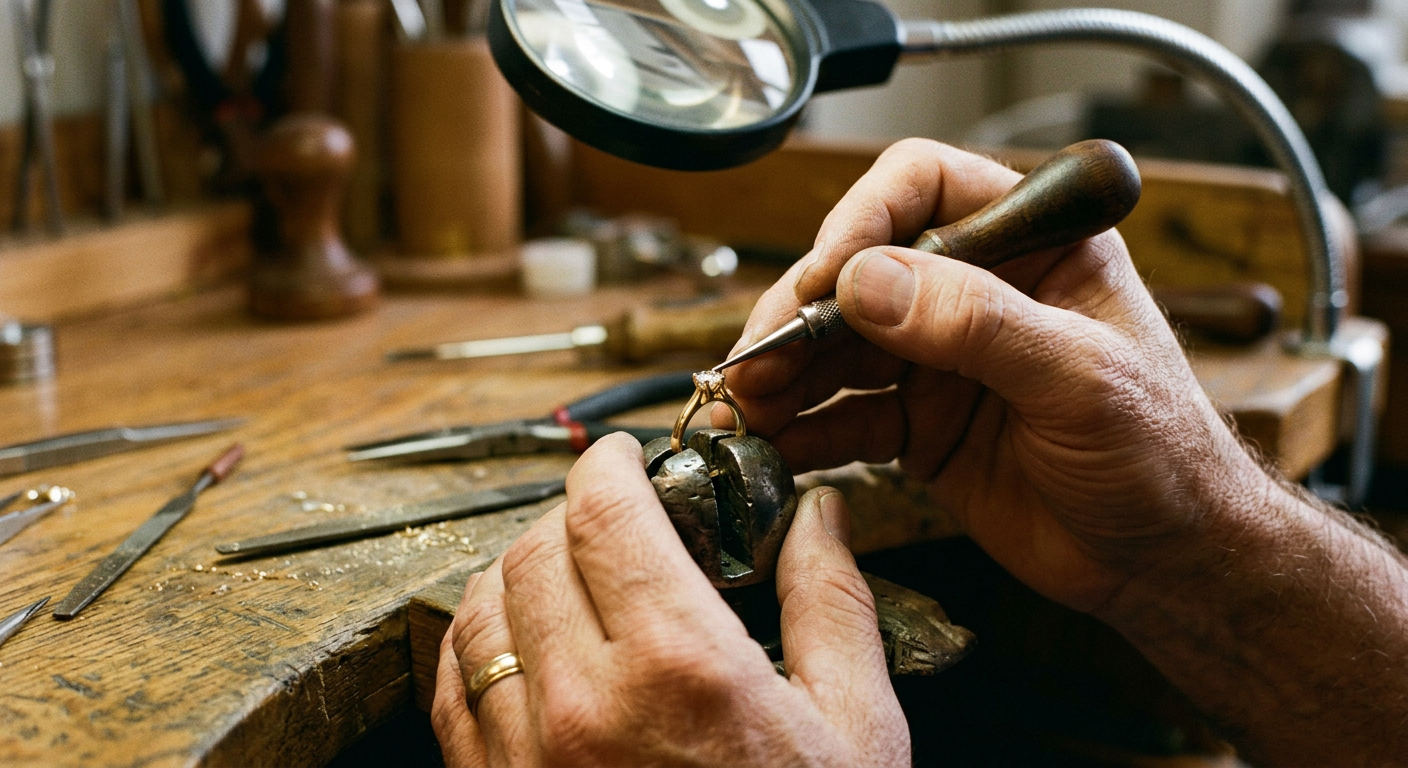
Watch the process on our YouTube channel @GOLDZENNJWL, where we have 335+ videos documenting everything from Cuban link chain fabrication to diamond setting to gold pouring. Over 20,000 subscribers follow our workshop content.
Diamond Jewelry Buying Checklist
Before you finalize any diamond jewelry purchase, run through this 10-point checklist:
- Verify the diamond certification. GIA for natural, IGI for lab-grown. No certification = no verified quality.
- Match clarity to jewelry type. SI1 is fine for tennis bracelets and Cuban links. VS2+ for solitaires and pendants.
- Check CTW vs single-stone weight. A "1 CTW" ring with 20 small stones looks very different from a 1-carat solitaire.
- Confirm the metal purity. 10K, 14K, or 18K — each has different durability, color, and price implications. Read our complete karat comparison.
- Inspect the settings. Prongs should be uniform, tight, and properly tipped. Pave stones should sit flush. Channel-set stones should not wiggle.
- Understand the return policy. GOLDZENN offers a 7-day return policy on standard items.
- Ask about warranty. GOLDZENN covers diamond-set pieces with a 1-year limited warranty against manufacturing defects (handmade Cuban chains and bracelets carry a limited lifetime craftsmanship warranty).
- Consider the occasion and lifestyle. Bezel settings for active lifestyles. Prong settings for maximum brilliance on special occasions.
- Factor in maintenance costs. White gold needs rhodium re-plating every 1-2 years. Prong settings need annual inspections.
- Get jewelry insurance. Any piece over $1,000 deserves a separate insurance rider. Get an appraisal for documentation.
Why GOLDZENN for Diamond Jewelry
GOLDZENN is not a marketplace and not a middleman. We are a Miami-based workshop that handcrafts diamond jewelry in solid gold — and we carry every stone type so you can make the right choice for your budget and goals.
Our founder Julio Cruz has been featured in ValiantCEO and Authority Magazine on the craftsmanship and American Dream story behind GOLDZENN. Jewelers of America member #81868590.
- 1,238 diamond-related products across every category: Cuban links, tennis chains, earrings, rings, pendants, bracelets, engagement rings, and moissanite pieces
- 334+ Google reviews at 4.9 stars — verified customer satisfaction
- 3,907+ verified product reviews on Judge.me — real buyers sharing real experiences
- 50+ years of combined workshop experience in our Miami facility
- 1-year limited warranty against manufacturing defects on diamond-set pieces — wear repairs honored case-by-case
- 335+ YouTube videos on our @GOLDZENNJWL channel (20K+ subscribers) showing exactly how your jewelry is made
- Natural, lab-grown, and moissanite — we carry all three and represent each honestly
- Real pricing transparency — no "contact for price" games. Every product has a listed price.
Ready to find your piece? Browse our collections online, call us at 321-521-4651, or email contact@goldzenn.com. Our team is standing by to answer every question — whether you are buying your first pair of diamond studs or designing a custom diamond Cuban link.
Frequently Asked Questions About Diamond Jewelry
Is diamond jewelry a good investment?
Diamond jewelry in solid gold combines two stores of value — the intrinsic metal value and the diamond value. Natural diamonds in high-quality settings have historically retained value, especially in 14K and 18K gold. Lab-grown diamonds offer less resale potential but provide identical beauty at 60-85% lower cost. The investment is strongest when you buy from a reputable jeweler who provides certification and uses solid gold — not plated or hollow construction. Read our investment guide for more on gold jewelry as a value asset.
What is the difference between CTW and carat weight?
Carat weight refers to the weight of a single diamond. CTW (Carat Total Weight) is the combined weight of all diamonds in a piece of jewelry. A "1 CTW tennis bracelet" contains multiple smaller diamonds that collectively weigh one carat — it does not contain a single one-carat stone. Always check whether a listing refers to individual stone weight or CTW.
Are lab-grown diamonds real diamonds?
Yes. Lab-grown diamonds are chemically, optically, and physically identical to mined diamonds. They are pure carbon, crystallized in the same cubic structure, with the same hardness (10 on the Mohs scale), refractive index, and brilliance. The only difference is origin: a laboratory versus the Earth's mantle. They are detectable with specialized equipment but indistinguishable to the naked eye. Learn more in our lab-grown diamond guide.
What diamond clarity should I choose for earrings?
For diamond stud earrings, VS2 to SI1 is the recommended range. Earrings sit close to the face but are viewed at conversational distance, so minor inclusions (SI1 and better) are invisible during normal wear. Spending more on VVS clarity for earrings yields no visible improvement to the naked eye. Save the higher clarity grades for solitaire rings and pendants.
How do I clean diamond jewelry at home?
Soak the piece in warm water with a few drops of mild dish soap for 20-30 minutes. Use a soft-bristle toothbrush to gently scrub around the diamonds and settings. Rinse under warm running water (use a strainer or plug the drain). Pat dry with a lint-free cloth. Avoid harsh chemicals, bleach, and chlorine. For detailed steps, see our complete jewelry cleaning guide.
What is the difference between natural diamonds and moissanite?
Natural diamonds are pure carbon (hardness 10) with a refractive index of 2.42. Moissanite is silicon carbide (hardness 9.25-9.5) with a higher refractive index of 2.65-2.69, which produces more rainbow fire. Moissanite costs 90%+ less than natural diamonds. Both are excellent jewelry stones — diamond for prestige and resale value, moissanite for maximum visual impact per dollar. See our complete comparison.
What makes diamond Cuban link chains so expensive?
Diamond Cuban link chains require hundreds of individually set diamonds across dozens of hand-forged, interlocking solid gold links. Each link must be cast, finished, and prepared with seats for the stones, which are then pave-set or prong-set by hand under magnification. The combination of gold weight (a 10mm 22-inch 14K Cuban link chain alone weighs significantly) plus diamond carat weight plus the labor-intensive setting process creates a piece that represents the pinnacle of chain jewelry craftsmanship. GOLDZENN's diamond Cubans start at $5,498 for a 4mm 14K chain.
Should I choose GIA or IGI certification?
For natural diamonds, GIA is the gold standard — the most strict and widely recognized grading laboratory in the world. For lab-grown diamonds, IGI has become the industry standard and is widely trusted. AGS is excellent for natural diamonds, particularly for shoppers who prioritize cut quality (AGS uses a 0-10 cut scale that many experts prefer). Avoid purchasing significant diamond jewelry with EGL-only certification, as EGL grades tend to be 1-2 grades more lenient than GIA.
What is the best diamond shape for a tennis chain?
Round brilliant is the standard for tennis chains because the uniform circular shape creates a seamless, unbroken line of light. The 57-58 facets of a round brilliant maximize light return, and the symmetrical shape allows each stone to sit uniformly in its prong setting. Princess cuts are occasionally used in tennis jewelry for a more geometric, modern aesthetic, but round remains dominant for good reason.
How much should I spend on diamond jewelry?
There is no universal rule. At GOLDZENN, diamond jewelry starts at $71 for sterling silver earrings and extends past $100,000 for fully iced-out solid gold Cuban links. The right budget depends on the occasion, the category, and your financial comfort. Entry-level natural diamond studs in 10K gold start at $215. A solid mid-range tennis chain in lab-grown diamonds starts around $2,359. A meaningful engagement ring starts around $1,048 in lab-grown. Start with what feels right, and let the 4 Cs guide where your dollars go within that budget.
Can I wear diamond jewelry every day?
Diamonds are the hardest natural material (10 on the Mohs scale), so the stones themselves handle daily wear without issue. The concern is the setting and the metal. Bezel-set pieces and channel-set bands are the most durable for daily wear. Prong-set pieces should be checked every 6-12 months for prong wear, especially on rings and bracelets that endure more contact. Avoid wearing diamond jewelry during gym workouts, manual labor, and in swimming pools or hot tubs.
Do diamond tennis bracelets fit all wrist sizes?
Tennis bracelets come in standard lengths (6.5", 7", 7.5", 8"), and GOLDZENN offers multiple length options within each product. The correct fit is your wrist measurement plus approximately 1/2 inch to 1 inch for comfortable movement. The bracelet should be snug enough that it cannot slide over your hand but loose enough to move freely on the wrist. Our lab diamond tennis bracelets come in 90 variant options covering different lengths, carat weights, and gold colors.
What is the difference between pave and prong settings?
Prong settings use individual metal claws (typically 4 or 6) to grip each diamond, lifting the stone above the surface for maximum light exposure. Prongs are used in solitaires, tennis jewelry, and statement pieces where brilliance is paramount. Pave settings seat tiny diamonds flush into the metal surface with micro-prongs barely visible to the naked eye, creating a continuous "paved" surface of diamonds. Pave is used in Cuban link chains, iced-out rings, and surfaces where a blanket of diamond coverage is the goal. Prong allows more light; pave allows more coverage.
Does GOLDZENN offer custom diamond jewelry?
Yes. GOLDZENN handcrafts custom diamond jewelry in our Miami workshop. Whether you want a custom Cuban link chain, a modified engagement ring, or a completely original pendant design, our team works from concept to completion. Contact us at 321-521-4651 or contact@goldzenn.com to discuss your vision. The process typically involves a design consultation, CAD rendering or hand sketch approval, production, and final quality inspection before delivery.
