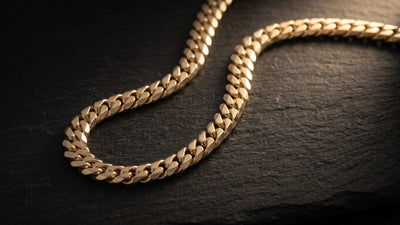
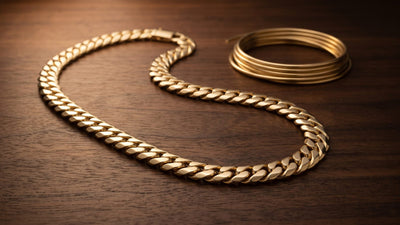
Updated by the GOLDZENN jewelry team — Miami, FL. With 347+ Google reviews at 4.9 stars and years of hands-on experience crafting solid gold Cuban link chains, we know authentic gold inside and out. This guide shares exactly what we look for — and what you should too. If you love chains, discover what makes Cuban link chains so special. These same verification methods apply to all gold jewelry — read more about gold pendant authenticity and what to look for when buying.
Quick Answer: 7 Ways to Test Gold at Home
If you need a fast answer, here are seven reliable ways to check if your gold is real:
- Check for hallmarks — Look for stamps like 10K, 14K, 18K, or numeric codes (417, 585, 750).
- The magnet test — Real gold is not magnetic. If it sticks to a magnet, it is not solid gold.
- The water/density test — Real gold sinks immediately. Fake gold may float or sink slowly.
- The skin test — Fake gold turns your skin green or black. Real gold does not cause discoloration.
- The ceramic plate test — Real gold leaves a gold streak on unglazed ceramic. Fake gold leaves a black streak.
- The weight test — Gold is dense and heavy for its size. If a piece feels unusually light, question its authenticity.
- Professional XRF testing — The most accurate method, used by reputable jewelers to verify exact gold content.
Keep reading for detailed, step-by-step instructions on each test, plus how to identify the most common types of fake gold flooding the market today. Gold vermeil contains real gold on the surface but is fundamentally different from solid gold — learn more in our gold vermeil explained guide.
Understanding Gold Purity Markings
Before you pick up a magnet or fill a glass of water, start with the simplest check available: the hallmark. Legitimate gold jewelry is almost always stamped with a purity marking, and learning to read these tiny engravings is the fastest way to tell if gold is real.
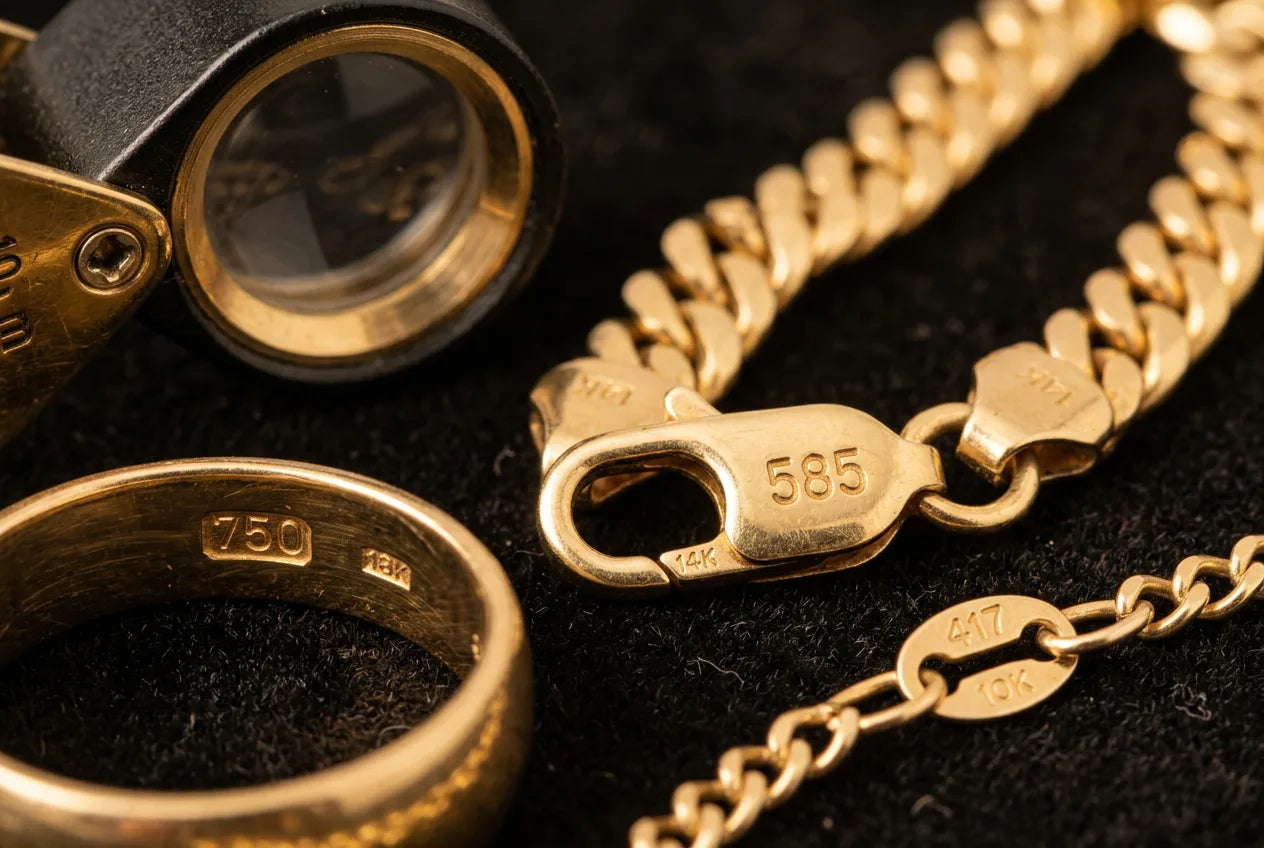
Common Gold Hallmarks (10K, 14K, 18K, 24K)
The karat system tells you how much pure gold is in a piece relative to other metals in the alloy. Here is the breakdown:
- 10K (10 karat) — 41.7% pure gold. The minimum karat that can legally be sold as "gold" in the United States. Durable and affordable.
- 14K (14 karat) — 58.5% pure gold. The most popular choice for everyday jewelry in America. A strong balance of purity, durability, and value.
- 18K (18 karat) — 75% pure gold. A richer gold color with higher purity. Preferred for luxury pieces and fine jewelry.
- 24K (24 karat) — 99.9% pure gold. Too soft for most jewelry applications, but used in bullion, 24K gold rings, and specialty collector pieces.
At GOLDZENN, we manufacture our solid gold Cuban link chains and solid gold tennis chains in 10K, 14K, and 18K — the three karats that give you the best combination of purity, wearability, and lasting value.
What the Numbers Mean (417, 585, 750, 999)
In addition to the karat stamp, many pieces carry a three-digit numeric hallmark. This number represents the gold's purity expressed as parts per thousand:
| Karat | Numeric Stamp | Gold Purity |
|---|---|---|
| 10K | 417 | 41.7% |
| 14K | 585 | 58.5% |
| 18K | 750 | 75.0% |
| 24K | 999 | 99.9% |
If you see "585" stamped on a chain, for example, that means the piece is 14K gold — 58.5% pure gold by weight. This numeric system is used internationally, so you may encounter it on imported pieces even if they do not carry the "K" marking.
Where to Find Hallmarks on Jewelry
Hallmarks are typically stamped in discreet locations that do not interfere with the piece's appearance:
- Chains and necklaces — On the clasp, the clasp's connecting ring, or the tag near the clasp.
- Rings — On the inside of the band.
- Bracelets — Near the clasp or on the inner surface of the clasp plate.
- Earrings — On the post or the back of the earring.
Use a jeweler's loupe or a smartphone magnifying app to read small stamps. Keep in mind that the absence of a hallmark does not automatically mean a piece is fake — very old or handmade jewelry may lack stamps — but the absence should prompt further testing.
The Magnet Test: Does Real Gold Stick to a Magnet?
This is the most popular at-home gold test, and for good reason: it takes five seconds, costs nothing, and can immediately expose many fakes. If you have ever searched "does real gold stick to a magnet," here is your definitive answer. Discover more in our gold nugget authentication.
How It Works
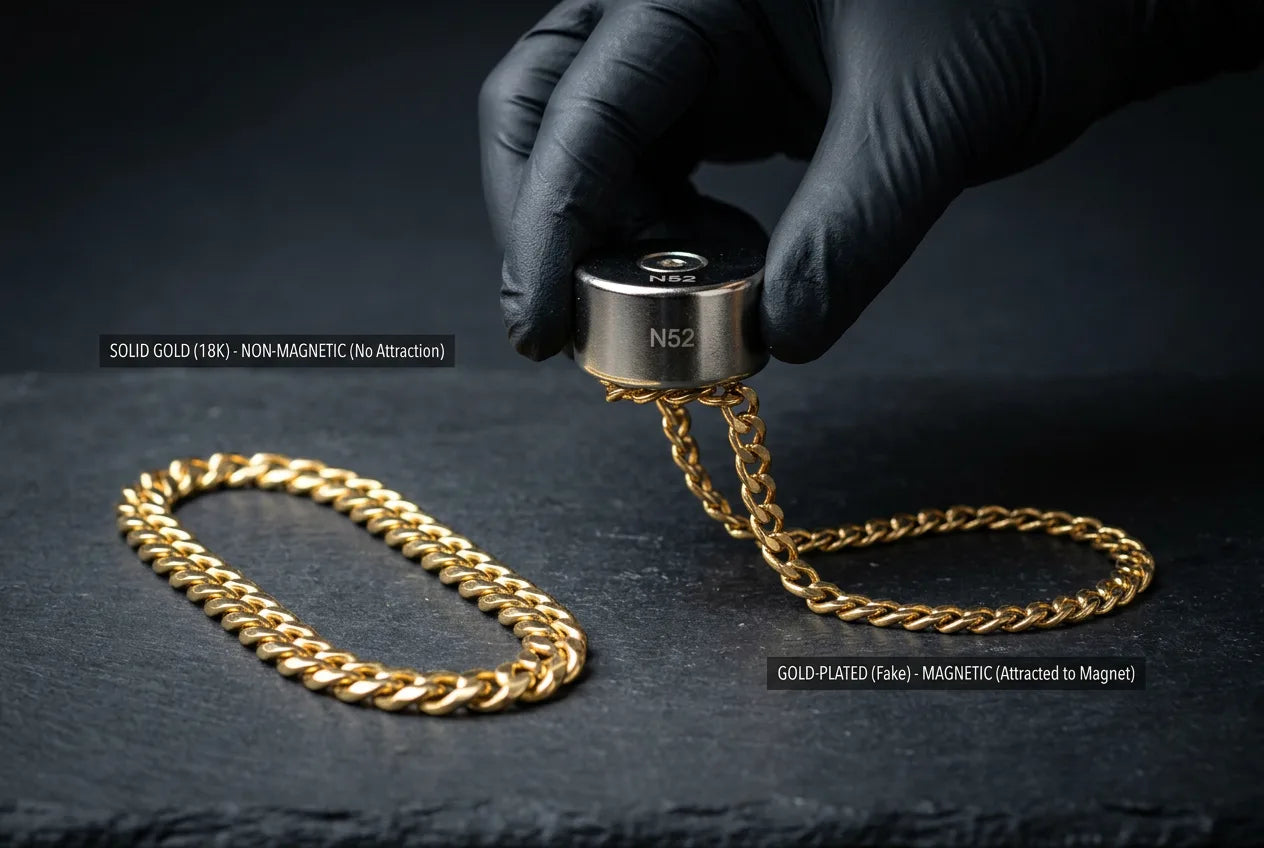
Gold is a diamagnetic metal, which means it has no magnetic attraction. Grab a reasonably strong magnet — a neodymium (rare earth) magnet from a hardware store works best, though a standard refrigerator magnet will work in a pinch.
Hold the magnet close to your jewelry piece. If the piece jumps toward the magnet or clings to it, the piece contains a significant amount of ferrous (iron-based) metal and is not solid gold.
If the piece shows absolutely no reaction to the magnet, that is a positive sign — but it does not guarantee authenticity on its own.
What It Does and Doesn't Tell You
The magnet test is a quick elimination tool, not a confirmation tool. Here is what you need to know:
- If it sticks: The piece is definitely not solid gold. It contains iron, nickel, or another magnetic metal. Fail.
- If it does not stick: The piece could be real gold — but it could also be made of non-magnetic metals like copper, brass, or aluminum that are not gold.
This is why the magnet test should always be combined with at least one or two other tests from this guide. Counterfeiters know about the magnet test and often use non-magnetic base metals to fool buyers. Still, it remains a valuable first step because it is instant and catches a surprising number of fakes — especially cheap costume jewelry and low-quality counterfeits sold online.
The Density/Water Test
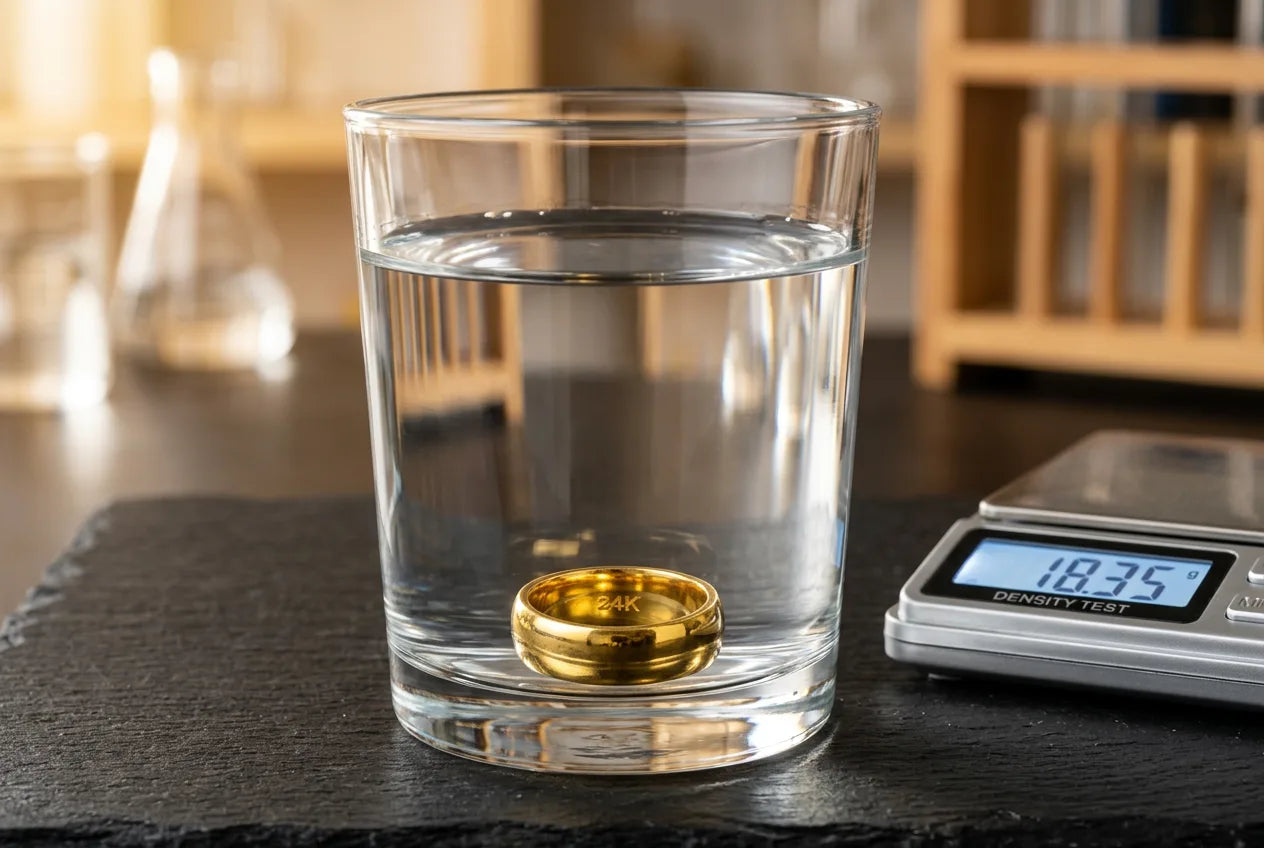
Gold is one of the densest metals on Earth. A solid gold piece will feel noticeably heavy for its size, and this property gives us a reliable at-home test using nothing more than a glass of water and a kitchen scale.
Step-by-Step Instructions
- Weigh your piece on a digital scale and record the weight in grams. (Example: 25.0 grams)
- Fill a tall, narrow container (a graduated cylinder is ideal, but a drinking glass works) with water. Note the water level.
- Gently lower the jewelry into the water. Real gold will sink immediately — it should drop straight to the bottom without hesitation.
- Measure the water displacement. Note how much the water level rose. This gives you the volume of the piece in milliliters (1 mL = 1 cm³).
- Calculate density. Divide the weight by the volume. Density = Weight (g) ÷ Volume (cm³).
Expected Results by Karat
| Karat | Expected Density (g/cm³) |
|---|---|
| 10K | 11.3 – 11.6 |
| 14K | 12.9 – 13.6 |
| 18K | 15.2 – 15.9 |
| 24K | 19.3 |
If the density of your piece falls significantly below the expected range for its stamped karat, the piece likely is not what it claims to be. This test is more involved than the magnet test, but it provides much stronger evidence of authenticity. For the most accurate results, use a digital scale that measures to at least 0.1 grams.
Important note: This test works best on solid pieces. Hollow jewelry will produce misleading density readings because the air pocket inside lowers the overall density. If you suspect your chain might be hollow, the density test alone will not give you a clear answer — you will need professional testing.
The Skin Discoloration Test
This is one of the oldest and simplest ways people test gold, and while it is not scientifically precise, it does reveal an important truth about the metals in your jewelry.
Why Fake Gold Turns Skin Green
When base metals like copper, brass, or nickel come in prolonged contact with your skin, they react with sweat, moisture, and natural body oils. This chemical reaction produces copper chloride — a green-colored compound that transfers onto your skin.
Gold-plated jewelry is especially prone to this. Once the thin gold layer wears through — and it will, often within weeks or months of regular wear — the base metal underneath is exposed directly to your skin. The result is that unmistakable green or blackish discoloration on your finger, wrist, or neck.
If you have ever wondered about the real differences, our gold plated vs solid gold comparison breaks it down in detail.
Why Real Gold Doesn't React
Pure gold is one of the least reactive elements on the periodic table. It does not oxidize, corrode, or react with human skin under normal conditions. This is precisely why gold has been valued for thousands of years — it stays beautiful indefinitely.
Solid gold jewelry in 10K, 14K, and 18K does contain alloyed metals (silver, zinc, copper) for strength and durability, but the gold content is high enough that the alloy remains stable against skin chemistry. You should not experience any discoloration from genuine solid gold jewelry, even with daily wear over many years.
To run this test: wear the piece continuously for a few days, especially during exercise or in warm weather when you sweat more. Check the skin underneath. Any green, black, or dark discoloration is a strong indicator that the piece is not solid gold.
The Ceramic Plate Test
The ceramic plate test — sometimes called the streak test — is a quick physical test that can help distinguish real gold from many common imitations. It is simple, but it does carry a small risk of scratching your jewelry, so proceed with care.
How to Do It Safely
- Find an unglazed ceramic plate or tile. The back of most ceramic floor tiles or the bottom of a ceramic coffee mug (the rough, unfinished ring) works well. The surface must be unglazed — a smooth, shiny glazed surface will not work.
- Press the piece of jewelry firmly against the ceramic surface and drag it across in a short line, about one to two inches long.
- Apply moderate pressure — enough to leave a mark, but not so much that you risk damaging a delicate piece.
Reading the Results
- Gold streak: Real gold leaves a gold-colored or yellowish streak on unglazed ceramic. This is a positive sign.
- Black or dark streak: Fake gold — typically pyrite (fool's gold), brass, or copper alloys — leaves a dark or black streak. This is a fail.
- No streak at all: Some plated items may not leave a clear streak. This inconclusive result means you should try another test.
A word of caution: this test can leave a small scratch on your jewelry. We recommend using it on an inconspicuous area — such as the inside of a ring band or near the clasp of a chain — and only when other non-destructive tests have been inconclusive. If you are testing a valuable or sentimental piece, skip this method and go straight to professional testing.
Professional Testing Methods
At-home tests are useful for quick screening, but they have limitations. When you need certainty — whether you are making a significant purchase, evaluating an estate piece, or verifying an item before resale — professional testing provides definitive answers.
Acid Testing
The acid test is one of the oldest and most widely used professional methods. A jeweler scratches a small sample of metal from the piece onto a testing stone, then applies nitric acid of varying concentrations. Real gold resists the acid — it does not dissolve or change color. Lower-karat or fake gold will react visibly, dissolving or turning green.
Different acid solutions are used for different karats (10K, 14K, 18K, 22K), allowing a jeweler to narrow down the exact purity. Acid testing is accurate and affordable, but it does require removing a tiny amount of material from the piece.
Electronic Gold Testers
Electronic testers measure the electrical conductivity of a metal's surface to estimate gold content. They are non-destructive, fast, and reasonably accurate for surface testing. However, they only read the surface layer of the metal, which means they can be fooled by thick gold plating over a base metal core.
For this reason, electronic testers are best used as a supplement to other methods rather than a standalone verification.
XRF Testing
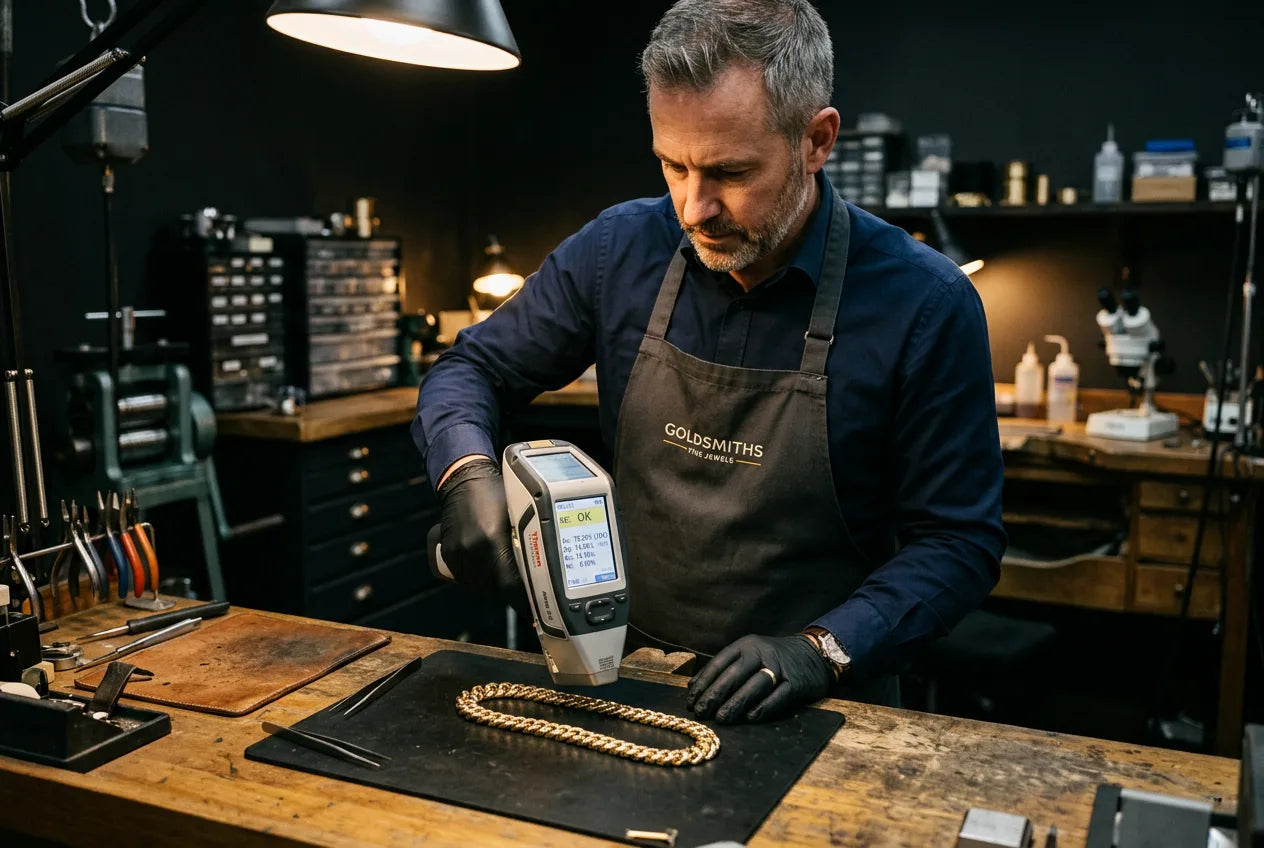
X-ray fluorescence (XRF) testing is the gold standard — quite literally. An XRF analyzer shoots a focused beam of X-rays at the piece, causing the atoms in the metal to emit their own characteristic fluorescent X-rays. A detector reads these emissions and identifies every element present, along with its exact percentage.
XRF is non-destructive, highly accurate, and provides a complete elemental breakdown in seconds. It can tell you not only whether a piece is real gold, but exactly what karat it is and what other metals are in the alloy.
At GOLDZENN, we use professional XRF testing equipment to verify the purity of every piece we produce. When you purchase from us, you are not taking anyone's word for it — the gold content has been confirmed with the most advanced testing technology available in the industry. That level of verification is part of why we maintain a 4.9-star rating across 347+ Google reviews.
Definitely NOT Silver - GOLDZENN Metal Testing — Watch on YouTube
Common Types of Fake Gold to Watch For
Not all "gold" jewelry is created equal. Understanding the terminology helps you know exactly what you are buying — and what to avoid if you want the real thing.
Gold Plated
Gold-plated jewelry has a very thin layer of gold (typically 0.5 to 2.5 microns) deposited over a base metal like brass, steel, or copper through an electrochemical process. The gold layer is so thin that it wears off relatively quickly with regular use — often within months. Once the plating wears through, the base metal underneath is exposed, leading to tarnishing, discoloration, and skin reactions.
Gold-plated pieces have virtually no gold value. They are costume jewelry with a gold appearance.
This is why protecting your gold investment starts with verifying authenticity before purchase.
Gold Filled
Gold-filled jewelry has a thicker layer of gold than gold-plated pieces — by law, it must contain at least 5% gold by weight. The gold layer is mechanically bonded (pressed) onto the base metal rather than electroplated. This makes it more durable than plating, and gold-filled pieces can last years with proper care. However, the gold layer will eventually wear through, and the piece contains mostly base metal.
Gold Vermeil
Gold vermeil (pronounced "ver-MAY") is a specific type of gold plating where the base metal must be sterling silver and the gold layer must be at least 2.5 microns thick. It is a step up from standard gold plating because of the silver base, but the gold layer will still wear over time. It is not solid gold.
Brass and Copper Alloys
Some of the cheapest fake gold jewelry is made entirely from brass (a copper-zinc alloy) or other copper-based alloys that mimic gold's color. These pieces often have no gold content whatsoever and are sometimes sold without any karat marking — or worse, with fraudulent stamps. They tarnish quickly, feel lighter than real gold, and often have a slightly different hue that an experienced eye can spot.
Here is a comparison table to help you see the differences at a glance:
| Characteristic | Solid Gold | Gold Plated / Fake Gold |
|---|---|---|
| Hallmark | Stamped 10K, 14K, 18K (or 417, 585, 750) | May say "GP," "GF," "GEP," or have no stamp |
| Weight | Heavy and dense for its size | Feels lighter than expected |
| Magnet reaction | No magnetic attraction | May stick to a magnet |
| Skin reaction | No discoloration | Turns skin green or black |
| Tarnishing | Does not tarnish | Tarnishes, fades, or peels over time |
| Ceramic streak | Gold-colored streak | Black or dark streak |
| Price | Reflects current gold market value | Suspiciously cheap |
| Longevity | Lasts generations | Deteriorates within months to years |
| Resale value | Retains and appreciates in value | Little to no resale value |
Lo Engañaron! Mira lo que Tiene esta Pieza de Oro por Dentro - GOLDZENN — Watch on YouTube
Red Flags When Buying Gold Jewelry
Knowing how to test gold is half the battle. The other half is recognizing the warning signs before you buy. Here are the most common red flags that should make you pause and investigate further.
Price Too Good to Be True
Gold is a globally traded commodity with a transparent market price. If someone is selling a "14K solid gold Cuban link chain" for a fraction of what established jewelers charge, something is wrong. The gold content alone has a minimum melt value based on weight and karat. Any price significantly below that floor is a clear signal that the piece is not what it claims to be.
Before buying, check the current spot price of gold and do a rough calculation: multiply the weight of the piece (in grams) by the gold purity percentage, then multiply by the current price of gold per gram. The retail price should be above this number — never significantly below it. Our guide to understanding gold value walks through these calculations step by step for every karat level.
Missing Hallmarks
Reputable manufacturers stamp every piece with its karat purity. If a seller claims a piece is solid gold but there is no hallmark anywhere on it, that is a significant concern. While it is possible for very old or artisan pieces to lack stamps, the vast majority of legitimate gold jewelry produced in the last several decades will carry proper markings.
Unusually Lightweight
Gold is dense. If you pick up a piece that is marketed as solid gold and it feels surprisingly light — almost airy — trust your instincts. Solid gold has a satisfying heft that is difficult to replicate with base metals. This is especially noticeable with chains: a solid gold Cuban link chain has a substantial, weighty feel that is immediately different from a plated or hollow piece.
Seller Can't Provide Documentation
Trustworthy jewelers provide documentation of authenticity. This can include receipts specifying karat purity and weight, certificates of authenticity, or the willingness to test a piece in front of you. If a seller gets evasive when you ask for proof of gold content, or pressures you to buy quickly without verification, walk away.
How to Buy Real Gold Jewelry with Confidence
Armed with everything you have learned in this guide, here is how to make sure your next gold jewelry purchase is the real thing:
- Buy from established, reviewed jewelers. A jeweler with a long track record and hundreds of verified customer reviews has a reputation to maintain. Read the reviews — look for mentions of quality, authenticity, and customer service.
- Ask about manufacturing. Where and how is the jewelry made? Jewelers who manufacture their own pieces have direct control over quality and can speak in detail about their process. At GOLDZENN, every piece is handcrafted in our Miami workshop — we control the process from raw gold to finished product. See our behind-the-scenes workshop walkthrough for the full production journey.
- Request testing or documentation. A confident jeweler will not hesitate to show you test results or verify purity in front of you.
- Understand what you are paying for. Compare weight and karat across different sellers. Price per gram at the same karat should be in a consistent range among reputable sources.
- Choose solid gold over plated alternatives. If you want jewelry that lasts, holds value, and never tarnishes or causes skin reactions, solid gold is the only option. Our gold plated vs solid gold comparison explains exactly why.
If you are looking for authentic, solid gold jewelry backed by professional verification and a quality guarantee, explore our collections. From solid gold Cuban link chains and solid gold tennis chains to custom jewelry built to your exact specifications — every piece is solid gold, handmade in Miami, and tested to verify purity. Check our 347+ Google reviews to see what our customers have to say.
For a deeper dive into chain styles, sizing, and what to look for, read our complete guide to Cuban link chains. Interested in a lighter flat-link style? See our guide to curb chains. For outfit inspiration, check out our guide to styling gold chains for men.
Frequently Asked Questions
Does real gold stick to a magnet?
No. Pure gold and solid gold alloys (10K, 14K, 18K) are not magnetic. If your jewelry sticks to a magnet, it contains iron, nickel, or another ferrous metal and is not real solid gold. The magnet test is a quick and easy first check, but because some fake gold is also non-magnetic, it should be combined with other testing methods for a definitive answer.
Can you test gold with vinegar?
You can apply white vinegar to gold and observe whether the metal changes color or reacts, but this method is not particularly reliable. Real gold will not react to vinegar, but many non-gold metals also resist vinegar. It is not a definitive test. For accurate results, professional acid testing, electronic testing, or XRF analysis is far more dependable. If you are unsure about a piece, take it to a reputable jeweler for professional verification.
How can you tell if a gold chain is real?
Start by checking for a hallmark stamp near the clasp — look for 10K, 14K, 18K, or numeric equivalents like 417, 585, or 750. Then perform the magnet test (it should not stick). Pick up the chain and feel its weight — solid gold chains are noticeably heavy and dense. Finally, for complete certainty, have the chain tested by a professional jeweler using acid testing or XRF analysis. A real solid gold chain will pass all of these checks.
Does real gold turn your skin green?
No. Real solid gold does not cause skin discoloration. Green or black marks on your skin are caused by base metals — particularly copper — reacting with your sweat and body chemistry. This is a telltale sign that a piece is gold plated, gold filled, or made from a copper-based alloy rather than solid gold. If your jewelry is turning your skin green, it is not solid gold regardless of what the seller claimed.
What does 585 mean on gold jewelry?
The number 585 is a hallmark indicating that the piece is 14-karat gold. It means the jewelry contains 58.5% pure gold by weight, with the remaining 41.5% being alloy metals (typically silver, copper, and zinc) added for durability and strength. The 585 stamp is the numeric equivalent of the 14K stamp and is commonly used in European and international jewelry. 14K gold is the most popular karat for jewelry in the United States because it offers an excellent balance of gold purity, strength, and value.