
10K gold is 41.7% pure gold. 14K gold is 58.3%. 18K gold is 75.0%. Those three numbers — stamped 417, 585 and 750 — decide everything else: how deep the yellow reads, how well the metal resists scratches, what it costs per gram, and how it behaves against sensitive skin. Higher karat means more gold and richer color; lower karat means more alloy and more hardness. Nothing else about the karat question is complicated.
This guide settles both of the comparisons buyers actually search: 14K vs 18K gold, and the difference between 10K and 14K gold. It carries live per-gram, per-pennyweight and per-troy-ounce pricing for every karat, a calculator that values your own piece at today's spot rate, and a full side-by-side matrix.
- 14K vs 18K: 18K holds 28.6% more pure gold (75.0% vs 58.3%), so it reads deeper yellow and carries a higher metal value per gram — but it is the softer of the two and marks up faster.
- 10K vs 14K: 14K holds 39.8% more pure gold (58.3% vs 41.7%), so it is warmer in color and worth more per gram — while 10K is the hardest of the three and the most scratch-resistant.
- Everyday chain or ring: 14K is the U.S. default for a reason — it is the middle of the durability/color/price curve.
- Rotation, statement or sensitive skin: 18K, because it has the least alloy in it.
- Hardest wear or entry into solid gold: 10K.
- Purity is fixed math: 10K = 10/24 = 41.7%. 14K = 14/24 = 58.3%. 18K = 18/24 = 75.0%. 24K = 99.9%.
- Hardness runs opposite to purity: more alloy means a harder metal, which is why 10K resists scratching best and 18K least.
- Gold-content value scales with purity, not brand: at the same weight, 18K carries about 1.29× the metal value of 14K and about 1.80× that of 10K.
- Rose gold does change with karat: 10K rose is visibly pinker and more coppery than 18K rose, because copper makes up a far larger share of the alloy.
- White gold mostly does not: nearly all white gold is rhodium-plated, so 10K, 14K and 18K white look near-identical at the surface until the plating wears.
- Weight beats karat for visual impact: a wider chain in a lower karat almost always makes a bigger impression than a thinner chain in a higher one.
- What Karat Actually Means
- 10K Gold — 41.7% Pure
- 14K Gold — 58.3% Pure
- 18K Gold — 75.0% Pure
- 10K vs 14K vs 18K: The Full Comparison Matrix
- Live Gold Price By Karat and Unit
- Karat Value Calculator
- The Difference Between 10K and 14K Gold
- Which Karat Should You Choose?
- What Else Is In Your Gold?
- How Karat Is Verified: XRF Testing
- Frequently Asked Questions
- 10K Gold Price Per Gram — the hardest alloy and the entry point into solid gold
- 14K Gold Price Per Gram — the American standard, in depth
- 18K Gold Buyers Guide — why the premium exists and when it is worth paying
- Complete Gold Prices Guide — spot price mechanics and the full calculator
What Karat Actually Means
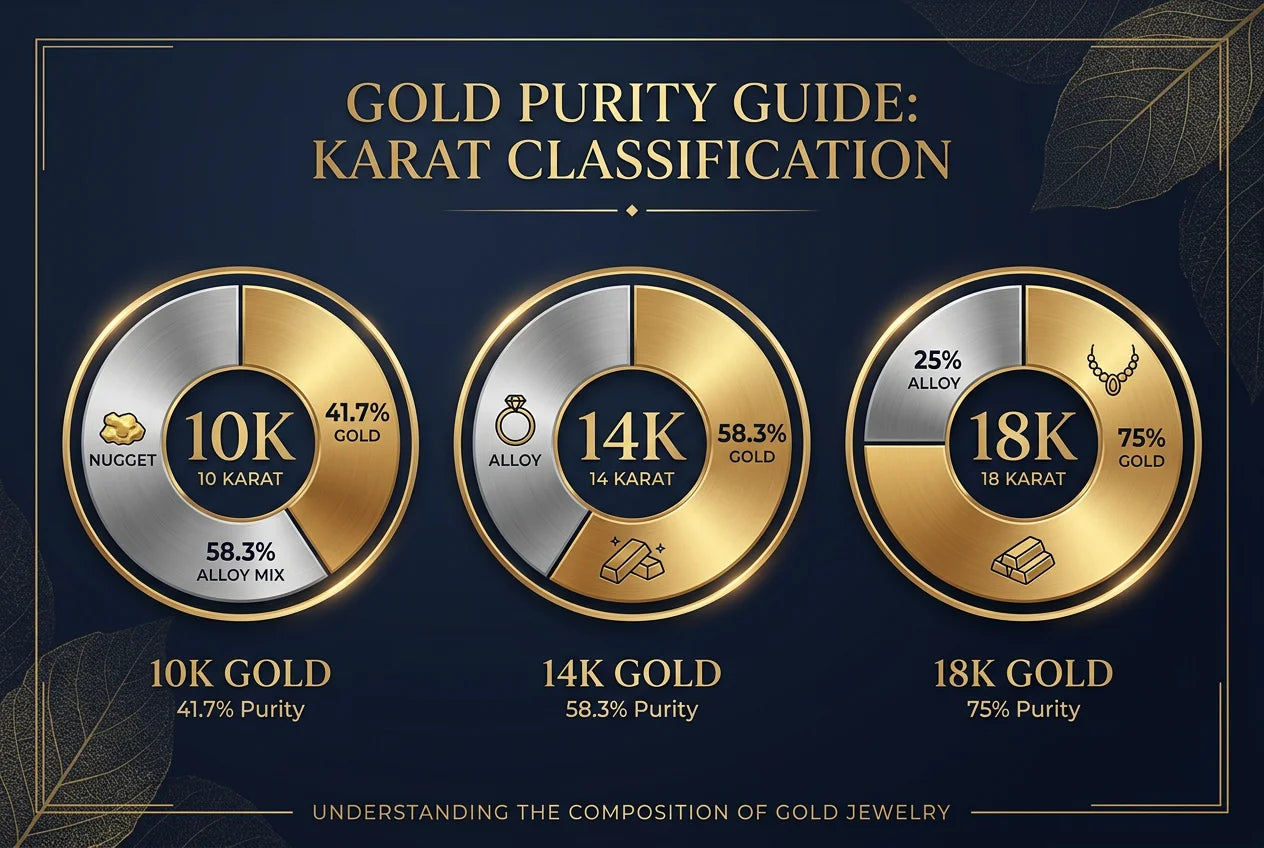
Karat (K or kt) measures gold purity on a 24-part scale. The karat number is how many of those 24 parts are pure gold. It is not "carat," which measures gemstone weight — in the gold world, karat is purity and nothing else.
- 10K gold — 10 of 24 parts pure gold = 41.7%. Hallmark: 417. The lowest karat commonly sold in mainstream US jewelry.
- 14K gold — 14 of 24 parts = 58.3%. Hallmark: 585. The dominant karat in the U.S. market.
- 18K gold — 18 of 24 parts = 75.0%. Hallmark: 750. The European and Middle Eastern standard, and the luxury tier here.
- 22K gold — 22 of 24 parts = 91.7%. Hallmark: 916. Common in South Asian and Middle Eastern jewelry.
- 24K gold — 99.9% pure. Too soft for chains and rings that get worn hard, though 24K gold rings hold a real niche for collectors and buyers who want the metal itself.
Why the Alloy Matters As Much As the Gold
The non-gold portion is not filler. Copper, silver, zinc and sometimes palladium or nickel are what give gold jewelry its structure. Pure gold bends under finger pressure and scratches against a countertop. The alloy adds hardness, scratch resistance and the ability to hold a clasp under tension — and it also shifts the color, which is the whole basis of rose and white gold.
This produces a trade-off that runs in a straight line: as purity goes up, hardness goes down. 10K is the hardest of the three common karats and 18K the softest. That is not a quality ranking, it is a property spectrum, and where you want to sit on it depends entirely on how the piece will be worn.
10K Gold — 41.7% Pure
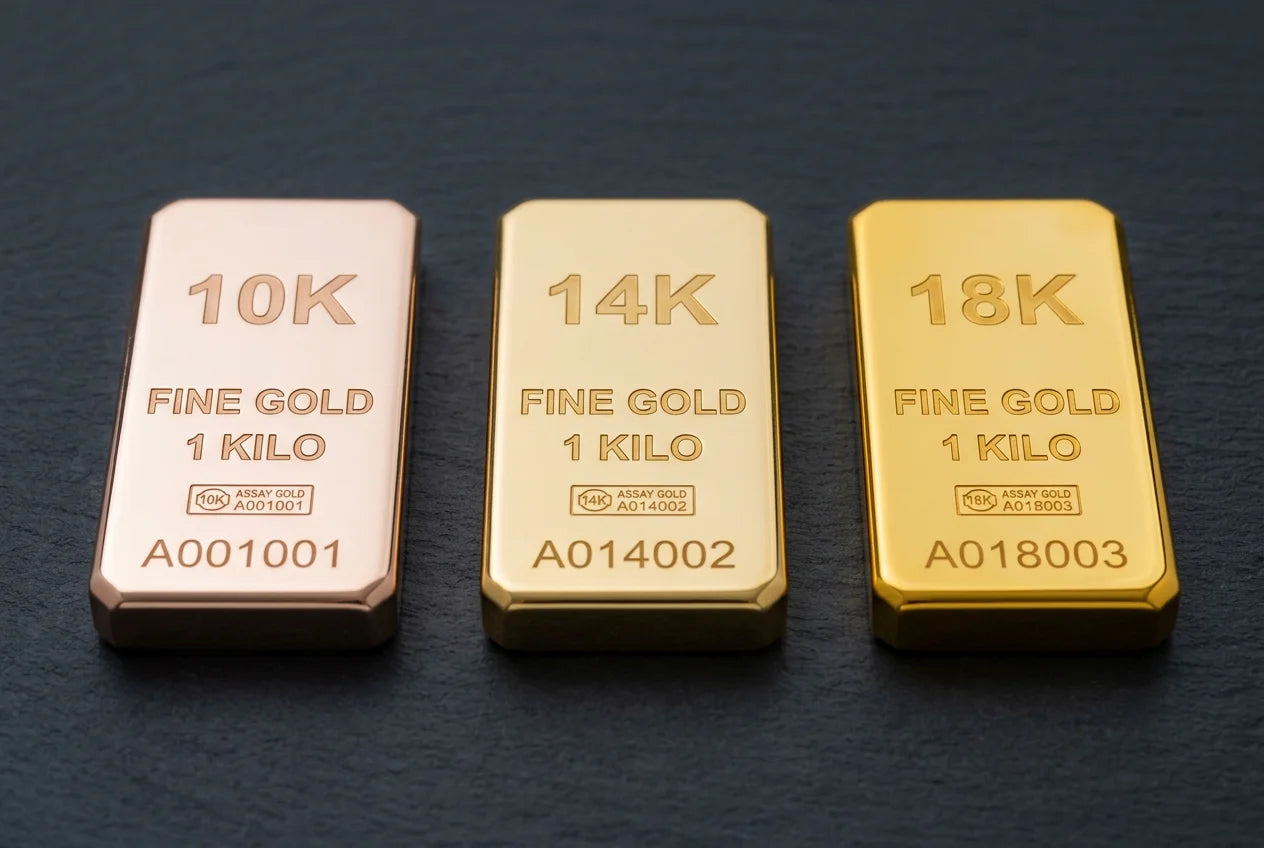
At 41.7% gold and 58.3% alloy, 10K contains more strengthening metal than gold. That composition makes it the hardest and most scratch-resistant of the common karats — the practical choice for a chain that never comes off.
Color
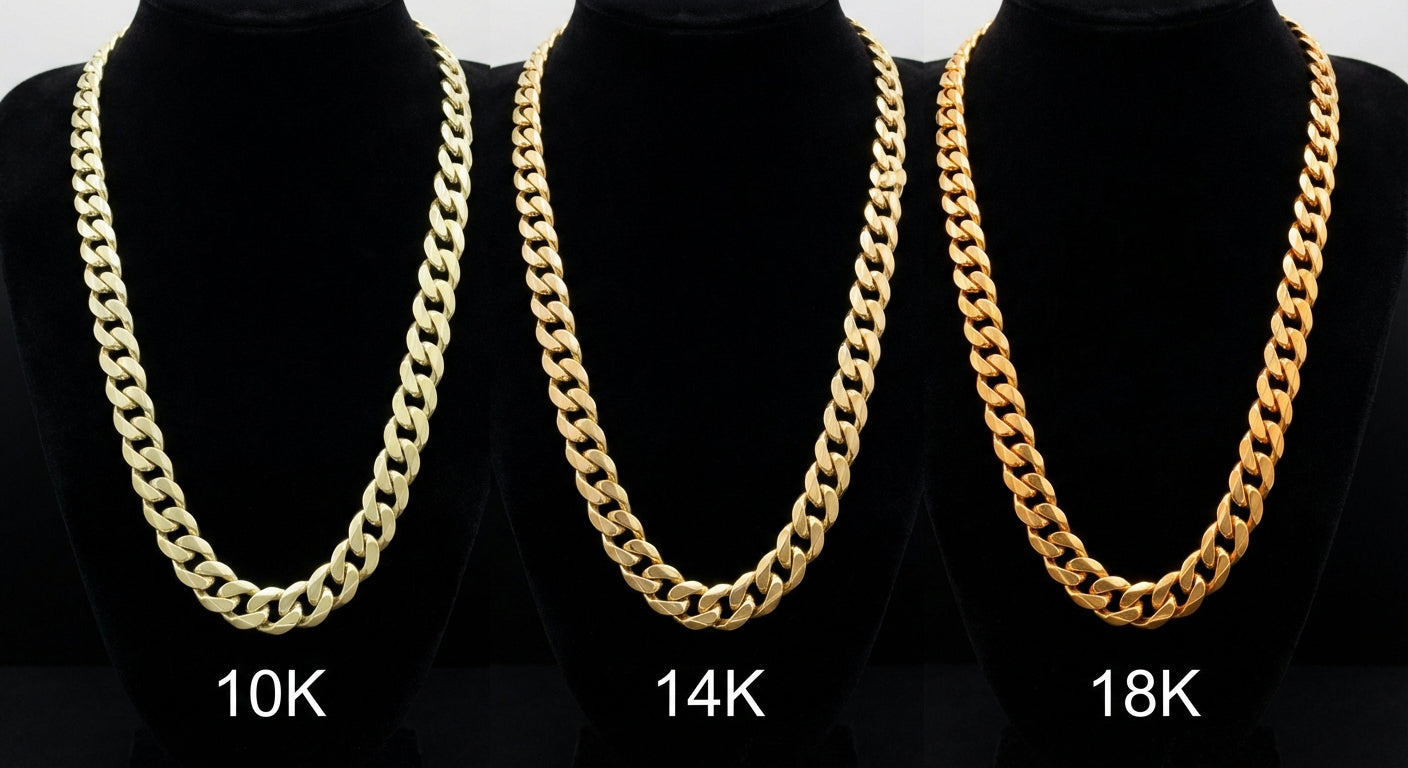
10K reads as a lighter, brighter yellow. It is unmistakably gold, just less saturated than 14K or 18K, because the alloy dilutes the color. In isolation almost nobody identifies it by eye; the difference only becomes obvious in a direct side-by-side like the photograph at the top of this page.
Durability
- Best scratch resistance of the three karats.
- Best resistance to dents and deformation — relevant for links that move constantly against each other.
- Best structural integrity under stress — clasps and link seams hold their tension longer.
Value and Trade-offs
10K carries the lowest metal value per gram of the three — $56.04 per gram at the current spot rate — which is exactly why it lets you buy more chain for the same money. The trade-off is the highest alloy content, which means the highest chance of a reaction if you are sensitive to nickel or copper, and a slightly greater tendency to develop a faint patina over many years. Both are manageable; neither is a reason to avoid it.
Go deeper: 10K Gold Price Per Gram Today — Complete Value Guide →
14K Gold — 58.3% Pure
14K is the most purchased karat in the United States. At 58.3% gold and 41.7% alloy it sits in the middle of every axis at once: enough gold for genuine warmth and weight, enough alloy for real structural strength, and a price between the other two.
Color
14K yellow gold is the warm, classic tone most American buyers picture when they think "gold." It is visibly richer than 10K. Against 18K, a trained eye can see that 14K is slightly less saturated — but on its own it reads unambiguously rich and premium.
Durability
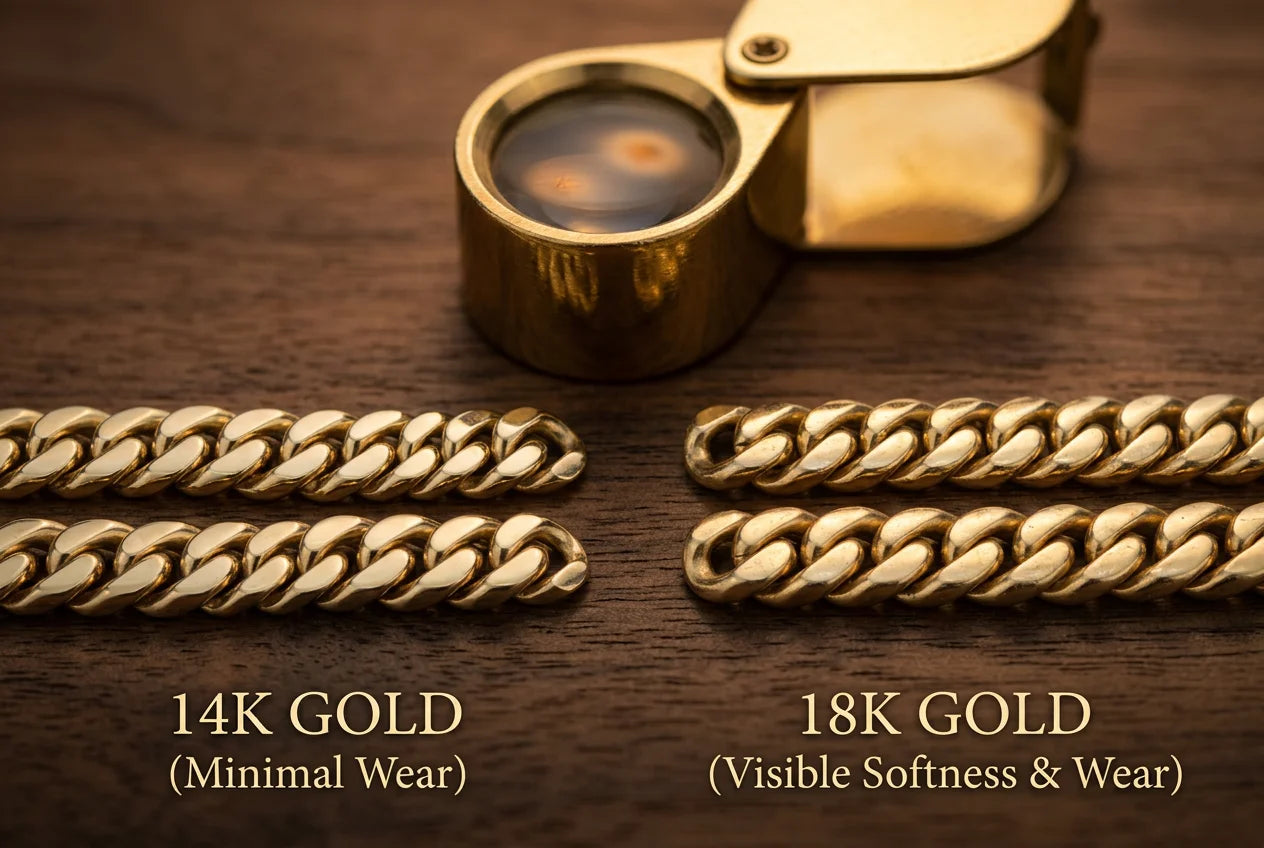
14K is softer than 10K but meaningfully harder than 18K. In practice this means it tolerates sleeping, training, seatbelts and daily friction without needing thought. That is why it dominates the categories that get worn continuously: everyday Cuban link chains, wedding bands, gold rings, and tennis chains where thin links need reliable structure.
Value
14K sits at $78.35 per gram of gold content today, and it has the most liquid resale market in the United States — the karat a buyer, a jeweler or a pawn desk will always price without hesitation.
Go deeper: 14K Gold Price Per Gram Today — Complete Value & Buying Guide →
18K Gold — 75.0% Pure
18K is three-quarters pure gold. Only 25% of the metal is alloy, and that changes the character of the piece: deeper color, more metal value per gram, less alloy against your skin, and a softer surface.
Color
This is where 18K separates itself. The higher gold concentration produces a warmer, more saturated yellow that is immediately readable next to 14K. The gap between 10K and 18K is obvious to anyone; the gap between 14K and 18K is subtle but real, and most people can see it when the two are held together.
Durability
18K is the softest of the three. With less alloy reinforcing it, it picks up fine surface marks faster than 14K under identical conditions. It is not fragile — enormous numbers of people wear 18K daily — but it builds a patina sooner. Some owners like that; if you do not, periodic professional polishing restores the surface. Our gold jewelry care guide covers what you can do at home between polishings.
Skin Sensitivity
Because 18K contains only 25% alloy — against 41.7% in 14K and 58.3% in 10K — it is the least likely of the three to trigger a reaction in people with metal sensitivities, particularly to nickel. If lower-karat pieces have irritated your skin before, 18K is the sensible move.
Value
18K carries $100.79 per gram of gold content today — the highest of the three, and the reason 18K holds the strongest melt value per gram on resale.
Go deeper: 18K Gold Buyers Guide — Price, Value & Why It Commands a Premium →
10K vs 14K vs 18K: The Full Comparison Matrix
Eleven factors, three karats, one table. The two price rows are live — they track the spot market rather than sitting at whatever gold cost on the day this page was written.
| Factor | 10K Gold | 14K Gold | 18K Gold |
|---|---|---|---|
| Gold Purity | 41.7% | 58.3% | 75.0% |
| Hallmark Stamp | 417 | 585 | 750 |
| Durability | Highest — most scratch and dent resistant | High — excellent for daily wear | Moderate — softer, shows wear faster |
| Color Richness | Warm yellow — lighter and brighter | Classic gold — warm and rich | Deep gold — warmest and most saturated |
| Gold Value Per Gram (live) | $56.04 | $78.35 | $100.79 |
| Gold Value Per Pennyweight (live) | $87.15 | $121.84 | $156.74 |
| Skin Sensitivity | Most alloy — highest reaction risk | Moderate alloy — generally well tolerated | Least alloy — best for sensitive skin |
| Tarnish Resistance | Good — may develop slight patina over years | Very good — minimal tarnishing | Strongest — highest resistance to tarnish |
| Resale Value | Good — recognized worldwide | Strong — most liquid U.S. market | Highest per gram — most gold content |
| Best For | Daily wear, active lifestyles, budget-conscious | All-purpose — the versatile choice | Statement pieces, rotation, sensitive skin |
| Weight Feel | Substantial and solid | Noticeably weighty | Heaviest — gold is the densest component |
Every karat in that table is genuine fine jewelry. The "right" choice is a fit question, not a quality ranking.
Live Gold Price By Karat and Unit
Most karat comparison guides either skip dollar figures entirely or print a number that was true on the day the page was published. These values move with the market. Spot gold is currently $4,180.09 per troy ounce, last refreshed .
| Karat | Purity | Per Gram | Per Pennyweight | Per Troy Ounce |
|---|---|---|---|---|
| 10K | 41.7% | $56.04 | $87.15 | $1,743.10 |
| 14K | 58.3% | $78.35 | $121.84 | $2,436.99 |
| 18K | 75.0% | $100.79 | $156.74 | $3,135.07 |
| 22K | 91.7% | $123.24 | $191.64 | $3,833.14 |
| 24K | 99.9% | $134.26 | $208.77 | $4,175.91 |
These are gold-content (melt) values only. Finished jewelry carries additional value for craftsmanship, design, stones and finishing. One pennyweight (dwt) = 1.555 grams; one troy ounce = 31.1035 grams. This table is the no-JavaScript reference for the calculator below and stays current whether or not scripts run in your browser.
The Karat Premium, As Pure Arithmetic
Because gold-content value scales directly with purity, the step-up between karats is fixed math and does not depend on gold's price on any given day:
- 10K → 14K: 58.3 ÷ 41.7 = 1.40× the gold content — about 40% more metal value at the same weight.
- 14K → 18K: 75.0 ÷ 58.3 = 1.29× — about 29% more metal value at the same weight.
- 10K → 18K: 75.0 ÷ 41.7 = 1.80× — the full spread across the common karat range.
Retail prices on finished pieces move by more than these ratios, because labor, design and stone-setting scale with the piece rather than with the metal. Current pricing on any specific chain, ring or bracelet is on the product page — start with solid gold Cuban link chains, all gold chains, tennis chains, gold rings or gold pendants. If you would rather have a number read to you, call or text (321) 521-4651.
Karat Value Calculator
Enter a weight, pick a unit, pick a karat. This values the gold content of a piece at the current live spot rate — useful whether you are sizing up a purchase, comparing a quote, or working out what an old chain in a drawer is actually worth.
Priced from live spot gold at $4,180.09/troy oz. Gold content (melt) value only — finished jewelry carries a craftsmanship premium above melt.
The Difference Between 10K and 14K Gold
The difference between 10K and 14K gold is 16.6 percentage points of purity — 41.7% against 58.3%. In practice that shows up in four places:
- Color. 14K is warmer and deeper. 10K is lighter and slightly cooler. Side by side it is easy to see; separately, most people cannot tell.
- Hardness. 10K is harder and holds a scratch-free surface longer. This is the one axis where the lower karat genuinely wins.
- Metal value. 14K carries about 40% more gold per gram — $78.35 versus $56.04 today.
- Skin tolerance. 10K has the most alloy of the three karats compared here, so it carries the highest chance of irritation for sensitive wearers.
Both are real, solid, hallmarked gold. 10K is stamped 417 and is legally gold in the United States; the idea that it is somehow "not real gold" is simply wrong. What is true is that it is the most alloy-heavy of the karats you will be offered, which is exactly why it is also the toughest.
When 10K Is the Smarter Buy
- You are stepping up from gold-plated or hollow jewelry and want genuine solid gold — see solid gold vs gold-bonded for what that upgrade actually changes.
- You work with your hands, train hard, or simply refuse to take a chain off.
- You want the widest chain your budget allows, and width matters more to you than tone.
- You are building a collection and intend to add higher karats later.
When 14K Is the Smarter Buy
- You want the warmer, more classic gold tone without stepping into 18K's softness.
- You want the most liquid resale market in the U.S.
- You have had mild reactions to lower-karat pieces but do not need full 18K.
- The piece is a ring or band that will be worn continuously for decades.
Deciding between just those two karats? Read the 14K vs 18K comparison →
Which Karat Should You Choose?
Choose 10K if…
- You want maximum durability and intend to wear the piece continuously without taking it off.
- You work in a physically demanding environment — trades, mechanics, construction, hard training.
- You are buying your first solid gold piece and want genuine hallmarked gold at the most accessible entry.
- You want the widest chain your budget allows, and presence matters more to you than tone.
- You are building a collection and plan to add higher karats over time.
Choose 14K if…
- You want the best overall balance of color, hardness and price and do not want to think about it further.
- The piece is a ring or wedding band that will be worn every day for decades.
- You want the most liquid resale market in the United States.
- You want a warmer tone than 10K without accepting 18K's softness.
- You want the widest selection — 14K is the U.S. industry default, so more designs exist in it.
Choose 18K if…
- You prioritize color depth above everything — you want the richest wearable yellow.
- You have known metal sensitivities, particularly to nickel.
- The piece is a statement item or part of a rotation rather than a 24/7 chain.
- You are buying partly as a store of value and want the most gold per gram.
- You are buying for a market where 750 is the expected standard — much of Europe, the Middle East and Latin America.
Choose 22K if…
- You want near-pure gold you can still wear, in the tradition of South Asian and Middle Eastern jewelry, and you will treat the piece carefully.
The Upgrade Path
A common progression: a 10K piece to get into solid gold, a 14K chain as the everyday anchor, and an 18K piece as the one that comes out for occasions. There is nothing lesser about starting at 10K — it is hallmarked solid gold with real metal value, and it is the toughest thing in the case.
Still deciding between karats?
Tell us how you plan to wear it and we will tell you which karat fits — including when the cheaper one is the right answer. Call or text (321) 521-4651, email contact@goldzenn.com, or visit the workshop in Miami.
What Else Is In Your Gold?
If a 14K chain is 58.3% gold, the other 41.7% is doing real work. The usual alloy metals:
- Copper — adds hardness and warmth. A copper-dominant alloy is what makes rose gold rose.
- Silver — improves workability and lightens the tone.
- Zinc — adds hardness and acts as a deoxidizer during casting.
- Palladium — used in white gold; corrosion-resistant and far less allergenic than nickel.
- Nickel — sometimes used in white gold. The most common cause of jewelry skin reactions.
The proportions map directly to the properties you feel:
- 10K (58.3% alloy) → hardest, most scratch-resistant, lightest tone
- 14K (41.7% alloy) → balanced hardness and color
- 18K (25% alloy) → softest, richest tone, most metal value per gram
Exact recipes vary by manufacturer, which is why two 14K chains from different makers can look slightly different in tone. If skin sensitivity matters to you, ask about the specific alloy before buying — any jeweler worth dealing with will answer. For related reading, see whether gold tarnishes and our guide to chain types.
How Karat Is Verified: XRF Testing
A karat stamp is a claim. XRF testing is a measurement.
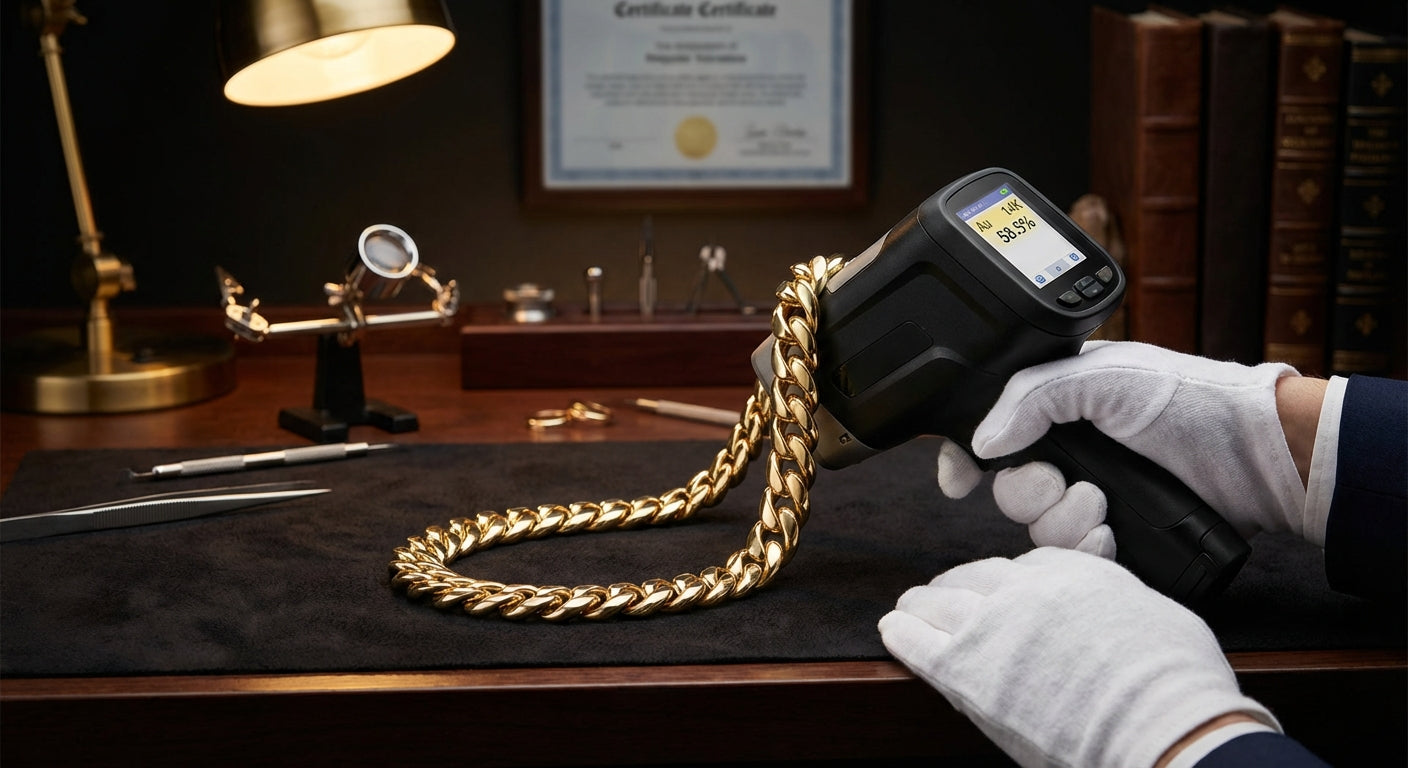
X-ray fluorescence testing is non-destructive: it reads the elemental composition of the metal without scratching, cutting or altering the piece. The instrument reports the percentages of gold, copper, silver, zinc and anything else it detects at the surface — confirming that a piece stamped 585 really is 58.3% gold and not 55%.
This matters because stamps can be wrong, whether through sloppiness or intent. At GOLDZENN every piece is checked on an XRF spectrometer before it ships, so the stamp and the measurement agree. If you want to verify a piece you already own, the three methods are:
- Read the hallmark — 417, 585, 750, 916 on the clasp, inside a ring band, or on a chain tag.
- Acid test — a jeweler's chemical test that distinguishes purity bands. Reliable, slightly destructive to the surface.
- XRF test — the strongest non-destructive option. It reads the surface rather than the core, so plating, heavy polishing or an uneven alloy can skew a single reading. Most established jewelers will run it for you.
Our full guide on how to spot real gold walks through each method in detail, including what to do when a piece has no stamp at all.
I Made a 24k Gold Cuban Link Chain (and it cost HOW MUCH?!) — what happens when you push karat to the top of the scale. Watch on YouTube.
Frequently Asked Questions
What is the difference between 10K and 14K gold?
10K gold is 41.7% pure gold and 14K is 58.3% — a 16.6-point gap. 14K therefore carries about 40% more gold per gram, looks warmer and more saturated, and has the more liquid resale market. 10K, having more alloy, is the harder and more scratch-resistant of the two, which makes it the better pick for someone who never takes a chain off or works with their hands. Both are legally and genuinely gold in the United States; 10K is stamped 417 and 14K is stamped 585. Neither is fake, and neither is fragile.
Is 10K gold real gold?
Yes. 10K gold contains 41.7% pure gold and is the lowest karat commonly sold in mainstream US jewelry. It is stamped 417, it is solid gold alloyed with strengthening metals, and it carries real precious-metal value that tracks the global gold price. It is not plated, filled or bonded — those are entirely different categories where a thin gold layer sits over a base metal. 10K is also the hardest of the common karats, which makes it the most practical choice for jewelry that never comes off.
Which gold karat is the most durable?
10K is the most durable karat in common jewelry use. Because 58.3% of it is strengthening alloy, it is the hardest, the most scratch-resistant and the most resistant to dents and deformation of the three. 14K sits in the middle and is more than strong enough for continuous daily wear. 18K is the softest and shows surface wear soonest. Durability runs opposite to purity across the whole karat scale, which is why 24K gold — at 99.9% purity — is too soft for chains and rings that get worn hard.
What is the best karat for a Cuban link chain?
14K is the most popular karat for Cuban link chains. It combines a rich gold color with enough hardness that the links hold their shape and the clasp holds its tension through years of daily wear. 10K is the better choice if maximum toughness or maximum width-per-dollar is the priority, and 18K is the better choice for a statement piece, a rotation piece, or a wearer with metal sensitivities. All three make excellent Cuban links.
Does 10K gold tarnish?
10K gold resists tarnish well but is not completely immune. Because it has the highest alloy content of the common karats, prolonged exposure to chlorine, saltwater, harsh cleaning chemicals or heavy perspiration can eventually leave a faint surface patina. Ordinary cleaning removes it — warm water, mild soap and a soft cloth handle almost every case. 14K and 18K are progressively more tarnish-resistant as gold content rises.
Which karat holds its value best for resale?
18K holds the highest value per gram because it contains the most pure gold — when you sell gold jewelry, the buyer is primarily paying for metal content. However, 14K has the deepest and most liquid secondary market in the United States, which usually means a faster sale at a fair number. 10K holds solid value relative to its lower purchase price. All three are recognized precious metals whose value tracks the global gold price, which separates them entirely from plated or fashion jewelry that has essentially no metal resale value.
Can you mix different karat jewelry and wear them together?
Yes, and it is common. Plenty of collectors wear a 14K chain with a 10K bracelet and an 18K ring without any visual conflict. The color differences between karats are subtle enough that they add depth to a layered look rather than clashing, in the same way that mixing metal tones deliberately has become standard styling. What matters more is that the pieces work together in scale and proportion.
How do I know what karat my gold jewelry is?
Three methods, in ascending order of accuracy. First, look for a hallmark stamp — 417 for 10K, 585 for 14K, 750 for 18K, 916 for 22K — usually on the clasp, inside a ring band, or on a small tag near the chain end. Second, a jeweler can run an acid test, which distinguishes purity bands chemically. Third, XRF spectrometry reads elemental composition without damaging the piece — the strongest non-destructive check, though it measures the surface, so plating or an uneven alloy can skew one reading. If a piece has no stamp at all, only testing will tell you.
Why We Make Every Karat
The right karat is not the most expensive one — it is the one that fits how you live. That is why our Cuban link chains, tennis chains, rings, pendants and bracelets are made in 10K, 14K and 18K, with select 22K work available.
Cuban links 7mm and wider are handmade in our Miami workshop; 3mm to 6mm widths come from Italian factories. Every piece, whichever karat, is checked on an XRF spectrometer before it ships, so the stamp and the metal agree. If you want a specific karat, weight, length or design that is not in the standard collection, our custom jewelry program handles it.
And if you are still not sure which karat is right, ask before you spend:
- Call or text: (321) 521-4651
- Email: contact@goldzenn.com
- Financing: payment and layaway options
- Visit: our Miami workshop, 1056 SW 67th Ave, Miami, FL 33144
- Watch: @GOLDZENNJWL on YouTube — the work, shot in the shop
Cuban links, tennis chains, pendants, rings and bracelets — handcrafted in Miami, XRF verified, 4.9-star rated.
Not sure which karat? Tell us how you will wear it and we will tell you which one to buy — including when the cheaper one is right.
Shop Solid Gold → Call (321) 521-4651 Financing