Updated for today's gold price. Every price on this page is live.
14K gold is 58.3% pure. 18K gold is 75% pure. That single difference drives everything else: 18K costs more per gram, shows a deeper yellow, and scratches more easily; 14K is harder, cheaper, and the more common choice for pieces worn every day.
Below: what each karat costs at today's spot price, how the colour actually differs, which one survives daily wear, and which is safer for sensitive skin.
14K vs 18K Gold, Head to Head
This is the matchup most buyers are actually deciding. Both are excellent; they fail in different directions.
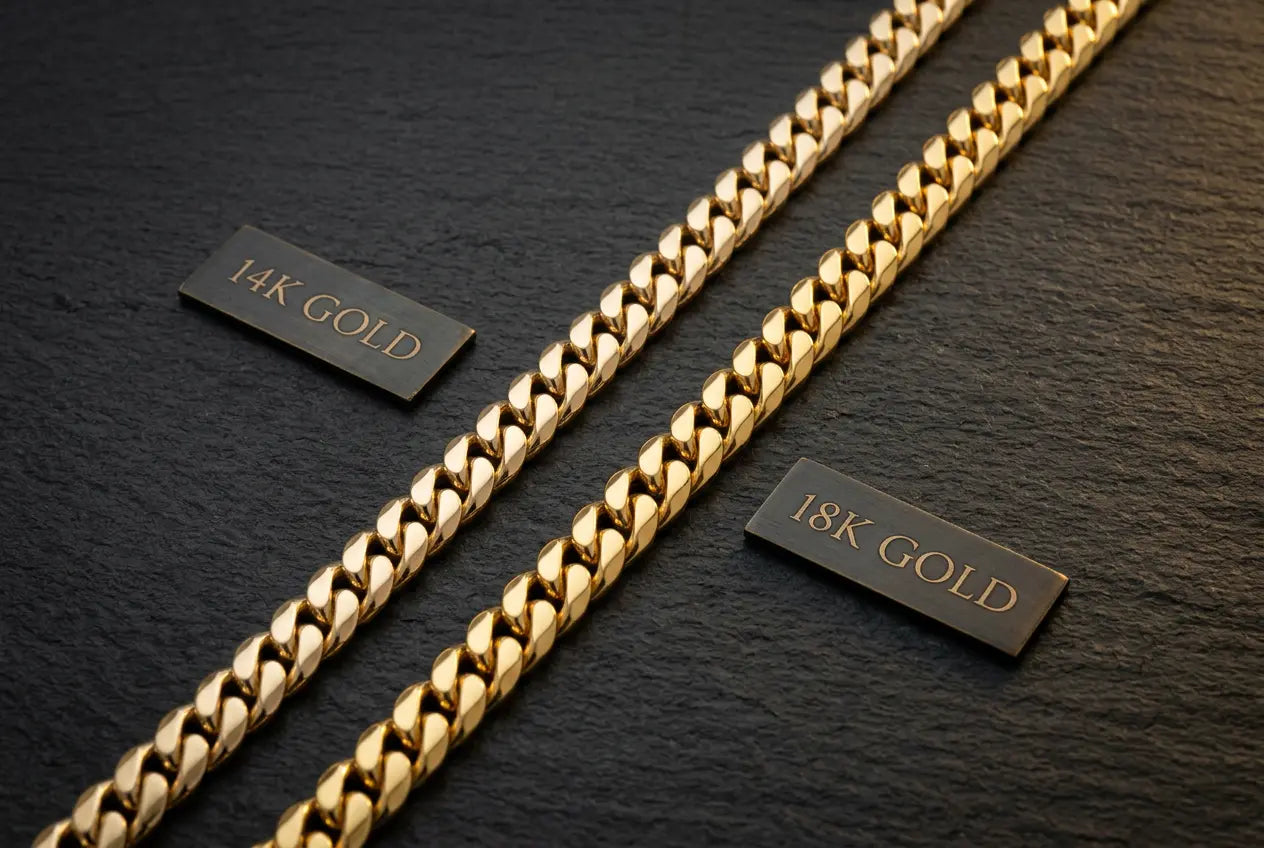
Color
18K is warmer and more saturated. Side by side the difference is visible to most people; alone, the average person cannot name the karat by eye. If gold's color is the reason you want gold, 18K gives you more of it.
Durability
14K wins, and not marginally. 41.7% alloy against 25% is a real hardness difference. For a piece that lives on your body through work, training and sleep, 14K holds a cleaner surface for longer.
Price
18K carries about 29% more gold per gram. On the live rate above that is $100.79 versus $78.35 per gram of metal. On a finished piece the difference depends on weight, labour, design and any stones, so it can land above or below 29%.
Skin
18K often helps here, since less alloy usually means less of whatever the skin objects to. What matters most is which metals the alloy contains and how readily they release, so if nickel has been a problem before, ask for the alloy composition rather than relying on karat alone.
Resale
18K holds more melt value per gram; 14K sells faster in the United States because more buyers deal in it every day. If you are optimizing for the highest number, 18K. If you are optimizing for the quickest sale, 14K.
The one rule that beats all of this
A heavier chain in a lower karat has more visual presence than a lighter chain in a higher karat, every time. If a given budget buys you a substantial 14K piece or a thin 18K one, the 14K piece will look better on you. Width and weight do more work than karat does. Our Cuban link width guide covers how much difference a millimeter makes.
14K vs 18K at a Glance
14K vs 18K Gold Price
Gold value scales directly with purity. At today's spot price, one gram of 14K alloy contains gold worth $78.35, and in 18K $100.79 — about 1.29× more. That ratio is fixed by the purity difference (0.750 ÷ 0.583) and does not move when the gold price moves.
Per pennyweight, the same comparison is $121.84 against $156.74.
That 29% applies to contained-gold value at equal weight. On a finished piece the difference depends on weight, labour, design, any stones, and how the seller prices the work — so it can land above or below 29%.
Durability: Which Holds Up Better
Pure gold is soft. The alloy metals mixed in are what give a piece its hardness, so a lower karat is physically tougher. 14K contains 41.7% alloy against 18K's 25%, which makes 14K noticeably more resistant to scratches, dents and bending.
In practice: 14K is the better choice for a chain worn daily, a ring that meets keyboards and steering wheels, or anything on an active wearer. 18K is better suited to pieces worn occasionally, or where the richer colour matters more than surface hardness.
Neither karat "wears out" — solid gold does not flake or fade the way plated or bonded pieces do. The difference is how quickly the surface picks up marks.
Skin Sensitivity
Reactions to gold jewellery are usually traced to the alloy metals rather than the gold, with nickel the most common culprit. Gold allergy itself is uncommon but documented, so it cannot be ruled out entirely. Because 18K contains less alloy (25% against 14K's 41.7%), it carries proportionally less of whatever a wearer might react to.
A higher karat therefore often helps — but what matters is which metals the alloy actually contains and how readily they release against skin, not the karat number on its own. If you have reacted to jewellery before, ask for the alloy composition and consider a patch test.
Ask what the alloy contains rather than assuming. Two pieces stamped 14K can use different alloy mixes.
Rose Gold: Karat Changes the Color
Rose gold is gold alloyed with a copper-dominant mix. The copper is what makes it pink — so the lower the karat, the more copper is in the piece, and the pinker it reads.
- 10K rose gold — 41.7% gold, with the remaining 58.3% heavily weighted to copper. The most intense, reddest pink of the three, and the hardest.
- 14K rose gold — 58.3% gold. A clearly pink but still golden tone. This is the balance point most rose gold buyers picture.
- 18K rose gold — 75.0% gold, leaving only 25% for the copper-led alloy. The subtlest blush of the three, closer to warm champagne than to true pink, and the softest.
This inverts the usual rule. With yellow gold, higher karat means a more intense color. With rose gold, higher karat means a less intense pink, because you are diluting the copper that creates the effect. If you want a strong rose tone, do not assume 18K is the upgrade — it may take you further from the look you want.
Two practical notes. First, copper-heavy alloys can develop a warmer patina over years of wear; some owners like it, and polishing reverses it either way. Second, if copper is one of the metals your skin reacts to, lower-karat rose gold is the wrong direction — go up in karat, not down. For how rose compares against the classic tone overall, see our rose gold vs yellow gold comparison.
White Gold: Karat Barely Changes the Color
White gold behaves almost opposite to rose. Yellow gold does not become white by alloying alone — the alloy (palladium, nickel, silver, zinc) lightens it, but the result is typically a faintly warm grey. Virtually all white gold jewelry is then finished with a rhodium plating, which is what produces the bright, cool white you actually see.
The consequence: 10K, 14K and 18K white gold look near-identical on the shelf. You are looking at rhodium in all three cases. Karat differences in white gold show up in four other places instead:
- What is underneath. As rhodium wears at high-contact points, the base alloy shows through. A higher-karat white gold base is warmer in tone, so the transition can read as a faint yellow cast; a lower-karat base is greyer.
- Replating cadence. Rhodium is a surface finish and it wears. How often a piece needs redoing depends on the piece and how it is worn, not on the karat — rings wear fastest, chains and pendants far slower. Rhodium replating is a service with a cost that varies by piece; ask what it runs for yours before you assume. Our rhodium dipping guide explains the process.
- Nickel. Some white gold alloys use nickel, which is the most common jewelry allergen. Lower karats have more alloy overall, so more of whatever the alloy contains. If you have a nickel sensitivity, ask specifically about the alloy — palladium-based white gold is the alternative.
- Hardness and value. Unchanged from yellow — 10K white is the hardest, 18K white carries the most gold per gram.
If you are choosing between white gold and a silver-toned alternative, our white gold vs sterling silver comparison covers the durability and value differences.
Want 10K in the picture, or a live value calculator? See the full 10K / 14K / 18K comparison and calculator →
Frequently Asked Questions
What is the difference between 14K and 18K gold?
14K gold is 58.3% pure gold; 18K gold is 75.0%. That 16.7-point gap means 18K holds about 29% more gold at the same weight, so it reads as a deeper, warmer yellow and carries a higher melt value per gram. The trade-off is hardness: 18K has only 25% alloy reinforcing it against 14K's 41.7%, so it picks up surface marks faster under identical wear. 18K often suits sensitive skin better because less alloy sits against you, though what matters most is which metals the alloy contains rather than the karat alone. 14K is the better choice for a piece that gets worn continuously without being taken off.
Is 14K or 18K gold better for everyday wear?
14K is generally better for everyday wear. Its higher alloy content — 41.7% against 25% in 18K — makes it more resistant to scratches, dents and general wear. If you plan to wear a chain, ring or bracelet daily without removing it, 14K holds a cleaner surface for longer with less maintenance. That said, 18K is perfectly wearable daily; it simply asks for a little more awareness around hard surfaces and will develop a patina of fine marks sooner. If you have metal sensitivities, 18K may still be the right daily choice despite the softness.
Does 18K gold scratch easier than 14K?
Yes. 18K gold is 75% pure gold, and pure gold is a soft metal — with only 25% alloy reinforcing it, 18K is measurably softer than 14K's 58.3% gold and 41.7% alloy structure. The difference is not dramatic in day-to-day handling, but over time an 18K piece will show a network of fine surface scratches sooner than a 14K piece worn identically. Professional polishing restores the surface, and some owners deliberately let the patina develop because it reads as character rather than damage.
What is the price difference between 14K and 18K gold?
On metal content alone, 18K carries exactly 1.29 times the gold of 14K at the same weight — 75.0 divided by 58.3 — so its melt value per gram runs about 29% higher. On finished jewellery the difference depends on weight, labour, design and any stones, so it can land above or below 29%; gold spot prices also move daily. The live per-gram and per-pennyweight figures for both karats are published on this page and refresh with the market rather than sitting at a published-day snapshot.
Can you tell the difference between 14K and 18K gold by looking at it?
Side by side, most people can. 18K reads warmer, deeper and more saturated than 14K under the same light. Viewed alone, without a comparison piece next to it, the average person cannot reliably name the karat by color — both look like rich, genuine gold, because both are. This is why a comparison photograph should show all karats together under a single light source; it is the only honest way to show a difference that disappears the moment the pieces are separated.
Is 18K gold worth the extra cost?
It depends on what you are optimizing for. The premium buys three things: a visibly deeper and warmer color, roughly 29% more gold content per gram for resale, and the lowest alloy exposure of the common karats for sensitive skin. If any of those is your priority, the premium is justified. If your priority is hardness for continuous daily wear, or getting the widest, heaviest piece your budget allows, then 14K or even 10K will serve you better at a lower price. There is no universally correct answer here.
Does karat change how rose gold and white gold look?
For rose gold, yes — and in the opposite direction to what most people expect. Rose gold gets its color from copper, so a lower karat means more copper and a stronger pink. 10K rose is the reddest, 18K rose is the subtlest, closer to warm champagne. For white gold, barely — nearly all white gold is finished with rhodium plating, so 10K, 14K and 18K white look almost identical at the surface. The karat difference in white gold shows in the base tone underneath as plating wears, in hardness, and in how much nickel-bearing alloy is present.
Why We Make Every Karat
The right karat is not the most expensive one — it is the one that fits how you live. That is why our Cuban link chains, tennis chains, rings, pendants and bracelets are made in 10K, 14K and 18K, with select 22K work available.
Cuban links 7mm and wider are handmade in our Miami workshop; 3mm to 6mm widths come from Italian factories. Every piece, whichever karat, is checked on an XRF spectrometer before it ships, so the stamp and the metal agree. If you want a specific karat, weight, length or design that is not in the standard collection, our custom jewelry program handles it.
And if you are still not sure which karat is right, ask before you spend:
- Call or text: (321) 521-4651
- Email: contact@goldzenn.com
- Financing: payment and layaway options
- Visit: our Miami workshop, 1056 SW 67th Ave, Miami, FL 33144
- Watch: @GOLDZENNJWL on YouTube — the work, shot in the shop
Cuban links, tennis chains, pendants, rings and bracelets — handcrafted in Miami, XRF verified, 4.9-star rated.
Not sure which karat? Tell us how you will wear it and we will tell you which one to buy — including when the cheaper one is right.
Shop Solid Gold → Call (321) 521-4651 Financing