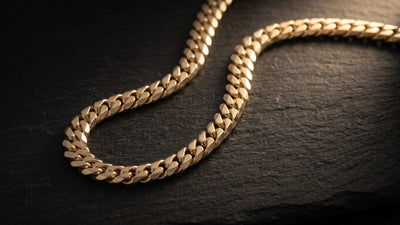
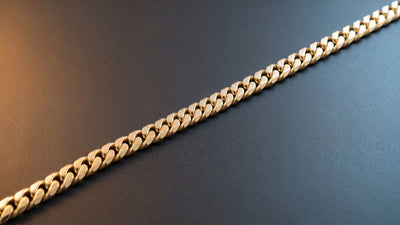
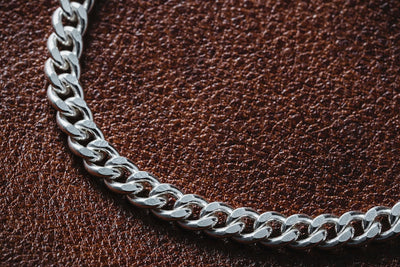
Two chains can both say "real 14k gold" on the product page and be completely different products. One is gold all the way through. The other is a steel chain with a thin layer of gold bonded to its surface. Neither description is a lie — but the difference shows up in price, lifespan, repairs, and what the chain is worth the day after you buy it. Here is the honest breakdown.
A note on scope before we start: this guide is about chains, and specifically about the choice between solid gold and gold-bonded steel — the construction behind today's biggest online chain brands. For the wider materials family — plating, vermeil, gold-filled, and traditional bonded-over-silver — our complete guide to gold plated and bonded jewelry covers every term in depth.
What "gold-bonded" actually means
Gold bonding, as the term is used by today's biggest chain brands, usually refers to PVD (physical vapor deposition): a process that vaporizes gold in a vacuum chamber and deposits it as a thin, tightly adhered layer onto a base metal — most often stainless steel. PVD is a genuine step up from traditional electroplating. The layer bonds harder to the surface, resists scratching better, and holds its color longer than the flash plating on typical fashion jewelry.
JAXXON, the most visible brand in this category, describes its core chains this way: "Real 14k Gold bonded to hypoallergenic Performance Steel using next-gen PVD technology for a waterproof, sweat-proof, and scratch-resistant shine that never fades." Their FAQ draws the distinction themselves: "JAXXON chains are gold-bonded, not gold-plated," and adds: "You get the look of solid gold with better durability and a fraction of the price."
That last phrase is the fairest summary. A bonded steel chain delivers the look of gold at a price solid gold cannot touch — JAXXON's 5mm gold Cuban retails for $199 as of July 2026 — on a core that is hard, light, and hypoallergenic. For the gym, travel, or a first chain, that is legitimate value.
What it is not: gold in any structural sense. The gold is a surface layer measured in microns. Everything underneath — the weight in your hand, the metal in every link — is steel.
One term, two constructions: the two meanings of "gold-bonded"
Before comparing anything, know that "gold-bonded" is used two different ways in the jewelry market, and they describe very different objects.
- Gold-bonded steel — the DTC-brand meaning. A micron-scale layer of karat gold applied to a stainless steel chain, today usually by PVD. The core is industrial metal; the gold is a decorative surface. This is the construction JAXXON and most large online chain brands sell.
- Gold-bonded over silver — the traditional jeweler's meaning. A substantially thicker layer of karat gold bonded over a sterling silver core, a close cousin of vermeil. The piece is precious metal through and through: the silver core has melt value of its own, and a bench jeweler can actually work on it. GOLDZENN and other traditional jewelers sell clearly labeled entry-level pieces built this way.
The distinction matters because every hard consequence in this guide — negligible melt value, limited repairs, steel under the surface — belongs to the steel version. From here on, "gold-bonded" means gold-bonded steel unless stated otherwise.
What "solid gold" means
A solid gold chain is the same alloy all the way through. Karat tells you the gold content: 10K is 41.7% pure gold, 14K is 58.3%, 18K is 75%, 22K is 91.7%, with the balance made up of alloying metals that add strength and set the color. Cut a solid 14K link in half and the inside is identical to the outside. There is no layer to wear through, because there is no layer.
Solid gold is also why real chains are priced by weight: grams of gold are the commodity you are buying. The chain carries a karat stamp (10K, 14K, 585, 750), and any jeweler can verify it with an acid or electronic test.
Hollow gold: the middle path
Between bonded steel and solid gold sits an option this comparison would be incomplete without: hollow gold. A hollow chain is real karat gold — the same alloy, the same hallmark, real melt value by the gram — formed into links with an open center. Less gold per inch means a bigger look at a noticeably lower price, and a lighter chain on the neck.
The trade-offs are real and worth stating plainly: hollow links can dent under pressure, and repairs are more delicate — soldering thin walls is careful work, and a badly kinked hollow link often has to be replaced rather than reshaped. Treat a hollow chain more gently than a solid one. But unlike a coating, a hollow chain is gold: a gold buyer will still weigh it and quote it, and a jeweler can still service it. GOLDZENN carries hollow options alongside the solid pieces in our gold chains collection — each one labeled hollow, priced by its actual gold weight, for buyers who want real gold in a lighter build.
Side by side: gold-bonded steel vs solid gold
| Gold-bonded steel | Solid gold | |
|---|---|---|
| Gold content | Micron-thin surface layer; negligible by weight | 41.7–91.7% of total weight (10K–22K) |
| Base metal | Stainless steel core | None — gold alloy throughout |
| Typical entry price | $150–$300 for a mid-width Cuban | Four figures for comparable width |
| Melt / resale value | Essentially none (scrap steel) | Tracks the gold spot price by the gram |
| Repairs | Limited — heat and solder damage the coating | Any bench jeweler can solder, resize, refinish |
| If the surface wears | Steel shows; coating cannot be restored like-new locally | Polish it — the metal below is the same gold |
| Verification | No karat hallmark on the metal itself | Karat stamp; testable by any jeweler |
Melt value: the difference that never goes away
The cleanest test: take both chains to any gold buyer and ask what they will pay.
The solid gold chain gets weighed. A 100-gram 14K Cuban contains roughly 58 grams of pure gold, and the offer will be a percentage of that day's spot price for those 58 grams. The chain is jewelry, but it is also a holding of a globally traded metal. That is why solid gold pieces are bought, sold, traded in, and passed down: the material itself keeps value independent of fashion, brand, or condition — the reason we've written separately about Cuban link chains as an investment.
The gold-bonded steel chain gets declined. The gold layer is far too thin to recover economically — the total gold in the entire chain amounts to a small fraction of a gram — and the remainder is scrap stainless steel. This is not a criticism of the product; it is simply what a coating is. But it means the full purchase price of a bonded chain is spent on appearance and wearability, with nothing on the asset side. A $199 bonded chain is $199 of product. A $2,000 solid gold chain is, in meaningful part, $2,000 of gold.
Repairs, resizing, and the long game
Solid gold is a jeweler's material. A clasp breaks: solder it. The chain is too long after a few years: remove a link. Scratches from daily wear: polish and refinish — the surface that emerges is the same gold. A quality solid chain can be serviced for decades, which is why established jewelers stand behind them for life. At GOLDZENN, every handmade Cuban link chain and bracelet carries a limited lifetime craftsmanship warranty (two free repairs included; 1-year limited warranty on other pieces): solid gold is repairable by nature, so the promise is easy to keep.
Bonded steel works differently. The torch heat a jeweler uses to solder will discolor or destroy a PVD coating around the repair, and most bench jewelers will not touch coated steel for that reason. Resizing runs into the same wall. In practice, a bonded chain is the length and condition it is on the day you buy it; service usually means replacement, on whatever terms the brand offers, rather than repair.
Does gold bonding wear off?
Fairness first: PVD is the most durable bonding method in mainstream jewelry, far tougher than electroplating — JAXXON's own FAQ answers "No" when asked whether the color will fade. For years of normal wear, a good PVD chain can genuinely hold its color. (Wondering how water affects gold jewelry generally? See can you shower with gold jewelry.)
The structural fact remains: any bonded layer is a surface treatment on a different metal. It can be scratched through at friction points — clasps, edges, anywhere the chain rubs daily — and once the steel is exposed, there is no polish that brings gold back. Solid gold cannot wear off because there is nothing to wear off of. The two products age in opposite directions: bonded chains are at their best on day one, while a solid chain can be restored to day one at any point in its life.
Quick glossary: bonded vs plated vs filled vs vermeil
A thirty-second reference for the terms you'll meet on product pages. (Full breakdown with buying advice: our gold plated jewelry guide.)
- Gold-plated — a very thin electroplated layer of gold, usually over brass. The entry level of coatings, and the quickest to wear through.
- Gold vermeil — gold plated over sterling silver, with a thicker gold layer than standard plating. A precious-metal core under a coated surface; our vermeil guide maps the whole material hierarchy.
- Gold-filled — a sheet of karat gold mechanically bonded to a base metal core, with the gold required to be at least 1/20 (5%) of the item's weight under U.S. trade guidelines. More durable than plating; still a layered product.
- Gold-bonded — two meanings, as covered above: PVD gold over stainless steel (the big-brand chain version) or thicker karat gold over sterling silver (the traditional jeweler's version).
- Solid gold — the same karat alloy all the way through. The only entry on this list with no layer, no core, and full melt value.
How to read a product page in 30 seconds
Brands in this space are mostly accurate in their wording — you just have to know what the words mean. Check five things:
- Find the base metal. "Bonded to stainless steel," "Performance Steel," "over brass" — if any base metal is named, the piece is coated, not solid.
- Look for the word "solid" next to the karat. "14k gold" alone can describe a coating. "Solid 14k gold" describes the whole chain. Honest brands use "solid" precisely because it is the word that carries legal weight.
- Look for a weight in grams. Solid gold sellers publish gram weights because that is what the price is built on. Coated jewelry almost never lists gold weight — there is nothing meaningful to list.
- Sanity-check the price. Gold has a public spot price. A "gold" Cuban link priced under a few hundred dollars cannot contain more than a token amount of gold. The market is efficient; nobody sells $2,000 of metal for $200.
- Check the hallmark policy. Solid pieces carry a karat stamp (10K, 14K, 585, 750) on the metal. Ask before you buy if it is not shown.
So which should you buy?
If your budget is a couple hundred dollars and you want the look for daily wear, a PVD gold-bonded chain is the honest product at that price — better than plated brass. Buy it knowing what it is: a durable coated steel chain with no gold value inside.
If you want the real thing — metal that holds value, survives repairs, and can be worn for decades or handed down — the answer is solid gold, and the karat and gram weight on the page should say so plainly. That is what our flagship chains are at GOLDZENN: solid 10K–22K Cuban links, including handmade pieces from 7mm to 16mm built link by link in our Miami workshop by artisans with 50+ years of combined experience. Full transparency: our catalog also carries hollow gold options for lighter wear and a small line of clearly labeled 14k gold-bonded pieces at entry prices — and every one of those product pages states its construction, karat, and weight plainly. The five checks above apply to our listings too. That's the point.
Comparing specific brands? See our guide to JAXXON alternatives for solid gold chains and the GOLDZENN vs JAXXON head-to-head.
Prefer a straight answer from a person? Call the Miami workshop at 321-521-4651 or email contact@goldzenn.com and tell us what you're weighing — we'll tell you honestly which construction fits, even when the right answer is the $199 chain.
Frequently asked questions
Is JAXXON real gold?
JAXXON's core chains use real gold, but they are not solid gold. In the brand's own words, they are "real 14k gold bonded to hypoallergenic Performance Steel using next-gen PVD technology." The gold is a thin bonded surface layer over a stainless steel chain. As of July 2026, JAXXON's full product catalog (674 items in its sitemap) lists no solid gold chains; the only solid gold pieces offered are wedding bands. Their "silver" chains are likewise described by JAXXON as Platinum 990 bonded to steel.
What is the difference between gold bonded and solid gold?
"Gold-bonded" describes a layered product; solid gold describes the whole chain. In today's chain market, gold-bonded usually means a micron-thin layer of gold applied to stainless steel via PVD; in the traditional trade it can also mean thicker gold bonded over sterling silver. Solid gold means the entire chain is a gold alloy — 10K (41.7% gold), 14K (58.3%), 18K (75%), or 22K (91.7%) — the same metal inside and out. The practical differences: solid gold has melt value, can be repaired and resized by any jeweler, and carries a karat hallmark. Bonded steel costs far less up front but has essentially no gold value and limited repair options; a bonded-over-silver piece at least keeps its silver core's value.
Is 18K gold bonded real gold?
Yes — the gold in an 18K gold-bonded piece is real 18-karat gold, 75% pure. What matters is the quantity: bonding applies that gold as a micron-thin surface layer over a base metal, usually stainless steel, so the entire chain carries only a small fraction of a gram of gold. "18K gold bonded" accurately describes the coating, not the chain. If you want a chain that is 18K gold throughout, the listing should say solid 18K gold and publish a weight in grams.
Does gold bonded wear off?
PVD bonding is very durable — significantly tougher than electroplating — and can hold its color through years of normal wear; some brands warrant that it will not fade. But it remains a surface layer: it can be scratched or worn through at friction points, and once the steel underneath is exposed it cannot be polished back to gold. Solid gold cannot wear off, because it is gold all the way through.
How long does gold-bonded jewelry last?
Expect years rather than months: with normal daily wear, a quality PVD gold-bonded chain typically keeps its color for roughly two to five years, and gentler use can stretch that well beyond — some brands guarantee the finish against fading for life. The real variables are friction and chemistry: clasps, link edges, gym sessions, and daily rubbing all work on the coating, so the lifespan ends when the layer wears through at a contact point, not on a fixed date. Solid gold runs on no such clock — there is no layer to lose, and a worn solid chain can be polished back to new at any age.
Does gold-bonded jewelry tarnish?
True tarnish is rare on gold-bonded steel. Gold itself does not oxidize, and the stainless steel core resists corrosion — which is why brands in this category market their chains as tarnish-proof, and on that specific point the marketing is fair. What owners sometimes read as tarnish is actually the coating thinning or wearing through at friction points, letting the grey of the steel show through the gold color. That is wear, not oxidation, and unlike tarnish on silver it cannot be polished away — polishing removes more of the gold layer instead of restoring it.
Can you shower with gold-bonded jewelry?
Generally yes. Water resistance is one of PVD-bonded steel's genuine strengths: the coating is sealed onto a corrosion-resistant core, and the major bonded brands market their chains as shower-safe and sweat-proof. Plain water is the easy case; soap film, chlorine, and salt water are harsher on any finish over time, so a quick rinse and dry after the pool or the ocean is smart maintenance for any coated piece. Solid gold needs none of that calculus — for the material-by-material answer, see our guide on whether you can shower with gold jewelry.
Is gold bonded worth it?
At its price, often yes. If the budget is $150–$300 and the goal is the look of a gold chain for everyday wear, PVD gold-bonded steel is the best product in that bracket. It is not worth it if you expect any resale or melt value, want the chain repaired or resized over time, or are treating the purchase partly as an asset — those are solid gold's jobs.
How can I tell if a chain is solid gold?
Look for the word "solid" next to the karat, a published weight in grams, a karat hallmark on the piece (10K, 14K, 585, 750), and a price consistent with gold's spot value. If the listing names a base metal — steel, brass, silver — anywhere in the description, the piece is coated or layered, not solid. Any jeweler can confirm with an acid or electronic test in minutes. For a step-by-step walkthrough, see our guide on how to tell if gold is real.