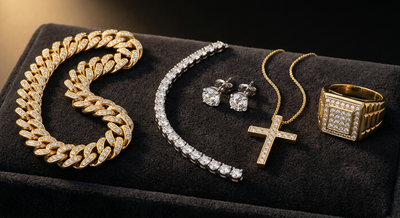
El diamante marquesa es uno de los tallados más románticos y con más historia en el mundo de la joyería fina. Encargado por la realeza hace casi tres siglos, el tallado marquesa transforma un diamante en bruto en una obra maestra alargada en forma de barco con 58 facetas brillantes que maximizan el brillo y la presencia visual. Ya sea que esté buscando un anillo de compromiso de diamante marquesa, un impresionante colgante o un juego nupcial personalizado en oro macizo, esta guía cubre todo lo que necesita saber, desde la historia y el simbolismo hasta las 4 C, precios, engastes, inspiración de celebridades y consejos de cuidado experto de los maestros joyeros de GOLDZENN.
En GOLDZENN, nuestro equipo de taller aporta más de 50 años de experiencia combinada a cada pieza que creamos. Cada engaste de diamante que sale de nuestro estudio de Miami es verificado por XRF en cuanto a la pureza del oro e inspeccionado a mano. Si tiene preguntas sobre los diamantes marquesa en cualquier momento mientras lee, llámenos al 321-521-4651 o envíe un correo electrónico a contact@goldzenn.com; siempre estaremos encantados de ayudarle.
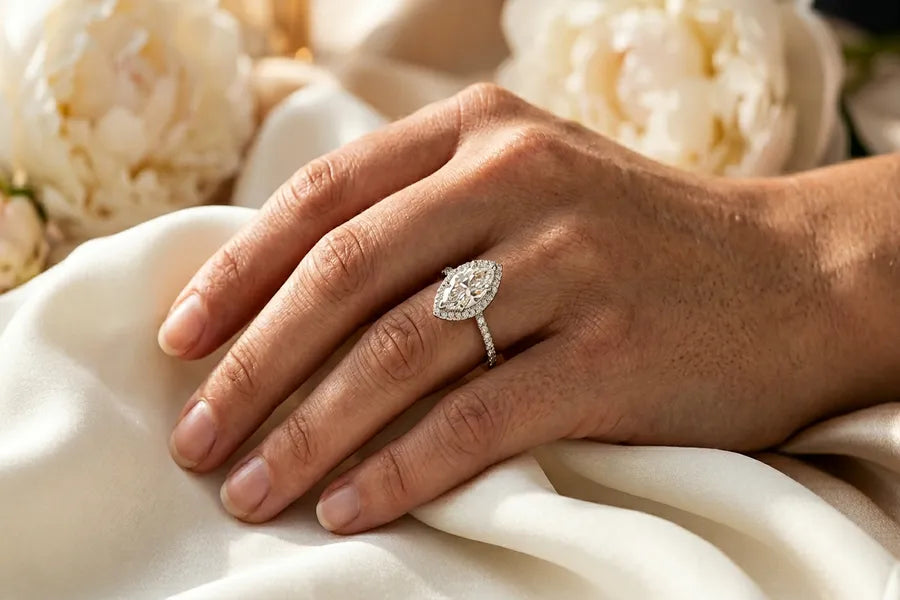
¿Qué es un diamante marquesa?
Un diamante marquesa, que se pronuncia mar-KEEZ, es un diamante de talla brillante modificada con una forma elíptica alargada que se estrecha en dos extremos puntiagudos. Presenta 58 facetas dispuestas en un patrón que produce un brillo y un fuego excepcionales, rivalizando incluso con la talla brillante redonda en su capacidad para devolver la luz al ojo del espectador.
La forma marquesa también se conoce como talla "navette", de la palabra francesa que significa "pequeño barco" o "bote", porque su contorno se asemeja a una pequeña embarcación con proa y popa puntiagudas. Entre todas las tallas de diamantes disponibles hoy en día, la marquesa se distingue por una razón notable: ofrece la mayor superficie visible de cualquier forma de diamante en relación con su peso en quilates. Un diamante marquesa de 1 quilate parece aproximadamente un 15% más grande que un brillante redondo de 1 quilate cuando se ve desde arriba, lo que significa que obtiene una mayor presencia visual por cada dólar gastado.
Características clave del diamante marquesa:
- 58 facetas (patrón de talla brillante modificado)
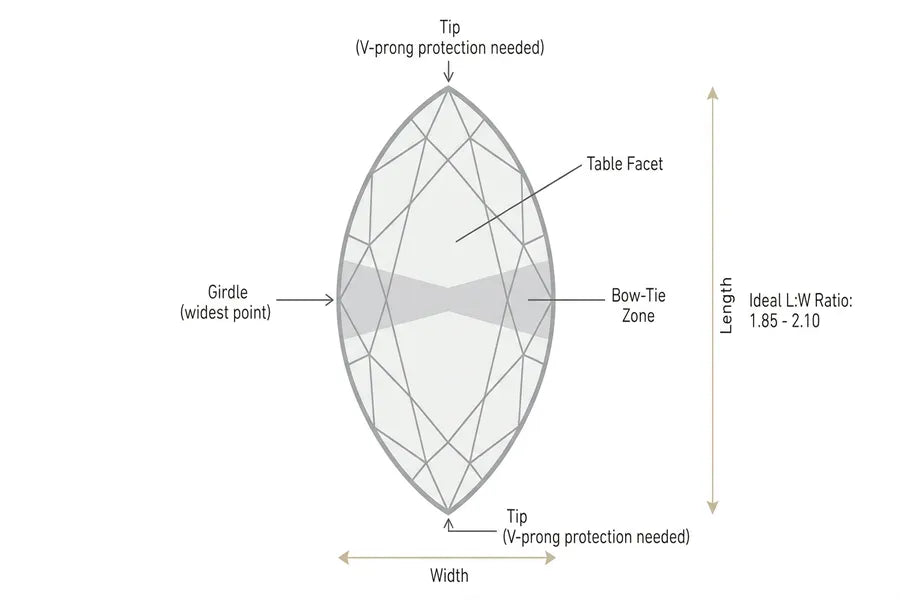
- Dos puntas afiladas que requieren protección con puntas en V en los engastes
- Forma alargada que favorece el dedo y crea la ilusión de longitud
- Sin calificación de talla GIA: el GIA solo asigna calificaciones de talla a los brillantes redondos, por lo que evaluar una marquesa requiere un examen cuidadoso de la simetría, las proporciones y el efecto de pajarita.
- Rareza: Solo alrededor del 1,5% de todos los diamantes certificados por el GIA son de talla marquesa
- Combinaciones de metales versátiles: Impresionante en todo tipo de oro (amarillo, blanco y rosa), así como en platino
La historia real del tallado marquesa
El diamante marquesa tiene una de las historias de origen más románticas de toda la gemología. En 1745, el rey Luis XV de Francia encargó a su joyero de la corte que creara un corte de diamante que capturara la forma de los labios de su amada amante, Jeanne Antoinette Poisson, más conocida por su título, la Marquesa de Pompadour. El resultado fue un deslumbrante corte alargado que llegó a conocerse simplemente como "marquesa".
El título "Marquesa" en sí se refiere a un rango de la nobleza francesa situado entre un duque y un conde. Al nombrar esta forma de diamante con su título, Luis XV inmortalizó efectivamente a su compañera favorita en forma de gema, un gesto de romance que ha perdurado durante casi 300 años.
El corte evolucionó considerablemente a lo largo de los siglos siguientes. Los primeros diamantes marquesa eran menos precisos, pero los avances en la tecnología de corte de diamantes durante los siglos XVIII y XIX refinaron la disposición de las facetas hasta el moderno patrón brillante modificado de 58 facetas que conocemos hoy. La marquesa alcanzó su primer pico de popularidad general durante las décadas de 1960 y 1970, cuando su silueta dramática se convirtió en un símbolo de glamour y sofisticación.
Después de décadas de que los cortes redondos y princesa dominaran el mercado de los anillos de compromiso, la marquesa está experimentando ahora un poderoso regreso en 2025-2026, impulsado por los anillos de compromiso de celebridades y un creciente deseo entre las novias de joyas distintivas y llamativas que se destaquen entre la multitud.
Significado y simbolismo del diamante marquesa
El diamante marquesa tiene un rico significado simbólico que lo hace particularmente significativo para anillos de compromiso y joyas nupciales:
- Romance y devoción: Nacido del amor de un rey por su compañera, el corte marquesa ha sido un símbolo de profundo apego romántico desde su creación.
- Individualidad: Elegir una marquesa en lugar del omnipresente brillante redondo denota confianza y voluntad de trazar su propio camino: solo el 1,5% de los diamantes certificados tienen este corte.
- Elegancia y feminidad: La forma alargada evoca gracia, y su efecto de alargamiento del dedo lo ha convertido en uno de los favoritos entre las novias que desean que su anillo se sienta dramático y refinado.
- Realeza: Desde sus orígenes aristocráticos franceses hasta los anillos de compromiso de celebridades de hoy en día, la marquesa siempre se ha asociado con el prestigio y la distinción. Para aquellos atraídos por la estética de los diamantes no convencionales, explore también nuestra guía de diamantes negros.
- Brillo maximizado: Con su gran área visible y su facetado de talla brillante, la marquesa simboliza aprovechar al máximo lo que se tiene, obteniendo una presencia y un brillo excepcionales de cada quilate.
Por qué el diamante marquesa es tendencia en 2025-2026
El diamante marquesa está en medio de un resurgimiento significativo. Después de haber sido eclipsado por los cortes redondos, ovalados y cojín durante años, varios factores están devolviendo a la marquesa al centro de atención:
- El efecto Selena Gomez: Cuando Selena Gomez mostró su anillo de compromiso de diamante marquesa de aproximadamente 8 quilates de Benny Blanco en 2024, generó un enorme aumento en las búsquedas y compras de diamantes marquesa.
- Atractivo de la rareza: Solo alrededor del 1,5% de todos los diamantes certificados por el GIA tienen talla marquesa, lo que significa que las novias que eligen esta forma realmente se destacan.
- Tendencia este-oeste: El engaste marquesa horizontal (este-oeste), popularizado por el anillo de compromiso de Portia de Rossi de Ellen DeGeneres, ha introducido una estética completamente moderna que atrae a las novias contemporáneas.
- Propuesta de valor: Los diamantes marquesa cuestan entre un 20 y un 30% menos por quilate que los brillantes redondos, mientras que parecen un 15% más grandes a la vista, una combinación que resuena con los compradores conscientes del valor que se niegan a comprometer el impacto visual.
- Renacimiento vintage: La tendencia general hacia los anillos de compromiso de inspiración vintage y antigua ha traído una renovada atención a la marquesa, que fue un elemento básico del glamour de mediados de siglo.
En GOLDZENN, hemos visto un creciente interés en los engastes de diamantes marquesa, tanto en nuestra colección nupcial lista para usar como a través de solicitudes de diseño personalizado. Si está considerando un diamante marquesa y desea la orientación de un maestro joyero, llámenos al 321-521-4651.
Ventajas y desventajas de los diamantes marquesa
Cada forma de diamante tiene sus compensaciones. Aquí hay una evaluación honesta de los diamantes marquesa para ayudarle a tomar una decisión informada:
| Ventajas | Consideraciones |
|---|---|
| Parece ~15% más grande que un redondo del mismo peso en quilates | El efecto de pajarita está presente en todos los diamantes marquesa (la gravedad varía) |
| 20-30% más económico por quilate que los brillantes redondos | Las puntas afiladas son vulnerables a las roturas si no están protegidas por puntas en V |
| Alarga y favorece bellamente el dedo | Sin calificación de talla GIA: requiere una evaluación más cuidadosa por parte del comprador |
| Brillo excepcional (corte brillante modificado de 58 facetas) | El color puede concentrarse en las puntas, haciendo que la calificación de color sea más notable |
| Raro y distintivo: solo el 1,5% de los diamantes certificados por GIA | Encontrar una alianza a juego puede requerir un diseño contorneado o personalizado |
| Versátil en orientación (tradicional norte-sur o moderna este-oeste) | La simetría es crítica: incluso una asimetría menor es visible en esta forma |
| Rica historia y simbolismo romántico | Menor selección disponible en comparación con los cortes redondos u ovalados |
En resumen: un diamante marquesa bien elegido en un engaste de calidad ofrece una belleza y un valor excepcionales. La clave es comprender cómo evaluar el corte y elegir un joyero, como GOLDZENN, que sepa cómo engastar y proteger esas delicadas puntas correctamente.
Comprender el efecto de pajarita
Cada diamante marquesa exhibe cierto grado del efecto de pajarita, una sombra oscura en forma de pajarita que aparece a lo largo del ancho central de la piedra. Comprender este fenómeno es esencial para elegir un hermoso diamante marquesa.
¿Qué causa el efecto de pajarita?
El efecto de pajarita ocurre debido a cómo la luz interactúa con las facetas en una forma de diamante alargada. En áreas donde las facetas están anguladas de tal manera que la luz pasa a través de la piedra en lugar de ser reflejada hacia el espectador, se forma una sombra. Esta sombra toma la forma de una pajarita en la parte central de la piedra.
Espectro de gravedad
La gravedad del efecto de pajarita varía desde casi invisible (un tenue oscurecimiento que añade profundidad y carácter) hasta severa (una banda oscura prominente que disminuye el brillo de la piedra). Un efecto de pajarita leve a moderado generalmente se considera aceptable e incluso puede realzar el interés visual del diamante. Sin embargo, un efecto de pajarita severo reduce significativamente la belleza y el valor de la piedra.
Cómo evaluar el efecto de pajarita antes de comprar
Esto es fundamental: no se puede determinar la gravedad del efecto de pajarita solo con un certificado GIA. El informe de calificación no incluye una evaluación del efecto de pajarita. Debe:
- Ver el diamante en persona o a través de un video de 360 grados de alta calidad
- Examinar la piedra bajo diferentes condiciones de iluminación
- Buscar una distribución uniforme de la luz a lo largo de toda la longitud del diamante
- Pedir a su joyero que compare varias piedras marquesa una al lado de la otra
En GOLDZENN, inspeccionamos personalmente cada diamante marquesa antes de que se coloque en un engaste. Nuestro equipo evalúa la gravedad del efecto de pajarita, la simetría y el rendimiento de la luz para garantizar que reciba una piedra que funcione maravillosamente. Llame al 321-521-4651 para hablar sobre piedras específicas con nuestro equipo.
Minimización del efecto de pajarita
Las piedras con las siguientes características tienden a tener el efecto de pajarita menos severo:
- Porcentaje de profundidad entre 58-62%
- Alineación simétrica de las facetas
- Relación largo-ancho en el rango de 1.85:1 a 2.10:1
- Porcentaje de tabla bien proporcionado (53-63%)
Cómo elegir un diamante marquesa: la guía de las 4 C
Debido a que el GIA no asigna una calificación de talla formal a los diamantes marquesa (solo los brillantes redondos reciben esta designación), elegir una marquesa de calidad requiere una atención adicional. Esto es lo que debe buscar en cada una de las 4 C: talla, color, claridad y quilates:
Calidad de talla y proporciones
Dado que no existe una calificación de talla estandarizada, utilice estos rangos de proporciones como guía:
| Parámetro | Excelente | Muy Bueno | Bueno | Regular | Pobre |
|---|---|---|---|---|---|
| Profundidad % | 58-62% | 56-57.9% o 62.1-66% | 53-55.9% o 66.1-70% | 50-52.9% | <50% o >70% |
| Tabla % | 53-63% | 51-52.9% o 63.1-66% | 49-50.9% o 66.1-70% | 46-48.9% | <46% o >70% |
| Relación largo-ancho | 1.85-2.10 | 1.75-1.84 o 2.11-2.15 | 1.65-1.74 o 2.16-2.25 | 1.55-1.64 | <1.55 o >2.25 |
| Faja | Delgada a Ligeramente Gruesa | Muy Delgada a Gruesa | Muy Delgada o Gruesa | Extremadamente Delgada | Extremadamente Gruesa |
| Pulido | Excelente | Muy Bueno | Bueno | Regular | Pobre |
| Simetría | Excelente | Muy Bueno | Bueno | Regular | Pobre |
La simetría es especialmente crítica para los diamantes marquesa. Debido a que la forma es larga y estrecha, incluso una ligera asimetría (una ala ligeramente más ancha que la otra, una punta desalineada) es inmediatamente visible. Busque siempre una simetría "Excelente" o "Muy Buena" en el informe del GIA.
Recomendaciones de color
Los diamantes marquesa tienden a mostrar una concentración de color en las puntas afiladas. Esto significa que los grados de color más bajos (I, J, K) pueden parecer más visiblemente cálidos en un marquesa que en un brillante redondo del mismo grado. Nuestras recomendaciones:
- Engastes de oro blanco o platino: Elija un color G-H o superior. El metal frío hace que cualquier calidez sea más aparente.
- Engastes de oro amarillo o oro rosa: El color I-J es aceptable: el metal cálido complementa y enmascara la ligera calidez del diamante.
- Elección consciente del presupuesto: El color H ofrece el mejor equilibrio entre valor y blancura visible en la mayoría de los engastes.
Recomendaciones de claridad
El facetado de estilo brillante del marquesa hace un excelente trabajo enmascarando las inclusiones a través de su patrón de reflexión y refracción de la luz. Esto significa que a menudo puede optar por una claridad más baja sin ningún impacto visible:
- Punto óptimo para el valor: Claridad SI1-SI2: la mayoría de las inclusiones son invisibles a simple vista.
- Precaución importante: Asegúrese de que no haya inclusiones cerca de las puntas vulnerables. Una inclusión en una punta debilita la integridad estructural del diamante en su área más frágil.
- Estándar "eye-clean": Si el diamante parece limpio a simple vista desde una distancia de 15-20 cm, el grado de claridad es suficiente para la mayoría de los compradores.
Para una inmersión profunda en la evaluación de la calidad de los diamantes, lea nuestra guía completa de compra de diamantes, que cubre cada una de las 4 C con todo detalle.
Tabla de tamaños de diamantes marquesa: dimensiones de quilates a milímetros
Una de las mayores ventajas del diamante marquesa es lo grande que parece en relación con su peso en quilates. Aquí hay una tabla de tamaños completa que muestra las dimensiones aproximadas para cada peso en quilates:
| Peso en quilates | Dimensiones aproximadas (mm) | Área visible aproximada (mm²) | Comparación de tamaño con un brillante redondo |
|---|---|---|---|
| 0.25 ct | 6.0 x 3.0 | ~14.1 | Parece similar a un redondo de 0.30 ct |
| 0.50 ct | 8.0 x 4.0 | ~25.1 | Parece similar a un redondo de 0.60 ct |
| 0.75 ct | 9.0 x 4.5 | ~31.8 | Parece similar a un redondo de 0.90 ct |
| 1.00 ct | 10.5 x 5.3 | ~43.7 | Parece similar a un redondo de 1.15 ct |
| 1.50 ct | 12.0 x 6.0 | ~56.5 | Parece similar a un redondo de 1.75 ct |
| 2.00 ct | 13.0 x 6.5 | ~66.4 | Parece similar a un redondo de 2.30 ct |
| 3.00 ct | 14.5 x 7.3 | ~83.1 | Parece similar a un redondo de 3.50 ct |
| 5.00 ct | 17.0 x 8.5 | ~113.4 | Parece similar a un redondo de 5.75+ ct |
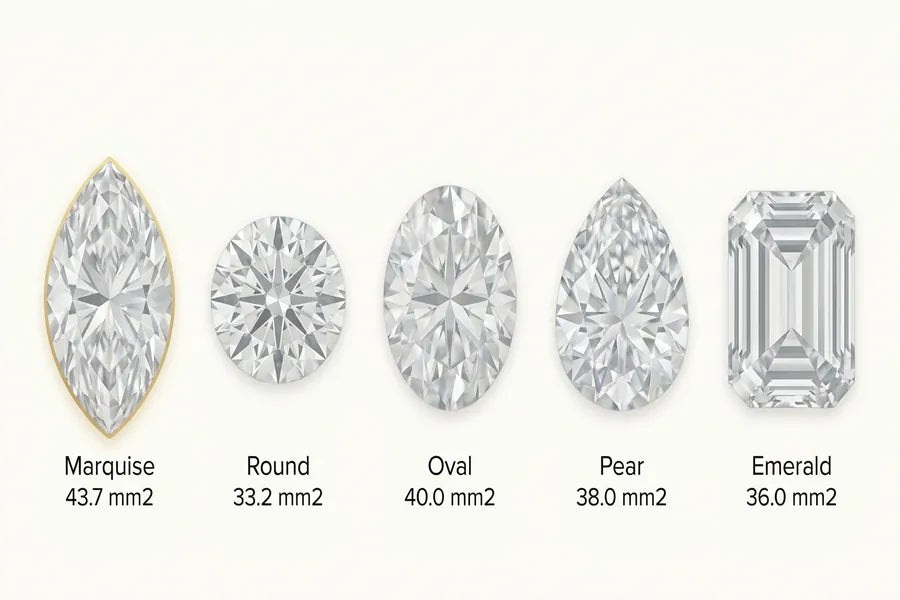
Esta ventaja de tamaño es una razón fundamental por la que los diamantes marquesa atraen a las novias que desean el máximo impacto visual. Un marquesa de 1 quilate ofrece aproximadamente 43,7 mm² de área visible, frente a aproximadamente 33,2 mm² para un redondo de 1 quilate, lo que representa aproximadamente un 32% más de superficie visible del diamante con el mismo peso en quilates.
Precios de los diamantes marquesa: qué esperar en 2026
Los diamantes marquesa ofrecen una ventaja de precio significativa sobre el corte brillante redondo más popular, típicamente entre un 20% y un 30% menos por quilate, porque los diamantes redondos tienen una prima al ser la forma más buscada. Aquí se muestran los rangos de mercado actuales:
| Peso en quilates | Natural (G-H, VS2-SI1) | Equivalente cultivado en laboratorio | Ahorro frente a un brillante redondo |
|---|---|---|---|
| 0.50 ct | $1,500 - $3,500 | $300 - $700 | ~25% |
| 1.00 ct | $3,000 - $8,000 | $800 - $2,000 | ~20-30% |
| 1.50 ct | $6,000 - $16,000 | $1,500 - $4,000 | ~25% |
| 2.00 ct | $9,000 - $25,000 | $2,500 - $6,000 | ~25-30% |
| 3.00 ct | $20,000 - $55,000+ | $5,000 - $12,000 | ~20-25% |
Estas son estimaciones generales del mercado. El precio final depende del color, la claridad, la simetría y la gravedad del efecto de pajarita de la piedra específica. Los diamantes marquesa cultivados en laboratorio ofrecen un ahorro del 60-80% sobre los equivalentes naturales, siendo química, óptica y físicamente idénticos.
Joyería de diamante marquesa GOLDZENN — Precios reales
GOLDZENN ofrece actualmente dos piezas exclusivas con diamantes marquesa, ambas elaboradas en oro macizo y disponibles para compra inmediata:
| Producto | Precio | Detalles clave |
|---|---|---|
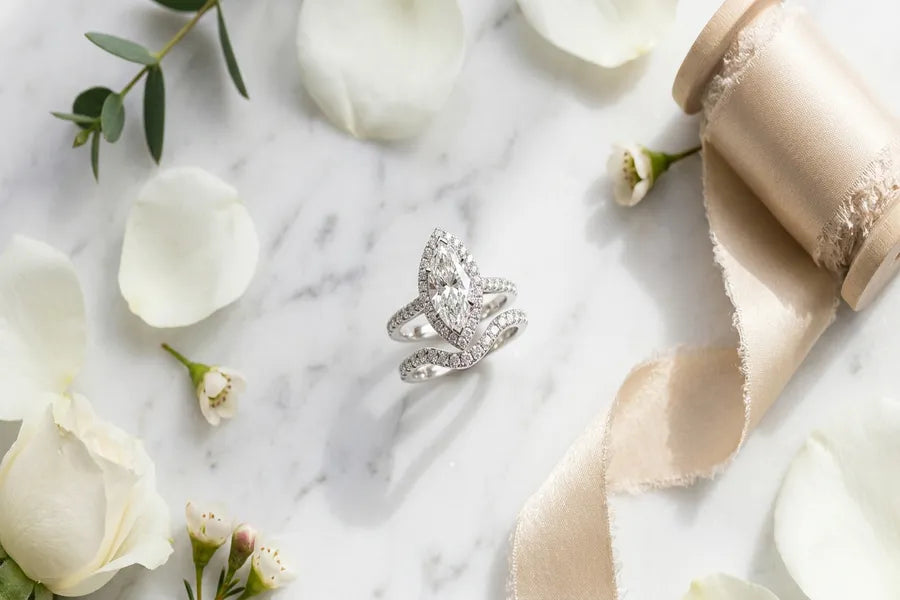
| Set de anillo de compromiso y alianza de boda de halo de diamante marquesa en oro blanco de 14K (3/4 CTTW) | $3,300 | Diamantes naturales, engaste de halo, alianza a juego incluida, oro blanco de 14K, puntas protegidas con engaste en V |
| Anillo de compromiso de tres piedras con diamante marquesa de laboratorio | $1,619 | Diamante marquesa central cultivado en laboratorio con dos piedras laterales, acabado de platino, diseño de tres piedras, elegancia contemporánea |
Además de estas piezas destacadas, el taller de GOLDZENN puede crear cualquier engaste de diamante marquesa personalizado que usted imagine. Nuestro equipo cuenta con más de 50 años de experiencia combinada en el diseño y la fabricación artesanal de anillos de compromiso de diamante, desde solitarios clásicos hasta intrincados diseños de halo. Explore nuestra colección completa de anillos de diamante, incluida nuestra guía completa de anillos de diamante o contáctenos al 321-521-4651 para discutir una pieza marquesa personalizada.
¿Necesita opciones de pago flexibles? GOLDZENN ofrece múltiples planes de financiación a través de proveedores como Shop Pay, Affirm, Klarna y Afterpay.
Marquesa vs. otras formas de diamante: una comparación completa
Elegir entre las formas de diamante es una de las decisiones más personales al comprar un anillo de compromiso. Así es como la marquesa se compara con las alternativas más populares:
| Factor | Marquesa | Redondo | Ovalado | Pera | Esmeralda |
|---|---|---|---|---|---|
| Área vista desde arriba (1 ct) | ~43.7 mm² | ~33.2 mm² | ~40.0 mm² | ~38.0 mm² | ~36.0 mm² |
| Ventaja de tamaño aparente | +15% vs redondo | Línea base | +10% | +8% | +5% |
| Brillo | Alto | Máximo | Alto | Alto | Menor (corte en escalones) |
| Fuego / Centelleo | Alto | Máximo | Alto | Alto | Moderado |
| Precio por quilate | 20-30% menos | Más caro | 10-15% menos | 15-20% menos | 15-25% menos |
| Efecto pajarita | Sí (varía) | Ninguno | Posible | Posible | Ninguno |
| ¿Grado de corte GIA? | No | Sí | No | No | No |
| Alargamiento del dedo | Máximo | Ninguno | Moderado | Moderado | Moderado |
| Vulnerabilidad | Las puntas son propensas a astillarse | Muy duradero | Duradero | La punta es propensa a astillarse | Las esquinas son propensas a astillarse |
| Cuota de mercado (2026) | ~1.5% (en aumento) | ~75% | ~8% | ~6% | ~5% |
| Mejor para | Elegancia distintiva, alargamiento del dedo | Máximo brillo | Clásico moderno | Único/romántico | Art deco/vintage |
Para las novias que aman el aspecto alargado pero no están seguras entre las formas, la marquesa se destaca por ofrecer el mayor impacto visual por quilate combinado con la máxima elongación del dedo. El óvalo es la alternativa más cercana en tamaño de vista frontal, pero las dos puntas de la marquesa le dan una silueta más dramática y distintiva. Para más comparaciones, lea nuestra comparación de moissanita vs diamante o nuestra guía de diamantes naturales vs cultivados en laboratorio vs moissanita.
Los mejores engastes de anillos de compromiso para diamantes marquesa
El engaste que elijas para un diamante marquesa no es solo una cuestión de estética, sino que afecta directamente la protección de la piedra, especialmente en esas delicadas puntas. Aquí te presentamos los engastes más populares y efectivos para anillos de compromiso marquesa:
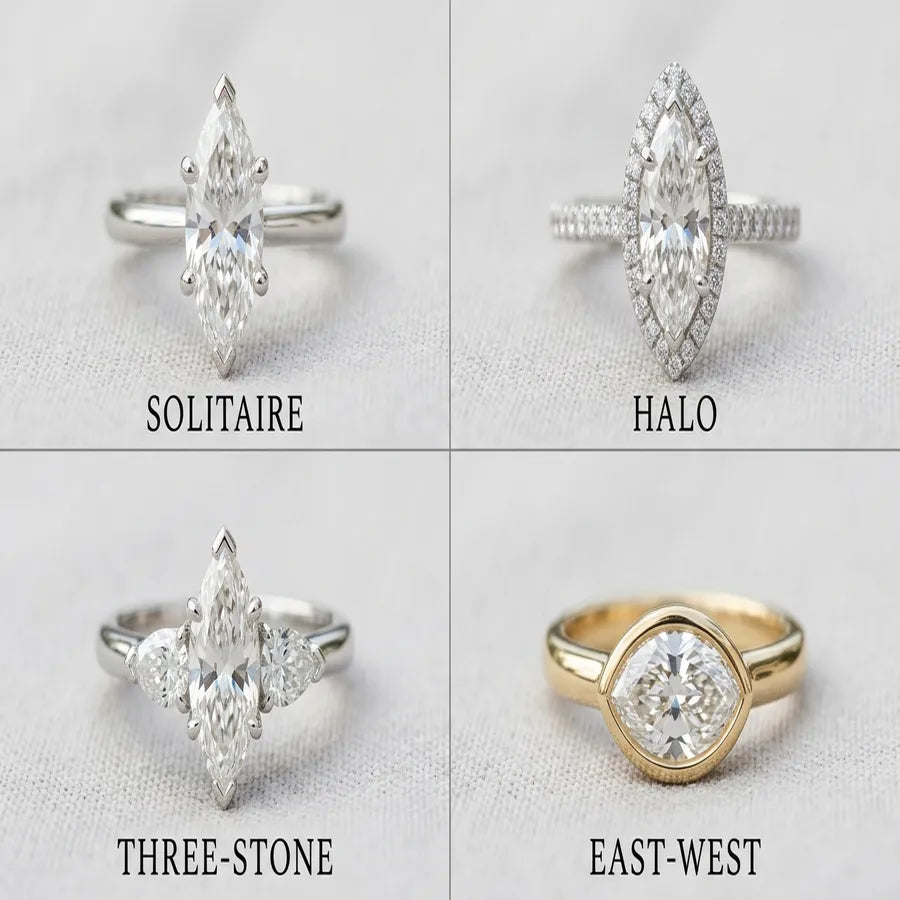
Engaste Solitario (6 garras con puntas en V)
El clásico solitario permite que el diamante marquesa sea el centro de atención. Para las piedras marquesa, una configuración de 6 garras con puntas en forma de V en ambos extremos es esencial. Las garras en V envuelven los puntos vulnerables, brindando protección estructural mientras mantienen líneas de visión limpias. Esta es la opción más atemporal y versátil para un anillo de compromiso marquesa.
Engaste de Halo
Un halo de diamantes más pequeños que rodea la piedra central marquesa realza el tamaño aparente del diamante en un 20-30% y añade una elegancia de inspiración vintage. Los engastes de halo son particularmente hermosos con diamantes marquesa porque la forma alargada crea un marco dramático. El Set nupcial de halo de diamante marquesa en oro blanco de 14K de GOLDZENN ($3,300) muestra este estilo con diamantes naturales en oro blanco de 14K e incluye una alianza a juego.
Engaste de Tres Piedras
Una piedra central marquesa flanqueada por dos piedras más pequeñas, típicamente en forma de pera o redondas, crea un diseño equilibrado y romántico. Las tres piedras simbolizan el pasado, el presente y el futuro. El Anillo de compromiso de tres piedras con diamante marquesa de laboratorio de GOLDZENN ($1,619) ofrece este diseño atemporal con diamantes cultivados en laboratorio a un precio accesible.
Engaste de Bisel
Para las novias con estilos de vida activos, el engaste de bisel rodea completamente el diamante marquesa con una fina banda de metal, proporcionando máxima protección para las puntas y los bordes. El perfil liso y resistente a enganches lo hace ideal para el uso diario. La desventaja es una entrada de luz ligeramente menor en comparación con un engaste de garras.
Orientación Este-Oeste (Horizontal)
Colocar el diamante marquesa horizontalmente a través del dedo es una elección moderna y a la moda que crea un aspecto elegante y contemporáneo. Esta orientación enfatiza el ancho del diamante en lugar de su longitud y combina maravillosamente con una alianza de boda recta, sin necesidad de una banda contorneada.
Brazos Divididos y Banda Retorcida
La banda se divide en dos hebras a medida que se acerca al diamante, enmarcando la piedra central marquesa y añadiendo interés visual. Algunos diseños incorporan un elemento de torsión o cruce. Estos engastes funcionan particularmente bien con diamantes marquesa porque la piedra alargada llena el espacio entre los brazos divididos con elegancia.
Engaste Catedral
Arcos de metal se elevan desde la banda para sostener el diamante, agregando soporte estructural y elevando la marquesa más por encima del dedo. Esta altura adicional permite que entre más luz por los lados, mejorando el brillo.
Combinación de alianza de boda con diamante marquesa
Una de las consideraciones únicas de los anillos de compromiso marquesa es encontrar la combinación de alianza de boda adecuada. La forma alargada con puntas significa que una banda recta estándar puede no quedar al ras con el anillo.
Opciones de combinación
- Banda contorneada / curvada: Una banda con forma para curvarse alrededor de las puntas del diamante marquesa, quedando al ras sin espacios. Esta es la solución más popular para los engastes marquesa norte-sur.
- Banda Chevron / en V: Una banda en forma de V que se anida en la punta de la marquesa, creando un aspecto cohesivo y añadiendo un elemento geométrico moderno.
- Banda recta con espacio: Algunas novias prefieren un pequeño espacio intencional entre el anillo de compromiso y la alianza de boda, lo que puede verse elegante y permite que cada anillo se destaque por sí mismo.
- Solución Este-Oeste: Si su marquesa está engastada este-oeste (horizontalmente), una banda recta estándar se combina naturalmente sin problemas de espacio.
- Banda hecha a medida: Para un ajuste verdaderamente perfecto, el taller de GOLDZENN puede crear una alianza de boda a medida contorneada con precisión para que coincida con su anillo de compromiso marquesa específico.
Explore la colección de alianzas de boda de diamante y alianzas de boda para hombre de GOLDZENN a partir de $2,938, o contáctenos en contact@goldzenn.com para una banda contorneada personalizada diseñada para complementar su anillo marquesa.
Elegir el quilate de oro adecuado para su engaste marquesa
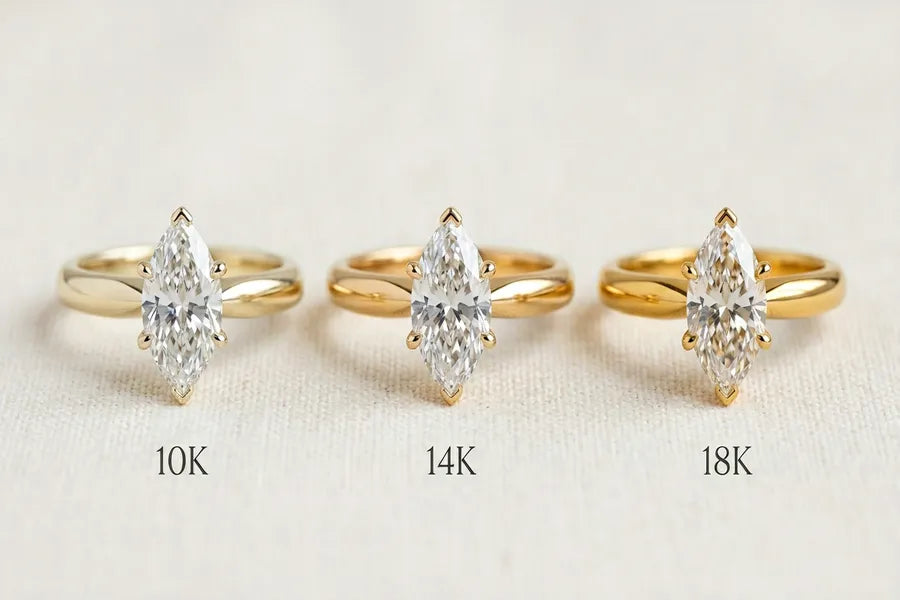
El quilate de oro que elija para un engaste de diamante marquesa es más importante que para la mayoría de las otras formas, porque las puntas requieren garras fuertes y duraderas. Aquí hay un desglose específico para la marquesa:
| Quilates | Contenido de Oro | Durabilidad de las garras | Carácter del color | Ideal para | Nivel de precio |
|---|---|---|---|---|---|
| 10K | 41.7% | Máximo: más resistente a arañazos y dobleces | Tono de oro ligeramente menos cálido, más pálido | Uso diario, estilos de vida activos, compradores con presupuesto limitado | Más asequible |
| 14K | 58.3% | Muy bueno: lo suficientemente fuerte para garras con punta en V | Oro rico y cálido con excelente brillo | Lo mejor en general para anillos de compromiso marquesa | Gama media |
| 18K | 75% | Bueno: más suave, requiere revisiones de garras más frecuentes | Calidez dorada profunda y rica, sensación de lujo | Piezas de herencia, coleccionistas de lujo | Premium |
| 22K | 91.7% | Demasiado blando: NO recomendado para engastes de garras (consulte nuestra guía de anillos de oro de 24K) | Color dorado más profundo | Diseños de bisel o solo banda (sin garras) | Máximo |
| Platino | 95% Pt | Excelente: el más duradero para garras | Blanco frío, no amarillea con el tiempo | Preferencia por metal blanco, necesidades hipoalergénicas | Máximo |
Nuestra recomendación para anillos de compromiso marquesa: oro de 14K. Ofrece el equilibrio ideal entre la resistencia de las garras (crucial para la protección de la punta en V), un color atractivo y el valor. Para las novias que prefieren el metal blanco, el juego nupcial marquesa de oro blanco de 14K de GOLDZENN combina la fuerza del 14K con un fresco acabado similar al platino.
Cada pieza de oro de GOLDZENN es verificada por XRF para una pureza exacta, sin conjeturas ni aproximaciones. Para una comparación más profunda de la pureza del oro, lea nuestra guía completa de oro de 14K vs 18K.
Diamantes marquesa más allá de los anillos de compromiso
Aunque los anillos de compromiso son la aplicación más célebre del diamante marquesa, esta forma se traduce maravillosamente en otras categorías de joyería. Aquí se muestra cómo se utiliza el marquesa más allá de las nupciales:
Colgantes y collares de diamantes marquesa
Un diamante marquesa engastado en un collar colgante crea una caída elegante y llamativa que funciona maravillosamente en una disposición de collares en capas y como una pieza llamativa por sí sola. Crea un efecto que capta la luz desde todos los ángulos. La forma alargada atrae naturalmente la mirada hacia abajo, lo que lo hace ideal para escotes en V y ropa formal. Un colgante solitario marquesa en una delicada cadena de oro es una de las formas más sutiles pero impactantes de llevar esta forma. Explore la guía de estilo de colgantes de GOLDZENN para ideas de combinación, o explore nuestra colección de colgantes de diamante a partir de $839.
Pendientes de diamantes marquesa
Los diamantes marquesa son pendientes excepcionales, tanto como pendientes de botón (engastados de norte a sur para un efecto vertical favorecedor a lo largo del lóbulo de la oreja) como pendientes colgantes o de gota, donde la forma alargada crea un movimiento elegante. Los diseños de racimo que presentan múltiples diamantes marquesa pequeños dispuestos en patrones florales o de estallido son particularmente populares para los pendientes llamativos. Los pendientes de botón de diamante de GOLDZENN comienzan en $1,599.
Pulseras de diamantes marquesa
Los diamantes marquesa engastados a lo largo de una pulsera, alternando con piedras redondas o en forma de pera, o en una fila continua de marquesa, crean una pulsera de línea distintiva que se diferencia de la silueta estándar de pulsera de tenis. Las formas alternas captan la luz de manera diferente, añadiendo una dimensión visual.
Marquesa en piezas personalizadas de eslabones cubanos
Para los clientes que buscan algo verdaderamente único, el taller de GOLDZENN puede incorporar diamantes marquesa en diseños de cadenas de eslabones cubanos con diamantes. Un colgante solitario marquesa colgado de una cadena de eslabones cubanos de oro macizo (disponible en varios anchos) fusiona la herencia de dos tradiciones icónicas de la joyería: el corte de diamante francés del siglo XVIII y la cadena de eslabones cubanos nacida en Miami. Los colgantes marquesa personalizados también se pueden integrar en joyería masculina, con el diamante engastado en un llamativo bisel o marco de oro.
Para cualquier joya con diamante marquesa más allá de nuestra colección lista para usar, visite nuestra página de proyectos personalizados o llame al 321-521-4651 para iniciar una consulta de diseño.
Engastes marquesa personalizados hechos a mano: la perspectiva de un maestro joyero
En GOLDZENN, abordamos los engastes de diamantes marquesa con especial cuidado porque esta forma exige una precisión que los engastes producidos en masa no pueden ofrecer. Esto es lo que implica la fabricación artesanal de un engaste de diamante marquesa en nuestro taller de Miami:
Por qué lo hecho a mano es importante para la marquesa
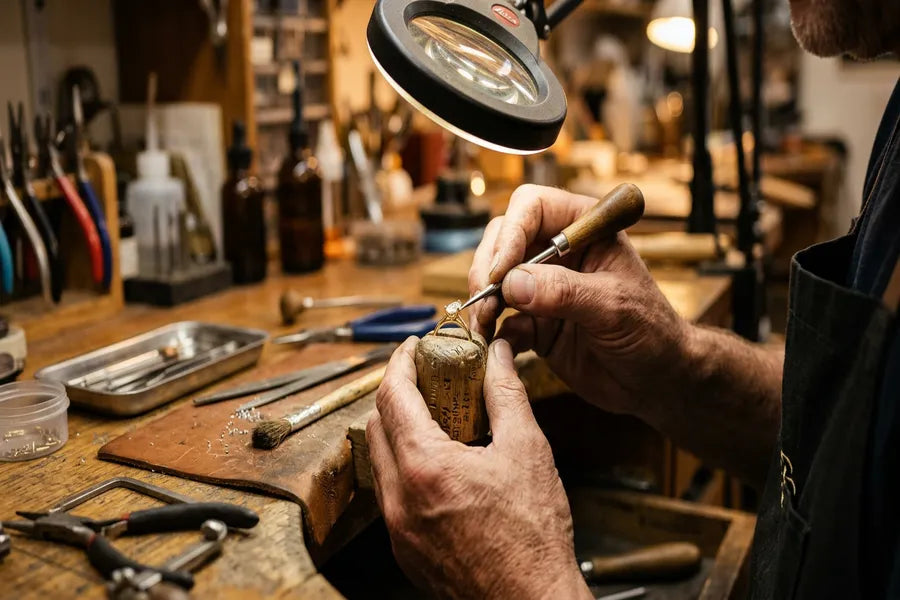
Las dos puntas de un diamante marquesa son su característica más vulnerable. En los engastes producidos en masa, las garras en V se estampan a partir de moldes que pueden no tener en cuenta las dimensiones exactas de su piedra específica. En un engaste hecho a mano, nuestros joyeros:
- Cortan a medida cada garra en V al ángulo y profundidad precisos de las puntas de su marquesa.
- Verifican la alineación bajo aumento para asegurar que las dos puntas estén perfectamente centradas en la banda.
- Prueban la tensión de las garras para confirmar que las puntas estén sujetas de forma segura sin una presión excesiva que pueda dañar el diamante.
- Verifican por XRF la pureza del oro del engaste terminado para confirmar que cumple con el estándar de quilates indicado.
El proceso de personalización de GOLDZENN
Si desea un anillo de compromiso marquesa diseñado exactamente según su visión, así es como funciona el proceso de personalización de GOLDZENN:
- Consulta: Llame al 321-521-4651 o envíe un correo electrónico a contact@goldzenn.com para hablar sobre su concepto. Comparta inspiraciones, metal preferido, presupuesto y cualquier detalle de diseño.
- Diseño: Nuestro equipo crea renderizaciones detalladas basadas en su visión.
- Tallado de cera / CAD: Un modelo de cera preciso o un diseño CAD captura cada detalle antes de que se funda cualquier metal.
- Fundición y acabado: El engaste se funde en el quilate de oro (o platino) elegido y se termina meticulosamente a mano.
- Engaste de la piedra: El diamante marquesa es engastado por un maestro engastador que garantiza una alineación perfecta, garras seguras y una entrada de luz óptima.
- Control de calidad: La inspección final incluye pruebas de seguridad de las garras, verificación de pureza por XRF y evaluación visual de la calidad.
GOLDZENN es miembro de Jewelers of America (#81868590) comprometido con prácticas de abastecimiento responsable, y nuestro taller aporta más de 50 años de experiencia combinada a cada pieza. Para ver nuestro taller en acción, explore nuestra guía detallada sobre cómo se hace la joyería personalizada, o vea videos de artesanía en nuestro canal de YouTube @GOLDZENNJWL (más de 335 videos, más de 20K suscriptores).
Cuidado y mantenimiento del diamante marquesa
Los diamantes marquesa requieren un cuidado ligeramente más atento que las formas redondas o de cojín debido a sus puntas afiladas. Siga estas pautas para mantener sus joyas de diamantes marquesa en excelentes condiciones durante décadas:
Calendario de inspección de las puntas
Las puntas en V de un diamante marquesa soportan la mayor tensión durante el uso diario. Haga que sus puntas sean inspeccionadas profesionalmente cada 6 meses. Entre los chequeos profesionales, inspeccione visualmente su anillo mensualmente; si una punta aparece levantada, doblada o desgastada, deje de usar el anillo y tráigalo inmediatamente. Una punta suelta es la principal causa de pérdida de piedras.
Limpieza de su diamante marquesa
Para la limpieza rutinaria en casa:
- Sumerja el anillo en agua tibia con unas gotas de jabón suave para platos durante 20-30 minutos
- Cepille suavemente alrededor y debajo del diamante con un cepillo de cerdas suaves, prestando atención al área alrededor de las puntas en V donde se acumula la suciedad
- Enjuague bajo agua tibia corriente (sobre un desagüe cerrado)
- Seque dando golpecitos con un paño sin pelusa
La limpieza ultrasónica es segura para los diamantes (dureza Mohs 10) siempre que las puntas estén seguras. La limpieza con vapor también es segura a menos que el diamante haya sido rellenado con fracturas. Para técnicas de limpieza completas en todas las joyas de oro, lea nuestra guía completa de limpieza de joyas de oro.
Consejos para el uso diario
- Quítese el anillo marquesa durante trabajos manuales pesados, jardinería y entrenamientos en el gimnasio; el impacto en las puntas es el riesgo principal
- Evite usarlo en piscinas; el cloro debilita las puntas de oro con el tiempo. Obtenga más información en nuestra guía sobre joyas de oro y exposición al agua. El oro en sí es altamente resistente al deslustre, pero los metales de aleación en quilates más bajos pueden verse afectados por productos químicos
- Guárdelo por separado en un compartimento forrado con tela suave; las puntas marquesa pueden rayar otras joyas
- Póngase el anillo al final (después de aplicar loción, perfume y laca para el cabello) y quítelo primero
Seguro y tasación
Cualquier diamante marquesa de más de 0.5 quilates debe ser tasado y asegurado de forma independiente. Obtenga la tasación de un gemólogo que no esté afiliado al joyero vendedor para una valoración imparcial. Para una guía detallada, lea nuestra guía de seguro de joyas y nuestro recurso sobre por qué las tasaciones de joyas son esenciales.
Diamantes marquesa cultivados en laboratorio vs. naturales
La elección entre un diamante marquesa natural y cultivado en laboratorio es cada vez más relevante a medida que la tecnología de laboratorio ofrece piedras que son química, óptica y físicamente idénticas a sus contrapartes extraídas de la tierra. Aquí hay una comparación directa:
| Factor | Marquesa natural | Marquesa cultivada en laboratorio |
|---|---|---|
| Composición química | Carbono (C) | Carbono (C) — idéntico |
| Dureza | 10 (escala de Mohs) | 10 (escala de Mohs) |
| Índice de refracción | 2.42 | 2.42 |
| Precio (1 ct, G, VS2) | $4,000 - $8,000 | $800 - $2,000 |
| Ventaja de precio | Línea base | 60-80% menos |
| Valor de reventa | Retiene ~30-50% | Valor de reventa mínimo |
| Método de producción | Extraído de la tierra (1-3 mil millones de años) | CVD o HPHT (2-6 semanas) |
| Impacto ambiental | Dependiente de la minería (varía según la fuente) | No requiere minería |
| Certificación GIA | Disponible | Disponible (indicado como cultivado en laboratorio) |
| Disponible en GOLDZENN | Sí — en catálogo y por encargo | Sí — en catálogo |
El anillo de compromiso de tres piedras de diamante marquesa de laboratorio de GOLDZENN ($1,619) demuestra el valor extraordinario que ofrecen los diamantes cultivados en laboratorio: un impresionante anillo marquesa de tres piedras a una fracción del precio natural, sin comprometer el brillo ni la durabilidad.
Para una exploración más profunda de cómo se crean los diamantes de laboratorio utilizando la tecnología CVD y cómo se comparan con las alternativas, lea nuestra comparación completa de moissanitas, diamantes cultivados en laboratorio y diamantes naturales.
Anillos de compromiso de diamantes marquesa de celebridades
Algunos de los anillos de compromiso de celebridades más memorables de la historia han presentado diamantes marquesa. Estos momentos de alto perfil han jugado un papel importante en mantener el marquesa en el imaginario público, e impulsando su resurgimiento actual:
Selena Gomez (2024) — El catalizador del regreso
Cuando Selena Gomez aceptó un anillo de compromiso de diamante marquesa de aproximadamente 8 quilates de Benny Blanco, encendió el resurgimiento moderno del marquesa. El anillo presenta una orientación clásica de norte a sur en una delicada banda de pavé de diamantes, lo que permite que la enorme piedra central marquesa acapare toda la atención. Este anillo fue ampliamente acreditado por provocar un aumento medible en las búsquedas y compras de diamantes marquesa.
Victoria Beckham (1998) — La elección del icono de la moda
El diamante marquesa de 3 quilates de Victoria Beckham de David Beckham fue solo el primero de su colección de más de 15 anillos de compromiso, pero estableció el marquesa como una elección para mujeres vanguardistas que quieren algo diferente al solitario redondo estándar.
Catherine Zeta-Jones (1999) — La piedra impactante
Michael Douglas le regaló a Catherine Zeta-Jones un impresionante diamante marquesa de 10 quilates valorado en aproximadamente 2 millones de dólares. La magnitud de esta piedra, con la forma marquesa que la alarga aún más, creó uno de los anillos de compromiso visualmente más dramáticos de la historia de Hollywood.
Portia de Rossi (2008) — La pionera de este a oeste
Cuando Ellen DeGeneres propuso matrimonio con un diamante marquesa de 3 quilates engastado de este a oeste (horizontalmente) con una banda de pavé de diamantes rosas, introdujo la tendencia del marquesa horizontal a una audiencia masiva. Esta orientación poco convencional le dio a la forma clásica una identidad completamente moderna.
Jackie Kennedy Onassis (1968) — El legendario Lesotho III
Aristotle Onassis regaló a Jackie Kennedy uno de los diamantes marquesa más famosos de la historia: el Lesotho III, un diamante marquesa de 40.42 quilates tallado de la legendaria gema en bruto Lesotho de 601 quilates. Esta piedra extraordinaria sigue siendo uno de los diamantes marquesa más grandes y célebres jamás creados.
Ashlee Simpson (2014)
Ashlee Simpson recibió un anillo de compromiso con diamante marquesa de Evan Ross, manteniendo la forma visible en el panorama de anillos de compromiso de celebridades de mediados de la década de 2010.
Estos momentos de celebridades demuestran que el diamante marquesa trasciende las tendencias: es una forma que ha sido elegida por mujeres icónicas de todas las generaciones, desde la realeza de mediados de siglo hasta la cultura pop moderna.
La perspectiva de inversión: rareza y valor del diamante marquesa
Si bien comprar un anillo de compromiso es principalmente una decisión emocional, vale la pena comprender la dinámica de valor de los diamantes marquesa desde una perspectiva de inversión:
- Rareza: Solo aproximadamente el 1.5% de todos los diamantes certificados por la GIA tienen talla marquesa. Esta escasez significa que la oferta es inherentemente limitada en comparación con los brillantes redondos (que representan aproximadamente el 75% del mercado)
- Demanda creciente: El resurgimiento impulsado por las celebridades está aumentando la demanda de diamantes marquesa en un momento en que la oferta se mantiene relativamente fija
- Valor de activo dual: Un diamante marquesa engastado en oro macizo representa dos activos que se aprecian: el diamante en sí y el contenido de oro del engaste. Esta propuesta de valor dual es un sello distintivo del enfoque de GOLDZENN hacia la joyería
- Consideraciones de reventa: Los diamantes marquesa naturales conservan aproximadamente el 30-50% de su valor original en el mercado secundario. Los diamantes marquesa cultivados en laboratorio tienen un valor de reventa mínimo, pero ofrecen precios de entrada excepcionales. Tenga en cuenta la diferencia entre los engastes chapados en oro (que tienen un contenido mínimo de metal precioso) y los vermeil de oro o los engastes de oro macizo al evaluar el valor a largo plazo
- Tasación y documentación: Obtenga siempre una tasación de joyas independiente y mantenga su certificación GIA para proteger el valor a largo plazo de su diamante marquesa
Para una visión completa de la joyería como inversión y cómo las piezas de lujo se aprecian con el tiempo, explore nuestras guías de inversión dedicadas.
Joyas de diamante marquesa para hombre
Aunque el diamante marquesa se asocia principalmente con los anillos de compromiso y las joyas nupciales femeninas, la forma aparece en algunas categorías de joyas masculinas:
- Colgantes marquesa personalizados: Un solo diamante marquesa engastado en un llamativo bisel de oro crea un colgante refinado que combina bien con cadenas de oro, incluidas cadenas de eslabones cubanos, cadenas de cuerda y cadenas fígaro
- Piedras de acento marquesa: La forma funciona como una piedra de acento distintiva en anillos para hombre, anillos de eslabones cubanos y diseños con incrustaciones, añadiendo un elemento geométrico entre piedras redondas o de talla princesa
- Pendientes de botón marquesa: Engastado verticalmente, un pequeño diamante marquesa crea un pendiente alargado y elegante que es más distintivo que el redondo estándar. Consulte nuestra guía de pendientes para hombre para obtener detalles de estilo
Para piezas de diamante marquesa para hombre personalizadas, comuníquese con GOLDZENN al 321-521-4651 o visite nuestra página de proyectos personalizados.
Cómo comprar un diamante marquesa: paso a paso
Aquí tiene una lista de verificación práctica para guiarlo en la elección de un diamante marquesa, ya sea para un anillo de compromiso, un colgante o cualquier otra pieza: para aquellos atraídos por la estética orgánica y texturizada del oro, explore nuestras joyas de pepita de oro.
- Establezca su presupuesto. Recuerde que los diamantes marquesa cuestan entre un 20 y un 30% menos por quilate que los brillantes redondos, por lo que su presupuesto puede rendir más de lo que espera. GOLDZENN ofrece opciones de financiación para que su pieza soñada sea accesible
- Elija natural o cultivado en laboratorio. Ambos son diamantes reales. Los naturales cuestan más pero conservan el valor de reventa; los cultivados en laboratorio ahorran un 60-80% y son ópticamente idénticos
- Priorice la simetría. Busque simetría "Excelente" o "Muy buena" en el informe de la GIA. En un marquesa, la asimetría es el defecto más visible
- Evalúe la pajarita. Vea el diamante en persona o a través de video de 360 grados. Acepte una pajarita ligera; rechace una severa. Llame a GOLDZENN (321-521-4651) y podemos guiarle a través de piedras específicas
- Verifique las proporciones. Objetivo: profundidad 58-62%, tabla 53-63%, relación L:W 1.85:1 a 2.10:1
- Seleccione el grado de color. H o mejor para metales blancos; I-J aceptable para oro amarillo o rosa
- Seleccione el grado de claridad. SI1-SI2 es el punto óptimo: confirme que no haya inclusiones cerca de las puntas
- Elija su engaste. Asegure puntas en V en las puntas. Considere su estilo de vida al elegir entre opciones de puntas, halo y bisel
- Elija su quilate de oro. 14K es nuestra recomendación para el mejor equilibrio entre durabilidad de las puntas y belleza. Lea la guía completa de comparación de quilates
- Verifique la pureza. Asegúrese de que su joyero pueda proporcionar verificación XRF de la pureza del oro: GOLDZENN prueba cada pieza con XRF
- Planifique la alianza de boda. Si es de norte a sur, considere una banda contorneada o en forma de chevrón. Si es de este a oeste, una banda recta funciona perfectamente
- Haga que lo tasen y lo aseguren. La tasación y el seguro independientes protegen su inversión desde el primer día
Uniendo tradición y tendencia: por qué GOLDZENN para su diamante marquesa
Elegir un diamante marquesa es una declaración de individualidad. Elegir dónde comprarlo determina la calidad, la artesanía y la protección a largo plazo de esa declaración. Esto es lo que distingue a GOLDZENN:
- Maestría artesanal: Más de 50 años de experiencia combinada en talleres. Cada engaste marquesa está hecho a mano con puntas en V ajustadas a medida a las dimensiones exactas de su piedra
- Pureza de oro verificada por XRF: Cada pieza de oro de GOLDZENN es probada y verificada, no estimada, no estampada y olvidada
- Confianza real del cliente: Más de 295 reseñas de Google con 4.9 estrellas, más de 3,900 reseñas de productos verificadas en Judge.me
- Garantía de por vida en defectos de fabricación: Respaldamos cada engaste, cada punta, cada pieza terminada
- Taller en Miami, acceso directo: Habla directamente con los joyeros que crearán su pieza, no con un centro de llamadas
- Opciones naturales y cultivadas en laboratorio: Ambas disponibles en nuestro catálogo y a través de pedidos personalizados
- Miembro de Jewelers of America (#81868590): Mantenemos los más altos estándares de ética y experiencia de la industria
- Capacidad personalizada: Cualquier diseño marquesa que pueda imaginar, podemos hacerlo realidad. Desde conjuntos nupciales de halo tradicionales hasta solitarios modernos de este a oeste y audaces combinaciones de eslabones cubanos con diamantes
Visite goldzenn.com para explorar nuestro conjunto de novia con diamantes marquesa ($3,300) y nuestro anillo de tres piedras de diamantes de laboratorio ($1,619), o inicie un diseño personalizado en goldzenn.com/pages/custom-projects. Llámenos al 321-521-4651 o envíenos un correo electrónico a contact@goldzenn.com en cualquier momento.
Glosario de terminología de diamantes marquesa
Comprender la terminología específica de los diamantes marquesa le ayuda a comunicarse con confianza con cualquier joyero:
- Navette: El nombre francés alternativo para la forma marquesa, que significa "pequeño barco" o "barquito"
- Efecto pajarita: Una sombra oscura en el centro de los diamantes alargados causada por la fuga de luz en ciertas áreas de las facetas
- Punta en V / Punta de garra en V: Una garra en forma de V que rodea la punta afilada de un diamante marquesa, proporcionando protección estructural
- Relación longitud-ancho (L:W): La relación entre las medidas más largas y más anchas del diamante. Ideal para marquesa: 1.85-2.10
- Punta francesa: Un diseño de garra donde el metal se extiende ligeramente más allá de la punta del diamante, añadiendo protección. Común en los engastes marquesa vintage y hechos a mano
- Engaste este-oeste: Un diamante marquesa engastado horizontalmente en el dedo en lugar de la orientación vertical tradicional (norte-sur)
- Banda contorneada: Una alianza de boda curvada para seguir la forma de una piedra central no redonda, permitiendo un ajuste al ras con un anillo de compromiso marquesa
- Corte brillante modificado: Un patrón de facetas basado en la disposición de un brillante redondo pero adaptado a una forma no redonda. El marquesa utiliza este patrón con sus 58 facetas
- Faja: La banda estrecha alrededor del punto más ancho del diamante. Para el marquesa, una faja "Delgada a Ligeramente Gruesa" es ideal
- Pabellón: La parte inferior del diamante debajo de la faja. El porcentaje de profundidad refleja cuán profundo se extiende el pabellón
Preguntas frecuentes sobre los diamantes marquesa
¿Qué es un diamante marquesa?
Un diamante marquesa es un diamante de talla brillante modificado con un contorno alargado en forma de barco que se estrecha hacia dos puntas. Presenta 58 facetas dispuestas para maximizar el brillo y el fuego. La forma se originó en 1745 cuando el rey Luis XV de Francia encargó un diamante tallado para parecerse a los labios de la Marquesa de Pompadour. Entre todas las formas de diamantes, el marquesa ofrece la mayor superficie visible en relación con el peso en quilates, pareciendo aproximadamente un 15% más grande que un brillante redondo del mismo peso. Solo alrededor del 1.5% de todos los diamantes certificados por la GIA tienen este corte, lo que lo hace distintivo y raro.
¿Por qué se llama diamante marquesa?
El nombre proviene de la Marquesa de Pompadour, la amada compañera del rey Luis XV de Francia, quien encargó el corte en 1745. "Marquesa" se refiere a un título de nobleza francesa que se ubica entre duque y conde. El diamante también se conoce como corte "navette", de la palabra francesa que significa "pequeño barco" o "barquito", porque su contorno alargado con puntas afiladas se asemeja a una pequeña embarcación. Esta historia de origen real le da al diamante marquesa una herencia romántica y aristocrática que ninguna otra forma de diamante puede reclamar.
¿Están volviendo los diamantes marquesa?
Sí, los diamantes marquesa están experimentando un resurgimiento significativo en 2025-2026. El catalizador fue el anillo de compromiso marquesa de aproximadamente 8 quilates de Selena Gomez de Benny Blanco en 2024, que generó un aumento medible en las búsquedas y ventas de diamantes marquesa. La tendencia más amplia hacia los anillos de compromiso de inspiración vintage y no tradicionales también ha impulsado el interés. La variación de engaste este-oeste (horizontal) ha introducido una estética moderna que atrae a las novias contemporáneas. A pesar de esta creciente popularidad, los diamantes marquesa todavía representan solo alrededor del 1.5 % de los diamantes certificados por el GIA, manteniendo su rareza e individualidad.
¿Cuánto cuesta un diamante marquesa de 1 quilate?
Un diamante marquesa natural de 1 quilate en el rango de color G-H y claridad VS2-SI1 generalmente cuesta entre $3,000 y $8,000, dependiendo de factores de calidad específicos como la simetría, la severidad del efecto de pajarita y las proporciones. Esto representa un ahorro del 20-30 % en comparación con un brillante redondo de 1 quilate de calidad equivalente. Los diamantes marquesa de laboratorio de 1 quilate oscilan entre $800 y $2,000, un ahorro del 60-80 % en comparación con los naturales. En GOLDZENN, nuestro anillo de compromiso de tres piedras con diamante de laboratorio marquesa tiene un precio de $1,619, mientras que nuestro juego de novia de halo de diamante marquesa de oro blanco de 14K con diamantes naturales cuesta $3,300.
¿Qué es el efecto de pajarita en un diamante marquesa?
El efecto de pajarita es una sombra oscura en forma de pajarita que aparece en el ancho central de un diamante marquesa. Es causado por la fuga de luz en áreas donde los ángulos de las facetas no devuelven eficientemente la luz al ojo del observador. Cada diamante marquesa exhibe cierto grado de efecto de pajarita; el objetivo es encontrar una piedra donde el efecto sea mínimo, apareciendo como un oscurecimiento sutil que agrega profundidad en lugar de una banda negra prominente que reduce el brillo. Es importante destacar que la severidad del efecto de pajarita no se puede determinar solo con un certificado GIA; debe ver el diamante en persona o a través de videos de alta calidad.
¿Cuál es la relación ideal de longitud a ancho para un diamante marquesa?
La relación de longitud a ancho más popular y ampliamente recomendada para los diamantes marquesa se encuentra entre 1.85:1 y 2.10:1, siendo 2:1 el estándar clásico. Una relación de 2:1 significa que el diamante es exactamente el doble de largo que de ancho. Las relaciones por debajo de 1.75 hacen que la marquesa parezca demasiado regordeta y más cercana a un óvalo, mientras que las relaciones por encima de 2.15 la hacen parecer excesivamente alargada y estrecha. La preferencia personal influye, pero mantenerse dentro del rango de 1.85-2.10 proporciona la silueta más equilibrada y visualmente agradable con el menor efecto de pajarita.
¿Son frágiles los diamantes marquesa?
El diamante en sí no es frágil; ocupa el puesto 10 en la escala de dureza de Mohs, lo que lo convierte en el material natural más duro de la Tierra. Sin embargo, las dos puntas de un diamante marquesa son más vulnerables a las astillas que los bordes de un corte redondo o de cojín. Esta es una vulnerabilidad estructural de la forma, no del material. La solución es un diseño de engaste adecuado: puntas en V o engastes de bisel que protejan completamente las puntas. Con la protección adecuada y prácticas de uso responsables (quitarse el anillo durante actividades físicas intensas, evitar impactos), un diamante marquesa es perfectamente duradero para el uso diario. Haga inspeccionar las puntas cada 6 meses.
¿Cuál es el mejor engaste para proteger un diamante marquesa?
El mejor engaste para proteger un diamante marquesa depende de su estilo de vida. Para una máxima protección, un engaste de bisel completo rodea todo el diamante en metal, cubriendo completamente las puntas vulnerables. Para aquellos que prefieren un aspecto más tradicional con puntas, un engaste de 6 puntas con puntas en forma de V en ambos extremos proporciona una fuerte protección al tiempo que permite la máxima entrada de luz. Los engastes de halo agregan un anillo de diamantes más pequeños alrededor de la marquesa que sirven como un amortiguador protector. Los engastes de catedral elevan el diamante y agregan refuerzo estructural. En GOLDZENN, cada engaste marquesa está hecho a mano con puntas en V ajustadas a medida a las dimensiones exactas de su piedra para una seguridad óptima.
¿Se puede engastar un diamante marquesa de este a oeste (horizontalmente)?
Sí, la orientación este-oeste u horizontal es una de las tendencias modernas más populares en anillos de compromiso marquesa. En lugar de la alineación tradicional norte-sur (de punta a punta a lo largo del dedo), la marquesa se gira 90 grados para que quede en el dedo. Esta orientación crea un aspecto elegante y contemporáneo y tiene el beneficio práctico de combinarse fácilmente con una banda de boda recta estándar, sin necesidad de una banda contorneada. La tendencia este-oeste fue popularizada por el anillo de compromiso de Portia de Rossi de Ellen DeGeneres, que presentaba una marquesa horizontal de 3 quilates con una banda pavé de diamantes rosas.
¿Un diamante marquesa hace que los dedos parezcan más largos?
Sí, el diamante marquesa es considerado la forma de diamante que más alarga los dedos. Cuando se engasta en la orientación tradicional norte-sur, la forma alargada crea una línea visual a lo largo del dedo que lo hace parecer más largo y delgado. Este efecto es una de las razones más citadas por las que las novias eligen la forma marquesa. Las mujeres con dedos más cortos o anchos a menudo encuentran la marquesa particularmente favorecedora. El grado de elongación depende de la relación longitud-ancho de la piedra: una relación más alta (más cercana a 2.10:1) produce una elongación más notable que una relación más corta (más cercana a 1.85:1).
¿Qué grado de color es mejor para un diamante marquesa?
Para diamantes marquesa engastados en oro blanco o platino, recomendamos el color G o H. Los diamantes marquesa tienden a mostrar concentración de color en sus puntas, lo que hace que los grados de color más bajos sean más notorios que en los brillantes redondos. Para engastes de oro amarillo u oro rosa, el color I o J es aceptable porque el tono cálido del metal complementa y enmascara cualquier ligera calidez en el diamante. El color H es generalmente la mejor opción en general: se ve blanco en prácticamente cualquier engaste, al tiempo que ofrece ahorros significativos en comparación con los grados incoloros D-F. En GOLDZENN, nuestro equipo evalúa personalmente el rendimiento del color de cada diamante antes de engastarlo.
Marquesa vs. oval: ¿cuál es mejor?
Ninguna forma es objetivamente mejor; la elección depende de sus preferencias estéticas y prioridades. La marquesa ofrece un área frontal más grande (+15 % vs. redondo, en comparación con el +10 % del óvalo), una elongación de dedos más dramática, precios más bajos (20-30 % menos que el redondo vs. el 10-15 % de descuento del óvalo) y mayor rareza (1.5 % de los diamantes vs. el 8 % del óvalo). El óvalo tiene la ventaja de ser ligeramente más duradero (sin puntas afiladas), más versátil en la combinación con anillos de boda y actualmente está más ampliamente disponible. Ambos son cortes brillantes modificados con un brillo similar. Si desea el máximo impacto visual y un aspecto distintivo, elija marquesa. Si desea una forma alargada con menos consideraciones de engaste, considere el óvalo.
¿Son los diamantes marquesa una buena inversión?
Los diamantes marquesa tienen características de inversión únicas. Por un lado, su rareza (solo el 1.5 % de los diamantes certificados por el GIA) proporciona una restricción natural de la oferta, y el resurgimiento actual de la demanda está impulsando los precios al alza. Los diamantes marquesa naturales conservan aproximadamente el 30-50 % de su precio de compra en el mercado secundario. Por otro lado, los diamantes en general deben comprarse principalmente como joyas, no como instrumentos financieros. Cuando se engasta en oro macizo, como se especializa GOLDZENN, una pieza marquesa representa un doble valor: el contenido de oro que se aprecia más el diamante. Los diamantes marquesa cultivados en laboratorio tienen un valor de reventa mínimo, pero ofrecen una asequibilidad excepcional para quienes priorizan la belleza sobre el retorno de la inversión.
¿Pueden los hombres usar joyas de diamante marquesa?
Absolutamente. Si bien los anillos de compromiso marquesa se asocian principalmente con las mujeres, la forma funciona bien en varias categorías de joyería masculina. Un solo diamante marquesa engastado en un llamativo colgante de bisel de oro crea un accesorio sofisticado que combina con cadenas de eslabones cubanos, cadenas de cuerda o cadenas fígaro. Las piedras acentuadas marquesa agregan una geometría distintiva a los anillos de hombre, incluidos los diseños helados y personalizados. Los pequeños diamantes marquesa engastados verticalmente como aretes ofrecen una alternativa elegante al arete redondo estándar. En GOLDZENN, nuestro taller personalizado puede crear cualquier pieza de diamante marquesa para hombre; visite goldzenn.com/pages/custom-projects o llame al 321-521-4651 para discutir su concepto. Explore nuestra guía de cadenas de oro extralargas.
¿Cómo limpiar y mantener un anillo de diamante marquesa?
Limpie su anillo de diamante marquesa en casa remojándolo durante 20-30 minutos en agua tibia con jabón suave para platos, luego frote suavemente alrededor y debajo del diamante con un cepillo de dientes de cerdas suaves. Preste especial atención a las áreas de las puntas en V, donde la suciedad y la loción tienden a acumularse. Enjuague con agua tibia corriente (siempre sobre un desagüe cerrado) y seque con un paño sin pelusa. Haga que las puntas sean inspeccionadas profesionalmente cada seis meses; las puntas afiladas soportan la mayor parte del estrés y el desgaste. Quítese el anillo durante trabajos manuales pesados, entrenamientos de gimnasio y natación (el cloro debilita las puntas de oro). Guárdelo por separado en un compartimento forrado de tela suave para evitar que las puntas rayen otras joyas. Para obtener técnicas de limpieza detalladas, lea la guía de limpieza de joyas de oro de GOLDZENN.