Actualizado con el precio del oro de hoy. Todos los precios de esta página son en vivo.
El oro de 14K es 58.3% puro. El oro de 18K es 75% puro. Esa sola diferencia decide todo lo demás: el 18K cuesta más por gramo, se ve de un amarillo más profundo y se raya más fácil; el 14K es más duro, más económico y la opción más común para piezas de uso diario.
Abajo: cuánto cuesta cada quilate al precio al contado de hoy, en qué se diferencia realmente el color, cuál aguanta mejor el uso diario y cuál conviene más para la piel sensible.
Oro de 14K vs 18K, cara a cara
Esta es la comparación que la mayoría de los compradores está decidiendo de verdad. Los dos son excelentes; fallan en direcciones distintas.
Color
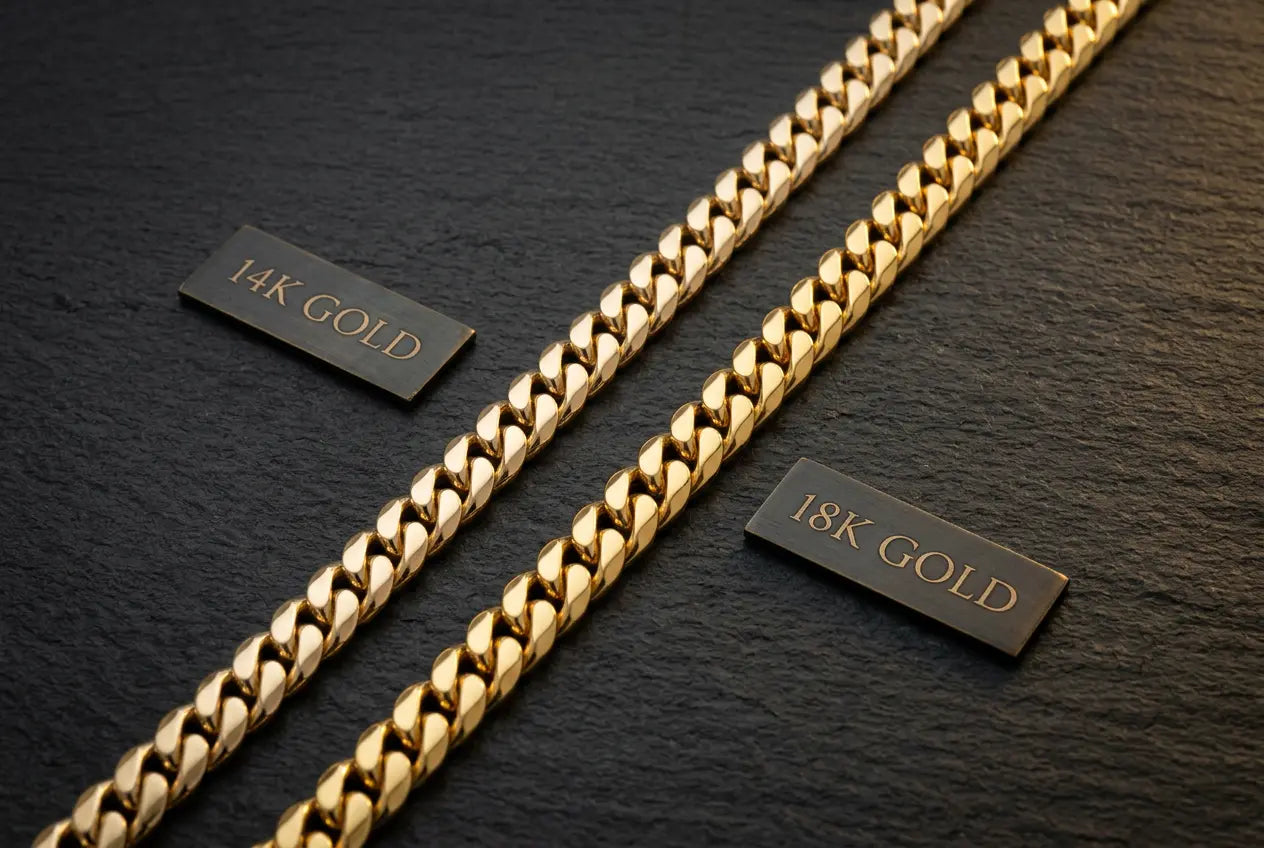
El 18K es más cálido y más saturado. Lado a lado, la mayoría de la gente ve la diferencia; por separado, la persona promedio no puede identificar el quilate a simple vista. Si el color del oro es la razón por la que quieres oro, el 18K te da más de eso.
Durabilidad
Gana el 14K, y no por poco. Un 41.7% de aleación frente a un 25% es una diferencia de dureza real. Para una pieza que vive sobre tu cuerpo en el trabajo, en el entrenamiento y al dormir, el 14K mantiene la superficie limpia por más tiempo.
Precio
El 18K lleva cerca de 29% más de oro por gramo. Al precio en vivo de arriba, eso es $100.45 frente a $78.08 por gramo de metal. En una pieza terminada la diferencia depende del peso, la mano de obra, el diseño y las piedras, así que puede quedar por encima o por debajo de ese 29%.
Piel
El 18K suele ayudar aquí, porque menos aleación normalmente significa menos de aquello a lo que la piel reacciona. Lo que más pesa es qué metales lleva la aleación y con qué facilidad se liberan, así que si el níquel te ha dado problemas antes, pide la composición de la aleación en lugar de fiarte solo del quilataje.
Reventa
El 18K conserva más valor de fundición por gramo; el 14K se vende más rápido en Estados Unidos porque más compradores lo manejan todos los días. Si estás optimizando por la cifra más alta, 18K. Si estás optimizando por la venta más rápida, 14K.
La regla que le gana a todo lo anterior
Una cadena más pesada en un quilataje más bajo tiene más presencia visual que una cadena más ligera en un quilataje más alto, siempre. Si con un mismo presupuesto puedes comprar una pieza de 14K sustancial o una de 18K delgada, la de 14K se te va a ver mejor. El ancho y el peso hacen más trabajo que el quilataje. Nuestra guía de anchos de cadena cubana explica cuánta diferencia hace un milímetro.
Oro de 14K vs 18K de un vistazo
Precio del oro de 14K vs 18K
El valor del oro escala directamente con la pureza. Al precio al contado de hoy, un gramo de aleación de 14K contiene oro por valor de $78.08, y en 18K $100.45 — cerca de 1.29× más. Esa proporción la fija la diferencia de pureza (0.750 ÷ 0.583) y no se mueve cuando se mueve el precio del oro.
Por pennyweight, la misma comparación es $121.42 frente a $156.19.
Ese 29% aplica al valor del contenido de oro a igual peso. En una pieza terminada la diferencia depende del peso, la mano de obra, el diseño, las piedras y de cómo el vendedor cobra el trabajo — así que puede quedar por encima o por debajo del 29%.
Durabilidad: cuál aguanta mejor
El oro puro es blando. Los metales de aleación que se le mezclan son los que le dan dureza a una pieza, así que un quilataje más bajo es físicamente más resistente. El 14K lleva 41.7% de aleación frente al 25% del 18K, y eso hace que el 14K resista notablemente mejor los arañazos, las abolladuras y las deformaciones.
En la práctica: el 14K es la mejor opción para una cadena de uso diario, para un anillo que choca con teclados y volantes, o para cualquier pieza sobre alguien activo. El 18K encaja mejor en piezas de uso ocasional, o donde el color más rico importa más que la dureza de la superficie.
Ningún quilate se "gasta" — el oro sólido no se descascara ni se desvanece como las piezas chapadas o bonded. La diferencia está en qué tan rápido la superficie acumula marcas.
Sensibilidad de la piel
Las reacciones a la joyería de oro suelen deberse a los metales de la aleación y no al oro, y el níquel es el culpable más común. La alergia al oro en sí es poco frecuente, pero está documentada, así que no se puede descartar del todo. Como el 18K contiene menos aleación (25% frente al 41.7% del 14K), lleva proporcionalmente menos de aquello a lo que quien la usa podría reaccionar.
Por eso un quilataje más alto muchas veces ayuda — pero lo que importa es qué metales lleva realmente la aleación y con qué facilidad se liberan contra la piel, no el número de quilates por sí solo. Si has reaccionado a alguna joya antes, pide la composición de la aleación y considera una prueba de parche.
Pregunta qué lleva la aleación en vez de suponerlo. Dos piezas selladas 14K pueden usar mezclas de aleación distintas.
Oro rosa: el quilataje sí cambia el color
El oro rosa es oro aleado con una mezcla dominada por el cobre. El cobre es lo que lo hace rosado — así que mientras más bajo el quilataje, más cobre lleva la pieza y más rosado se ve.
- Oro rosa de 10K — 41.7% de oro, con el 58.3% restante muy cargado hacia el cobre. El rosa más intenso y más rojizo de los tres, y el más duro.
- Oro rosa de 14K — 58.3% de oro. Un tono claramente rosado pero todavía dorado. Este es el punto de equilibrio que la mayoría de los compradores de oro rosa se imagina.
- Oro rosa de 18K — 75.0% de oro, y solo queda 25% para la aleación liderada por el cobre. El rubor más sutil de los tres, más cerca del champán cálido que del rosa verdadero, y el más blando.
Esto invierte la regla habitual. Con el oro amarillo, más quilataje significa un color más intenso. Con el oro rosa, más quilataje significa un rosa menos intenso, porque estás diluyendo el cobre que crea el efecto. Si quieres un tono rosa fuerte, no supongas que el 18K es la mejora — puede alejarte del look que buscas.
Dos notas prácticas. Primero, las aleaciones cargadas de cobre pueden desarrollar una pátina más cálida tras años de uso; a algunos dueños les gusta, y de todos modos el pulido la revierte. Segundo, si el cobre es uno de los metales a los que tu piel reacciona, el oro rosa de menor quilataje es la dirección equivocada — sube de quilataje, no bajes. Para ver cómo se compara el rosa con el tono clásico en general, mira nuestra comparación de oro rosa vs oro amarillo.
Oro blanco: el quilataje casi no cambia el color
El oro blanco se comporta casi al revés que el rosa. El oro amarillo no se vuelve blanco solo con la aleación — la aleación (paladio, níquel, plata, zinc) lo aclara, pero el resultado suele ser un gris levemente cálido. Prácticamente toda la joyería de oro blanco se termina después con un baño de rodio, que es lo que produce el blanco brillante y frío que en realidad ves.
La consecuencia: el oro blanco de 10K, 14K y 18K se ve casi idéntico en la vitrina. En los tres casos estás viendo rodio. Las diferencias de quilataje en el oro blanco aparecen, en cambio, en otros cuatro lugares:
- Lo que hay debajo. A medida que el rodio se desgasta en los puntos de mayor contacto, la aleación base asoma. Una base de oro blanco de mayor quilataje tiene un tono más cálido, así que la transición puede leerse como un leve matiz amarillo; una base de menor quilataje se ve más gris.
- Cada cuánto hay que repetir el baño. El rodio es un acabado superficial y se desgasta. Cada cuánto hay que rehacerlo depende de la pieza y de cómo se usa, no del quilataje — los anillos se desgastan más rápido, y las cadenas y los dijes mucho más lento. Repetir el baño de rodio es un servicio con un costo que varía según la pieza; pregunta cuánto sale el de la tuya antes de darlo por hecho. Nuestra guía del baño de rodio explica el proceso.
- Níquel. Algunas aleaciones de oro blanco usan níquel, que es el alérgeno más común en la joyería. Los quilatajes más bajos llevan más aleación en total, y por lo tanto más de lo que sea que esa aleación contenga. Si tienes sensibilidad al níquel, pregunta específicamente por la aleación — el oro blanco a base de paladio es la alternativa.
- Dureza y valor. Igual que en el amarillo — el blanco de 10K es el más duro, y el blanco de 18K lleva más oro por gramo.
Si estás eligiendo entre oro blanco y una alternativa en tono plateado, nuestra comparación de oro blanco vs plata esterlina cubre las diferencias de durabilidad y de valor.
¿Quieres meter el 10K en la ecuación, o una calculadora de valor en vivo? Mira la comparación completa de 10K / 14K / 18K y la calculadora →
Preguntas frecuentes
¿Cuál es la diferencia entre el oro de 14K y el de 18K?
El oro de 14K tiene 58.3% de oro puro; el de 18K, 75.0%. Esa brecha de 16.7 puntos significa que el 18K lleva cerca de 29% más de oro al mismo peso, y por eso se lee como un amarillo más profundo y cálido y tiene un valor de fundición más alto por gramo. La contrapartida es la dureza: el 18K solo tiene 25% de aleación reforzándolo frente al 41.7% del 14K, así que acumula marcas superficiales más rápido con el mismo uso. El 18K suele llevarse mejor con la piel sensible porque hay menos aleación en contacto contigo, aunque lo que más pesa es qué metales lleva la aleación y no el quilataje por sí solo. El 14K es la mejor opción para una pieza que se usa de forma continua sin quitársela.
¿Es mejor el oro de 14K o 18K para uso diario?
El oro de 14K es generalmente la mejor opción para uso diario. Su mayor contenido de aleación — 41.7% frente al 25% del 18K — lo hace más resistente a los arañazos, las abolladuras y el desgaste general. Si planeas usar tu cadena, anillo o pulsera todos los días sin quitártela, el 14K mantiene la superficie limpia por más tiempo y con menos mantenimiento. Dicho esto, el 18K es perfectamente usable a diario; simplemente pide un poco más de atención cerca de las superficies duras y desarrolla antes una pátina de marcas finas. Si tienes sensibilidad a los metales, el 18K puede seguir siendo la opción diaria correcta a pesar de ser más blando.
¿Se raya más fácil el oro de 18K que el de 14K?
Sí. El oro de 18K es 75% oro puro, y el oro puro es un metal blando — con solo 25% de aleación reforzándolo, el 18K es más blando que la estructura de 58.3% de oro y 41.7% de aleación del 14K, y la diferencia es medible. No es dramática en el manejo del día a día, pero con el tiempo una pieza de 18K muestra una red de arañazos finos en la superficie antes que una pieza de 14K usada de forma idéntica. El pulido profesional restaura la superficie, y algunos dueños dejan que la pátina se desarrolle a propósito, porque se lee como carácter y no como daño.
¿Cuál es la diferencia de precio entre oro de 14K y 18K?
Solo por contenido de metal, el 18K lleva exactamente 1.29 veces el oro del 14K al mismo peso — 75.0 dividido entre 58.3 — así que su valor de fundición por gramo corre cerca de 29% más alto. En la joyería terminada la diferencia depende del peso, la mano de obra, el diseño y las piedras, así que puede quedar por encima o por debajo del 29%; además, el precio al contado del oro se mueve a diario. Las cifras en vivo por gramo y por pennyweight de los dos quilates están publicadas en esta página y se actualizan con el mercado en lugar de quedarse con la foto del día en que se publicó.
¿Se puede notar la diferencia entre oro de 14K y 18K a simple vista?
Lado a lado, la mayoría de las personas sí. El 18K se lee más cálido, más profundo y más saturado que el 14K bajo la misma luz. Visto por separado, sin una pieza de comparación al lado, la persona promedio no puede identificar el quilataje de forma confiable solo por el color — los dos lucen como oro genuino y rico, porque lo son. Por eso una fotografía comparativa debe mostrar todos los quilates juntos bajo una sola fuente de luz; es la única forma honesta de enseñar una diferencia que desaparece en cuanto separas las piezas.
¿Vale la pena el costo extra del oro de 18K?
Depende de qué estés optimizando. La prima te compra tres cosas: un color visiblemente más profundo y cálido, cerca de 29% más de contenido de oro por gramo para la reventa, y la menor exposición a la aleación de los quilates comunes para la piel sensible. Si alguna de esas es tu prioridad, la prima se justifica. Si tu prioridad es la dureza para uso diario continuo, o llevarte la pieza más ancha y pesada que permita tu presupuesto, entonces el 14K o incluso el 10K te van a servir mejor a un precio más bajo. Aquí no hay una respuesta universalmente correcta.
¿El quilataje cambia cómo se ven el oro rosa y el oro blanco?
En el oro rosa, sí — y en la dirección contraria a la que espera la mayoría. El oro rosa saca su color del cobre, así que un quilataje más bajo significa más cobre y un rosa más fuerte. El rosa de 10K es el más rojizo y el de 18K el más sutil, más cerca del champán cálido. En el oro blanco, casi nada — casi todo el oro blanco se termina con un baño de rodio, así que el blanco de 10K, 14K y 18K se ve casi idéntico en la superficie. La diferencia de quilataje en el oro blanco se nota en el tono de la base que hay debajo a medida que el baño se desgasta, en la dureza y en cuánta aleación con níquel hay presente.
Por qué fabricamos todos los quilates
El quilate correcto no es el más caro — es el que encaja con tu forma de vivir. Por eso nuestras cadenas cubanas, cadenas de tenis, anillos, dijes y pulseras se hacen en 10K, 14K y 18K, con trabajos selectos disponibles en 22K.
Las cadenas cubanas de 7 mm en adelante se hacen a mano en nuestro taller de Miami; los anchos de 3 mm a 6 mm vienen de fábricas italianas. Cada pieza, sea del quilataje que sea, se verifica con un espectrómetro XRF antes de salir, para que el sello y el metal coincidan. Si quieres un quilataje, peso, largo o diseño específico que no está en la colección estándar, nuestro programa de joyería personalizada se encarga.
Y si todavía no estás seguro de qué quilate te conviene, pregunta antes de gastar:
- Llama o escribe: (321) 521-4651
- Correo electrónico: contact@goldzenn.com
- Financiamiento: opciones de pago y apartado
- Visítanos: nuestro taller de Miami, 1056 SW 67th Ave, Miami, FL 33144
- Míranos: @GOLDZENNJWL en YouTube — el trabajo, filmado en el taller
Cadenas cubanas, cadenas de tenis, dijes, anillos y pulseras — hechas a mano en Miami, verificadas con XRF, con 4.9 estrellas en Google.
¿No sabes qué quilate? Cuéntanos cómo la vas a usar y te decimos cuál comprar — incluso cuando la más barata es la correcta.
Comprar oro sólido → Llamar al (321) 521-4651 Financiamiento