
¿Qué es el oro de 24K?
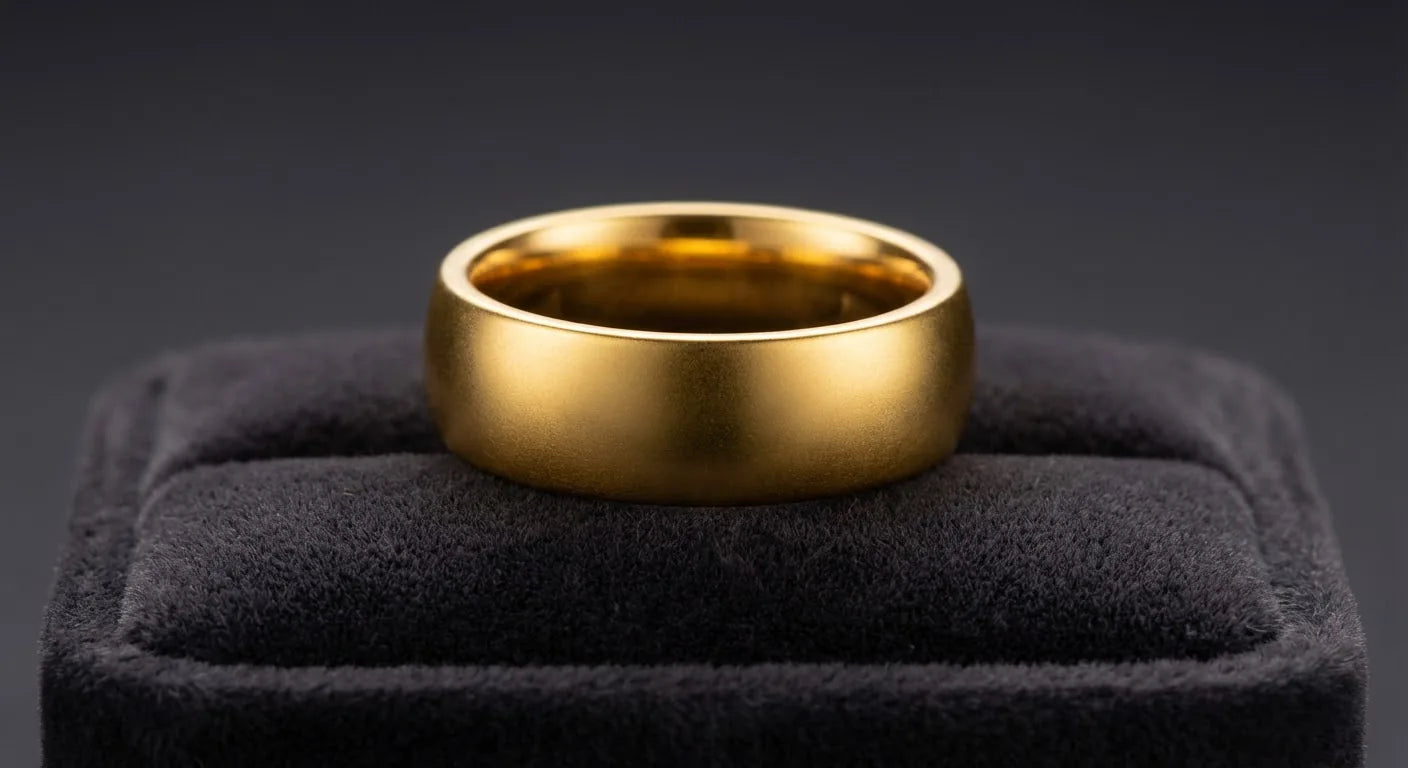
El sistema de quilates mide la pureza del oro en una escala del 1 al 24. En la cima: el oro de 24K es oro puro al 99.9% sin metales de aleación. Sin cobre. Sin plata. Sin zinc. Sin níquel. Solo oro.
En términos prácticos, esto significa tres cosas para los anillos. Primero, el oro de 24K es el metal más hipoalergénico que se puede usar. No hay aleaciones que puedan desencadenar una reacción, particularmente el níquel, que es el alérgeno más común en joyería y se encuentra en muchas formulaciones de 10K y 14K. Segundo, el color es inconfundible. El oro de 24K tiene el tono amarillo-naranja más profundo y cálido en el espectro de quilates, un color que las aleaciones de quilates más bajos no pueden replicar. Tercero, el oro de 24K es el oro más denso que se puede comprar. Con 19.32 g/cm3, un anillo de 24K pesa notablemente más que el mismo anillo hecho en 14K (aproximadamente 12.9 g/cm3).
Cada anillo genuino de 24K lleva un sello distintivo de 999 o 24K en la banda interior. Este sello es su verificación de que el anillo contiene oro puro al 99.9%. Si no está familiarizado con los sellos distintivos y cómo verificar la pureza del oro, cubrimos todos los métodos, desde pruebas de ácido hasta escaneo XRF, en nuestra guía de autenticación.
¿Es el oro de 24K demasiado blando para anillos? La verdad
Esto es lo que todas las otras guías le dicen: el oro de 24K es demasiado blando para la joyería. No lo compre. Quédese con 14K o 18K.
Esto es lo que le decimos después de fabricar anillos de oro de 24K en nuestro taller de Miami durante años: los anillos de oro de 24K no son frágiles, requieren un diseño intencional.
La diferencia de dureza es real. El oro de 24K mide aproximadamente 25 HV en la escala de dureza Vickers. Compare eso con el oro de 14K a 150-220 HV. Esa es una brecha significativa, y no vamos a fingir lo contrario. Una banda delgada de 2mm de 24K se deformaría con el uso diario. Eso es un hecho.
Pero el diseño compensa la suavidad. Así es como:
- Las bandas más anchas (6mm+) distribuyen la presión sobre una superficie mayor, reduciendo drásticamente el riesgo de doblarse.
- Los perfiles abovedados y redondeados resisten mejor la deformación que los perfiles planos y delgados porque la geometría curva es intrínsecamente más fuerte.
- Las texturas martilladas tienen un doble propósito: añaden carácter visual y ocultan los micro-arañazos que el oro puro desarrolla naturalmente con el tiempo.
- Las secciones transversales más gruesas añaden masa estructural. Nuestras bandas de 24K de 8mm y 13mm son piezas sustanciales que mantienen su forma.
Los anillos de oro de 24K están hechos para personas que rotan sus joyas, coleccionistas que quieren oro de calidad de inversión en sus manos, personas con alergias a metales que necesitan pureza sin aleaciones, y cualquiera que use oro para ocasiones culturales o ceremoniales. Si trabaja con sus manos todo el día y nunca se quita el anillo, una opción de 14K o 18K es la elección correcta. Conozca su estilo de vida y elija en consecuencia.
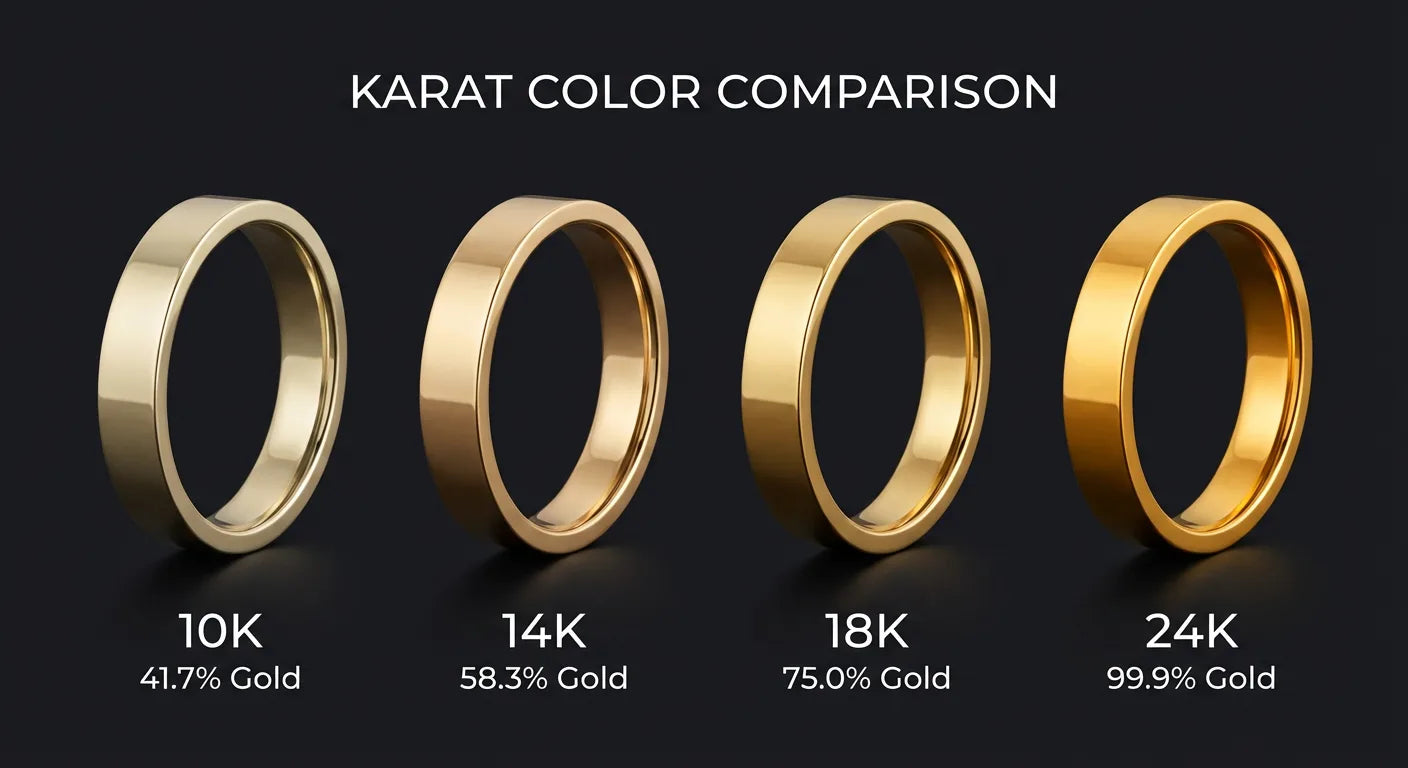
24K vs 18K vs 14K para anillos: la comparación completa
Elegir un quilate no se trata de cuál es el "mejor". Se trata de cuál es el mejor para su propósito. El 24K gana en pureza, color, propiedades hipoalergénicas y valor de inversión. El 14K gana en durabilidad diaria y resistencia a los arañazos. El 18K se sitúa en el medio. La siguiente tabla lo desglosa en nueve dimensiones.
| Criterios | Oro de 10K | Oro de 14K | Oro de 18K | Oro de 22K | Oro de 24K |
|---|---|---|---|---|---|
| Pureza del oro | 41.7% | 58.3% | 75.0% | 91.7% | 99.9% |
| Dureza Vickers (HV) | 170-250 | 150-220 | 120-180 | 45-70 | ~25 |
| Uso diario | Excelente | Excelente | Bueno | Limitado | Ocasional |
| Eventos formales/especiales | Bueno | Excelente | Excelente | Excelente | Excelente |
| Resistencia a los arañazos | Alta | Alta | Moderada | Baja | Muy Baja |
| Hipoalergénico | Bajo (aleaciones de Ni) | Moderado | Alto | Muy Alto | 100% (sin aleaciones) |
| Inversión / Valor de reventa | Bajo | Moderado | Alto | Muy Alto | El más alto |
| Riqueza de color | Amarillo pálido | Amarillo cálido | Amarillo intenso | Amarillo profundo | Amarillo-naranja más profundo |
| Peso (por volumen) | Más ligero | Ligero-Medio | Medio-Pesado | Pesado | El más pesado |
Algunas conclusiones clave de esa matriz. Si su prioridad es el uso diario con un mantenimiento mínimo, el 14K es la opción más práctica, lo suficientemente duro como para resistir los arañazos, lo suficientemente asequible para la confianza diaria. Si desea un color más rico y un mayor contenido de oro con una durabilidad razonable, el 18K es el punto dulce. Si su prioridad es la máxima pureza, el valor de inversión o la seguridad hipoalergénica, el 24K es inigualable.
Para una inmersión más profunda en las diferencias entre quilates más bajos, lea nuestra guía completa de comparación de quilates. Y si está decidiendo entre opciones de oro macizo y chapado, nuestro desglose de oro chapado vs. oro macizo cubre las diferencias de durabilidad y valor.
Comprar anillos de oro de 24K | Ver todos los anillos de oro
Tipos de anillos de oro de 24K que fabrica GOLDZENN
En GOLDZENN, no solo hablamos de anillos de oro de 24K, los fabricamos. Cada pieza a continuación está hecha a mano en nuestro taller de Miami con oro puro al 99.9%. Aquí está la línea completa.
Anillos de banda plana
La banda plana es la base de nuestra colección de 24K. Líneas limpias, diseño minimalista, máxima presencia de oro. Disponible en anchos de 4mm, 6mm, 8mm, 10mm y 13mm. La banda plana de 4mm es ideal para apilar, lo suficientemente estrecha como para usar dos o tres juntas. La banda plana de 8mm es el ancho diario más popular: sustancial sin ser voluminosa. Y la banda plana de 13mm de 1 onza es la pieza destacada, una onza troy completa (31.1 gramos) de oro puro al 99.9% en su dedo.

Anillos de banda martillada
El mismo rango de ancho que las bandas planas, pero con una textura martillada a mano que hace que cada anillo sea único. No hay dos bandas martilladas idénticas, cada golpe crea un patrón único. Más allá de la estética, la superficie martillada tiene un propósito práctico: oculta los micro-arañazos que se desarrollan naturalmente en el oro de 24K con el tiempo. La banda martillada de 8mm es una de las favoritas de los clientes por su equilibrio entre textura visual y peso cómodo.

Anillos Donut
El anillo donut tiene un perfil redondeado y orgánico que se curva suavemente contra el dedo. Es uno de los diseños de 24K más cómodos porque la forma redondeada distribuye el peso de manera uniforme y el interior liso se desliza fácilmente. El anillo donut martillado de 4mm combina esa comodidad redondeada con una superficie texturizada, perfecto para personas que desean oro puro con una sensación suave y natural.

Bandas de inversión de 1 onza
Estas son lingotes usables. Nuestras bandas de 1 onza de 10mm y 13mm contienen exactamente una onza troy (31.1 gramos) de oro de 24K. Su valor intrínseco de oro sigue directamente el precio al contado, lo que las hace populares entre inversores y coleccionistas que desean oro que puedan usar, no solo almacenar en una bóveda. Consulte nuestra guía de anillos de diamantes o explore nuestros anillos de diamantes si está considerando alternativas con piedras.
¿Qué tipo de anillo se adapta a su propósito?
| Tipo de anillo | Mejor quilate | ¿Adecuado para 24K? | Por qué |
|---|---|---|---|
| Alianza de boda de uso diario | 14K-18K | Con cuidado | Los perfiles más anchos (6mm+) en 24K resisten bien; quitar para trabajos manuales |
| Alianza de boda para ocasiones | 18K-24K | Sí | Se usa selectivamente; el 24K ofrece el tono de oro ceremonial más rico |
| Anillo de sello | 14K-18K | Limitado | Los detalles del grabado se suavizan rápidamente en 24K; el 14K mantiene los detalles finos por más tiempo |
| Anillo llamativo | 18K-24K | Sí | Las piezas llamativas se rotan, no se usan a diario; el color 24K llama la atención |
| Banda apilable | 24K | Ideal | Las bandas estrechas de 4mm se ajustan suavemente; la pátina de oro puro se desarrolla hermosamente con el tiempo |
| Anillo de compromiso | 14K-18K | Con adaptación de diseño | Los engastes de piedras necesitan dureza; el 24K funciona para biseles de solitario lisos pero no para engastes de garra |
| Anillo de inversión / coleccionista | 24K | La mejor opción | 99.9% de contenido de oro = el mayor valor de fundición; las bandas de 1 onza son lingotes usables |
| Cultural / Ceremonial | 22K-24K | Tradicional | Estándar en bodas chinas, vietnamitas, indias y de Oriente Medio |
Explore la colección completa de anillos de oro de 24K para ver todos los estilos, o llame al (321) 521-4651 para discutir qué diseño se adapta a sus necesidades.
Alianzas de boda de oro de 24K
Las alianzas de boda de oro de 24K ocupan un nicho específico y significativo. Son el estándar en las tradiciones matrimoniales chinas, vietnamitas, indias y de Oriente Medio, culturas donde el oro puro simboliza la prosperidad, la permanencia y el compromiso de una manera que los metales aleados no lo hacen. También son la elección para parejas donde uno de los cónyuges tiene alergia al níquel, ya que el 24K es la única opción de oro verdaderamente sin aleaciones.
Elegir el ancho adecuado
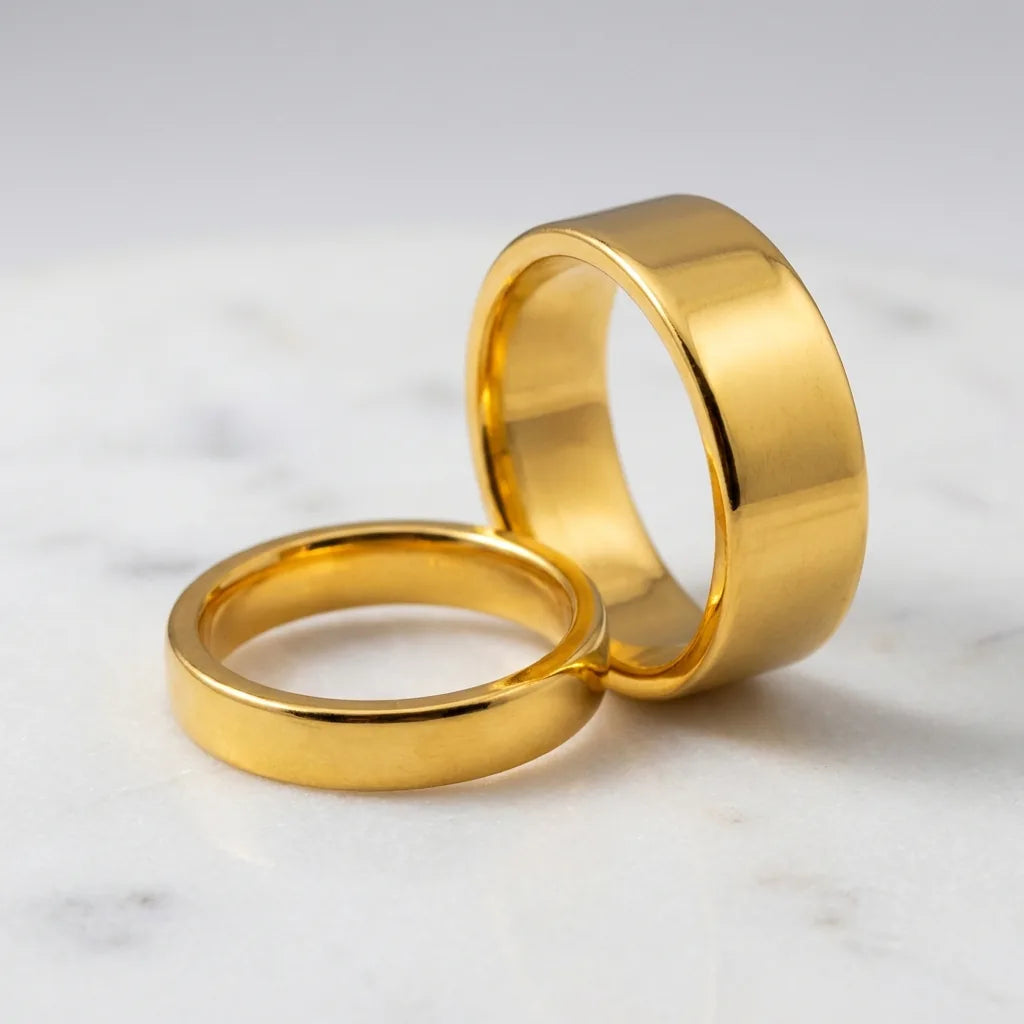
El ancho es la decisión más importante para una alianza de boda de 24K. Una banda de 4mm ofrece una elegancia discreta, lo suficientemente delgada para una sutileza diaria y a la vez ofrece el color profundo del 24K. Una banda de 6mm es el ancho clásico de las alianzas de boda: equilibrada, visible, tradicional. Una banda de 8mm o más ancha hace una declaración y le da al oro de 24K la integridad estructural para soportar años de uso.
Plana vs. martillada para bodas
Las bandas planas ofrecen un acabado limpio y pulido espejo que se fotografía bellamente y combina con cualquier estilo. Las bandas martilladas añaden un carácter orgánico; cada anillo se martilla a mano individualmente, por lo que no hay dos iguales. Para un conjunto de él y ella, considere anchos iguales en diferentes texturas: una banda martillada de 6mm combinada con una banda plana pulida de 6mm crea un conjunto coherente pero distinto.
El concepto de "alianza para ocasiones"
Muchas parejas usan una banda de 24K como su anillo para ocasiones o ceremonias —usado para eventos especiales, citas nocturnas y aniversarios— mientras conservan una banda de 14K o 18K para el uso diario. Este enfoque de rotación protege el anillo de 24K de escenarios de uso intensivo al tiempo que garantiza su presencia en los momentos más importantes. Lea nuestra guía de combinación de alianzas de boda para obtener más estrategias de emparejamiento, y consulte la guía de estilo de oro para hombres para obtener consejos sobre cómo coordinar su anillo con cadenas y relojes.
Precios
Todas las alianzas de boda GOLDZENN de 24K se fabrican bajo pedido. El precio depende del ancho, la talla del anillo y el peso del oro. Dado que el 24K es oro puro al 99.9%, el precio actual del oro al contado es el principal factor de costo. Contáctenos para una cotización personalizada: llame al (321) 521-4651 o envíe un correo electrónico a contact@goldzenn.com.
Explorar Anillos de Oro de 24K | Anillos de Boda para Hombres | Anillos de Compromiso
Guía de Peso, Tallas y Ajuste para Anillos de Oro de 24K
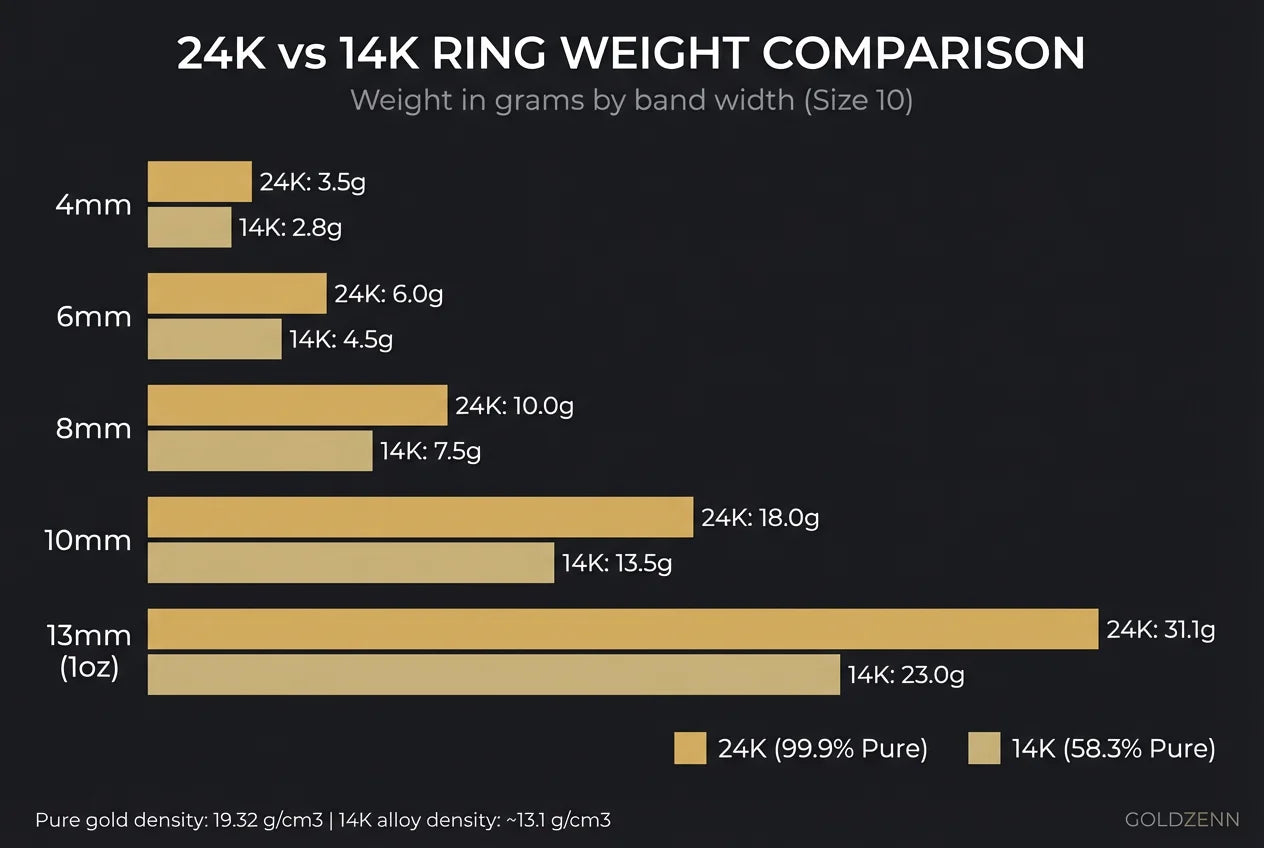
El oro de 24K es más denso que cualquier oro aleado. El oro puro tiene una densidad de 19.32 g/cm3 en comparación con aproximadamente 12.9 g/cm3 para el oro de 10K y 13.1 g/cm3 para el de 14K. En términos prácticos: un anillo de 24K de las mismas dimensiones pesa notablemente más que el mismo anillo en 14K. Ese peso es parte de la experiencia: sientes oro real en tu mano.
Peso por Ancho: 24K vs 14K
Así es como se comparan los pesos aproximados en cada ancho de banda (basado en una talla de anillo estándar 10):
- Banda de 4mm: ~3.5g (24K) vs ~2.8g (14K)
- Banda de 6mm: ~6.0g (24K) vs ~4.5g (14K)
- Banda de 8mm: ~10.0g (24K) vs ~7.5g (14K)
- Banda de 10mm: ~18.0g (24K) vs ~13.5g (14K)
- Banda de 13mm 1oz: ~31.1g (24K) vs ~23.0g (14K)
Consideraciones sobre el tamaño
Debido a que el oro de 24K es más blando que el oro aleado, puede adaptarse ligeramente a la forma de su dedo con el tiempo. Esto no es un defecto, es oro puro adaptándose a su anatomía. Pero sí significa que la precisión del tamaño es importante. Recomendamos un ajuste profesional en una joyería antes de realizar el pedido. Si está entre dos tallas, elija la talla más pequeña, ya que el oro de 24K se adaptará naturalmente al ajuste.
Para los anillos de 24K más pesados (bandas de 1 onza con 31.1 g), un interior de ajuste cómodo, ligeramente redondeado en la superficie interior, marca una diferencia significativa en la comodidad de uso diario. Todas las bandas de 24K de GOLDZENN están diseñadas pensando en la comodidad. Contáctenos en contact@goldzenn.com con su talla de anillo y ancho preferido para una cotización personalizada.
Cómo se Hacen los Anillos de Oro de 24K
Trabajar con oro de 24K es fundamentalmente diferente a trabajar con oro aleado. El oro puro requiere técnicas especializadas que la mayoría de los talleres simplemente no practican, porque la mayoría de los talleres no trabajan con oro de 24K.
Recocido
El oro de 24K se endurece por trabajo de manera diferente a las aleaciones. Durante el moldeo, el metal se vuelve quebradizo más rápido, requiriendo un recocido frecuente, un proceso de tratamiento térmico que restaura la maleabilidad aliviando el estrés interno. Nuestro equipo recoce las piezas de 24K varias veces durante el proceso de formación, mucho más a menudo de lo que lo haríamos con 14K o 18K.
Acabado a Mano sobre Estampado a Máquina
Debido a que el oro de 24K es blando, el simple moldeado no produce un anillo terminado. Cada pieza de 24K moldeada requiere un cuidadoso acabado a mano: lijado, pulido y moldeado para lograr el perfil final. Las texturas martilladas se crean a mano, golpe a golpe, no se estampan con una máquina. Esto es lo que hace que cada anillo GOLDZENN de 24K sea único.
Hecho a Pedido
Cada anillo de oro de 24K de GOLDZENN es elaborado individualmente por nuestro equipo de taller con más de 50 años de experiencia combinada. No producimos en masa en 24K porque el material no permite atajos. Cada anillo se hace a su tamaño y especificaciones exactas.
Vea nuestro proceso de taller en YouTube: @GOLDZENNJWL (más de 20,000 suscriptores, más de 335 videos que documentan nuestra artesanía).
Valor de Inversión y Reventa: Por Qué los Anillos de 24K Mantienen su Valor
Los anillos de oro de 24K tienen el valor intrínseco mínimo más alto de cualquier quilate porque no hay dilución de aleación. Cada gramo de un anillo de 24K es oro puro. Compare eso con un anillo de 14K, donde solo el 58.3% del metal es oro, el resto es cobre, plata y zinc con un valor independiente mínimo.
Cálculo del Valor de Fusión
El valor base de cualquier anillo de oro es simple: peso en gramos x precio spot actual del oro por gramo. Para un anillo de 24K de 1 onza (31.1 g), se multiplica 31.1 por el precio spot actual. Ese número es su valor base, el valor mínimo de su anillo en cualquier momento en el futuro, independientemente del diseño o la marca. El valor de reventa real suele ser más alto porque los refinadores pagan una prima por el oro de 24K que no requiere separación de aleaciones.
Ahora aplique esa matemática a un anillo de 14K del mismo peso total. Un anillo de 14K de 31.1g contiene solo 18.1 gramos de oro real (31.1 x 0.583). El resto es aleación. El anillo de 24K contiene 72% más de oro puro en peso, y esa diferencia va directamente a su resultado final en la reventa.
Lingotes Portátiles
Los lingotes y monedas de oro se guardan en una caja fuerte. Un anillo de oro de 24K se lleva en el dedo. Nuestra banda plana de 13 mm y 1 onza y nuestra banda plana de 10 mm y 1 onza son la alternativa práctica a los lingotes tradicionales: oro de grado de inversión en un formato que realmente puede disfrutar. El valor intrínseco sigue el precio spot. El anillo en sí le brinda una utilidad que un lingote nunca tendrá.
Para una visión más amplia de las características de inversión del oro, consulte nuestra guía sobre joyas de oro como inversión, nuestra guía de inversión en joyas de lujo y nuestra guía de tasación de joyas para las mejores prácticas de documentación.
Cómo Verificar que su Anillo de Oro de 24K es Auténtico
Si está gastando dinero real en un anillo de oro de 24K, la verificación no es negociable. Aquí están los métodos, clasificados del más al menos confiable.
Las pruebas XRF (fluorescencia de rayos X) son el estándar de oro. Una pistola XRF escanea la superficie del metal y devuelve una lectura exacta de pureza, de forma no destructiva. En GOLDZENN, verificamos cada pieza de 24K con XRF antes de que salga del taller. Cualquier joyero de buena reputación debería estar dispuesto a proporcionar la verificación XRF bajo petición.
Los sellos de contraste son su primera verificación visual. Los anillos de oro auténtico de 24K llevan un sello 999, .999 o 24K en la banda interior. La marca 999 significa que 999 partes por mil son oro puro. Si el sello dice 750, se trata de 18K. Si dice 585, es 14K. La ausencia de sello es una señal de alerta.
La prueba de gravedad específica utiliza el desplazamiento de agua para medir la densidad. El oro de 24K tiene una gravedad específica de 19.32 g/cm3, significativamente más alta que la mayoría de las imitaciones. Una simple prueba de Arquímedes en casa puede confirmar si la densidad de un anillo coincide con la del oro puro.
La prueba de ácido es el método tradicional. Se expone un pequeño rasguño en un área discreta a reactivos ácidos. La reacción (o la falta de ella) indica la pureza. Funciona, pero es ligeramente destructiva.
Prueba del imán: El oro no es magnético. Si un anillo responde a un imán de neodimio potente, no es oro. Esta prueba descarta las falsificaciones pero no puede confirmar la pureza.
Para un desglose completo de cada método de autenticación, consulte nuestra guía completa para detectar oro real.
Cómo Cuidar un Anillo de Oro de 24K
El oro de 24K no se deslustra. No se corroe. No se oxida. El oro es uno de los elementos menos reactivos de la tabla periódica y, con una pureza del 99.9%, no hay metales de aleación que causen decoloración. Su anillo de 24K mantendrá su color amarillo intenso indefinidamente. Pero la suavidad exige un manejo cuidadoso.
Retirar Antes de
- Gimnasio y ejercicio: la presión de agarre y el equipo metálico pueden abollar el oro puro.
- Trabajo manual y jardinería: los impactos directos dejarán marcas.
- Dormir: la presión sostenida contra un colchón o cabecero puede causar una deformación sutil con el tiempo.
- Levantar objetos pesados: barras, muebles, comestibles con bordes afilados.
Limpieza
Agua tibia, unas gotas de jabón suave para platos y un paño de microfibra suave. Eso es todo lo que necesita. Sumerja el anillo durante 5-10 minutos, limpie suavemente, enjuague con agua limpia y seque con golpecitos. No utilice limpiadores ultrasónicos: las vibraciones de alta frecuencia pueden dañar el oro puro. No utilice productos químicos agresivos, limpiadores abrasivos ni soluciones a base de amoníaco. Para el protocolo completo, consulte nuestra guía completa de limpieza de oro.
Almacenamiento
Guarde los anillos de 24K en compartimentos individuales forrados de terciopelo. Nunca junte un anillo de 24K con metales más duros; un anillo de 14K rayará un anillo de 24K al contacto. Cada pieza debe tener su propio espacio dedicado.
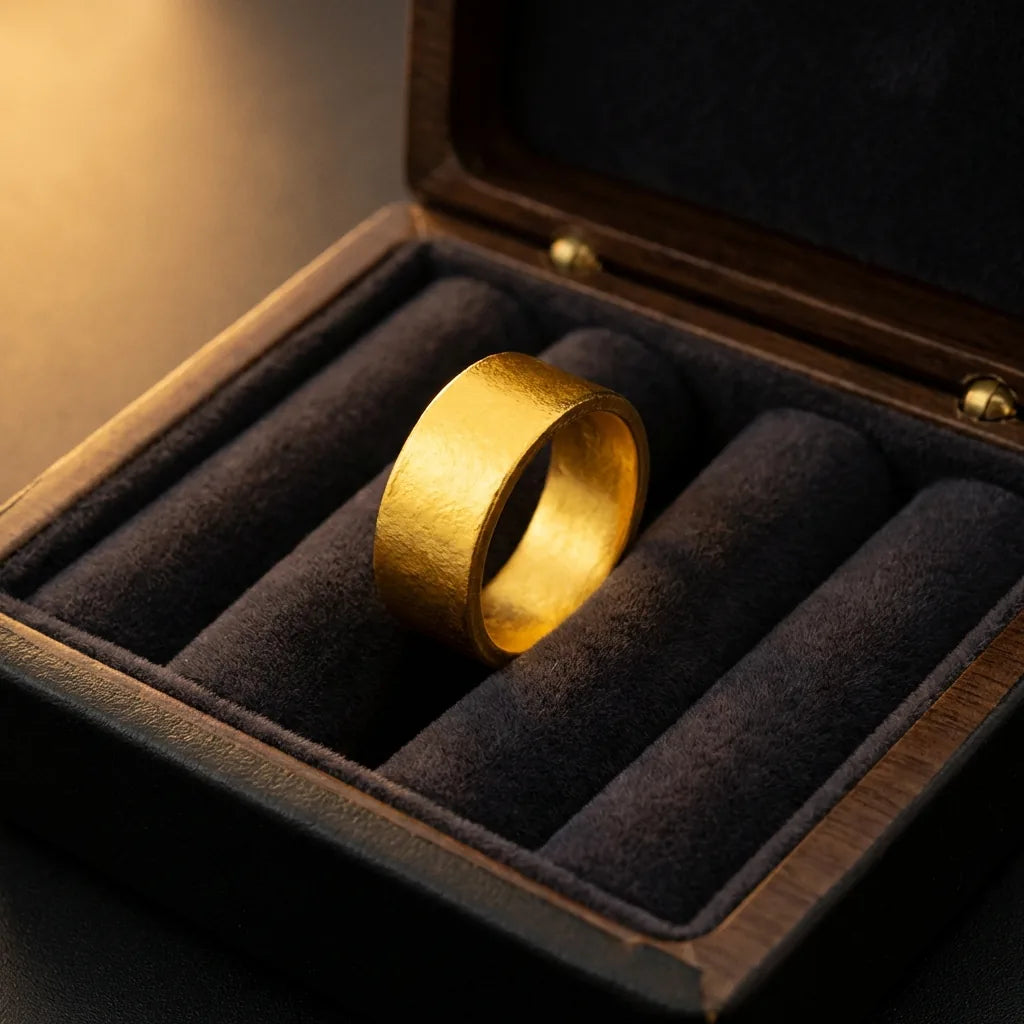
Mantenimiento Profesional
Un joyero puede volver a pulir un anillo de 24K para restaurar su brillo original, normalmente cada 1-2 años para anillos de uso regular. Si un anillo de 24K desarrolla una ligera ovalidad con los años de uso, un joyero puede volver a redondearlo sin pérdida de oro. Considere un seguro de joyería para piezas de 24K de alto valor.
Por qué GOLDZENN para Anillos de Oro de 24K
- Hecho a mano en Miami por nuestro equipo de taller con más de 50 años de experiencia combinada.
- Cada pieza de 24K verificada con pruebas de pureza XRF antes del envío.
- Más de 295 reseñas en Google con 4.9 estrellas.
- Más de 3,900 reseñas de productos en Judge.me.
- Garantía de por vida contra defectos de fabricación.
- Envío asegurado en cada pedido.
Contacto: (321) 521-4651 | contact@goldzenn.com | Comprar Anillos de Oro de 24K
Preguntas Frecuentes sobre los Anillos de Oro de 24K
¿Es el oro de 24K demasiado blando para un anillo?
El oro de 24K es más blando que el oro aleado (25 HV de dureza Vickers frente a más de 150 para el 14K), pero no es demasiado blando para un anillo si el diseño lo tiene en cuenta. Las bandas más anchas (6 mm o más), los perfiles abovedados y las texturas martilladas añaden integridad estructural. Los anillos de 24K se usan en todo el mundo para bodas, ceremonias culturales y fines de inversión. Quítelos antes de realizar trabajos manuales pesados.
¿Se puede usar un anillo de oro de 24K todos los días?
Puede usar un anillo de oro de 24K a diario si elige una banda más ancha (6 mm o más) y se lo quita durante actividades que apliquen presión, como el gimnasio, el trabajo manual o el levantamiento de objetos pesados. Muchas personas usan alianzas de 24K a diario durante años. La clave es adaptar el ancho del anillo a su estilo de vida y alternar los días de mayor uso con una alternativa de 14K o 18K.
¿Cuánto cuesta un anillo de oro de 24K?
El precio de un anillo de oro de 24K depende del peso (gramos), el ancho y la complejidad del diseño. Debido a que el oro de 24K es 99.9% puro, el contenido de oro por sí solo impulsa la mayor parte del costo. Todos los anillos de 24K de GOLDZENN se hacen bajo pedido; contáctenos al (321) 521-4651 o por correo electrónico a contact@goldzenn.com para obtener una cotización personalizada basada en su talla y estilo preferido.
¿Cuánto vale un anillo de oro de 24K?
El valor intrínseco de un anillo de oro de 24K es igual a su peso en gramos multiplicado por el precio spot actual del oro por gramo. Un anillo de 24K de 1 onza (31.1 g) contiene 31.1 gramos de oro puro. A diferencia de los anillos de 14K (que contienen solo un 58.3% de oro), los anillos de 24K mantienen su peso total en contenido de oro puro, lo que los convierte en el quilate de mayor valor para la reventa.
¿Cuál es la diferencia entre los anillos de oro de 24K y 18K?
El oro de 24K es oro 99.9% puro; el 18K es 75% oro mezclado con 25% de metales de aleación (cobre, plata, zinc). El 24K es más blando, más pesado, de un amarillo más intenso y más valioso por gramo. El 18K es más duro, más resistente a los arañazos y mejor para el uso diario con engastes de piedras. Elija 24K por su pureza, valor de inversión y necesidades hipoalergénicas. Elija 18K por su durabilidad diaria.
¿Es el oro de 24K hipoalergénico?
Sí. El oro de 24K es la única opción de oro verdaderamente hipoalergénica porque no contiene metales de aleación. La alergia al níquel, la alergia a metales más común, es imposible con el oro de 24K ya que no hay níquel presente. Si experimenta irritación en la piel por anillos de oro de 10K o 14K, un anillo de 24K elimina por completo ese problema.
¿Es un anillo de oro de 24K una buena inversión?
Los anillos de oro de 24K ofrecen el valor intrínseco del oro más alto de cualquier quilate. Una banda de 24K de 1 onza contiene 31.1 gramos de oro puro cuyo valor base sigue directamente el precio spot. A diferencia de las monedas o los lingotes, un anillo de 24K es portátil, lo que le brinda utilidad y valor de inversión. La reventa es sencilla porque los refinadores pagan las primas más altas por el 24K sin necesidad de separación de aleaciones.
¿Cómo se puede saber si un anillo es de oro de 24K auténtico?
Busque un sello distintivo de 999, .999 o 24K en la banda interior. Para una verificación definitiva, solicite una prueba XRF (fluorescencia de rayos X), un escaneo no destructivo que lee la pureza exacta del oro. GOLDZENN verifica cada pieza de 24K con pruebas XRF. Verificaciones adicionales: el oro de 24K no es magnético, tiene una gravedad específica de 19.32 g/cm3 y muestra el color amarillo anaranjado más intenso de cualquier quilate.
¿Qué es un anillo de oro de 1 onza?
Un anillo de oro de 1 onza contiene exactamente una onza troy (31.1 gramos) de oro. En GOLDZENN, nuestros anillos de 1 onza están elaborados en 24K (oro 99.9% puro) en anchos de 10mm y 13mm. Funcionan como lingotes portátiles: oro de grado de inversión que puede usar en su dedo. El valor intrínseco del oro sigue directamente el precio spot, lo que los hace populares entre coleccionistas e inversores.
¿Se empañan los anillos de oro de 24K?
No. El oro de 24K no se deslustra, corroe ni oxida. El oro es uno de los elementos menos reactivos de la tabla periódica, y con una pureza del 99.9%, no hay metales de aleación presentes que puedan causar decoloración. Su anillo de 24K mantendrá su color amarillo intenso indefinidamente con un cuidado básico.
Explore nuestra colección completa: Comprar Anillos de Oro de 24K
¿Preguntas? Llame al (321) 521-4651 o envíe un correo electrónico a contact@goldzenn.com.
Siga nuestra artesanía en YouTube: @GOLDZENNJWL
Para una visión más amplia de todos los estilos de anillos más allá del 24K, incluyendo tablas de tallas, educación sobre diamantes y precios en 307 productos, lea nuestra guía completa de anillos para hombres.
