Los anillos de hombre han sido símbolos de poder, compromiso e identidad personal durante más de 5,000 años, y en 2026, son más relevantes que nunca. Se proyecta que el mercado mundial de joyería masculina supere los $9 mil millones para 2030, con los anillos ocupando constantemente el puesto de la categoría más popular después de las cadenas. Ya sea que esté comprando una alianza de boda, buscando su primer anillo de sello, o buscando una pieza de diamante llamativa que capte la atención, esta guía cubre todo: tipos de anillos, metales, pureza del oro, ciencia del tamaño, comparaciones de ancho, reglas de estilo, cuidado, valor de inversión y precios reales de la colección de 307 anillos de GOLDZENN. Sin conjeturas, sin adornos, solo el conocimiento de un maestro joyero respaldado por datos. Explore nuestra guía de cadenas de oro extra largas.
En GOLDZENN, elaboramos y seleccionamos a mano anillos de hombre en oro macizo de 10K, 14K y 24K, engastados con diamantes naturales, diamantes cultivados en laboratorio y moissanita. Nuestro taller de Miami cuenta con más de 50 años de experiencia combinada en la fabricación de joyas, y cada pieza se envía con una garantía de por vida en defectos de fabricación. Con más de 300 reseñas de Google con 4.8 estrellas y más de 3,900 reseñas verificadas de productos en Judge.me, nos hemos ganado la confianza de miles de clientes que exigen calidad. Esta guía le ayudará a encontrar exactamente el anillo adecuado, y a comprender precisamente por lo que está pagando.
Tipos de anillos para hombre: todos los estilos explicados
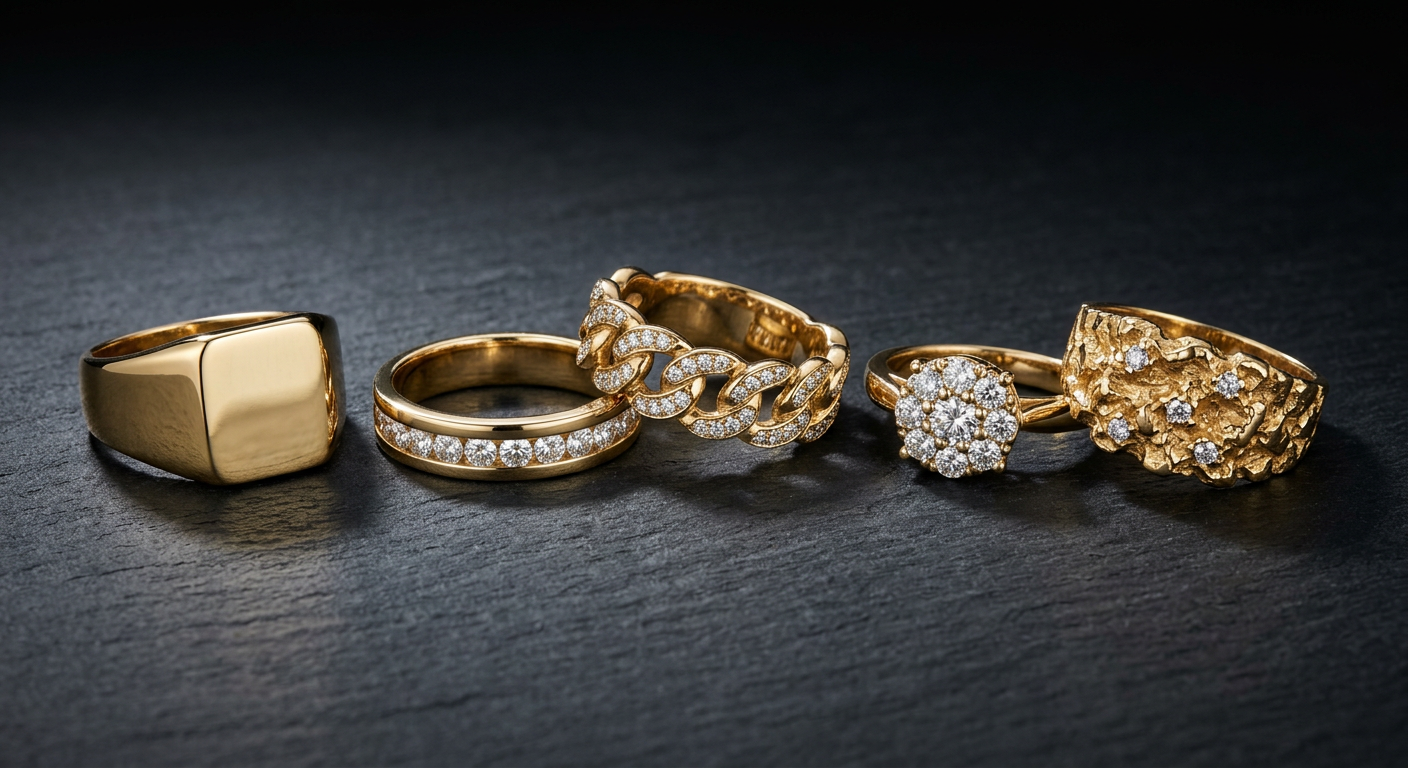
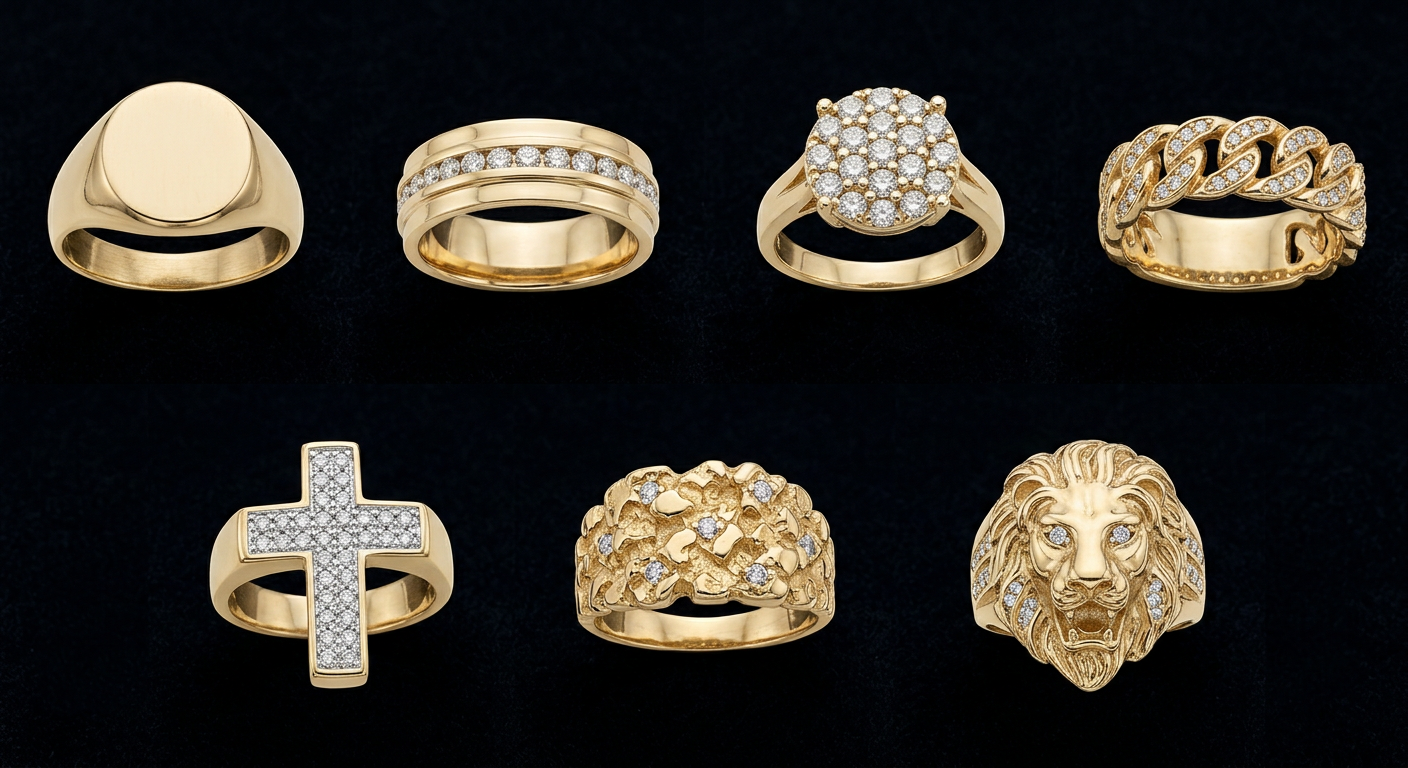
El mundo de los anillos para hombre se extiende mucho más allá de la sencilla alianza de boda. El mercado actual ofrece docenas de estilos distintos, cada uno con su propia historia, propósito y público. Aquí tiene un desglose completo de cada categoría principal de anillos, con precios reales del catálogo de GOLDZENN para que sepa exactamente qué esperar.
Anillos de sello: herencia, identidad y estilo moderno
El anillo de sello es uno de los estilos de anillo más antiguos de la historia de la humanidad, que se remonta a la antigua Mesopotamia alrededor del 3500 a. C., donde servían como sellos personales estampados en cera para autenticar documentos y marcar propiedades. Los faraones egipcios, los senadores romanos y la nobleza europea medieval usaban sellos como símbolos de autoridad. La superficie superior plana, llamada "mesa", tradicionalmente llevaba un escudo familiar, un monograma o un escudo de armas grabado a la inversa para que se leyera correctamente al estamparlo en cera. Descubra más en nuestros anillos de pepitas de oro.
Hoy en día, los anillos de sello han evolucionado de herramientas funcionales a poderosas declaraciones de estilo. El sello moderno se usa en el dedo meñique o en el anular y comunica herencia, confianza y gusto refinado sin decir una palabra. A diferencia de los anillos de moda producidos en masa, un anillo de sello de calidad en oro macizo es una pieza que puede usar todos los días durante décadas y, finalmente, transmitir. Para los hombres que quieren un solo anillo que funcione en una sala de juntas, en una boda o con ropa de fin de semana, el sello es la elección definitiva.
Alianzas de boda: tradiciones, materiales y diseños modernos
La alianza de boda sigue siendo el anillo de hombre más usado en todo el mundo. Si bien la tradición de intercambiar anillos se remonta a la antigua Roma, donde las bandas de hierro simbolizaban el acuerdo legal vinculante del matrimonio, las alianzas de boda modernas están disponibles en una extraordinaria gama de estilos. GOLDZENN ofrece 71 estilos de alianzas de boda que van desde $369.55 en plata de ley hasta $12,989.70 para una banda de eternidad de diamantes de 4 quilates en oro de 14K.
Los estilos populares de alianzas de boda incluyen bandas de diamantes engastadas en canal (diamantes asegurados entre dos paredes de metal para una superficie lisa y sin enganches), bandas de pavé (pequeños diamantes engastados en toda la superficie para un brillo máximo), bandas de milgrain (con un fino detalle de borde perlado para un carácter vintage) y bandas clásicas de oro liso. Para las parejas que compran juntas, GOLDZENN ofrece conjuntos de trío a partir de $933.34 que incluyen bandas a juego para él y para ella, además de un anillo de compromiso. Para una guía detallada sobre cómo combinar su alianza de boda con un anillo de compromiso, lea nuestra guía completa de combinación de alianzas de boda.
Anillos de diamantes en racimo: máximo impacto, valor inteligente
Los anillos de diamantes en racimo agrupan múltiples diamantes más pequeños en una disposición geométrica (redonda, rectangular, circular o cuadrada) para crear un impacto visual que rivaliza con una sola piedra grande a una fracción del costo. Este principio de diseño es la razón por la que los anillos en racimo se encuentran entre los estilos de anillos para hombre más vendidos: se obtiene un brillo espectacular sin el precio de un solitario raro y de gran quilate. La colección de anillos en racimo de GOLDZENN abarca 31 diseños desde $568.65 hasta el racimo rectangular de 2 CTW a $4,888.35. El Racimo de Diamantes CEO en Oro de 14K ($1,921.23) es un anillo destacado, audaz y listo para la sala de juntas que proyecta autoridad. Para más opciones de anillos de diamantes, consulte nuestra guía de anillos de diamantes.
Anillos de eslabones cubanos: el lujo urbano se une a la joyería fina
Los anillos de eslabones cubanos miniaturizan el icónico patrón de eslabones entrelazados, famoso por las cadenas de eslabones cubanos, en un audaz formato de anillo. Estos anillos representan una de las categorías distintivas de GOLDZENN, disponibles en anchos de 8 mm y 10 mm con engastes de diamantes o moissanita. Disponibles en oro amarillo, oro blanco y oro rosa, los anillos de eslabones cubanos se fabrican bajo pedido con un plazo de entrega de 16 a 23 días para la artesanía personalizada. Los precios comienzan en $916.78 para una opción de moissanita de 10 mm y llegan hasta $2,936.14 para las versiones de diamantes completamente heladas. Las tallas van de la 7 a la 13.5. Lea nuestra guía de estilo de anillos de eslabones cubanos dedicada para ideas de combinación.
Anillos de cruz y religiosos: la fe se une a la artesanía
Los anillos religiosos tienen un profundo significado personal y se encuentran entre las piezas más detalladas del catálogo de cualquier joyero. La colección de GOLDZENN incluye 13 diseños de anillos de cruz y religiosos, desde el Racimo de Diamantes en forma de cruz por $1,499.40 hasta el extraordinario Anillo de Cruz de Jesús de Diamantes de 3.75 CTW por $7,739.25, una pieza de exhibición con casi cuatro quilates de diamantes engastados en un detallado motivo de cruz. Otros diseños incluyen manos en oración, cruces ankh y sutiles alianzas de boda acentuadas con cruces. Estas son piezas llamativas que combinan el significado espiritual con una artesanía seria.
Anillos de declaración y motivo: lleva tu identidad
Los anillos de declaración son iniciadores de conversación. La colección de GOLDZENN incluye diseños atrevidos con motivos que le permiten mostrar su personalidad: el Anillo de Diamantes con Cara de León de 1 3/4 CTW ($5,398.35) para una presencia imponente, el Anillo de Águila de Diamantes ($1,708.50) para fuerza y libertad, el Anillo de Herradura ($749.70) para la buena fortuna, y el Anillo "El Mundo es Tuyo" ($4,857.75), una declaración de diamantes de 1 3/8 CTW en oro de 10K. Para aquellos que se sienten atraídos por el estilo de anillos "iced out", estas piezas ofrecen el máximo impacto visual.
Anillos de moda con diamantes: elegancia diaria
Las bandas de diamantes de moda cierran la brecha entre las alianzas lisas y los anillos de declaración completos. Son anillos de uso diario con elementos de diseño distintivos: bordes escalonados, texturas martilladas, patrones de trébol y acabados de oro multitono. Los 40 estilos de bandas de moda de GOLDZENN van desde $538.05 hasta la Banda de oro de 14K de tres tonos de 1/4 CTW a $4,049.40. La Banda de diamantes martillados ($1,468.80) es una pieza destacada: su superficie texturizada combina maravillosamente con otros anillos para un look en capas.
Anillos de compromiso: la propuesta moderna
La colección de anillos de compromiso de GOLDZENN abarca 49 diseños en oro de 10K y 14K, con formas de diamantes redondos, ovalados, pera, princesa, esmeralda y cojín en engastes solitarios, halo, doble halo y de tres piedras. Están disponibles opciones de diamantes naturales y cultivados en laboratorio. Los precios oscilan entre $507.45 para un anillo de compromiso de oro de 10K y $5,939 para un diseño de halo de medio quilate de 14K premium. Los diamantes cultivados en laboratorio ofrecen las mismas propiedades físicas y ópticas que las piedras naturales a un costo entre un 60% y un 85% menor; el anillo de diamante ovalado cultivado en laboratorio de 2 CTW en oro de 14K ($2,462.50) demuestra claramente este valor. Visite nuestra colección de anillos de compromiso para explorar todas las opciones.
| Estilo de anillo | Ideal para | Ancho típico | Rango de precios GOLDZENN | Productos |
|---|---|---|---|---|
| Alianzas de boda | Matrimonio, uso diario | 4 mm – 8 mm | $369 – $12,989 | 71 |
| Racimo de diamantes | Brillo audaz, ocasiones especiales | Cara de 10 mm – 18 mm | $568 – $4,888 | 31 |
| Eslabón cubano | Lujo urbano, moda | 8 mm – 10 mm | $916 – $2,936 | 4 |
| Cruz/Religioso | Fe, regalos significativos | Cara de 12 mm – 20 mm | $599 – $7,739 | 13 |
| Pepita | Estilo clásico, rústico | Cara de 8 mm – 14 mm | $1,708 – $2,728 | 6 |
| Declaración/Motivo | Personalidad, conversación | Cara de 12 mm – 22 mm | $749 – $5,398 | Más de 10 |
| Bandas de moda | Elegancia cotidiana | 4 mm – 8 mm | $538 – $4,049 | 40 |
| Compromiso | Propuestas, hitos | Banda de 2 mm – 4 mm | $507 – $5,939 | 49 |
Materiales de los anillos: lo que todo hombre debe saber
El metal que elija define el color, el peso, la durabilidad, las propiedades hipoalergénicas y el valor a largo plazo de un anillo. Aquí tiene un desglose práctico de cada metal principal para anillos, con evaluaciones honestas de cada uno.
Oro (amarillo, blanco y rosa) — El estándar atemporal
El oro es el metal definitivo para los anillos y lo ha sido durante milenios. Su brillo cálido no se oxida ni se corroe, puede ser redimensionado y reparado por cualquier joyero cualificado, y los anillos de oro macizo conservan un valor de fundición real como activo. GOLDZENN se especializa en anillos de oro macizo, no chapados, no rellenos, sino oro macizo genuino.
El oro amarillo es la opción clásica: de tono cálido y universalmente favorecedor para todos los tonos de piel. El oro blanco está aleado con paladio o níquel y recubierto con rodio para un acabado blanco plateado; ofrece un aspecto contemporáneo pero requiere un nuevo baño de rodio cada 12-18 meses para mantener su brillo. El oro rosa está aleado con cobre para un distintivo tono rosa cálido que ha aumentado en popularidad. Los anillos de eslabones cubanos de GOLDZENN están disponibles en los tres colores de oro.
Platino: máxima durabilidad y prestigio
El platino es más denso, más raro y más duradero que el oro. No se desgasta, se desplaza, desarrollando una pátina que muchos consideran deseable. Un anillo de platino pesará notablemente más que el mismo diseño en oro, y es naturalmente hipoalergénico (sin aleación de níquel). La desventaja es el costo: los anillos de platino suelen tener un recargo del 30 al 50% sobre las piezas de oro de 14K comparables, y el platino se raya más visiblemente (aunque el metal no se pierde, solo se mueve). Para los hombres que desean el metal más pesado y prestigioso y no les importa un pulido profesional ocasional, el platino es el nivel superior.
Titanio y tungsteno: alternativas modernas y ligeras
El titanio es extremadamente ligero (aproximadamente un 45% más ligero que el acero) y naturalmente hipoalergénico, lo que lo hace popular entre los hombres con alergias al níquel o aquellos a quienes no les gusta el peso del oro. El carburo de tungsteno es el metal para anillos más duro disponible comercialmente, prácticamente a prueba de arañazos. El inconveniente crítico de ambos: no se pueden redimensionar, y el tungsteno no se puede cortar en una emergencia con los cortadores de anillos estándar (debe romperse). Ninguno de los materiales tiene un valor de reventa o de fundición significativo. Estos metales sirven para hombres que desean anillos de bajo mantenimiento y asequibles, pero no están en la misma categoría que los metales preciosos en cuanto a valor a largo plazo.
Plata de ley y acero inoxidable: puntos de entrada accesibles
La plata de ley (92.5% de plata pura) ofrece un acabado brillante y de tono frío a un precio accesible. GOLDZENN ofrece una pequeña selección de opciones de anillos de plata de ley a partir de $178.50. La plata se deslustra y requiere pulido regular. El acero inoxidable es el metal para anillos más asequible y es muy duradero, pero tiene un valor de reventa mínimo y no se puede redimensionar. Para los hombres que están explorando anillos por primera vez y quieren experimentar con el estilo antes de comprometerse con el oro, la plata y el acero sirven como puntos de partida razonables, pero la mayoría de los hombres se pasan al oro macizo una vez que experimentan la diferencia en peso, color y prestigio.
| Metal | Durabilidad | Peso | Valor de reventa | Redimensionable | Hipoalergénico | Mantenimiento |
|---|---|---|---|---|---|---|
| Oro 10K | Excelente (aleación de oro más dura) | Medio | Sí (valor de fusión) | Sí | Moderado (aleación de níquel) | Bajo |
| Oro 14K | Muy bueno | Medio-pesado | Sí (mayor valor de fusión) | Sí | Bueno | Bajo |
| Oro 18K | Bueno (más blando) | Pesado | Sí (alto valor de fusión) | Sí | Muy bueno | Bajo-Medio |
| Oro 24K | Bajo (muy blando) | El más pesado | Sí (valor de fusión máximo) | Sí | Sí (oro puro) | Alto (propenso a arañazos) |
| Platino | Excelente | El más pesado | Sí (metal precioso) | Sí | Sí | Medio (pulido) |
| Titanio | Muy bueno | Muy ligero | Mínimo | No | Sí | Muy bajo |
| Tungsteno | Más alto (a prueba de arañazos) | Pesado | Ninguno | No | Sí | Muy bajo |
| Plata de ley | Moderado | Ligero | Mínimo | Sí | Generalmente sí | Alto (deslustre) |
Guía de pureza del oro: 10K vs 14K vs 18K vs 24K para anillos
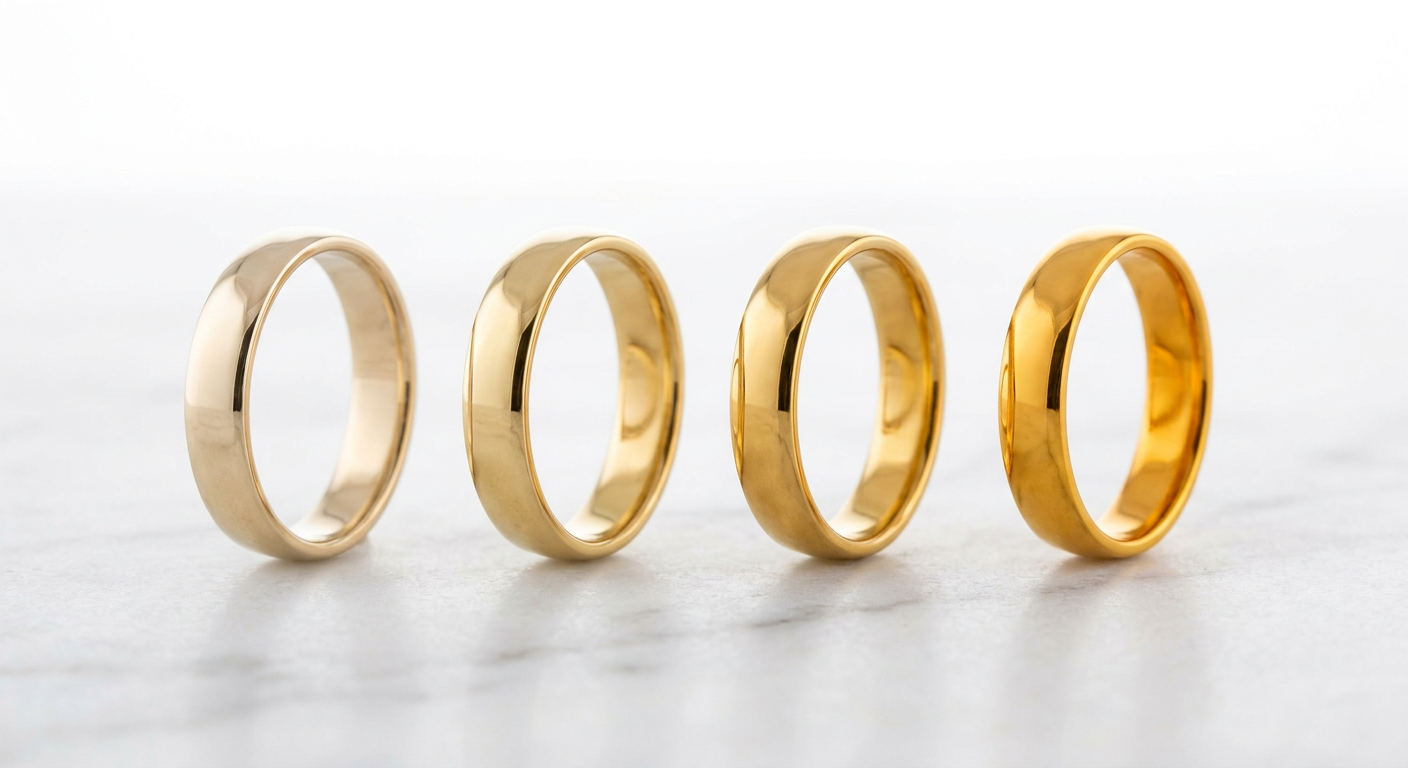
La pureza del oro se mide en quilates (K), indicando la proporción de oro puro en la aleación. Esta es la decisión más importante al comprar un anillo de oro, ya que determina el color, la dureza, el peso, el precio y el valor a largo plazo. La mayoría de los otros minoristas pasan por alto esto por completo. Aquí está lo que realmente necesita saber.
| Propiedad | Oro 10K | Oro 14K | Oro 18K | Oro 24K |
|---|---|---|---|---|
| Contenido de oro | 41.7% | 58.3% | 75.0% | 99.9% |
| Durabilidad | Más duradero: la mejor resistencia a los arañazos | Excelente equilibrio entre dureza y belleza | Más blando: más propenso a las marcas superficiales | Muy blando: no recomendado para uso diario |
| Color | Tono dorado más claro y sutil | Oro clásico cálido | Oro rico y profundo | Oro puro intenso y saturado |
| Sensación de peso | El más ligero | Medio | Más pesado | El más pesado |
| Riesgo de alergia | Mayor (más níquel en la aleación) | Menor | Muy bajo | Ninguno (oro puro) |
| Rango de precios de anillos GOLDZENN | $479 – $7,739 | $599 – $12,989 | Disponible bajo pedido personalizado | Colección de bandas de 24K |
| Inventario de GOLDZENN | 182 productos de anillos | 119 productos de anillos | Pedido personalizado | Colección 24K |
| Mejor para | Uso diario, estilos de vida activos, compradores conscientes del valor | Alianzas de boda, bandas de moda, lujo diario | Ocasiones especiales, coleccionistas, inversión | Ceremonial, inversión, piezas de herencia |
¿Qué quilate es el adecuado para ti? Para los hombres que usan su anillo todos los días —en el trabajo, en el gimnasio, mientras viajan— el oro de 10K ofrece la mejor durabilidad al precio más accesible. Para alianzas de boda y anillos que quieras usar a diario priorizando un color de oro más intenso, el 14K es el estándar de oro (literalmente). Para anillos de ocasiones especiales, piezas de herencia y hombres que prefieren un tono de oro profundo y cálido, el 18K ofrece una belleza inigualable. Y para los hombres que quieren la expresión más pura del oro —las bandas de oro de 24K están disponibles en la colección dedicada de GOLDZENN, aunque su suavidad las hace más adecuadas para uso ocasional.
Para una inmersión completa en la pureza del oro —incluyendo cómo cada quilate afecta el valor de reventa, los cálculos del valor de fundición y las comparaciones de color— lee nuestra Guía de comparación completa de oro de 10K, 14K y 18K.
Cómo Medir tu Talla de Anillo en Casa
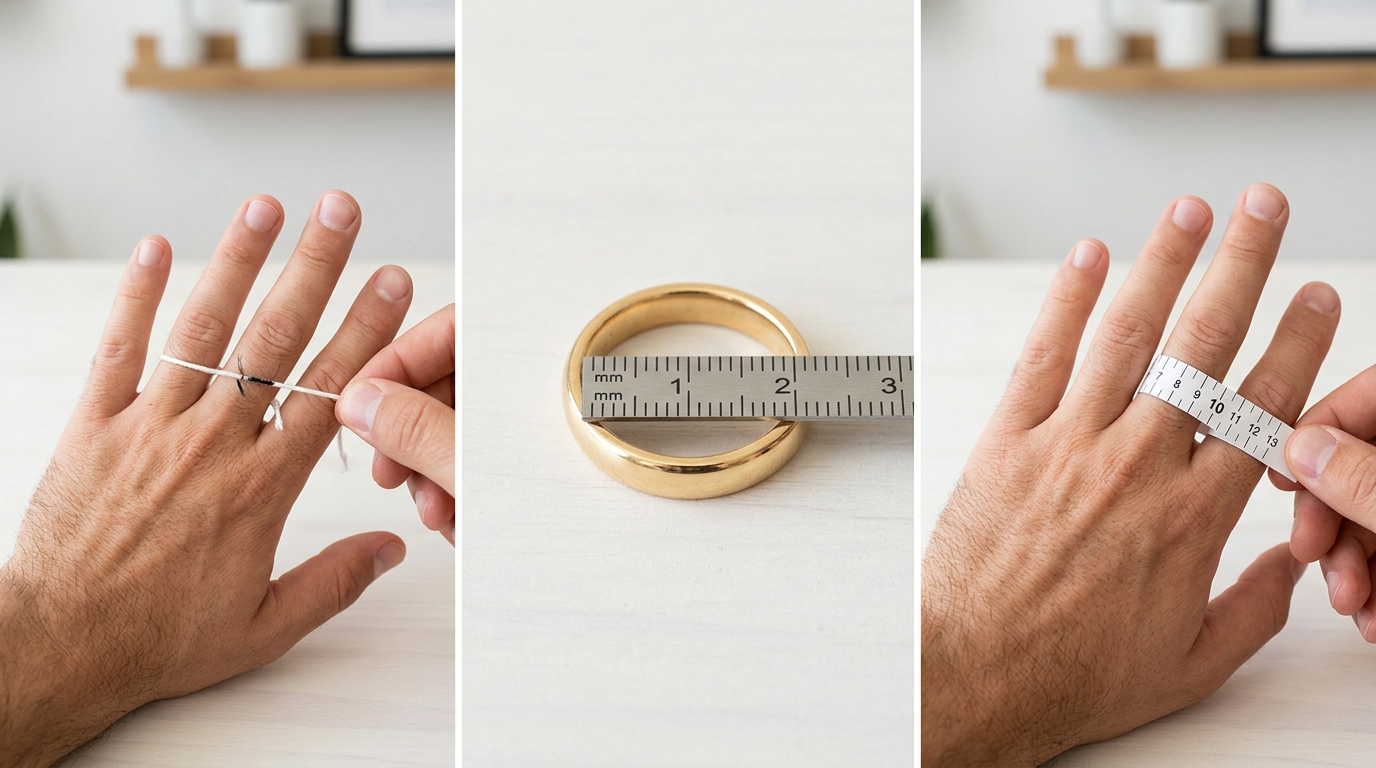
Acertar con la talla de tu anillo es innegociable, especialmente al comprar online. Un anillo demasiado apretado es incómodo y restringe la circulación. Un anillo demasiado suelto corre el riesgo de caerse y perderse. La mayoría de los anillos de hombre se encuentran entre las tallas 8 y 12, siendo la talla 10 la talla de hombre más comúnmente solicitada en GOLDZENN. Aquí te presentamos tres métodos fiables para medir tu talla de anillo en casa —además de consejos profesionales que solo provienen de décadas de experiencia en ajuste.
Método 1: El Método de la Cuerda o Tira de Papel
- Corta una tira fina de papel o un trozo de cuerda no elástica, de aproximadamente 10 cm de largo.
- Envuélvela alrededor de la parte más ancha del dedo deseado —generalmente el nudillo, no la base.
- Marca el punto exacto donde la tira se superpone con un bolígrafo o marcador.
- Extiende la tira y mide la longitud marcada en milímetros.
- Compara tu medida con la columna de circunferencia en la tabla de tallas a continuación.
- Si tu medida se encuentra entre dos tallas, redondea hacia arriba para bandas más anchas (6 mm o más), redondea a la talla más cercana para bandas estrechas.
Método 2: El Método del Anillo Existente
- Elige un anillo que ya te quede bien en el dedo en el que planeas usar tu nuevo anillo.
- Colócalo sobre una superficie plana.
- Mide el diámetro interior en milímetros —de borde interior a borde interior, pasando por el centro.
- Compara con la columna de diámetro en la tabla de tallas.
- Este suele ser el método más preciso si ya posees un anillo para ese dedo.
Método 3: Medidor de Anillos Imprimible
- Imprime una plantilla de medidor de anillos a escala exactamente del 100% —no permitas que tu impresora escale o "ajuste a la página".
- Recorta la tira del medidor y envuélvela alrededor de tu dedo.
- Lee la talla donde el extremo se une con la escala numerada.
- Verifica la precisión comparando con el método de la cuerda.
Consejos Profesionales de un Maestro Joyero
Estos son los detalles que diferencian una medida precisa de un error costoso:
- Mide al final del día. Los dedos son más pequeños por la mañana y se hinchan a lo largo del día. Una medida vespertina captura tu dedo en su tamaño más grande —exactamente cuando un anillo apretado sería más incómodo.
- La temperatura importa. Los dedos se expanden con el calor y la humedad (crítico para Miami y climas cálidos) y se encogen con el frío. Si vives en un clima cálido, esa es tu línea de base. Si estás midiendo en invierno, añade un cuarto de talla.
- Mide tres veces en días diferentes. Una sola medida no es fiable. Toma tres lecturas durante varios días y usa el promedio. La consistencia importa más que cualquier número individual.
- Tu mano dominante suele ser media talla más grande. Si eres diestro y planeas usar tu anillo en la mano derecha, talla en consecuencia.
- Las bandas más anchas necesitan media talla más. Los anillos de más de 6 mm de ancho ocupan más superficie del dedo, creando una sensación más ajustada. Si estás pidiendo un anillo de eslabones cubanos o una banda ancha, sube media talla de tu ajuste medido en un anillo de ancho estándar.
- GOLDZENN ofrece medias tallas en la mayoría de los anillos, desde la talla 7 hasta la 13.5. Si estás entre tallas, contáctanos al 321-521-4651 o contact@goldzenn.com —podemos ayudarte a elegir la talla correcta antes de realizar el pedido.
| Talla EE. UU. | Diámetro Interior (mm) | Circunferencia Interior (mm) | Común para |
|---|---|---|---|
| 7 | 17.3 | 54.4 | Manos de hombre más pequeñas, anillos de meñique |
| 7.5 | 17.7 | 55.7 | Anillos de meñique, constituciones delgadas |
| 8 | 18.1 | 57.0 | Talla promedio-pequeña de hombre |
| 8.5 | 18.5 | 58.3 | Talla promedio de hombre |
| 9 | 19.0 | 59.5 | Talla promedio de hombre |
| 9.5 | 19.4 | 60.8 | Talla promedio-grande de hombre |
| 10 | 19.8 | 62.1 | Talla de hombre más popular en GOLDZENN |
| 10.5 | 20.2 | 63.4 | Talla grande común |
| 11 | 20.6 | 64.6 | Manos de hombre grandes |
| 11.5 | 21.0 | 65.9 | Manos grandes-XL |
| 12 | 21.4 | 67.2 | Talla XL de hombre |
| 12.5 | 21.8 | 68.5 | Talla XL de hombre |
| 13 | 22.2 | 69.7 | Talla XXL de hombre |
| 13.5 | 22.6 | 71.0 | Talla estándar más grande |
¿Todavía no estás seguro de tu talla? Llama a GOLDZENN al 321-521-4651 —nuestro equipo ha medido a miles de clientes y puede guiarte a través del proceso por teléfono.
Guía de Ancho de Anillo: Comparación de 2mm a 10mm+
El ancho es la dimensión que la mayoría de los hombres subestiman al elegir un anillo. Una banda de 4 mm se ve y se siente completamente diferente a una de 8 mm, y el ancho afecta directamente la comodidad, el peso visual e incluso la talla que necesitas pedir. Aquí te mostramos cómo se ve cada ancho y cuándo elegirlo.
| Ancho | Perfil Visual | Mejor para | Nota de Talla | Ejemplo de GOLDZENN |
|---|---|---|---|---|
| 2mm | Ultrafino, apenas visible | Bandas apilables, look minimalista | Fiel a la talla | Bandas de acento delicadas |
| 3mm | Fino y refinado | Anillos de meñique, segundos anillos para apilar | Fiel a la talla | Bandas de moda finas |
| 4mm | Clásico y versátil | Alianzas de boda estándar, uso diario | Fiel a la talla | Bandas de oro clásicas |
| 5mm | Presencia media | Ancho de transición, comodidad diaria | Considerar media talla más | Bandas de moda con diamantes |
| 6mm | Ancho clásico de hombre | Alianza de boda estándar de hombre | Media talla más recomendada | Bandas con diamantes engastados en carril |
| 7mm | Sustancial y seguro | Bandas de moda, hombres que quieren presencia | Media talla más | Bandas con borde escalonado y martilladas |
| 8mm | Declaración audaz | Anillos de eslabones cubanos, piezas llamativas | Media talla más obligatoria | Anillo Cubano Iced de 8mm |
| 10mm+ | Máximo impacto visual | Anillos de eslabones cubanos, diseños "iced-out" | Media talla más obligatoria | Anillo Cubano Iced de 10mm |
La regla general: haz coincidir el ancho de tu anillo con las proporciones de tu mano. Los hombres con manos más grandes y dedos más gruesos pueden usar bandas más anchas sin que el anillo domine su mano. Los hombres con dedos más delgados generalmente lucen mejor con anchos de 4 mm a 6 mm. En caso de duda, 6 mm es el ancho de anillo para hombres más universalmente favorecedor.
¿En qué dedo debo usar un anillo?
Cada dedo tiene un significado, un peso cultural e implicaciones prácticas. Comprender la ubicación del anillo en el dedo te ayuda a tomar decisiones de estilo intencionales en lugar de aleatorias.
Anular (Cuarto Dedo) — Compromiso y Conexión
El dedo anular es la posición más universalmente reconocida para las alianzas de boda y los anillos de compromiso. La antigua creencia romana —la "vena amoris" o vena del amor que va directamente del cuarto dedo al corazón— estableció una tradición que perdura a nivel mundial. En Estados Unidos, el Reino Unido y la mayoría de los países occidentales, el dedo anular izquierdo indica matrimonio. En muchas culturas latinoamericanas, de Europa del Este y de Oriente Medio, el dedo anular derecho es el dedo de la boda. Si no estás casado, llevar un anillo de moda en el dedo anular derecho es una declaración de estilo fuerte que evita cualquier confusión sobre el estado civil.
Meñique — Tradición, Herencia y Estilo
El anillo en el meñique tiene siglos de tradición detrás. En la aristocracia británica, los anillos de sello en el meñique indicaban el linaje familiar y se usaban para sellar correspondencia oficial. En la cultura italoamericana, un anillo en el meñique representa el éxito propio. En algunos círculos profesionales —particularmente en ingeniería y ciertas organizaciones fraternales— el anillo en el meñique significa membresía o logro. Hoy en día, el anillo en el meñique es una de las posiciones más versátiles: no interfiere con tu agarre, funciona con cualquier estilo de anillo y añade personalidad sin implicaciones de compromiso. Los anillos de sello y las finas bandas de diamantes son las opciones más populares para el meñique en GOLDZENN.
Dedo Medio — Equilibrio y Declaración
El dedo medio es el más largo y central, lo que lo convierte en una ubicación natural para anillos llamativos que necesitan espacio visual. Debido a que no tiene asociaciones culturales o simbólicas fuertes, el dedo medio es una posición "neutral" —no comunica nada excepto estilo personal. Anillos más grandes, incluyendo grupos de diamantes y motivos llamativos, se ven proporcionales en el dedo medio, donde podrían abrumar al meñique. Para más información sobre este tema, explora nuestros anillos de diamantes marquesa para hombres.
Dedo Índice — Autoridad y Poder
Históricamente, el dedo índice estaba reservado para la realeza y los líderes religiosos. Reyes, papas y obispos usaban anillos en el dedo índice para significar autoridad; los súbditos besaban el anillo como señal de respeto. Hoy en día, el dedo índice es una posición infrautilizada que proyecta confianza. Funciona bien para anillos de sello, anillos de clase y bandas gruesas. Debido a que el dedo índice es el dedo señalador más activo, los anillos aquí se notan naturalmente durante la conversación.
Pulgar — Creativo y Audaz
Los anillos de pulgar son la elección más vanguardista y han ganado una tracción significativa en los últimos años. Una banda gruesa en el pulgar se lee como creativa, audaz y poco convencional. Debido a que el pulgar se separa de los otros dedos, un anillo de pulgar nunca interfiere con los anillos en otros dedos, lo que lo convierte en una excelente adición al apilar. Elige bandas más anchas (6 mm+) para el pulgar, ya que los anillos estrechos pueden parecer perdidos en su perfil más grueso.
Cómo Estilizar y Apilar Anillos de Hombre
Usar múltiples anillos ya no está reservado para estrellas de rock y raperos, es una técnica de estilismo deliberada que añade dimensión a cualquier atuendo. La clave es la intencionalidad. Aquí están las reglas que separan un look pulido de múltiples anillos de uno desordenado.
Equilibrio en ambas manos. Si usas un anillo llamativo en tu mano derecha, mantén la mano izquierda más sencilla —una alianza de boda o un solo anillo delgado. El equilibrio visual entre tus manos crea un look cohesivo en lugar de uno desequilibrado.
Mezcla metales intencionalmente. La vieja regla de "combina todos tus metales" está anticuada. Mezclar oro amarillo con oro blanco u oro rosa es una elección de estilo deliberada en 2026, pero funciona mejor cuando hay un metal dominante (70-80% de tus joyas en un tono) con un acento en otro. Si tu cadena es de oro amarillo, deja que ese sea tu tono dominante y añade un solo anillo de oro blanco como contraste.
Crea contraste de ancho. Al apilar anillos en la misma mano, varía los anchos. Una banda de 4 mm junto a una de 7 mm crea un ritmo visual. Dos anillos del mismo ancho parecen que tomaste lo que estaba disponible.
Mantente en un máximo de tres anillos en ambas manos para la mayoría de los ajustes. Una alianza de boda más dos anillos adicionales es el punto óptimo para los hombres que quieren un look pulido y en capas sin exagerar. Para una guía completa sobre cómo combinar y apilar joyas, incluyendo el emparejamiento de anillos con cadenas, lee nuestra guía dedicada.
Ideas de combinación de GOLDZENN: Prueba una banda de diamantes martillada ($1,468.80) en el dedo anular con un anillo delgado de pepita en el meñique. O combina un anillo de eslabones cubanos de 10 mm en el dedo índice con una alianza de boda clásica en el dedo anular. El contraste entre texturas y anchos crea un look cohesivo e intencional.
Diamantes en Anillos de Hombre: Lo que Necesitas Saber
Los diamantes son la característica distintiva de la mayoría de los anillos premium para hombres, y comprender lo básico evita errores costosos. Aquí te presentamos lo que importa específicamente para los compradores de anillos para hombres.
Las 4 C Aplicadas a los Anillos de Hombre
El corte determina cuánto brilla un diamante. Para anillos que usas a diario y ves a distancia (no bajo una lupa), un grado de corte "Bueno" a "Muy Bueno" ofrece un excelente rendimiento visual. No necesitas pagar por un corte "Ideal" o "Excelente" en un anillo de hombre como lo harías para un anillo de compromiso solitario.
La claridad mide los defectos internos (inclusiones). GOLDZENN utiliza grados SI (Slightly Included) a I1 para la mayoría de los anillos de hombre y VS (Very Slightly Included) para piezas premium. En los tamaños utilizados en anillos de grupo y de banda para hombres (normalmente menos de 0.25ct por piedra), las inclusiones en los grados SI-I1 son invisibles a simple vista. Guarda los grados VS+ para solitarios grandes.
El color se clasifica de D (incoloro) a Z (amarillo claro). Los diamantes GOLDZENN suelen caer en el rango G-J (casi incoloro). En engastes de oro amarillo, los diamantes en el rango H-J lucen hermosos; el tono cálido del oro disimula cualquier color de cuerpo tenue, haciendo de los diamantes H-J una opción de valor inteligente para anillos de oro.
El peso en quilates (CTW) en los anillos de hombre varía desde 1/20 CTW (0.05ct, un acento sutil) hasta 4 CTW (una banda de eternidad cubierta de diamantes). El punto óptimo para la mayoría de los hombres es de 1/4 CTW a 1 CTW —suficiente presencia para captar la luz y llamar la atención sin caer en el terreno de la bisutería. Para más educación sobre diamantes, consulta nuestra Guía Definitiva de Diamantes y nuestra Guía de Calidad de Corte de Diamantes.
Diamantes Naturales vs. Cultivados en Laboratorio
Los diamantes cultivados en laboratorio son química, física y ópticamente idénticos a los diamantes naturales. La diferencia es el origen, no la calidad. Los diamantes cultivados en laboratorio cuestan entre un 60 y un 85% menos que los diamantes naturales de las mismas especificaciones, lo que los convierte en una opción atractiva para los hombres que desean el máximo tamaño y brillo con un presupuesto definido. GOLDZENN ofrece tanto diamantes naturales como cultivados en laboratorio en todas las categorías de anillos, y nuestro equipo puede ayudarte a elegir la opción adecuada para tus prioridades. Para una comparación detallada, lee Moissanita vs. Diamante: ¿Cuál vale tu dinero?
Engastes de Diamantes en Anillos de Hombre
Engaste de canal: Los diamantes se aseguran entre dos paredes paralelas de metal. Este es el engaste más popular para las alianzas de boda masculinas porque crea una superficie lisa y sin enganches ideal para el uso diario. No hay garras que puedan engancharse en la ropa o las herramientas.
Engaste pavé: Pequeños diamantes se colocan muy juntos sobre una superficie, sujetos por diminutas cuentas de metal. El pavé crea el máximo brillo superficial y es común en anillos de racimo y diseños "iced-out".
Engaste de garra: Garras individuales (normalmente 4 o 6) sujetan cada piedra, permitiendo que la máxima luz entre en el diamante. Este es el estándar para solitarios y anillos de compromiso, ofreciendo el mayor brillo por piedra.
Engaste de bisel: Un borde continuo de metal rodea completamente el diamante. Es el engaste más seguro, ideal para hombres que trabajan con las manos, ya que el borde de metal protege el diamante del impacto directo.
Oro Macizo vs. Chapado: Lo que Necesitas Saber Antes de Comprar
Aquí es donde tu decisión de compra protege tu inversión o desperdicia tu dinero. La distinción entre oro macizo y chapado en oro no es sutil, es la diferencia entre poseer un activo y poseer un accesorio desechable.
El oro macizo (10K, 14K, 18K, 24K) es oro en toda la pieza. Nunca se pelará, descascarillará ni revelará un metal base debajo. Puede pulirse, cambiar de tamaño y repararse. Cuando termines de usarlo —años o décadas después— tiene un valor real de fusión basado en el contenido de oro y los precios actuales del oro. Un anillo de oro macizo de 14K comprado hoy se convierte en una reliquia familiar o en un valor tangible.
La joyería chapada en oro es un metal base (latón, cobre, acero inoxidable) con una capa extremadamente fina de oro depositada en la superficie, típicamente de 0.5 a 2.5 micras de espesor. Esa capa se desgasta con el contacto regular. En 6-12 meses de uso diario, el chapado en oro se desvanece visiblemente, expone el metal base y puede causar una decoloración verde o negra en la piel. El valor de reventa de un anillo chapado es esencialmente cero.
El oro laminado (a veces marcado como "GF") es un punto intermedio, una capa más gruesa de oro unida mecánicamente a un metal base. Dura más que el chapado (1-3 años de uso diario) pero aún no tiene un valor de fusión significativo y no se puede reparar como el oro macizo.
Cómo identificar oro macizo: Busca sellos de quilates (10K, 14K, 18K, 24K o los números equivalentes: 417, 585, 750, 999). El oro macizo tiene un peso notable, se siente más pesado de lo que parece. Si un anillo anunciado como "oro" parece ligero para su tamaño, es probable que esté chapado. En caso de duda, cualquier joyero de confianza puede probar una pieza con un kit de ácido o un analizador XRF. Lee nuestra guía completa sobre cómo identificar oro real.
GOLDZENN vende anillos de oro macizo: cada pieza está sellada, cada quilate está verificado y cada cliente recibe exactamente lo que paga. Esa transparencia es una de las razones por las que hemos obtenido más de 300 reseñas en Google con 4.8 estrellas.
Ajuste cómodo vs. Ajuste estándar: ¿Cuál es el adecuado para ti?
El ajuste del anillo se refiere al perfil interior de la banda, y afecta significativamente cómo se siente un anillo en tu dedo hora tras hora, día tras día.
El ajuste estándar (ajuste plano) tiene una superficie interior completamente plana. El anillo se desliza con una resistencia constante de borde a borde. El ajuste estándar funciona bien para bandas estrechas (2mm-5mm) donde la superficie de contacto es lo suficientemente pequeña como para que el tipo de ajuste tenga un impacto mínimo.
El ajuste cómodo presenta un interior ligeramente abovedado; el interior del anillo es ligeramente redondeado, lo que reduce el área de contacto entre el metal y la piel. Esto facilita que el anillo se deslice sobre el nudillo, reduce la presión en los lados del dedo y crea una sensación de que el anillo "flota" en lugar de agarrarse. Para bandas más anchas (6 mm y más), se recomienda encarecidamente el ajuste cómodo, y la mayoría de las alianzas de boda y anillos de moda para hombre de GOLDZENN utilizan la construcción de ajuste cómodo.
Nota sobre el tamaño: Los anillos de ajuste cómodo quedan ligeramente más holgados que los de ajuste estándar en la misma talla. Si te han medido para un anillo de ajuste estándar y cambias a ajuste cómodo, es posible que necesites reducir media talla. En caso de duda, llámanos al 321-521-4651; nuestro equipo ha medido a miles de hombres en ambos tipos de ajuste.
Cuidado y mantenimiento de anillos: Protege tu inversión
Un anillo de oro macizo puede durar toda la vida —múltiples vidas— con un cuidado básico. Aquí te mostramos cómo mantener tus anillos en óptimas condiciones y proteger tu inversión.
Hábitos de uso diario
Quítate los anillos antes de realizar trabajos manuales pesados, levantar pesas y trabajar en el jardín. Los impactos pueden abollar el oro (especialmente el oro de mayor quilataje) y aflojar los engastes de los diamantes. Quítate los anillos antes de nadar; el cloro de las piscinas y jacuzzis ataca las aleaciones de oro, debilitando el metal con el tiempo. Evita el contacto con productos químicos domésticos: la lejía, el amoníaco, la acetona (quitaesmalte) y los limpiadores de baño fuertes pueden dañar el oro y corroer los engastes. Para obtener más información sobre lo que el oro puede soportar, lee ¿Puedes ducharte con joyas de oro? Consejos de expertos y ¿Se deslustra el oro? La verdad completa.
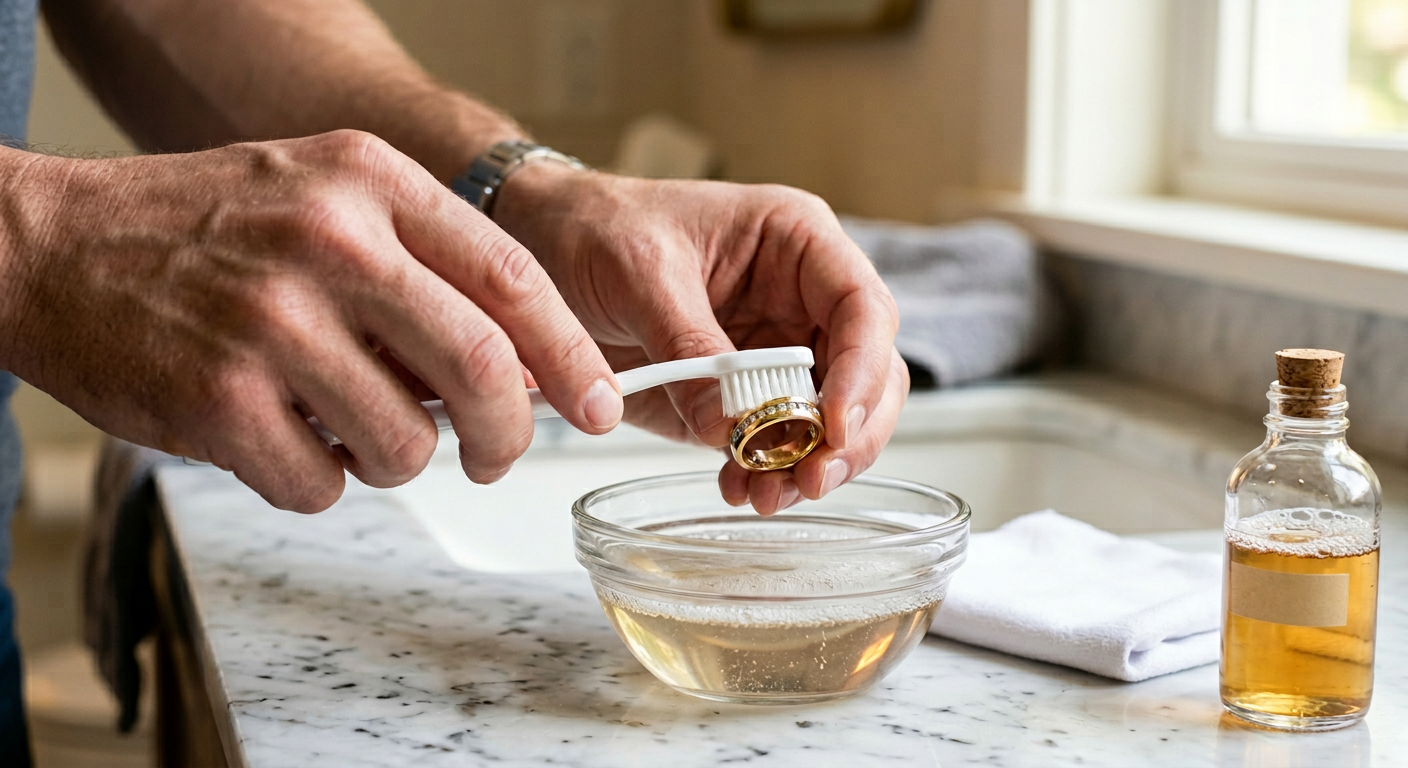
Limpiar tu anillo de oro en casa
- Sumerge el anillo en un recipiente con agua tibia (no caliente) mezclada con unas gotas de jabón suave para platos durante 20-30 minutos.
- Cepilla suavemente con un cepillo de dientes de cerdas suaves, prestando atención a los engastes de diamantes y las áreas texturizadas donde se acumulan aceites y residuos.
- Enjuaga bajo agua corriente limpia (tapa el desagüe o usa un colador).
- Seca dando palmaditas con un paño sin pelusa, no con toallas de papel, que pueden dejar micro-arañazos en las superficies pulidas.
- Para acumulaciones persistentes, repite el remojo con agua ligeramente más caliente.
No usar: pasta de dientes (abrasiva), bicarbonato de sodio en piezas chapadas (elimina el revestimiento), limpiadores ultrasónicos en anillos con diamantes con fracturas (pueden empeorar las fracturas) o limpiadores a vapor en piedras sensibles al calor. Para nuestro protocolo de limpieza completo, lee Cómo limpiar joyas de oro: La guía completa de cuidado.
Cuándo acudir a un joyero profesional
Programa una inspección profesional anualmente si usas anillos de diamantes a diario. Un joyero verificará la tensión de las garras (las garras sueltas son la principal causa de pérdida de piedras), pulirá las superficies y examinará el desgaste estructural. Los anillos de oro blanco deben recibir un nuevo baño de rodio cada 12-18 meses para restaurar su acabado brillante de color blanco plateado. Para el cuidado de anillos más allá de lo que puedes hacer en casa, el taller de GOLDZENN está disponible; llama al 321-521-4651 o envía un correo electrónico a contact@goldzenn.com para programar el servicio.
Almacenamiento
Guarda los anillos en bolsas individuales suaves o en un joyero con ranuras separadas para anillos. Los diamantes son el material natural más duro; rayarán otros metales y piedras preciosas si se guardan sueltos. Nunca tires los anillos en un cajón o bolsa de viaje sin protección. Para piezas de alto valor, considera un seguro de joyas; generalmente es del 1-2% del valor tasado por año y cubre pérdidas, robos y daños.
Qué buscar: Lista de verificación de compra de un maestro joyero
Con más de 50 años de experiencia combinada en talleres, el equipo de GOLDZENN ha visto todos los atajos, todas las tácticas de marketing engañosas y todos los fallos de calidad en la industria de la joyería. Esto es lo que debes comprobar antes de comprar cualquier anillo para hombre, ya sea a nosotros o a cualquier otro.
- Sello de quilates. Todo anillo de oro legítimo tiene un sello de quilates (10K, 14K, 18K, 24K o equivalente: 417, 585, 750, 999). ¿No hay sello? No lo compres.
- Peso y tacto. El oro macizo tiene una densidad que se puede sentir. Un anillo de oro de 14K debe sentirse notablemente más pesado que un anillo de acero inoxidable de las mismas dimensiones. Si se siente ligero, puede ser hueco, chapado o de un quilataje inferior al anunciado.
- Acabado de los bordes. Pasa el dedo por los bordes interior y exterior de la banda. La artesanía de calidad produce bordes lisos y redondeados sin puntos afilados. La fabricación barata deja bordes interiores ásperos que irritan la piel.
- Calidad del engaste de los diamantes. En anillos con pavé y engaste de canal, todos los diamantes deben estar al ras y nivelados. Sin piedras inclinadas, sin espacios visibles entre las piedras y el metal. En anillos con engaste de garra, las garras deben ser de tamaño uniforme, espaciadas uniformemente y sujetar la piedra firmemente; no debes poder sentir movimiento en ninguna piedra.
- Consistencia del pulido. Un anillo bien acabado tiene un pulido uniforme en todas las superficies. Busca arañazos, marcas de herramientas o superficies irregulares; esto indica una fabricación apresurada. Los acabados texturizados (martillado, cepillado) deben tener un patrón consistente.
- Verificación del sello. Más allá del sello de quilates, busca la marca del fabricante. Los anillos GOLDZENN llevan marcas de identificación claras que rastrean cada pieza hasta nuestro taller.
- Política de devolución y garantía. Los joyeros de buena reputación respaldan su trabajo. GOLDZENN ofrece una garantía de por vida en defectos de fabricación; si una garra falla o un engaste se afloja con el uso normal, lo reparamos. Pregunta a cualquier joyero sobre su garantía antes de comprar, no después de que aparezca un problema.
- Descripciones precisas del producto. Ten cuidado con el lenguaje vago: "tono dorado", "color dorado", "acabado dorado" significan "no es oro". Los minoristas legítimos especifican el quilate exacto, el peso total de los diamantes y el grado de claridad. GOLDZENN enumera cada especificación en cada página de producto.
Para una guía más profunda sobre cómo identificar joyas de calidad, incluyendo señales de alerta al comprar en línea, lee nuestro artículo dedicado.
Guía de precios de anillos para hombre: Qué esperar en cada nivel
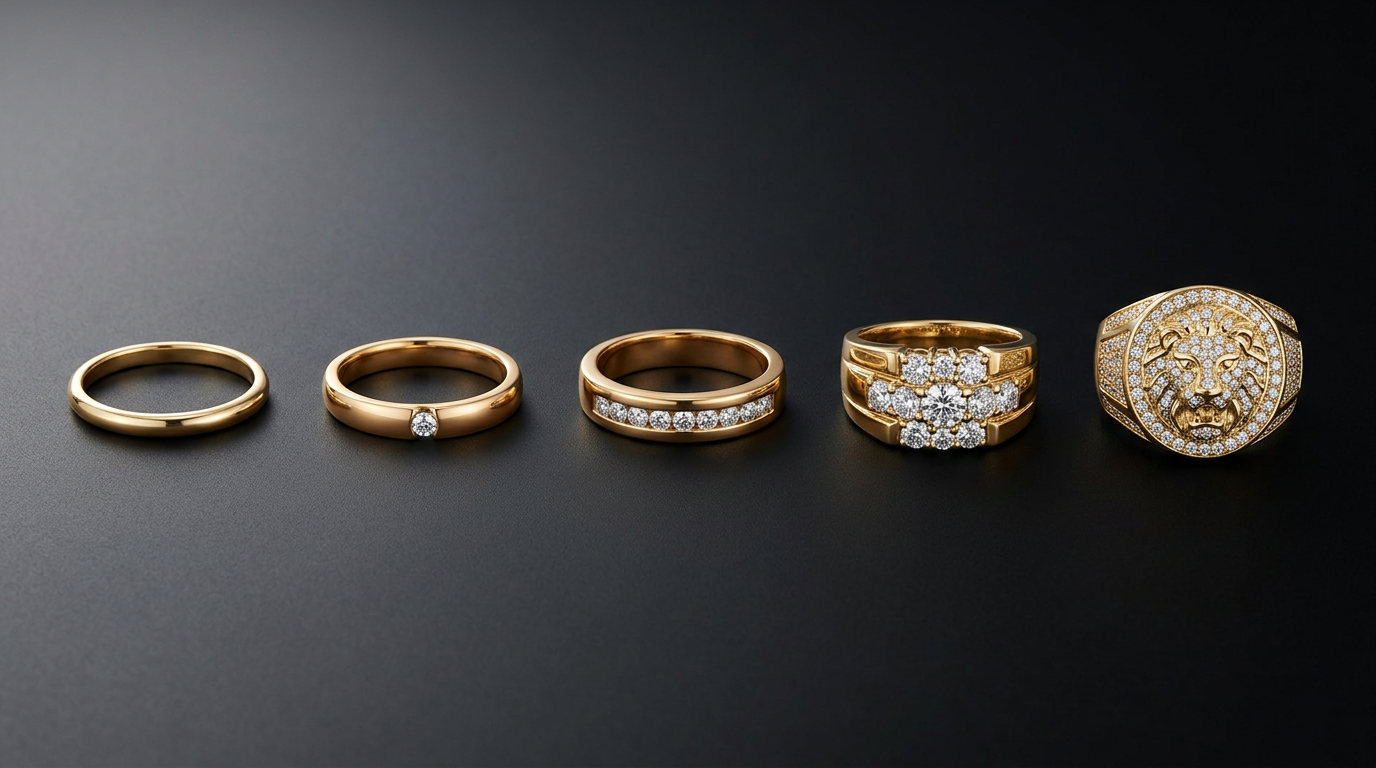
Una de las mayores frustraciones al comprar anillos para hombre en línea es la completa falta de transparencia en los precios. Otros minoristas te muestran guías editoriales sin cifras, y luego te redirigen a colecciones donde los precios parecen arbitrarios. Aquí te mostramos exactamente lo que obtendrás en cada rango de precios, con productos GOLDZENN específicos en cada nivel.
| Rango de precios | Lo que obtienes | Ejemplos de GOLDZENN | Cantidad en catálogo |
|---|---|---|---|
| Menos de $500 | Anillos de diamante de plata esterlina, anillos de oro básicos, opciones de moissanita | Anillo de diamante de plata esterlina ($369.55), anillos de oro de 10K de entrada ($479+) | 9 productos |
| $500 – $1,000 | Anillos de diamante de oro de 10K, anillos básicos de racimo, pulseras cubanas de entrada | Anillo de herradura con diamante ($749.70), Alianza de boda de oro de 10K con cruz ($897.60) | 49 productos |
| $1,000 – $2,500 | Anillos de diamante de oro de 14K, racimos de gama media, anillos de eslabones cubanos, anillos de moda, solitarios de compromiso | Anillo de diamante martillado ($1,468.80), Racimo de cruz ($1,499.40), Racimo CEO 14K ($1,921.23) | 146 productos |
| $2,500 – $5,000 | Anillos de diamante premium, racimos grandes, anillos de moda de 14K, alianzas de boda de varios quilates | Racimo rectangular de 2 CTW ($4,888.35), Alianza de boda de 14K de 3 filas ($3,988.20) | 74 productos |
| Más de $5,000 | Anillos llamativos de varios quilates, anillos de eternidad premium, piezas de lujo con cruz/religiosas | Anillo de diamante con cara de león ($5,398.35), Cruz de Jesús 3.75 CTW ($7,739.25), Anillo de eternidad de 4 CTW ($12,989.70) | 29 productos |
Dónde la mayoría de los hombres aterrizan: El 71% del catálogo de anillos de GOLDZENN se encuentra entre $1,000 y $5,000. Este es el punto óptimo para anillos de oro macizo con diamantes reales, piezas que están hechas para durar, mantienen su valor con el tiempo y hacen una declaración visible. Si estás comprando tu primer anillo de calidad, el rango de $1,000 a $2,500 ofrece la mejor combinación de calidad de material, presencia de diamantes y usabilidad diaria.
Perspectiva de costo por uso: Un anillo de diamantes de oro macizo de $1,500 usado 5 días a la semana durante 10 años cuesta $0.58 por uso, menos que una taza de café. Compáralo con un anillo chapado de $150 que se desmorona en 8 meses ($0.62 por uso con cero valor de reventa). El oro macizo no es caro; el chapado sí lo es. Las matemáticas lo demuestran cada vez.
El valor de inversión de los anillos de oro macizo
A diferencia de los accesorios de moda que se deprecian a cero en el momento de comprarlos, los anillos de oro macizo son activos tangibles respaldados por el precio al contado del oro. Esta dimensión de inversión es algo que ningún competidor discute en sus guías de anillos, porque la mayoría de ellos venden productos chapados o de metales básicos sin valor de reventa.
El valor de fundición es tu base. Todo anillo de oro macizo tiene un valor mínimo determinado por su contenido de oro y el precio al contado actual. Un anillo de oro de 14K que pesa 10 gramos contiene 5.83 gramos de oro puro. Con un precio al contado del oro de $2,900 por onza troy (aproximadamente $93.25 por gramo), el valor de fundición de ese anillo por sí solo es de $543.65, independientemente del diseño, los diamantes o la marca. A medida que los precios del oro han aumentado en los últimos 20 años, el valor de fundición de tu anillo aumenta con ellos.
Anillos de oro como diversificación de cartera. El oro ha servido históricamente como una cobertura contra la inflación y la devaluación de la moneda. Llevar tu inversión en la mano significa que siempre la tienes contigo, no está sujeta a quiebras bancarias ni caídas del mercado de valores, y no requiere tarifas de gestión. Para un desglose detallado del rendimiento del oro como inversión, lee nuestra guía Inversiones en joyas: ¿Sigue siendo el oro una apuesta segura?.
La realidad de la reventa: Las joyas de oro macizo suelen revenderse entre el 70% y el 90% de su valor de fundición en compradores de oro de buena reputación, y a menudo con una prima si la artesanía y la marca son reconocidas. Las joyas chapadas se revenden por cero. La plata de ley se revende por centavos. Este es el argumento económico fundamental para invertir en oro macizo desde el principio.
Significados culturales y simbólicos de los anillos masculinos
Los anillos son la pieza de joyería más cargada de simbolismo en la historia de la humanidad. Comprender lo que comunican los diferentes anillos, en diversas culturas y contextos, te ayuda a llevarlos con intención.
Anillos de sello e identidad familiar. Desde los antiguos sellos cilíndricos mesopotámicos hasta los escudos aristocráticos europeos, los anillos de sello siempre han comunicado linaje y autoridad. En la tradición británica, los anillos de sello se transmiten de padre a hijo mayor y se usan en el dedo meñique de la mano no dominante. Grabar un monograma personal o un símbolo significativo en un anillo de sello continúa esta tradición centenaria en un contexto moderno.
Alianzas de boda y compromiso. El círculo ininterrumpido de una alianza de boda simboliza la eternidad y el compromiso interminable en prácticamente todas las culturas. El dedo y la mano específicos varían —mano izquierda en EE. UU., mano derecha en Rusia, Alemania y gran parte de América Latina—, pero el simbolismo es universal.
Anillos religiosos y espirituales. Los anillos con cruces, anillos con ankhs y diseños de manos orando tienen un profundo significado personal para los hombres de fe. En la tradición católica, los obispos usan un anillo de oficio besado por los fieles. En la cultura islámica, los anillos (especialmente en la mano derecha) siguen la tradición Sunnah. El Anillo de moda con cruz de Ankh de diamante ($2,038.50) y el Anillo con cruz de manos orando ($3,238.50) de GOLDZENN atienden a clientes que desean expresar su fe a través de la artesanía de joyería fina.
Anillos de campeonato y logros. Desde los anillos del Super Bowl hasta los anillos de graduación, los anillos de logros celebran hitos. La tradición se remonta a la Serie Mundial de 1922 y se ha expandido a todos los deportes principales, instituciones académicas y ramas militares. Si bien los anillos de campeonato se ganan, los anillos llamativos de GOLDZENN, como "The World Is Yours" ($4,857.75), canalizan esa misma energía de logro y autoexpresión.
Tradiciones del anillo en el meñique en todo el mundo. En la cultura italoamericana, el anillo en el meñique simboliza el éxito logrado por uno mismo. En el Reino Unido, tradicionalmente indica la pertenencia a la nobleza. En la ingeniería estadounidense, el "Anillo de hierro" o "Anillo de la Orden del Ingeniero" se usa en el meñique como símbolo de ética profesional. El anillo en el meñique es una de las pocas posiciones de anillo que es simultáneamente tradicional y vanguardista.
Tendencias de anillos para 2026
El diseño de anillos para hombres está evolucionando rápidamente. Aquí están las tendencias que impulsan el mercado este año:
Los acabados texturizados están en auge. Las superficies martilladas, cepilladas con alambre y arenadas añaden carácter sin necesidad de diamantes. La alianza de diamantes martillada de GOLDZENN combina ambos —textura y piedras— para un estilo que está de moda ahora, pero lo suficientemente atemporal como para usarlo durante décadas.
Los anillos de eslabones cubanos están pasando de las cadenas. El patrón de eslabones entrelazados que dominó la joyería de cadenas para hombres es ahora una de las categorías de anillos de más rápido crecimiento. Los hombres que ya usan cadenas de eslabones cubanos están añadiendo anillos a juego para un look coordinado.
Apilamiento de metales mixtos. Llevar un anillo de oro amarillo junto a uno de oro blanco —intencionadamente— denota sofisticación y conocimiento del estilo actual. Esta tendencia combina bien con el movimiento más amplio de estilismo de joyería para hombres.
Los diamantes cultivados en laboratorio se están generalizando. A medida que aumenta la conciencia de que los diamantes cultivados en laboratorio son químicamente idénticos a las piedras extraídas, los hombres están eligiendo piedras más grandes a precios más bajos. El anillo de diamante de laboratorio de 2 CTW ($2,462.50) de GOLDZENN costaría más de $8,000 con un diamante natural de tamaño y calidad equivalentes.
Revival del anillo de sello sobredimensionado. El anillo de sello está regresando con fuerza, con mesas más anchas y proporciones más audaces que los sellos delgados de décadas pasadas. Se espera ver a más hombres usando anillos estilo sello como accesorios cotidianos, no solo como piezas formales.
Motivos personalizados y significativos. Los hombres se están alejando de los diseños genéricos hacia anillos que cuentan una historia personal: símbolos religiosos, motivos culturales y grabados personalizados que tienen un significado individual.
Compra anillos para hombre en GOLDZENN
GOLDZENN es un taller de joyería con sede en Miami, especializado en anillos, cadenas, colgantes, pulseras y pendientes de oro macizo, hechos a mano con más de 50 años de experiencia combinada. Nuestra colección de 307 anillos abarca todos los estilos cubiertos en esta guía, desde bandas de plata esterlina de $178.50 hasta anillos de eternidad de diamante de $12,989.70, todos en oro macizo con especificaciones transparentes en cada página de producto.
Explora nuestras colecciones:
- Colección de anillos de diamante — Anillos de racimo, anillos de moda, piezas llamativas
- Colección de anillos de oro — Alianzas de boda, anillos lisos, anillos de moda
- Colección de anillos de compromiso — Solitario, halo, tres piedras, opciones de laboratorio
- Colección de alianzas de boda para hombre — Con engaste de canal, pavé, milgrain, eternidad
- Colección de anillos de oro de 24K — Anillos de oro puro y piezas ceremoniales
- Colección de anillos de 24K — Opciones de ancho de 4mm a 13mm
Por qué los clientes confían en GOLDZENN:
- Más de 300 reseñas en Google con 4.8 estrellas: comentarios reales de clientes verificados
- Más de 3,900 reseñas verificadas de productos en Judge.me: la base de reseñas más grande en nuestra categoría
- Garantía de por vida en defectos de fabricación: respaldamos cada pieza
- Más de 50 años de experiencia combinada en talleres en Miami, FL
- Más de 335 videos en nuestro canal de YouTube (@GOLDZENNJWL) que muestran la artesanía real
- Solo oro macizo: cada anillo está sellado, verificado y exactamente como se describe
¿Necesita ayuda para elegir? Llame al 321-521-4651 o envíe un correo electrónico a contact@goldzenn.com. Nuestro equipo ha medido, estilizado y ajustado miles de anillos para hombre; le ayudaremos a encontrar la pieza adecuada al precio justo. Para una visión más amplia de las categorías de joyería para hombre, comience con nuestra Guía completa de tipos de joyería.
Preguntas frecuentes sobre los anillos de hombre
¿Cuál es el tamaño medio de un anillo para hombre?
El tamaño medio de un anillo para hombre en Estados Unidos está entre 9 y 11, siendo el tamaño 10 el más solicitado en GOLDZENN. Los tamaños del 8 al 12 cubren aproximadamente el 90% de los hombres. Factores como la dominancia manual, el peso corporal y la forma de los dedos afectan el tamaño individual. Recomendamos medir en casa utilizando el método del hilo y confirmar con un anillo existente para mayor precisión. Para una explicación completa con una guía de tallas imprimible y una tabla de conversión internacional, consulte nuestra guía detallada de tallas de anillos. GOLDZENN ofrece medias tallas de 7 a 13.5 en la mayoría de los estilos de anillos.
¿Cuál es el ancho de anillo para hombre más popular?
El ancho más popular para los anillos de hombre es de 6 mm, que se considera el ancho clásico de banda para hombre. Proporciona suficiente presencia visual para lucir masculino sin abrumar las manos más pequeñas o de tamaño promedio. Para los hombres que desean más impacto, 8 mm es la elección más popular para un ancho audaz. Los anillos de eslabones cubanos en GOLDZENN están disponibles en anchos de 8 mm y 10 mm para hombres que prefieren la máxima presencia. Las bandas más anchas (6 mm y más) requieren pedir media talla más grande que su tamaño medido para un ajuste cómodo.
¿Pueden los hombres usar anillos en cualquier dedo?
Sí. No hay reglas absolutas sobre en qué dedo puede usar un hombre un anillo. Cada dedo tiene diferentes asociaciones culturales —el dedo anular simboliza compromiso, el meñique simboliza herencia o logros, el índice simboliza autoridad y el pulgar simboliza confianza creativa— pero el estilo moderno acepta los anillos en todos los dedos. La única consideración práctica es la comodidad y el estilo de vida: los hombres activos pueden preferir anillos en dedos que no interfieran con su agarre o tareas diarias.
¿Cómo debe quedar un anillo?
Un anillo bien ajustado se desliza sobre el nudillo con una ligera resistencia, se asienta cómodamente en la base del dedo sin pellizcar y se puede quitar con un suave tirón giratorio. Debería poder quitarse un anillo sin usar jabón o lubricante, pero no debería girar libremente ni salirse cuando sacude la mano. Si un anillo deja una hendidura profunda en su piel después de usarlo, está demasiado apretado. Si se mueve más de un cuarto de vuelta por sí solo, está demasiado suelto. Los anillos de ajuste cómodo se sentirán ligeramente diferentes a los de ajuste estándar, más como flotando que como agarrando.
¿Es mejor el oro de 10K o de 14K para un anillo de hombre?
Ambas son excelentes opciones, y la mejor depende de sus prioridades. El oro de 10K (41,7% oro puro) es la aleación de oro más duradera —resiste arañazos y abolladuras mejor que los quilates más altos, lo que lo hace ideal para hombres que trabajan con las manos o llevan estilos de vida activos. También es más asequible, con precios de anillos GOLDZENN a partir de 479 dólares. El oro de 14K (58,3% oro puro) ofrece un color dorado más rico y cálido con una excelente durabilidad, y es el estándar para alianzas de boda y anillos de lujo de uso diario. Los anillos de 14K empiezan en 599 dólares en GOLDZENN. Para una comparación completa, lea nuestra guía de oro de 10K vs 14K vs 18K.
¿Los anillos de oro mantienen su valor?
Los anillos de oro macizo conservan su valor porque contienen un metal precioso real con un valor intrínseco de fusión determinado por el peso, los quilates y el precio actual del oro al contado. Un anillo de oro de 14K que pesa 10 gramos contiene 5,83 gramos de oro puro; ese contenido de oro tiene un valor mínimo independientemente de las condiciones del mercado. El oro se ha revalorizado significativamente en los últimos 20 años, lo que significa que los anillos comprados hace años han aumentado su valor material. Los anillos chapados en oro y de metales base, por el contrario, tienen un valor de reventa o de fusión nulo. El oro macizo es a la vez joyería y un activo tangible.
¿Cómo saber si un anillo es de oro auténtico?
Busque un sello de quilates dentro de la banda —10K, 14K, 18K o 24K (o sus equivalentes métricos: 417, 585, 750, 999). El oro macizo tiene un peso notable en relación con su tamaño. El oro auténtico no se deslustra, no se oxida ni se pone verde. Una prueba de ácido profesional o un análisis XRF proporcionan resultados definitivos. Minoristas reputados como GOLDZENN enumeran los quilates exactos, el peso y las especificaciones de los diamantes en cada página de producto; si un vendedor es vago sobre el contenido del metal, es una señal de alerta.
¿Qué ancho de anillo queda mejor en manos grandes?
Los hombres con manos grandes y dedos gruesos pueden usar con confianza bandas más anchas —7 mm, 8 mm e incluso 10 mm+— sin que el anillo parezca demasiado grande. Las bandas anchas son proporcionales en manos más grandes y, de hecho, pueden parecer discretas si son demasiado estrechas. Los anillos de eslabones cubanos de 8 mm y 10 mm de GOLDZENN y las bandas anchas de diamantes de moda son opciones populares para hombres con manos más grandes. Para manos medianas, 6 mm-7 mm es el punto ideal. Para manos más delgadas, 4 mm-6 mm proporciona presencia sin abrumar el dedo.
¿Puedo usar un anillo si trabajo con las manos?
Sí, con las precauciones adecuadas. Elija oro de quilates más bajos (el 10K es la aleación más duradera), un engaste de bisel o canal para los diamantes (sin garras expuestas que puedan engancharse o doblarse) y un ancho moderado (6 mm-8 mm). Quítese el anillo durante trabajos mecánicos pesados, deportes de contacto y exposición a productos químicos. Muchos trabajadores usan una banda de silicona durante el trabajo y se cambian a su anillo de oro después del horario laboral. Las alianzas de oro de 10K de GOLDZENN con diamantes engastados en canal son especialmente adecuadas para hombres que equilibran el trabajo manual con el uso diario de un anillo.
¿Con qué frecuencia debo limpiar mi anillo de oro?
Limpie su anillo de oro en casa cada 2-4 semanas con agua tibia y jabón suave para platos si lo usa a diario. Los anillos de diamantes deben limpiarse con un poco más de frecuencia porque los aceites corporales y la loción para manos se acumulan alrededor de las piedras y reducen el brillo. Se recomienda una limpieza e inspección profesional una vez al año para cualquier anillo de diamantes: un joyero revisará la tensión de las garras, lo limpiará ultrasónicamente y lo volverá a pulir si es necesario. GOLDZENN proporciona una guía de limpieza con cada compra, y nuestro taller ofrece servicio profesional para cualquier anillo de nuestro catálogo. Explore nuestra guía completa sobre anillos de diamantes negros para obtener más información sobre este tema.
¿Para qué se utiliza hoy en día un anillo de sello?
Los anillos de sello modernos han evolucionado de herramientas funcionales de sellado de cera a declaraciones de estilo que comunican herencia, identidad personal y gusto refinado. Hoy en día, los hombres usan anillos de sello en el meñique o en el dedo anular como accesorios diarios. Algunos hombres todavía graban escudos familiares, monogramas o símbolos personales en la superficie plana, continuando la tradición centenaria en un contexto contemporáneo. Los anillos de sello combinan bien con trajes, ropa informal y todo lo demás; son uno de los estilos de anillo más versátiles que un hombre puede poseer.
¿Cómo me pongo varios anillos sin exagerar?
Limítate a un máximo de tres anillos entre ambas manos. Varía los anchos; no uses dos anillos del mismo ancho en la misma mano. Equilibra el peso visual: si tu mano derecha tiene un anillo llamativo, mantén la mano izquierda simple con una banda delgada o solo un anillo de boda. Combina los metales de forma ligera; un tono dorado dominante con un acento contrastante (oro blanco u oro rosa) funciona mejor que cuatro metales diferentes. Deja al menos un dedo libre entre los anillos apilados para un aspecto limpio. Lee nuestra guía de capas de cadenas para conocer más principios de apilamiento de joyas.
¿Se puede cambiar el tamaño de un anillo de oro?
Sí, los anillos de oro macizo pueden ser redimensionados por un joyero cualificado, normalmente dentro de 1-2 tallas en cualquier dirección. El proceso implica cortar la banda, añadir o quitar oro, soldar y volver a pulir. Los anillos con diamantes o piedras preciosas engastados alrededor de toda la circunferencia (anillos de la eternidad) son difíciles o imposibles de redimensionar sin alterar los engastes. Los anillos con diamantes engastados en canal o pavé solo en la parte superior suelen poder redimensionarse sin problemas. Los anillos de tungsteno y titanio no pueden redimensionarse en absoluto. Si prevé cambios significativos de tamaño, elija un estilo que permita el redimensionamiento, o llame a GOLDZENN al 321-521-4651 para obtener orientación antes de realizar el pedido.
¿Cuál es la diferencia entre los diamantes naturales y los cultivados en laboratorio?
Los diamantes naturales se forman durante miles de millones de años bajo calor y presión extremos en las profundidades del manto terrestre. Los diamantes cultivados en laboratorio se crean en entornos de laboratorio controlados utilizando métodos de Deposición Química de Vapor (CVD) o Alta Presión Alta Temperatura (HPHT). El resultado es química, física y ópticamente idéntico; incluso los gemólogos no pueden distinguirlos sin equipo especializado. La diferencia clave es el precio: los diamantes cultivados en laboratorio cuestan entre un 60 y un 85% menos que los diamantes naturales de tamaño y calidad equivalentes. GOLDZENN ofrece ambas opciones en todas las categorías de anillos, brindando a los clientes total transparencia y elección.
¿Cuánto debo gastar en un anillo de hombre?
No existe una regla universal para el gasto en anillos de hombre; depende de su presupuesto, el propósito del anillo y si lo considera una compra de moda o una inversión. En GOLDZENN, el 71% de nuestro catálogo de anillos se encuentra entre los 1.000 y los 5.000 dólares, lo que representa el punto óptimo para los anillos de oro macizo con diamantes auténticos. Para un comprador de anillos por primera vez, el rango de 500 a 1.500 dólares ofrece una excelente calidad en oro de 10K. Para alianzas de boda, los hombres suelen gastar entre 1.000 y 3.000 dólares. Para piezas llamativas y anillos de calidad heredada, entre 3.000 y 8.000 dólares se obtiene una artesanía excepcional y una cobertura de diamantes. Concéntrese en el costo por uso en lugar del precio de venta; un anillo de oro macizo de calidad cuesta centavos al día cuando se usa durante años.