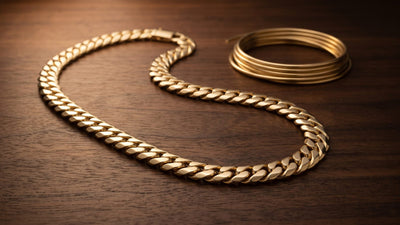
¿El oro se empaña? La verdad completa sobre la durabilidad del oro
Acaba de invertir en una cadena de oro macizo y alguien le dice que el oro se empaña. Antes de que cunda el pánico, aquí está la verdad científica completa: el oro puro no se empaña. El oro se clasifica como un metal noble, lo que significa que resiste la oxidación y la corrosión a nivel molecular. Pero las joyas de oro que usa rara vez son de oro 100% puro. Comprender la diferencia entre el oro puro y las aleaciones de oro es clave para saber exactamente qué se empañará y qué no en su colección de joyas. El vermeil de oro, por ejemplo, sí se empaña con el tiempo; aprenda por qué en nuestra guía de vermeil de oro.
En GOLDZENN, fabricamos joyas de oro macizo en 10K hasta 22K, y creemos que cada cliente merece comprender exactamente lo que está comprando. Esta guía desglosa la ciencia del deslustre del oro, explica cómo se comportan los diferentes quilates con el tiempo y le brinda estrategias de prevención accionables para mantener sus piezas impecables durante décadas.
Por qué el oro puro nunca se empaña: la ciencia
El oro se encuentra en una categoría rara de elementos conocidos como metales nobles. A diferencia del hierro, el cobre o la plata, los átomos de oro no ceden fácilmente electrones a las moléculas de oxígeno en el aire. Esta estabilidad química es lo que hace que el oro sea virtualmente indestructible con el tiempo. Los artefactos de oro del antiguo Egipto recuperados de tumbas después de más de 3000 años todavía brillan tan intensamente como el día en que fueron hechos.

Esto es lo que sucede a nivel atómico: el empañamiento es una reacción de oxidación. Cuando un metal como la plata se encuentra con compuestos de azufre en el aire, los átomos de azufre se unen con los átomos de plata para crear sulfuro de plata, un compuesto oscuro que aparece como deslustre. El oro no participa en esta reacción. El oxígeno, el agua y los productos químicos ambientales comunes simplemente no pueden romper los enlaces atómicos del oro en condiciones normales.
Es por eso que el oro ha sido valorado en todas las civilizaciones de la historia humana. Su permanencia no es solo estética; es una propiedad fundamental del elemento en sí.
Por qué las aleaciones de oro pueden decolorarse
Si el oro puro nunca se empaña, ¿por qué algunas piezas de oro cambian de color con el tiempo? La respuesta radica en la aleación. El oro puro de 24 quilates es demasiado blando para la mayoría de las aplicaciones de joyería, especialmente las cadenas que soportan el uso diario. Los joyeros mezclan oro con metales más duros como cobre, plata, níquel, zinc y paladio para crear aleaciones duraderas. Estos metales añadidos pueden reaccionar con los factores ambientales.
Las reacciones de aleación más comunes incluyen:
- Oxidación del cobre: El cobre en las aleaciones de oro puede reaccionar con los ácidos del sudor, produciendo cloruro de cobre, un compuesto verdoso. Es por eso que algunas personas notan un tinte verde en su piel con joyas de oro de menor quilataje.
- Deslustre de la plata: El contenido de plata en las aleaciones de oro reacciona con los compuestos de azufre (que se encuentran en la contaminación, los huevos, las bandas de goma y ciertos cosméticos) para formar sulfuro de plata, que aparece como una decoloración oscura o negruzca.
- Opacamiento del níquel: El níquel, a veces utilizado en aleaciones de oro blanco, puede oxidarse y crear una película superficial opaca y amarillenta.
- Reacciones del zinc: El zinc puede reaccionar con la humedad y el CO2 del aire para formar carbonato de zinc, un residuo blanquecino.
Cuanto mayor sea el quilataje, más oro puro estará presente, lo que significa menos metales de aleación reactivos y un riesgo significativamente menor de decoloración. Comprender las diferencias entre los quilates de oro es esencial para realizar una compra informada.
Desglose del riesgo de empañamiento quilate por quilate
No todas las joyas de oro se comportan de la misma manera con el tiempo. Esto es lo que se puede esperar de cada nivel de quilate:

Oro de 24 quilates (99,9% puro) — Riesgo de deslustre: prácticamente cero
Con un contenido de oro puro del 99,9%, prácticamente no hay metales de aleación presentes que puedan reaccionar con el medio ambiente. El oro de 24 quilates mantendrá su color indefinidamente en condiciones normales. La desventaja es la blandura: el oro de 24 quilates no es ideal para cadenas o pulseras que sufren impactos diarios. Es más adecuado para colgantes, piezas de exhibición y lingotes de inversión. GOLDZENN ofrece selectas cadenas cubanas de oro de 24 quilates para coleccionistas que desean la máxima pureza.
Oro de 22 quilates (91,7% puro) — Riesgo de deslustre: extremadamente bajo
Con más del 91% de contenido de oro, el pequeño porcentaje de metales de aleación (típicamente cobre y plata) tiene una reactividad mínima. El oro de 22 quilates puede desarrollar una pátina muy ligera después de muchos años de uso constante en condiciones adversas, pero esto se limpia fácilmente. Para fines prácticos, el oro de 22 quilates es resistente al deslustre para la gran mayoría de los usuarios.
Oro de 18 quilates (75% puro) — Riesgo de deslustre: muy bajo
Con un 75% de oro, el 25% de contenido de aleación introduce algunos metales reactivos. Sin embargo, el contenido de oro sigue siendo lo suficientemente dominante como para evitar una decoloración significativa en el uso normal. El oro de 18 quilates puede mostrar cambios sutiles en la superficie después de años de exposición a productos químicos fuertes o a una química corporal extremadamente ácida, pero la limpieza regular lo mantiene impecable. Este es el punto dulce para la joyería de lujo: lo suficientemente duradero para el uso diario, lo suficientemente puro para resistir el deslustre. Obtenga más información sobre el oro de 14K vs 18K para decidir qué quilate se adapta a su estilo de vida.
Oro de 14 quilates (58,3% puro) — Riesgo de deslustre: bajo a moderado
El oro de 14K es el quilate más popular en los Estados Unidos por una buena razón: equilibra durabilidad, asequibilidad y apariencia. Con un 58,3% de oro, los metales de la aleación constituyen casi la mitad de la composición. En condiciones normales, el oro de 14K mantiene bien su aspecto. Sin embargo, la exposición prolongada al cloro, al agua salada o al sudor ácido puede causar decoloración superficial con el tiempo. La decoloración es superficial y se revierte fácilmente con una limpieza adecuada.
Oro de 10 quilates (41,7% puro) — Riesgo de deslustre: moderado
Como el quilate mínimo que se puede vender legalmente como oro en los Estados Unidos, el oro de 10 quilates contiene más metales de aleación que oro real. Esto lo hace el más susceptible al deslustre entre las opciones de oro macizo. Los usuarios con química corporal ácida o aquellos que exponen con frecuencia sus joyas a productos químicos pueden notar una decoloración más rápida que con quilates más altos. Dicho esto, el oro de 10 quilates sigue siendo oro macizo y es mucho más duradero que cualquier alternativa chapada. El mantenimiento regular mantiene las piezas de 10 quilates con un aspecto excelente durante años.
Oro chapado vs. Oro macizo: la división del deslustre
Aquí es donde reside la mayor parte de la confusión. Cuando la gente dice que el oro se empaña, casi siempre se refiere a joyas chapadas en oro, no a oro macizo. La diferencia es enorme:

- Las joyas chapadas en oro tienen una capa microscópicamente fina de oro (0,5 a 2,5 micras) sobre un metal base como latón, cobre o acero inoxidable. Esta capa de oro se desgasta por la fricción, el sudor y la exposición a productos químicos, exponiendo el metal base debajo. Una vez expuesto, el metal base se empaña rápidamente. La mayoría de las piezas chapadas en oro muestran un desgaste significativo dentro de los 6 a 12 meses de uso regular.
- El vermeil de oro es una capa de oro más gruesa (mínimo 2,5 micras) sobre plata esterlina. Dura más que el chapado estándar, pero aún se degrada con el tiempo, especialmente con la exposición al agua.
- Las joyas con relleno de oro tienen una capa de oro unida mecánicamente que es 50-100 veces más gruesa que el chapado. Resiste el deslustre mucho mejor que las piezas chapadas, pero aún no puede igualar la permanencia del oro macizo.
- Las joyas de oro macizo son de oro de principio a fin. No hay metal base que exponer, ninguna capa que desgastar. El contenido de oro es constante desde la superficie hasta el núcleo. Una cadena de oro macizo puede durar generaciones con un cuidado básico.
En GOLDZENN, nos especializamos en cadenas y pulseras de oro macizo porque creemos que las joyas deben ser una inversión a largo plazo, no un accesorio desechable. Cuando comprende la diferencia entre el oro real y el falso, la propuesta de valor del oro macizo queda clara.
Factores ambientales que afectan a las aleaciones de oro
Incluso las aleaciones de oro macizo interactúan con su entorno. Estos son los culpables más comunes de la decoloración:
Química corporal y sudor
El sudor humano contiene cloruros, amoníaco, urea y ácido láctico. El pH del sudor varía de persona a persona: algunas personas tienen sudor muy ácido (pH 4,5-5,5) que reacciona de forma más agresiva con los metales de la aleación. Esta es la razón por la que la misma cadena de 14K puede parecer perfecta en una persona y mostrar una ligera decoloración en otra. La dieta, los medicamentos y los cambios hormonales influyen en la química corporal.
Cloro y productos químicos para piscinas
El cloro es uno de los químicos más dañinos para las aleaciones de oro. Ataca el cobre y la plata en las aleaciones de oro, debilitando la estructura metálica y causando decoloración. La exposición repetida al cloro puede, de hecho, hacer que el oro se vuelva quebradizo con el tiempo, especialmente en quilates más bajos. Siempre quítese las joyas antes de nadar en piscinas cloradas o jacuzzis. Para una inmersión más profunda, consulte nuestra guía sobre cómo limpiar joyas de oro después de la exposición a químicos.
Compuestos de azufre
El azufre reacciona principalmente con el contenido de plata en las aleaciones de oro. Las fuentes comunes incluyen: bandas de goma, guantes de látex, ciertos alimentos (huevos, cebollas, ajo), aguas termales volcánicas y contaminación del aire. Si guarda joyas de oro en un cajón con bandas de goma o en una habitación con una contaminación atmosférica significativa, la exposición al azufre puede causar una pátina oscura en piezas de quilates más bajos.
Cosméticos, lociones y perfumes
Muchos productos de belleza contienen químicos que reaccionan con los metales de la aleación. Las bases con óxido de zinc, los protectores solares con dióxido de titanio, los perfumes con alcohol y las lociones con ingredientes ácidos pueden dejar residuos en las joyas de oro. El residuo en sí no empaña el oro, pero crea una película que atrapa la humedad y acelera las reacciones con los metales de la aleación que se encuentran debajo. La mejor práctica es ponerse las joyas al final, después de que todos los cosméticos se hayan aplicado y absorbido.
Humedad y aire salino
Los ambientes costeros con alta humedad y aire salino aceleran la corrosión de los metales de aleación. Si vive cerca del océano, sus joyas de oro están constantemente expuestas a la humedad y la sal, dos ingredientes que aceleran la oxidación. Esto no daña el oro en sí, pero puede afectar los componentes de aleación de cobre y plata, especialmente en piezas de 10K y 14K.
Prevención: cómo mantener su oro como nuevo
Aunque el oro macizo es notablemente duradero, unos pocos hábitos sencillos mantendrán sus piezas en perfecto estado:

Almacenamiento adecuado
- Guarde cada pieza por separado en una bolsa de tela suave o en un joyero forrado para evitar arañazos.
- Mantenga las joyas en un lugar fresco y seco, lejos de la luz solar directa.
- Añada tiras antideslustre a su joyero si vive en un clima húmedo.
- Nunca guarde el oro en el baño, donde la humedad de las duchas acelera la oxidación de las aleaciones.
Limpieza regular
Una rutina de limpieza sencilla cada 2-4 semanas previene la acumulación de residuos. Sumerja su oro en agua tibia con unas gotas de jabón líquido suave durante 15-20 minutos, cepille suavemente con un cepillo de cerdas suaves (centrándose en los eslabones y cierres donde se acumula la suciedad), enjuague bajo agua tibia corriente y seque con un paño sin pelusas. Para obtener instrucciones de limpieza detalladas por tipo de joya, consulte nuestra guía completa de limpieza de oro.
Retire antes de estas actividades
- Nadar en piscinas cloradas o jacuzzis
- Aplicar lociones, protectores solares o perfumes
- Limpieza del hogar con productos químicos
- Ejercicio intenso (exceso de sudor + fricción)
- Jardinería o trabajo en el jardín (la tierra contiene azufre y compuestos ácidos)
Mantenimiento profesional
Para piezas muy usadas, la limpieza ultrasónica profesional una o dos veces al año elimina los residuos incrustados que la limpieza casera no puede alcanzar. Los joyeros también pueden inspeccionar los cierres, verificar el desgaste estructural y pulir las imperfecciones superficiales menores. GOLDZENN ofrece servicios de limpieza e inspección para nuestras piezas hechas a mano. Llámenos al 321-521-4651 o envíe un correo electrónico a contact@goldzenn.com para programar una cita.
Cuándo preocuparse frente a la pátina normal
No todos los cambios en la apariencia de sus joyas de oro indican un problema:
Normal e inofensivo:
- Un color cálido y ligeramente más profundo después de años de uso (esto es, de hecho, valorado por muchos coleccionistas como un signo de autenticidad).
- Pequeños arañazos superficiales por el uso diario (se pueden pulir).
- Ligero opacamiento por residuos de jabón o loción (se limpia en minutos).
Digno de investigación:
- Decoloración verde o negra en la superficie del metal (indica reacción de la aleación; limpiar a fondo y considerar limitar la exposición a productos químicos).
- Descamación, pelado o astillado (esto significa que la pieza está chapada, NO es oro macizo; el metal base se está mostrando).
- Opacamiento persistente que no responde a la limpieza (puede indicar daño superficial por productos químicos agresivos).
- Decoloración verde de la piel debajo de las joyas (común con joyas chapadas; raro con oro macizo por encima de 14K).
Si su pieza de oro macizo muestra una decoloración inesperada, no se asuste. Una limpieza profesional casi siempre restaura la apariencia original. La decoloración en aleaciones de oro macizo es siempre un fenómeno superficial y nunca afecta la integridad estructural del metal. Para obtener consejos sobre cómo verificar si su pieza es genuina, lea nuestra guía sobre cómo detectar oro real.
El oro comparado con otros metales preciosos
Para poner la durabilidad del oro en perspectiva, aquí se compara con otros metales preciosos populares para joyería:
- Plata esterlina (92,5% plata): Se empaña fácilmente cuando se expone al aire y a compuestos de azufre. Requiere pulido regular. Oro blanco vs. plata esterlina es una comparación común para los compradores que deciden entre los dos.
- Platino: No se empaña, pero desarrolla una pátina (opacidad superficial) con el tiempo. Más resistente a los arañazos que el oro, pero significativamente más pesado y más caro.
- Acero inoxidable: Resistente a la corrosión, pero puede decolorarse en condiciones extremas. No se puede cambiar el tamaño ni reparar como el oro. No tiene un valor inherente de metal precioso.
- Titanio: Extremadamente resistente a la corrosión, pero no se puede soldar, ajustar el tamaño ni reparar. Los arañazos son permanentes.
El oro ocupa una posición única: combina belleza, maleabilidad y resistencia a la corrosión de una manera que ningún otro metal iguala. Por eso, el oro macizo sigue siendo el estándar para joyas de inversión y piezas de herencia.
La ventaja del oro macizo de GOLDZENN
Cada cadena, pulsera y colgante en GOLDZENN está elaborado con oro macizo en nuestro taller de Miami. Nuestro equipo de maestros joyeros con más de 50 años de experiencia combinada trabaja con oro de 10K, 14K, 18K y 22K para crear piezas hechas para durar generaciones. No escatimamos en el chapado ni en la construcción hueca en nuestras colecciones hechas a mano.
Cuando invierte en una pieza de oro macizo de GOLDZENN, está comprando una pieza que:
- No se empañará en condiciones normales de uso
- Mantiene su valor con el tiempo (el oro es un activo tangible con una demanda de mercado duradera)
- Puede transmitirse como una herencia
- Está respaldada por una garantía de por vida contra defectos de fabricación
Explore nuestra colección completa de cadenas cubanas, cadenas de cuerda, cadenas de tenis y pulseras para encontrar su próxima pieza de inversión.
¿Tiene preguntas sobre la durabilidad o el cuidado del oro? Póngase en contacto con nuestro equipo al 321-521-4651 o contact@goldzenn.com. Síganos en YouTube en @GOLDZENNJWL para contenido detrás de escena del taller, educación sobre oro y guías de estilo.
Preguntas frecuentes sobre el deslustre del oro
¿El oro real se empaña con el tiempo?
El oro puro (24K) no se empaña. El oro es un metal noble que no reacciona con el oxígeno ni el agua en condiciones normales. Sin embargo, las aleaciones de oro (10K-18K) contienen otros metales como el cobre y la plata que pueden reaccionar con el sudor, los productos químicos y los factores ambientales, causando decoloración superficial. Este es un efecto superficial que se limpia fácilmente y no daña el oro en sí.
¿Por qué mis joyas de oro se están poniendo verdes?
Un tinte verde suele provenir de la oxidación del cobre en la aleación de oro que reacciona con los ácidos de su sudor o con lociones y cosméticos. Esto es más común con oro de menor quilataje (10K-14K) y no es una señal de que el oro sea falso. Limpie la pieza con agua tibia y jabón y considere aplicarse las joyas después de que las lociones se hayan absorbido.
¿El oro de 14K se empaña?
El oro de 14K tiene un riesgo de deslustre de bajo a moderado. Con un 58,3% de oro puro, los metales de la aleación pueden reaccionar con productos químicos agresivos, cloro o una química corporal muy ácida con el tiempo. En condiciones de uso diario normal, el oro de 14K mantiene bien su aspecto con un cuidado básico y una limpieza periódica.
¿Cómo puedo saber si mi oro es chapado o macizo?
El oro chapado acaba mostrando desgaste en los puntos de fricción (cierres, bordes, interior de los anillos) donde la fina capa de oro se desgasta, revelando el metal base que hay debajo. El oro macizo mantiene un color consistente en toda su extensión, incluso en los puntos de desgaste. Un joyero puede realizar una prueba de ácido o un análisis XRF para una verificación definitiva. Lee nuestra guía completa sobre cómo identificar el oro auténtico.
¿Se deslustra el oro en el agua?
El agua pura no hace que el oro se deslustre. Sin embargo, el agua de piscina clorada, el agua salada y los productos químicos de los jacuzzis pueden reaccionar con los metales de la aleación en el oro de 10K-18K, causando una decoloración superficial con el tiempo. El oro macizo es seguro para una breve exposición al agua, pero debe evitarse el contacto prolongado o repetido con agua química.
¿Cuál es el mejor quilate para el uso diario sin que se deslustre?
El oro de 14K y 18K ofrecen el mejor equilibrio para el uso diario. El oro de 18K (75% oro) proporciona una excelente resistencia al deslustre con buena durabilidad. El oro de 14K (58,3% oro) es más duradero y asequible, a la vez que ofrece una fuerte resistencia al deslustre en condiciones normales. Ambos quilates son opciones populares para cadenas de hombre y joyas de uso diario.
¿Se puede restaurar el oro deslustrado?
Sí. El deslustre en aleaciones de oro macizo es siempre un fenómeno superficial. Agua tibia jabonosa con un cepillo suave elimina la mayor parte de la decoloración. Para el deslustre persistente, la limpieza ultrasónica profesional o un paño de pulido de joyero restaura el brillo original. A diferencia de las joyas chapadas, el oro macizo nunca pierde su contenido de oro a través de la limpieza.
¿El sudor estropea las joyas de oro?
El sudor no estropea el oro, pero los ácidos y las sales del sudor pueden reaccionar con los metales de la aleación en el oro de menor quilate durante períodos prolongados. Las personas con una química corporal más ácida pueden notar una decoloración más rápida. Enjuagar las joyas después de sudar mucho y limpiarlas regularmente previene cualquier efecto duradero. El oro macizo, en cualquier nivel de quilates, no se ve afectado estructuralmente por el sudor.
¿El oro o la plata son más resistentes al deslustre?
El oro es mucho más resistente al deslustre que la plata. La plata de ley se deslustra fácilmente cuando se expone al aire y a los compuestos de azufre y requiere un pulido regular. El oro, incluso a 10K, es significativamente más resistente a la decoloración ambiental. Esta es una de las razones por las que el oro tiene un precio más alto y se prefiere para las joyas de uso diario.
¿Con qué frecuencia debo limpiar mis joyas de oro?
Para las piezas de uso diario, una limpieza suave cada 2-4 semanas es ideal. Remojar en agua tibia con jabón suave para platos, cepillar suavemente con un cepillo de dientes suave, enjuagar y secar con un paño sin pelusa. Las piezas que se usan con menos frecuencia se pueden limpiar mensualmente o antes de usarlas. Se recomienda una limpieza profunda profesional una o dos veces al año.