
La moissanita y el diamante son las dos piedras más populares para las cadenas cubanas "iced-out" (cubiertas de gemas), pero cumplen propósitos muy diferentes. Una ofrece el máximo brillo a un precio accesible. La otra es una inversión a largo plazo respaldada por siglos de prestigio. Esta guía las compara directamente (específicamente para cadenas cubanas) para que pueda tomar una decisión de compra segura basada en sus prioridades, no en el bombo publicitario. Para obtener una visión general completa de los estilos, tamaños y precios de las cadenas cubanas, consulte nuestra guía definitiva de cadenas cubanas. Esta comparación entre diamantes y moissanita también se aplica a los pendientes, donde la diferencia de precio es aún más impactante.
En GOLDZENN, elaboramos a mano cadenas cubanas de diamantes y moissanita en nuestro taller de Miami. Hemos visto de primera mano cómo se comporta cada piedra en la plataforma de la cadena cubana, y esta guía comparte ese conocimiento práctico con usted. Descubra cómo GOLDZENN elabora a mano cada pieza personalizada en nuestro taller de Miami.
¿Por qué GOLDZENN? Cada cadena cubana está hecha a mano en nuestro taller de Miami utilizando materiales verificados. Respaldamos cada pieza con una garantía de por vida y hemos obtenido más de 263 reseñas de Google con 4.9 estrellas y más de 3,900 reseñas de productos verificadas. Vea nuestra artesanía en acción en YouTube (18.5K suscriptores, más de 335 videos).
Para obtener una descripción completa de cada categoría de joyería de diamantes, consulte nuestra guía experta de joyería de diamantes.¿Preguntas? Llame al 321-521-4651 o envíe un correo electrónico a contact@goldzenn.com
¿Qué es la Moissanita?
La moissanita es una piedra preciosa creada en laboratorio a partir de carburo de silicio. Fue descubierta por primera vez en 1893 por el químico francés Henri Moissan dentro de un cráter de meteorito en Arizona, de ahí el nombre de la piedra. La moissanita natural es excepcionalmente rara; casi toda la moissanita que se vende hoy en día se cultiva en un laboratorio bajo condiciones controladas. ¿No está seguro de qué quilates de oro elegir? Consulte nuestro desglose completo de 10K vs 14K vs 18K.
Lo que hace que la moissanita sea notable para la joyería es su combinación de dureza y brillo. Puntuación 9.25 en la escala de dureza de Mohs (el diamante es 10), lo que la convierte en una de las sustancias más duras de la Tierra y lo suficientemente duradera para el uso diario. Su índice de refracción de 2.65 a 2.69 es en realidad más alto que el 2.42 del diamante, lo que significa que la moissanita refracta más luz y produce un brillo más visible.
La característica visual más distintiva de la moissanita es su fuego, los destellos de color del arco iris que aparecen cuando la luz atraviesa la piedra. La moissanita tiene un coeficiente de dispersión de 0.104, que es más del doble que el 0.044 del diamante. Esto significa que la moissanita produce significativamente más brillo de color arco iris que un diamante de tamaño equivalente. Para una mirada más profunda a esta piedra, lea nuestra guía sobre la moissanita y cómo se compara con otras piedras preciosas.
¿Qué es un Diamante?
Los diamantes son gemas hechas de carbono cristalizado, formadas bajo presión y calor extremos en las profundidades de la Tierra durante miles de millones de años. Son la sustancia natural más dura conocida, con una calificación perfecta de 10 en la escala de Mohs. Los diamantes tienen un índice de refracción de 2.42 y una dispersión de 0.044, produciendo un brillo blanco distintivo con sutiles destellos espectrales.
Hoy en día, los diamantes se presentan en dos formas: naturales (extraídos de la Tierra) y cultivados en laboratorio (creados mediante métodos de alta presión y alta temperatura o deposición química de vapor). Los diamantes cultivados en laboratorio son química, física y ópticamente idénticos a los diamantes naturales; la única diferencia es su origen. Las opciones cultivadas en laboratorio suelen costar entre un 60 y un 85 por ciento menos que las piedras naturales equivalentes, una brecha que se ha ampliado a medida que la tecnología de producción se escala. Para una comparación en profundidad, lea nuestro artículo sobre cómo se fabrican los diamantes cultivados en laboratorio.
Los diamantes se evalúan utilizando las 4 C: talla, claridad, color y peso en quilates. Para las cadenas cubanas específicamente, la calidad de la talla y el grado de claridad son los que más importan porque se engarzan docenas de pequeñas piedras en la superficie de la cadena, y cualquier inconsistencia se hace visible en el patrón repetitivo.
Moissanita vs. Diamante: La Comparación Completa
Antes de sumergirnos en los detalles, aquí tiene una comparación lado a lado de las dos piedras en todas las métricas que importan para las cadenas cubanas.
¿Listo para ver la diferencia en persona?
Comprar Cadenas Cubanas de Moissanita | Comprar Cadenas Cubanas de Diamantes | Llamar al 321-521-4651
Brillo y Fuego: Cómo Brilla Cada Piedra
Aquí es donde las dos piedras difieren más, y es aún más importante en una cadena cubana que en un anillo o colgante. Una cadena cubana tiene docenas de piedras engastadas en un patrón repetitivo de eslabones entrelazados. Cuando la cadena se mueve (y se mueve constantemente), cada piedra capta y refleja la luz simultáneamente.
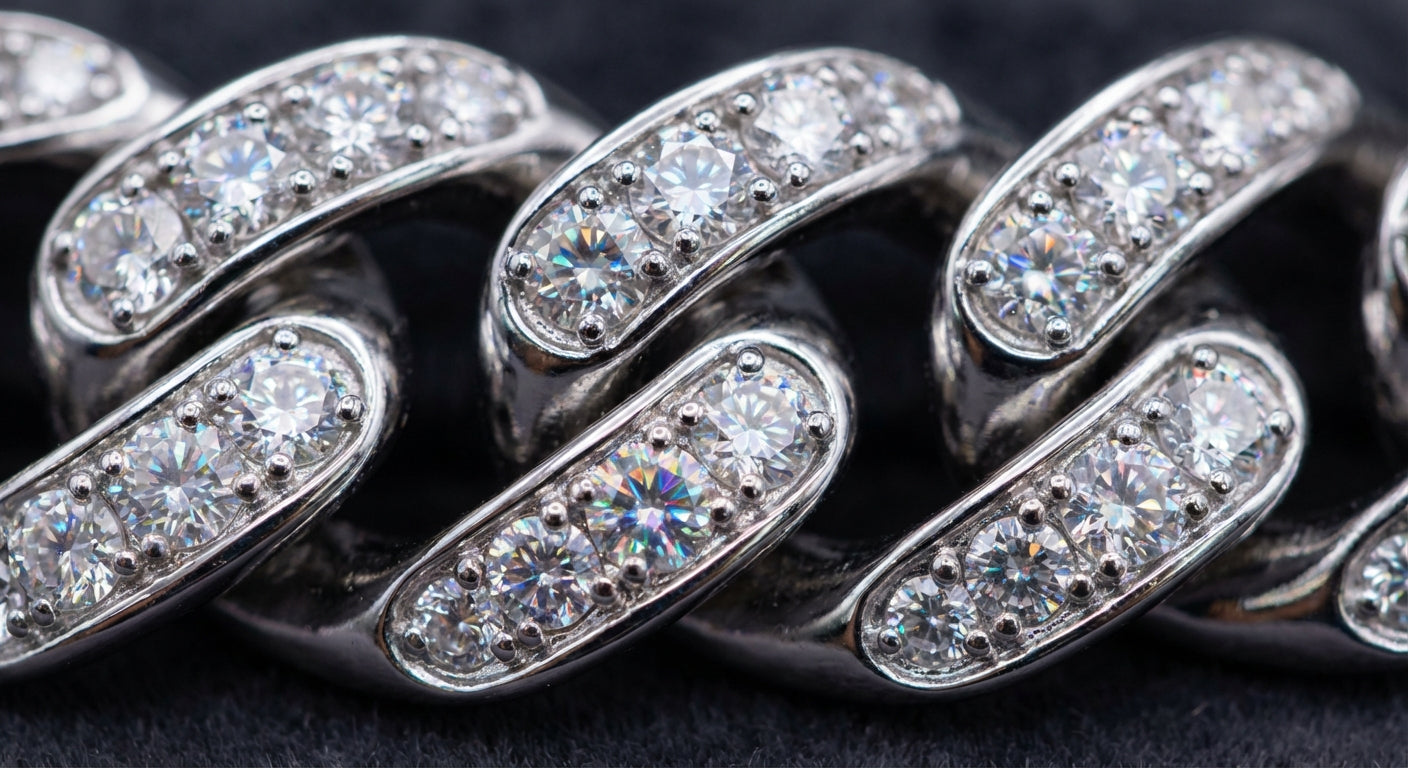
La moissanita produce lo que los joyeros llaman "fuego arcoíris". Cuando la luz entra en una piedra de moissanita, se dispersa en vívidos destellos de azul, verde, naranja y rosa. En una cadena cubana con 50 o más piedras de moissanita, este efecto se multiplica en una cascada continua de color que es visible desde el otro lado de una habitación, especialmente bajo iluminación artificial por la noche.
El diamante produce un "brillo blanco", un brillo más limpio y gélido con solo sutiles toques de color espectral. Una cadena cubana de diamantes se ve más como una lámina continua de luz blanca que se mueve sobre el oro. El efecto es refinado, clásico y menos ostentoso que el de la moissanita.
Ningún tipo de brillo es objetivamente mejor. La moissanita es más llamativa y dramática. El diamante es más discreto y tradicional. Su elección depende del aspecto que quiera proyectar. Para ver cómo lucen las cadenas cubanas "iced-out" en la práctica, explore nuestro desglose de estilos y precios de cadenas cubanas de diamantes.

Dureza y Resistencia a los Arañazos
Tanto la moissanita (9.25 Mohs) como el diamante (10 Mohs) son excepcionalmente duros y resistentes a los arañazos. Para contextualizar, el zafiro, una de las piedras preciosas más duras, tiene una calificación de 9 en la escala de Mohs, y tanto la moissanita como el diamante lo superan.
En términos prácticos para una cadena cubana, ambas piedras resistirán los arañazos del contacto diario, la abrasión en el bolsillo y el uso normal sin ninguna degradación. La diferencia de 0.75 puntos en la escala de Mohs es medible en un laboratorio, pero funcionalmente irrelevante para las joyas que se usan en el cuerpo. Ambas piedras se verán tan nítidas y brillantes dentro de diez años como hoy, asumiendo un cuidado básico.
Color y Claridad
La moissanita de alta calidad se clasifica como "incolora" o "casi incolora", pero algunas piedras exhiben un leve tinte amarillo o verdoso bajo ciertas condiciones de iluminación, particularmente en tamaños de quilates más grandes. Este ligero tinte es inherente a la estructura cristalina del carburo de silicio y no está relacionado con la doble refracción de la piedra, que es una propiedad óptica separada que causa la duplicación de facetas bajo aumento en lugar de cambios de color. En una cadena cubana con piedras pequeñas (típicamente de 1.5 mm a 3 mm por piedra), este tinte generalmente no es visible.
Los diamantes se clasifican en una escala de color de D (completamente incoloro) a Z (notablemente amarillo o marrón). Para las cadenas cubanas, la mayoría de los joyeros utilizan piedras en el rango F a H, que parecen incoloras a simple vista. El diamante es de refracción simple, por lo que su color parece más consistente y predecible en todas las condiciones de iluminación.
Cómo Lucen la Moissanita y el Diamante en una Cadena Cubana
Esta es la pregunta que la mayoría de los compradores realmente se hacen: cuando use esta cadena, ¿qué verá la gente?
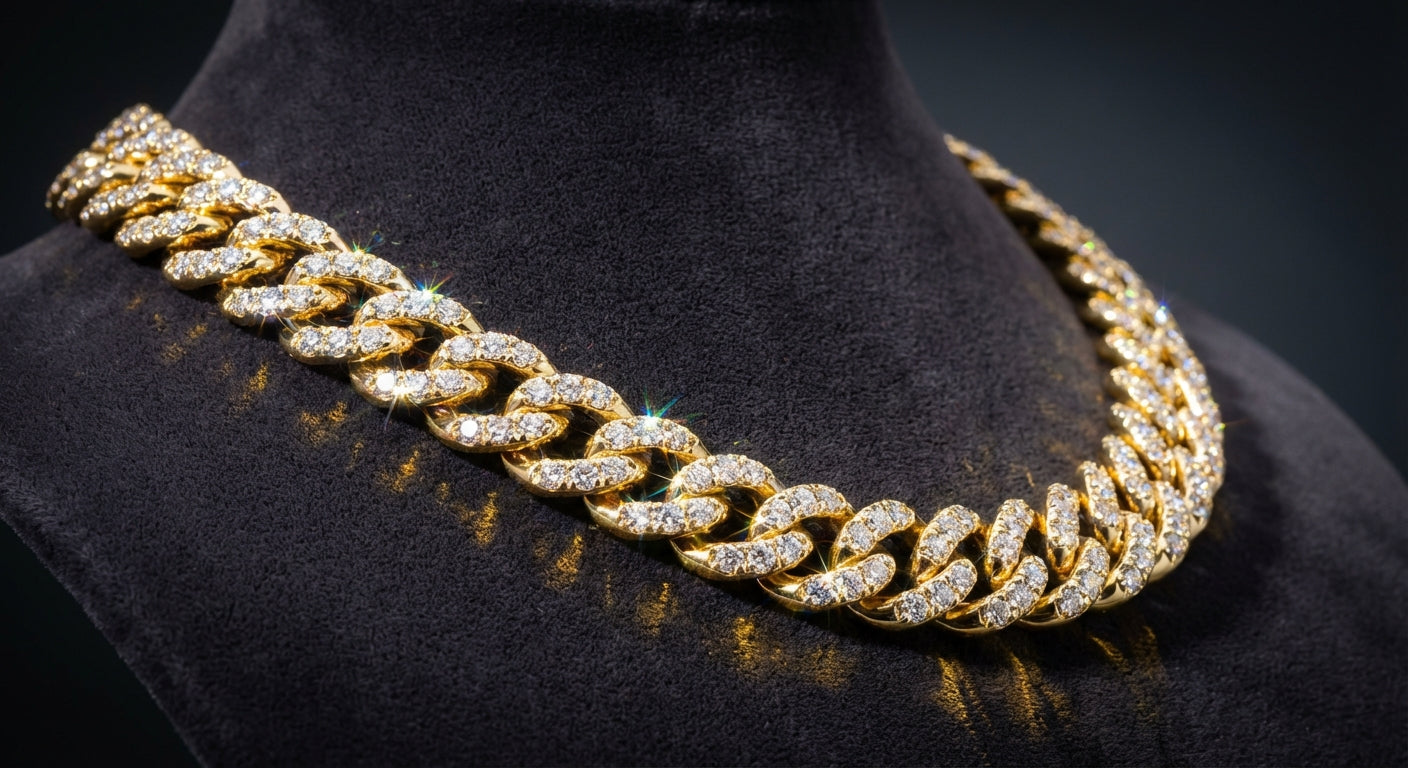
Una cadena cubana es la plataforma ideal para exhibir piedras debido a sus superficies de eslabones planas y anchas. Cada eslabón ovalado entrelazado proporciona un lienzo amplio e ininterrumpido para el engaste de piedras. A medida que la cadena se mueve con el cuerpo, cada eslabón se desplaza de forma independiente, capturando la luz desde diferentes ángulos en rápida sucesión. Esto es lo que crea el efecto "drip", ese brillo continuo por el que son conocidas las cadenas "iced-out".
Con la moissanita, ese brillo adquiere una cualidad colorida y dinámica. Bajo la iluminación de un club, las luces de la calle o cualquier fuente de luz artificial, una cadena cubana de moissanita proyecta destellos de color en todas direcciones. El efecto es audaz, llamativo e inconfundiblemente presente. Se traduce en el máximo brillo por cada dólar.
Con el diamante, el brillo es más blanco y uniforme. Una cadena cubana de diamantes capta la luz y la refleja como un brillo blanco concentrado, con solo toques ocasionales de fuego espectral. El efecto es más parecido a un hielo líquido moviéndose sobre su pecho. Se traduce en riqueza discreta y gusto refinado.
El ancho importa aquí. En una cadena cubana delgada de 4 mm a 6 mm, la diferencia visual entre la moissanita y el diamante es sutil porque las piedras son pequeñas y en menor número. En una cadena atrevida de 10 mm a 15 mm, la diferencia se vuelve mucho más pronunciada porque se está mirando a cientos de piedras que crean un efecto visual combinado. Si todavía está decidiendo el ancho ideal de su cadena, nuestra guía de anchos de cadena de oro desglosa cada opción de tamaño.
Comparación de Precios Reales: Cadenas Cubanas de Moissanita vs Diamante de GOLDZENN
Aquí es donde los números hablan por sí mismos. Estos son precios reales del catálogo de GOLDZENN, no estimaciones ni promedios.
Cadenas Cubanas de Moissanita (Plata Esterlina)
- Cubana de Moissanita de 8mm -- desde $540 (comprar 8mm)
- Cubana de Moissanita de 10mm -- desde $967 (comprar 10mm)
- Cubana de Moissanita de 12mm -- desde $1,355 (comprar 12mm)
- Cubana de Moissanita de 15mm -- desde $1,656 (comprar 15mm)
- Cubana de Moissanita de 18mm -- desde $2,284 (comprar 18mm)
- Cubana de Moissanita de 20mm -- desde $3,500 (comprar 20mm)
Cadenas Cubanas de Diamante (Oro Sólido de 14K)
- Cubana de Diamante de 4mm (14K) -- desde $5,498 (comprar 4mm)
- Cubana de Diamante de 5mm (14K) -- desde $8,654 (comprar 5mm)
- Cubana de Diamante de 7mm (14K) -- desde $13,215 (comprar 7mm)
- Cubana de Diamante de 9mm (14K) -- desde $17,231 (comprar 9mm)
- Cubana de Diamante de 10mm (14K) -- desde $21,176 (comprar 10mm)
- Cubana de Diamante de 11mm (14K) -- desde $28,716 (comprar 11mm)
Cadenas Cubanas de Moissanita (Oro Sólido)
Para los compradores que desean el brillo de la moissanita sobre una base de oro sólido, GOLDZENN también ofrece cadenas cubanas de moissanita en oro amarillo sólido a partir de $14,102 para anchos de 8 mm. Esta opción le brinda el brillo colorido de la moissanita con el valor intrínseco del metal de oro sólido.
En resumen: una cadena cubana de moissanita de plata esterlina suele costar entre 5 y 20 veces menos que una cadena cubana de diamantes comparable de oro de 14K. Incluso comparando moissanita y diamante sobre la misma base de oro, las cadenas de moissanita cuestan significativamente menos porque la piedra en sí es una fracción del precio. ¿No está seguro de cuál elegir? Llame a nuestro equipo al 321-521-4651 para obtener orientación personalizada. Para una visión más amplia del valor de inversión de las cadenas de oro, lea nuestro análisis sobre si las cadenas cubanas son una buena inversión.
Costo por Uso: El Cálculo del Valor Real
Aquí hay una perspectiva que cambia la forma en que la mayoría de los compradores piensan sobre esta compra. Si compra una cadena cubana de moissanita de $967 (10 mm) y la usa 3 veces por semana durante 5 años, eso equivale a 780 usos, lo que significa $1.24 por uso para una pieza que llama la atención cada vez que sale. Esa misma cadena se verá idéntica el primer día y el día 780 porque la moissanita no se degrada.
Una cadena cubana de diamantes de $21,176 (10 mm, oro de 14K) usada con la misma frecuencia asciende a $27.15 por uso. Sin embargo, después de 5 años, usted todavía posee un activo físico con un valor de fundición de oro significativo y un valor de reventa de diamantes. Ambas son compras inteligentes: la pregunta es qué propuesta de valor se ajusta a sus prioridades en este momento.
Valor de Reventa e Inversión a Largo Plazo
Si compra una cadena cubana puramente como un activo portátil, la piedra que elija importa para la reventa.
Los diamantes naturales conservan el valor de reventa más fuerte entre las tres opciones de piedras. Una cadena cubana de diamantes naturales bien elaborada de un joyero de renombre conserva un porcentaje significativo de su precio de compra, especialmente si los diamantes están certificados y la pureza del oro está verificada. La base de oro en sí tiene un valor de fundición que sigue el mercado de productos básicos.
Los diamantes cultivados en laboratorio han experimentado una disminución en sus valores de reventa a medida que los costos de producción bajan y la oferta del mercado aumenta. Si bien son ópticamente idénticos a los diamantes naturales, el mercado secundario actualmente los valora significativamente más bajos. Para una cadena cubana, esto significa que el valor a largo plazo de su cadena recae más en el contenido de oro que en las piedras.
La moissanita tiene un valor de reventa independiente mínimo. Sin embargo, una cadena cubana de moissanita con base de plata esterlina o de oro macizo conserva el valor de fundición del metal. La implicación práctica: si la reventa es una prioridad, elige diamantes. Si compras para usar y disfrutar, la moissanita te brinda mucho más impacto visual por dólar.
En GOLDZENN, cada cadena se somete a pruebas XRF para verificar la pureza del oro y viene con una garantía de por vida que cubre defectos de fabricación. Ya sea que compres una cadena de moissanita sobre plata esterlina o una cadena de diamantes sobre oro macizo de 14K, sabes exactamente lo que estás obteniendo. Lee más sobre cómo verificar joyas de oro auténticas y lo que revelan las pruebas XRF. También explora nuestra guía de cadenas tennis para otra opción popular de cadena de diamantes.
Diamantes cultivados en laboratorio: el término medio
Los diamantes cultivados en laboratorio ofrecen una atractiva opción intermedia para los compradores de cadenas cubanas. Son diamantes reales en todos los aspectos mensurables (la misma dureza, el mismo índice de refracción, el mismo brillo blanco), pero cuestan entre un 60 y un 85 por ciento menos que los diamantes naturales a partir de 2026, un descuento que ha aumentado a medida que la producción escala. Explora nuestra guía completa sobre diamantes negros para obtener más información sobre este tema.
En una cadena cubana, los diamantes cultivados en laboratorio y los diamantes naturales son visualmente indistinguibles a simple vista. Incluso un joyero experimentado no puede distinguirlos sin equipo especializado. Esto hace que los diamantes cultivados en laboratorio sean una opción atractiva para los compradores que desean el brillo genuino de un diamante en una cadena cubana sin pagar la prima que impone la rareza natural. Para obtener más información sobre este tema, explora nuestros diamantes marquesa.
La desventaja es el valor de reventa. Los precios de los diamantes cultivados en laboratorio han estado cayendo a medida que mejora la tecnología de producción y más fabricantes ingresan al mercado. Una cadena cubana de diamantes cultivados en laboratorio comprada hoy puede valer significativamente menos en el mercado secundario dentro de cinco años, no porque la cadena se haya degradado, sino porque las mismas piedras costarán menos de producir.
Para un desglose completo de los tipos de diamantes y cómo se fabrican, explora nuestras guías sobre moissanita vs. diamantes cultivados en laboratorio vs. diamantes naturales y cómo se crean los diamantes CVD.
¿Cuál elegir? Un marco de decisión
Después de ayudar a miles de clientes a tomar esta decisión (tenemos más de 263 reseñas de Google con 4.9 estrellas y más de 3,900 reseñas de productos verificadas), este es el marco que recomendamos.
Elige moissanita si:
- Quieres el máximo look "iced-out" a un precio accesible
- Prefieres un brillo audaz y colorido a un brillo discreto
- Estás comprando tu primera cadena cubana "iced-out" y quieres experimentar el estilo
- Planeas usar la cadena con frecuencia en entornos sociales con iluminación artificial
- El presupuesto es un factor y quieres la cadena más ancha posible por tu dinero
Explora nuestra selección completa de cadenas cubanas de moissanita.
Elige diamantes si:
- Estás comprando una pieza de inversión a largo plazo o una reliquia
- Prefieres un brillo limpio y blanco con un fuego sutil
- El valor de reventa y la preservación de activos te importan
- Quieres el prestigio y la tradición asociados con los diamantes reales
- Estás añadiendo a una colección existente de joyas finas
Explora nuestra colección de cadenas cubanas de diamantes.
El factor de la cadena cubana
Aquí hay algo específico de las cadenas cubanas que muchas guías pasan por alto: debido a que una cadena cubana usa tantas piedras (una cadena de 22 pulgadas y 10 mm puede tener más de 200 piedras individuales), la diferencia de costo por piedra entre la moissanita y el diamante se multiplica drásticamente. Por eso, una cadena cubana de moissanita de 10 mm podría costar $1,200, mientras que el mismo tamaño en diamante cuesta más de $21,000. La base de la cadena es similar; es el costo de la piedra lo que crea la brecha.
Esto también significa que, por el precio de una delgada cadena cubana de diamantes de 4 mm, podrías comprar una audaz cadena cubana de moissanita de 18 mm o 20 mm con mucha más presencia visual. Muchos de nuestros clientes comienzan con moissanita para obtener el aspecto "iced-out" que desean, y luego agregan piezas de diamantes a su colección con el tiempo.
Cómo distinguir la moissanita del diamante
Para compradores y coleccionistas, saber cómo distinguir las dos piedras es un conocimiento valioso.
La prueba del fuego del arcoíris. Sostén la cadena bajo una fuente de luz puntual brillante (como la linterna de un teléfono) y observa el patrón de brillo. La moissanita emite destellos más coloridos, parecidos a un arcoíris. El brillo del diamante es predominantemente blanco con toques ocasionales de color. En una cadena cubana con muchas piedras, el efecto general es el indicador más claro.
La prueba térmica. Los probadores de diamantes estándar funcionan midiendo la conductividad térmica. Los diamantes conducen el calor de manera muy eficiente, y la mayoría de los probadores están calibrados para esto. La moissanita también conduce bien el calor, lo suficientemente bien como para que los probadores de diamantes básicos a menudo den un falso positivo para la moissanita. Los probadores más nuevos que miden la conductividad eléctrica pueden distinguirlos porque la moissanita conduce la electricidad, mientras que la mayoría de los diamantes naturales no lo hacen (los diamantes raros tipo IIb son una excepción).
El efecto de duplicación. Debido a que la moissanita es birrefringente, si miras a través de una piedra de moissanita en el ángulo correcto con aumento, puedes ver las facetas traseras aparecer duplicadas. El diamante es monorrefringente y no muestra este efecto. En una cadena cubana, esta prueba requiere una lupa de joyero y paciencia.
Pruebas profesionales. En GOLDZENN, utilizamos pruebas XRF (fluorescencia de rayos X) y herramientas gemológicas avanzadas para verificar cada piedra y metal en nuestras cadenas. Cuando nos compras, los materiales se confirman antes de que la cadena salga de nuestro taller. Obtén más información sobre la autenticación en nuestra guía sobre cómo detectar joyas de oro auténticas.
Cuidado de tu cadena cubana "iced-out"
Tanto las cadenas cubanas de moissanita como las de diamantes requieren los mismos cuidados básicos para mantener su brillo.
- Limpia regularmente con agua tibia, jabón suave para platos y un cepillo de cerdas suaves. Frota suavemente alrededor y entre las piedras para eliminar los aceites corporales y la acumulación que opacan el brillo.
- Guárdalas por separado de otras joyas para evitar arañazos. Si bien la moissanita y el diamante son extremadamente duros, pueden rayar metales y piedras más blandos.
- Evita productos químicos fuertes, incluidos el cloro (piscinas, jacuzzis), la lejía y los agentes de limpieza fuertes que pueden dañar los engastes de las piedras y los acabados de metal.
- Quítatelas antes de realizar actividad física intensa para proteger los engastes de las puntas que sujetan cada piedra en su lugar.
Para una guía de mantenimiento completa, lee nuestro detallado manual sobre cómo limpiar joyas de oro correctamente.
Preguntas Frecuentes
¿Se puede distinguir la moissanita del diamante en una cadena cubana?
A una distancia conversacional, la mayoría de las personas no pueden distinguir la moissanita del diamante en una cadena cubana. Las piedras son pequeñas (típicamente de 1.5 mm a 3 mm cada una) y están engastadas muy juntas, por lo que las características individuales de las piedras son difíciles de aislar. La principal diferencia visible es que la moissanita emite un brillo más parecido a un arcoíris, mientras que el brillo del diamante es predominantemente blanco. Bajo iluminación artificial (clubes, restaurantes, farolas), la diferencia se vuelve más notoria pero rara vez es identificada por observadores casuales.
¿Es la moissanita un diamante falso?
No. La moissanita es una gema completamente diferente con su propia composición química (carburo de silicio frente a carbono), sus propias propiedades ópticas y sus propios estándares de clasificación. Llamar a la moissanita un "diamante falso" es como llamar al platino un "oro falso". Son materiales distintos que se utilizan en aplicaciones similares. La moissanita es una gema legítima y de alto rendimiento por derecho propio.
¿La moissanita pasará la prueba del probador de diamantes?
Los probadores térmicos básicos de diamantes a menudo identifican la moissanita como "diamante" porque ambas piedras conducen el calor de manera eficiente. Sin embargo, los probadores múltiples modernos que también miden la conductividad eléctrica pueden distinguirlas porque la moissanita conduce la electricidad, mientras que la mayoría de los diamantes naturales no lo hacen. Si compras a un joyero de buena reputación como GOLDZENN, las piedras se identifican y verifican claramente antes de la venta.
¿Cuál es más duradero para el uso diario en una cadena cubana?
Ambos son excelentes para el uso diario. El diamante (10 Mohs) es la sustancia natural más dura, y la moissanita (9.25 Mohs) es más dura que el zafiro, el rubí y cualquier otra piedra preciosa excepto el diamante. Para una cadena cubana de uso diario, ambas piedras resistirán los arañazos y mantendrán su brillo indefinidamente con cuidados básicos.
¿La moissanita pierde su brillo con el tiempo?
No. La moissanita no se nubla, ni se desvanece, ni pierde brillo con el tiempo. Sus propiedades ópticas son permanentes e inherentes a la estructura cristalina. Una cadena cubana de moissanita brillará de la misma manera en 20 años que el primer día, siempre y cuando la limpies periódicamente para eliminar la acumulación superficial de aceites corporales y la exposición ambiental.
¿Cuál es la diferencia de precio entre las cadenas cubanas de moissanita y diamantes?
Sobre una base de plata esterlina, las cadenas cubanas de moissanita varían desde aproximadamente $540 (8 mm) hasta $5,500 (25 mm). Sobre oro macizo de 14K, las cadenas cubanas de diamantes varían desde aproximadamente $5,500 (4 mm) hasta más de $55,000 (11 mm y más). Para anchos comparables, las versiones de diamantes suelen costar entre 5 y 20 veces más que las de moissanita, principalmente debido al costo de la piedra multiplicado en docenas de engastes.
¿Puedo cambiar de moissanita a diamante más tarde?
Esto depende de la construcción de la cadena. Si compras una base de cadena cubana de oro macizo, es técnicamente posible que un joyero experto reemplace las piedras de moissanita por diamantes, aunque esto requiere mucha mano de obra y es costoso. La mayoría de los clientes que desean ambas opciones compran cadenas separadas. Muchos comienzan con una pieza de moissanita para uso diario y agregan una pieza de diamante para ocasiones especiales.
¿GOLDZENN vende cadenas cubanas de moissanita y diamantes?
Sí. GOLDZENN fabrica artesanalmente tanto cadenas cubanas de moissanita (en plata esterlina y oro macizo) como cadenas cubanas de diamantes (en oro macizo de 14K, oro blanco y oro rosa). Cada cadena se fabrica en nuestro taller de Miami utilizando piedras genuinas y metales verificados. Ya sea que elijas moissanita o diamante, la artesanía y el control de calidad son los mismos.
¿Listo para encontrar tu cadena cubana perfecta?
Todas las cadenas GOLDZENN se fabrican a mano en Miami, se verifican mediante pruebas XRF y están respaldadas por una garantía de por vida. Contamos con más de 263 reseñas de Google con 4.9 estrellas y más de 3,900 reseñas de productos verificadas con 4.8 estrellas.
Comprar cubanas de moissanita • Comprar cubanas de diamantes • Explorar todas las cadenas cubanas
¿Necesitas ayuda para elegir? Llama al 321-521-4651 o envía un correo electrónico a contact@goldzenn.com
Para más orientación, explora nuestra completa guía de cadenas cubanas, la guía de estilo de cadenas de oro para hombres, o la guía definitiva de cadenas cubanas.
