How to Measure a Ring Size at Home (2026 Guide + Printable PDF)
By Julio Cruz, Founder, GOLDZENN — Miami
A ring size is the measurement of your finger's circumference (or inside diameter) where the band sits. To measure a ring size at home, wrap a thin strip of paper or string snugly around the base of the finger, mark the overlap, measure in millimeters, and convert to a US, UK, or EU size using a standard ring size chart. Most adult sizes fall between 48 mm and 68 mm inside circumference — roughly US 4 through US 13.
This guide covers four proven methods, a printable GOLDZENN chart, an international conversion table across nine countries, and the edge cases that trip people up — knuckle-larger fingers, wide Cuban-link bands, resizing, and spy-sizing for a proposal. Browse our solid gold rings to see the widths you'll be sizing for.
What Is a Ring Size and How Is It Measured?
A ring size is a standardized number or letter tied to the inside circumference of a band, expressed in millimeters. Jewelers use two equivalent measurements: inside diameter (straight-line distance across the opening) and inside circumference (distance around it). They're linked by circumference = diameter × pi. A 17.3 mm diameter gives a 54.4 mm circumference — US 7, UK N, EU 54.
The US/Canada system uses numeric sizes 3 through 13 in half-step increments. The UK and Australia share an alphabetical A–Z system. The European (ISO 8653) system uses the inside circumference as the size number. Japan uses its own integer scale. Standards are published by GIA and reinforced by members of Jewelers of America (GOLDZENN is Member ID 81868590).
How to Measure a Ring Size at Home — 4 Proven Methods
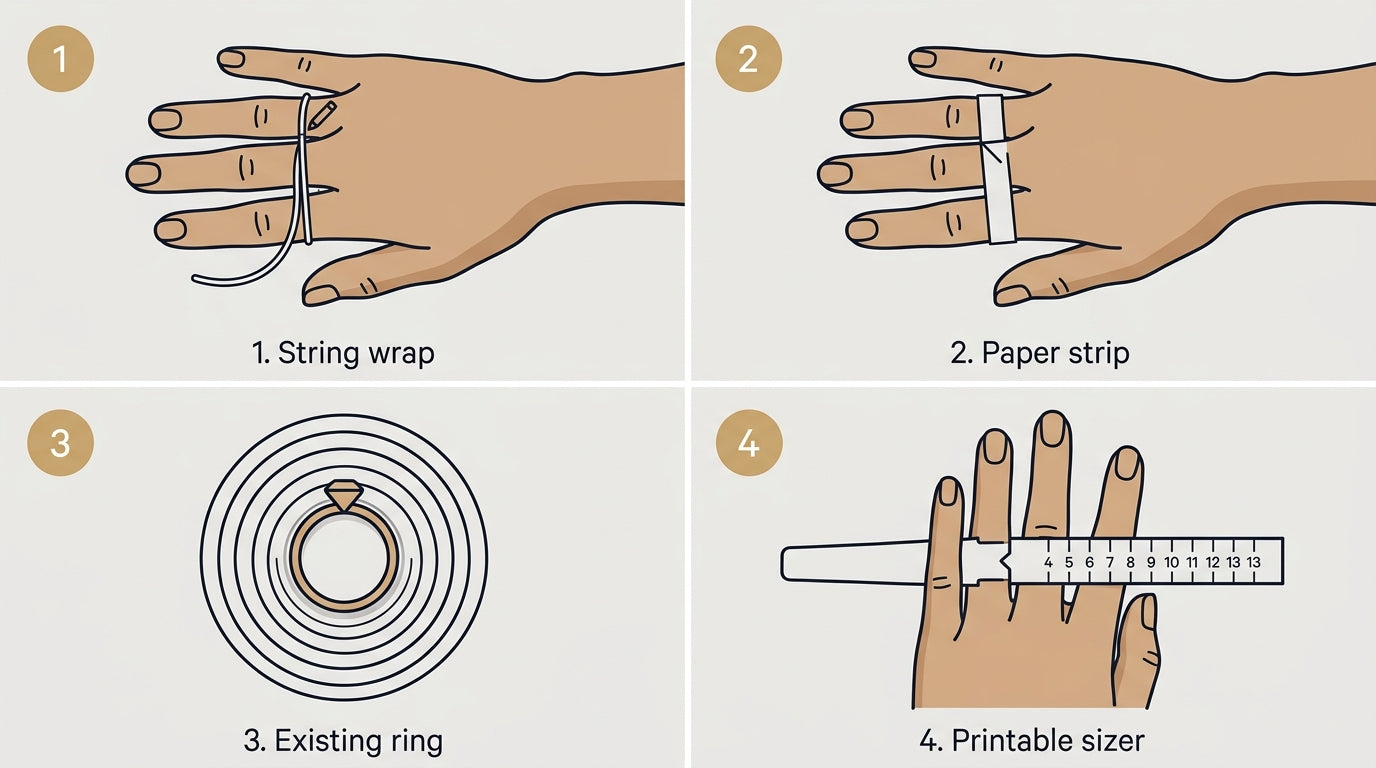
Four methods cover every situation: measuring a bare finger, sizing a ring you already own, or pinning down someone else's size discreetly. Measure at day's end when hands are warm, repeat twice, and take the larger reading.
Method 1 — String wrap
Cut 100 mm of thin cotton string or dental floss. Wrap it once around the base of the finger so it sits snug but slides over the knuckle. Mark the overlap, lay flat against a ruler, and read the length — that's your inside circumference. 54 mm is US 7; 57 mm is US 8. Avoid thick yarn or elastic.
Method 2 — Paper strip
Cut a strip of printer paper 6 mm wide by 100 mm long. Wrap around the base of the finger, overlap the ends, mark the point, measure with a ruler. Paper doesn't stretch — our Miami bench recommends it over string when no professional sizer is handy.
Method 3 — Measure a ring you already own
Place a ring that fits the intended finger on a flat surface. Measure straight across the inside opening at its widest point with a ruler or digital caliper. That reading is your inside diameter: 16.5 mm is US 6; 17.3 mm is US 7; 18.1 mm is US 8. Full walkthrough below.
Method 4 — Printable sizer
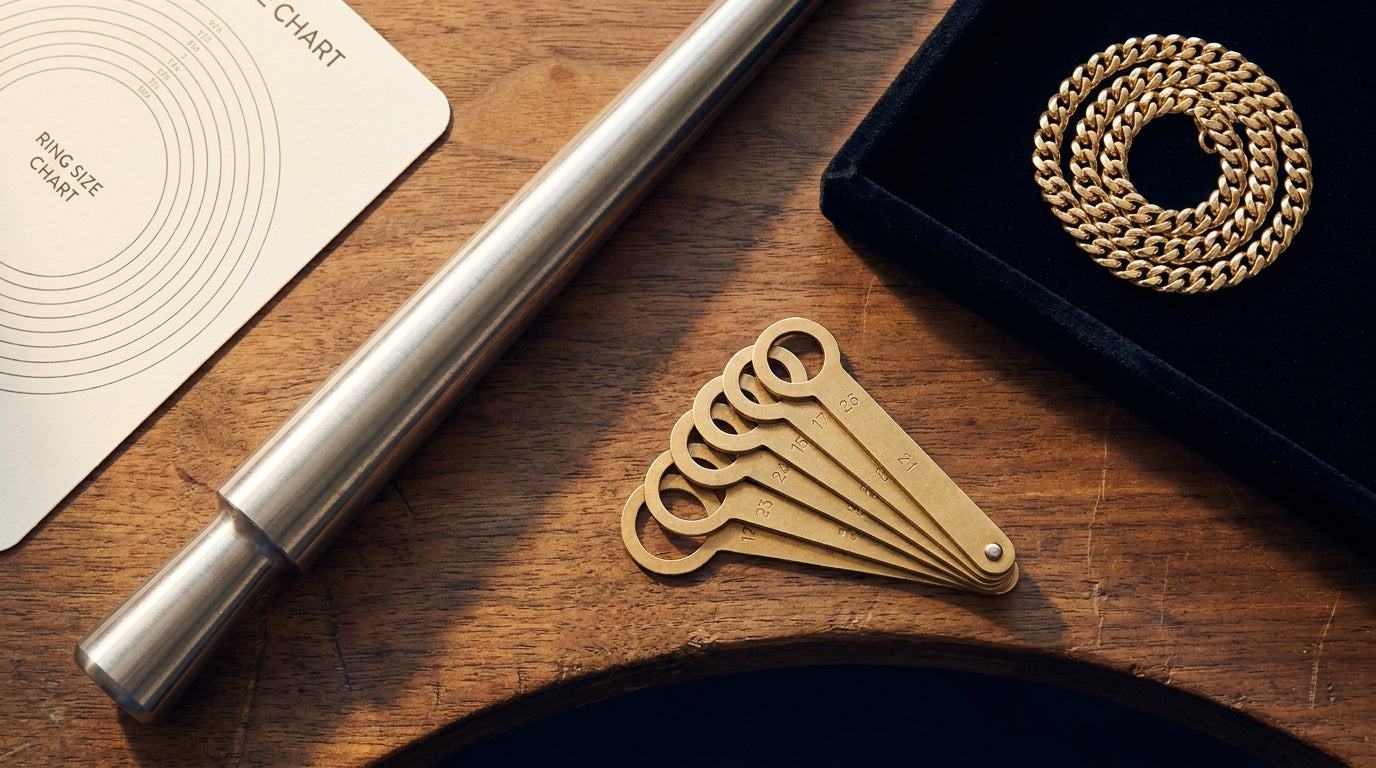
Download the GOLDZENN printable chart, print at 100% scale, and use either the concentric-circle chart (lay your ring over the matching circle) or the cut-out paper sizer strip. Closest at-home equivalent to a jeweler's steel mandrel.
Once you have a size, our 10K vs 14K vs 18K gold comparison explains how alloy choice affects durability and sizing.
Printable Ring Size Chart (Download PDF)
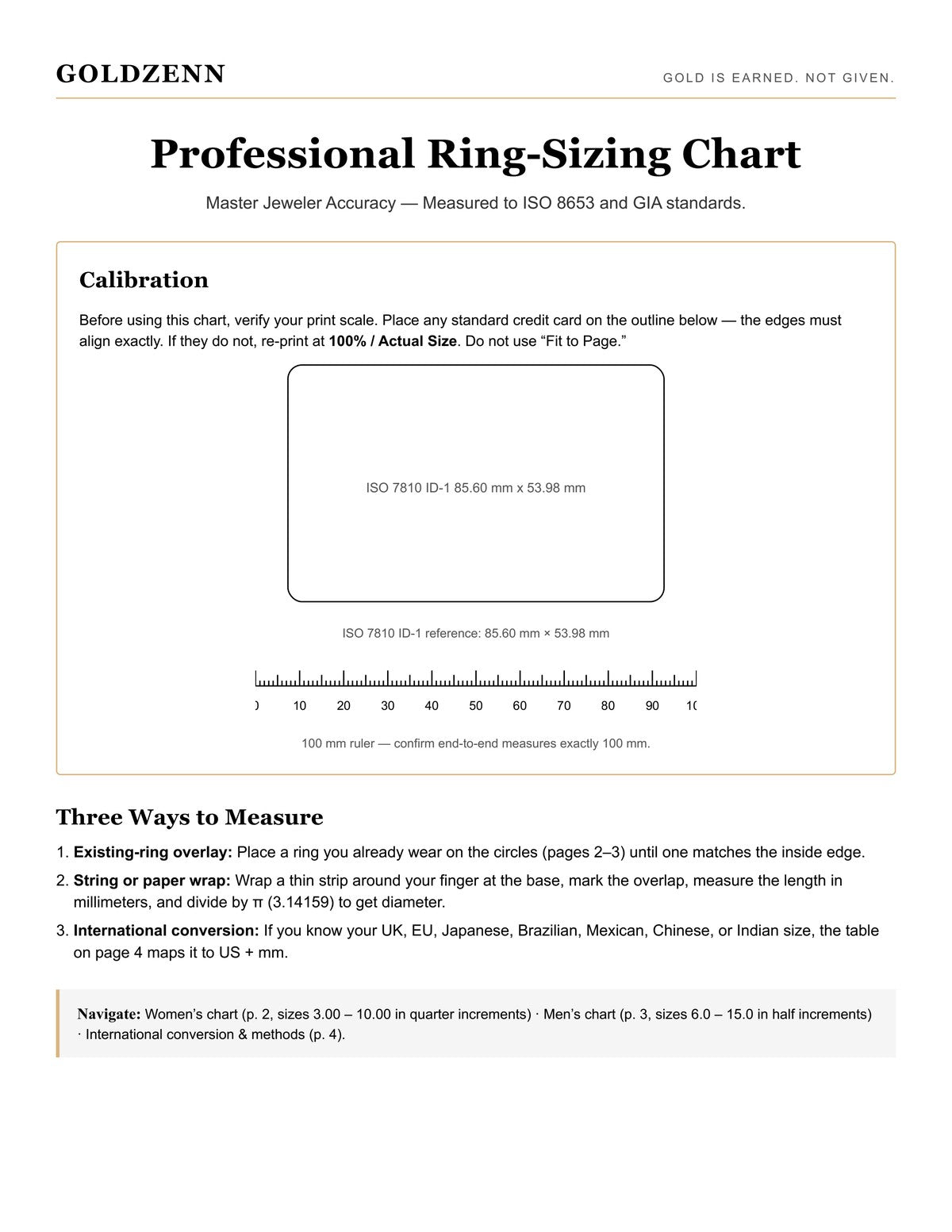
Our printable chart is a two-page PDF: page one covers women's US 4–10 as concentric circles; page two covers men's US 7–14. Each page includes a 50 mm calibration ruler and a cut-out paper sizer strip.
Download the GOLDZENN ring-size chart (PDF, printable)
How to print the chart at the correct scale
Print at 100% scale — not "fit to page." Hold a physical ruler against the 50 mm calibration bar; if it reads exactly 50 mm, the chart is accurate. If less, reprint with scaling off.
How to use the concentric-circle chart
Lay a ring that fits on top of the printed chart. Align the ring's inside edge with each circle until you find the exact match. The number beneath is your US size; cross-reference the table below for UK, EU, Japan.
How to use the paper sizer strip
Cut along the dotted line. Make a small slit where indicated. Thread the tapered end through to form a loop. Slide onto the finger, tighten until snug but removable. The number aligned with the slit is your ring size.
Ring Size Chart — US, UK, EU, Japan + International Conversion
Ring sizes are regional. A US 7 is a UK N, EU 54, and Japan 14 — same finger, four labels. The international ring size chart below maps inside diameter and circumference across nine countries. Sources: GIA's ring size reference and Jewelers of America's conversion standard, cross-checked against ISO 8653.
| Inside Diameter (mm) | Inside Circumference (mm) | US / Canada | UK / Australia | EU (ISO) | Japan | Brazil | Mexico | India / China |
|---|---|---|---|---|---|---|---|---|
| 14.9 | 46.8 | 4 | H | 46¾ | 7 | 7 | 7½ | 7 / 7 |
| 15.7 | 49.3 | 5 | J½ | 49¼ | 9 | 10 | 9¼ | 9 / 9 |
| 16.1 | 50.6 | 5.5 | K½ | 50½ | 10 | 12 | 10¼ | 10 / 10 |
| 16.5 | 51.9 | 6 | L½ | 51¾ | 12 | 14 | 11½ | 12 / 12 |
| 17.3 | 54.4 | 7 | N½ | 54¼ | 14 | 17 | 14 | 14 / 14 |
| 18.1 | 56.9 | 8 | P½ | 56¾ | 16 | 19 | 16¼ | 16 / 16 |
| 18.5 | 58.1 | 8.5 | Q½ | 58 | 17 | 20 | 17¼ | 17 / 17 |
| 18.9 | 59.4 | 9 | R½ | 59¼ | 18 | 21 | 18½ | 18 / 18 |
| 19.8 | 62.1 | 10 | T½ | 61¾ | 20 | 24 | 20½ | 20 / 20 |
| 20.6 | 64.6 | 11 | V½ | 64½ | 22 | 26 | 22¼ | 22 / 22 |
| 21.4 | 67.2 | 12 | X½ | 67¼ | 24 | 28 | 24¼ | 24 / 24 |
| 22.2 | 69.7 | 13 | Z½ | 69¾ | 26 | 30 | 26¼ | 26 / 26 |
Sources: GIA Ring Size Reference; Jewelers of America conversion reference (GOLDZENN Member ID 81868590). Values rounded to standard jewelry bench conventions. Half sizes in mm interpolated linearly.
Men's typical range: US 9–11. Women's typical range: US 5–7.
Are you a blogger or editor? Embed this chart on your site →
Copy the snippet below and paste it into your post. It includes attribution back to this guide.
<div style="max-width:700px;margin:24px auto;padding:16px;border:1px solid rgba(127,127,127,.25);border-radius:6px;font-family:-apple-system,BlinkMacSystemFont,Segoe UI,Helvetica,Arial,sans-serif;text-align:center;background:rgba(233,231,229,.4);">
<img src="https://goldzenn.com/cdn/shop/t/91/assets/a3-ring-sizing-intl-chart.jpg" alt="International ring size conversion chart — US, UK, EU, Japan, Brazil, Mexico, India, China" style="max-width:100%;height:auto;display:block;margin:0 auto 10px;border-radius:4px;" loading="lazy">
<p style="font-size:13px;line-height:1.5;margin:6px 0 0;color:inherit;">
Ring size chart by <a href="https://goldzenn.com/blogs/news/how-to-measure-a-ring-size-at-home-printable-guide" rel="noopener" style="color:#d8b47f;text-decoration:none;font-weight:600;">GOLDZENN</a> — Miami.
</p>
</div>Share with attribution — © GOLDZENN Miami.
How to Measure a Ring You Already Own
Measuring an existing ring is the most accurate home method — you're measuring a manufactured object, not a living finger. You need a millimeter ruler or digital caliper. Lay the ring flat. Measure straight across the inside opening at its widest point. 15.7 mm is US 5; 16.5 mm is US 6; 17.3 mm is US 7; 18.1 mm is US 8; 18.9 mm is US 9; 19.8 mm is US 10. Rotate 90 degrees and re-measure; if readings differ, the band is oval — average them.
Common pitfalls when measuring an existing ring
Worn bands stretch oval. Comfort-fit interiors read about a quarter-size larger than standard-fit. A band thicker than 4 mm sits tighter than a thin band of the same internal dimension — size up by a half. Before resizing a suspect ring, verify it's solid gold and not plated — see how to spot real gold. Plated rings cannot be resized without destroying the plating.
Men's Ring Size Chart + Average Size by Hand Circumference
The average men's ring size in the US is a US 10 — 19.8 mm inside diameter, 62.1 mm circumference. Most men wear between US 9 and US 11. Hand circumference is a reliable cross-check: measure around the palm below the knuckles. 184 mm (7.25 in) typically corresponds to US 9; 197 mm (7.75 in) to US 10; 210 mm (8.25 in) to US 11.
Wide-band and Cuban-link sizing rule
Any band wider than 4 mm needs to size up by a half — a wider band contacts more skin and reads tighter. A 6 mm or 8 mm Cuban-link ring — one of our most requested men's profiles — should be ordered a full half size above measured. Browse our men's wedding bands and Cuban link rings for widths in this category. For design context, see our men's rings complete style guide and 14K vs 18K gold comparison.
What Is the Average Women's Ring Size?
The average women's ring size in the US is between US 6 and US 7. US 6 is 16.5 mm inside diameter (51.9 mm circumference); US 7 is 17.3 mm (54.4 mm). Engagement rings should fit snug so the center stone stays centered; thin stackables can fit a touch looser because they shift less.
Stacking rings — sizing for layered looks
Wearing two or three bands together? Measure with all bands stacked, not individually. Three thin bands (1.5 mm each) size like a single 4.5 mm band. For wedding-band pairings, see matching wedding band to engagement ring.
Sizing for a proposal — how to find her size without asking
Three reliable discreet methods: (1) borrow a ring she wears on the intended finger and trace the inside edge on paper, then measure the diameter; (2) ask a close friend or family member; (3) compare her existing ring to someone with similar hand size. See our custom jewelry process and engagement ring styles.
Special Cases: Knuckle-Larger Fingers, Temperature, Swelling, Pregnancy
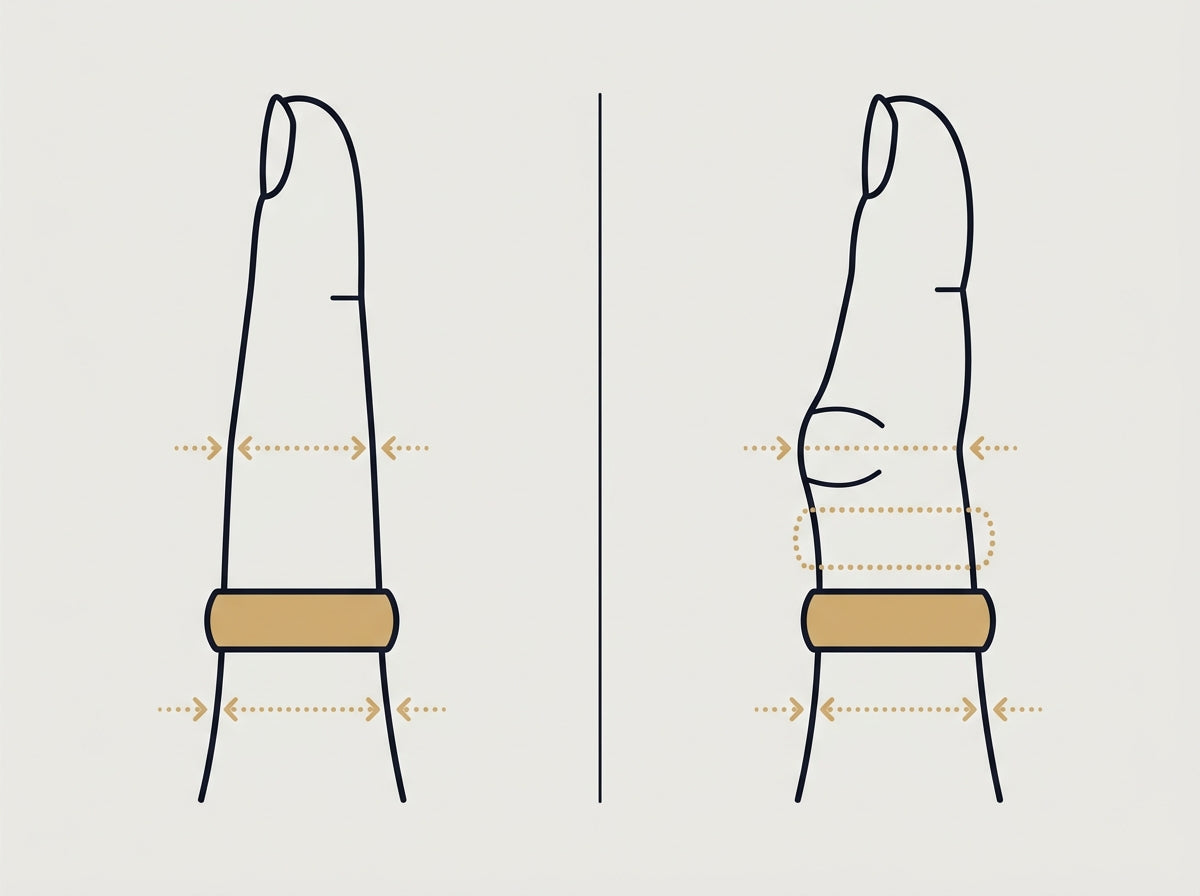
Fingers are not cylinders. For knuckle-larger fingers, size to the knuckle so the ring slides over it without force — the band will sit slightly loose at the base. A size-bead retrofit (two small gold beads soldered inside the band) holds the ring upright so the setting doesn't spin — a reversible fix our Miami bench performs in under an hour on solid 10K through 22K bands.
Temperature, time of day, pregnancy, and medication
Fingers swell in heat, after exercise, and in humid weather. Measure at day's end in a room-temperature environment — not first thing in the morning or right after a workout. If readings hours apart disagree by more than a half size, take a third and use the middle value. Pregnancy can shift finger size by up to a full size and sometimes doesn't revert fully; some cardiovascular medications also affect finger volume. Order to current measurement during these periods and plan on one in-workshop adjustment later.
Top-heavy rings — diamonds, iced-out, statement pieces
A ring with a tall center stone or pave halo carries weight above the finger and amplifies any looseness, letting the setting rotate. Size a quarter-step tighter, or add a size bead. Browse our diamond rings, iced-out rings for men, and diamond jewelry buying guide. 24K gold rings are softer than 14K or 18K and can drift in fit — see our 24K gold ring buying guide.
Can Rings Be Resized? Which Metals, What It Costs
Solid gold rings in 10K, 14K, 18K, 22K, and 24K all resize. Sterling silver and solid platinum resize cleanly as well. Titanium, tungsten carbide, cobalt, stainless steel, and ceramic cannot — the metals are too hard to cut and re-solder without destroying the ring's integrity. Plated rings cannot be resized because the plating breaks at the join. Eternity or channel-set bands are limited to a quarter or half-size adjustment to avoid dislodging stones.
Resize cost depends on metal, karat, size change, and setting complexity. See our live guides on 10K gold price per gram, 14K gold price per gram, and the 18K gold buyer's guide.
GOLDZENN in-workshop resizing
Need a different fit after your order arrives? Our Miami bench offers in-workshop resizing on GOLDZENN solid gold rings — contact us for a quote. Resizing is a maintenance service, separate from the GOLDZENN warranty (limited lifetime craftsmanship warranty on handmade Cuban chains and bracelets; 1-year limited warranty on all other pieces); the warranty covers manufacturing defects, not fit adjustments. See the bench where this work happens in our inside the GOLDZENN workshop feature.
Our Miami workshop team brings 50+ years of combined bench experience. GOLDZENN is rated 4.9 stars across 334 Google reviews for service at the Miami storefront. Our gold bracelet sizing guide applies the same circumference-based method to the wrist.
Frequently Asked Questions About Ring Sizing
How do I measure a ring size at home without a ring sizer?
Wrap a thin paper strip or cotton string around the base of the intended finger so it sits snug but slides over the knuckle. Mark the overlap, lay the strip flat against a millimeter ruler, and read the length. That's your inside circumference — 54 mm is US 7, 57 mm is US 8. Repeat at day's end and take the larger reading.
What is the average ring size for a man?
The average men's ring size in the US is a 10, roughly 19.8 mm inside diameter and 62.1 mm inside circumference. Most men fall between a US 9 and a US 11.
What is the average ring size for a woman?
The average women's ring size in the US is between 6 and 7, roughly 16.5 to 17.3 mm inside diameter (51.9 to 54.4 mm inside circumference).
Can I measure a ring I already own?
Yes. Lay the ring flat and measure straight across the inside opening in millimeters with a ruler or caliper. That reading is the inside diameter — 16.5 mm is a US 6, 17.3 mm is a US 7, 18.1 mm is a US 8. Rotate the ring 90 degrees and re-measure; if the readings differ, average them.
What time of day should I measure my ring size?
Measure at day's end at room temperature, when hands are warm but not actively swollen. Fingers are smallest in the morning and largest after exercise, so the end-of-day reading gives the most reliable everyday fit.
Does band thickness affect ring size?
Yes. A band wider than 4 mm on the outside sits tighter on the finger than a narrow band of the same internal dimension. Size up by a half when ordering any wide band — Cuban-link rings, signet rings, and wide wedding bands included.
How do I secretly find someone's ring size for a proposal?
Borrow a ring she already wears on the intended finger and trace the inside opening on paper, then measure the diameter. Alternatively, ask a close friend or family member, or compare her existing ring to someone with similar hand size. Never guess.
Can gold rings be resized?
Solid gold rings in 10K, 14K, 18K, 22K, and 24K can all be resized. Titanium, tungsten, cobalt, stainless steel, and ceramic cannot. Resizing is a separate bench service, not a warranty repair — the GOLDZENN warranty (limited lifetime craftsmanship on handmade Cuban chains and bracelets; 1-year limited on all other pieces) covers manufacturing defects, not fit changes.
How do I convert US ring sizes to UK or EU?
Use the conversion table in this guide. A US 7 is a UK N and EU 54; a US 10 is a UK T 1/2 and EU 62. The European system uses the inside circumference in millimeters as the size number — which is why EU numbers look larger.
What's the best way to print a ring-size chart accurately?
Set your printer to 100% scale — never "fit to page." Hold a physical ruler against the 50 mm calibration bar on the GOLDZENN chart. If it reads exactly 50 mm, the chart is accurate. If less, reprint with scaling off.
Conclusion — Get the Fit Right the First Time
Sizing a ring at home is a five-minute job — pick one of the four methods, download the printable chart, and cross-reference the international conversion table. For a wide band or top-heavy piece, adjust by a half size. For a surprise, use a borrowed ring and trace the inside.
When you're ready, browse our solid gold rings or visit our Miami workshop for an in-person measurement. Every GOLDZENN ring is made in our Miami bench in solid 10K, 14K, or 18K gold — no plating, no hollow shortcuts. 3,907+ verified Judge.me product reviews and Jewelers of America membership back that promise.