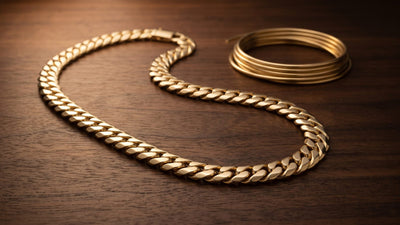
What Makes Gold Unique: The Science, History, and Value Behind the World's Most Precious Metal
Gold is the only metal on Earth that combines extreme rarity, permanent beauty, and total resistance to the forces of time. It does not rust. It does not tarnish. It does not corrode. A gold artifact pulled from a 3,000-year-old Egyptian tomb looks exactly as it did the day it was buried. No other material in existence can make that claim. This guide explores the science, history, and enduring value that make gold unique among all elements -- and why GOLDZENN builds every piece around this extraordinary metal.
The Physical Properties That Set Gold Apart
Gold's physical characteristics are what first attracted humans to it thousands of years ago, and those same properties make it irreplaceable in modern jewelry and industry today.
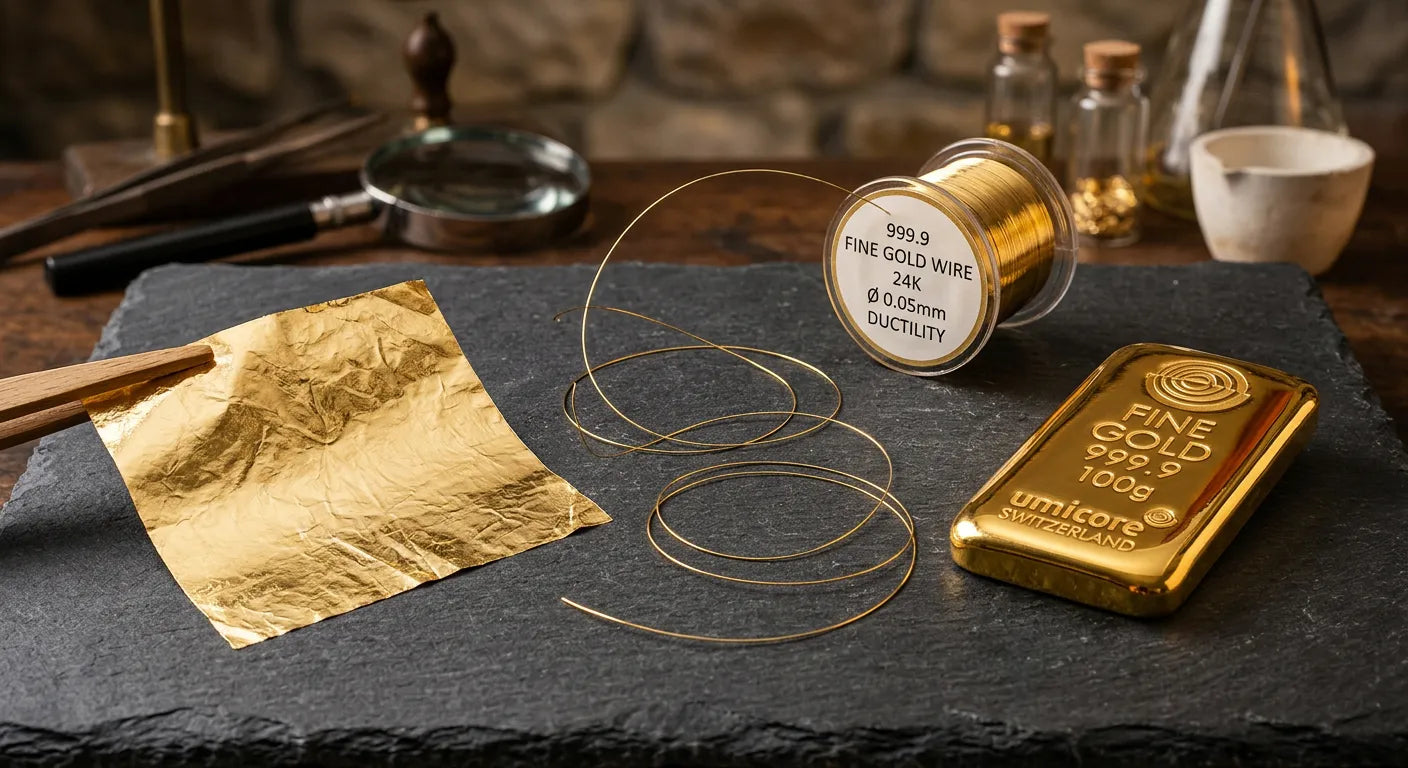
Malleability: Gold is the most malleable of all metals. A single ounce of pure gold can be hammered into a sheet roughly 300 square feet in area -- thin enough to be translucent. This extreme malleability is what allows jewelers to create intricate chain designs like the Cuban link, where each individual link must be precisely shaped, bent, and interlocked without cracking. At GOLDZENN, our craftsmen exploit gold's malleability daily to produce handcrafted chains with links that fit together seamlessly.
Ductility: Gold is equally remarkable in ductility -- the ability to be drawn into wire without breaking. A single ounce of gold can be drawn into a wire more than 50 miles long. This property is essential for creating rope chains, where thin gold strands are twisted together to form the spiral pattern that defines the style.
Conductivity: Gold is an excellent conductor of both electricity and heat. While this property matters more to the electronics and aerospace industries than to jewelry, it contributes to gold's overall demand. Every smartphone, satellite, and advanced circuit board contains gold components, creating industrial demand that supports gold's value alongside jewelry and investment demand.
Density: Gold is dense -- 19.3 grams per cubic centimeter, nearly twice as dense as lead. This density is why solid gold jewelry has that satisfying, substantial weight that immediately distinguishes it from plated or hollow alternatives. When you pick up a solid gold Cuban link chain, the heft tells you exactly what you are holding.
Softness: Pure 24K gold is soft compared to other metals, which is both an advantage and a limitation. The softness makes gold easy to work with -- essential for detailed jewelry design. But it also means pure gold scratches easily during daily wear. This is why jewelry-grade gold is alloyed with other metals (copper, silver, zinc, nickel) to increase hardness, creating the karat system that balances purity with practicality.
Chemical Uniqueness: Why Gold Never Tarnishes
The chemical behavior of gold is arguably its most extraordinary trait. Gold is one of the least reactive chemical elements in existence, sitting in the "noble metals" category alongside platinum and palladium.
Resistance to oxidation: Most metals react with oxygen in the air, forming oxides that we see as rust (iron), tarnish (silver), or patina (copper). Gold does not. Its electron configuration makes it exceptionally resistant to chemical bonding with oxygen, water, sulfur, and most acids. This is why gold jewelry requires minimal maintenance -- it does not degrade under normal conditions.
Resistance to corrosion: Gold survives exposure to saltwater, chlorine, sweat, perfume, and virtually every substance encountered in daily life. The only known chemical that can dissolve gold is aqua regia -- a mixture of nitric acid and hydrochloric acid in a 1:3 ratio. This mixture was named "royal water" (aqua regia) specifically because only it could dissolve the "royal metal."
Why this matters for jewelry: When you invest in a solid gold chain or ring, you are buying permanence. A 14K gold chain worn daily for 30 years will look essentially the same as the day it was purchased -- the gold portion of the alloy does not degrade. This chemical stability is what makes gold jewelry an heirloom material. Pieces crafted centuries ago retain their original beauty, which is why museums display ancient gold jewelry that looks freshly made.
The Atomic Structure That Creates Gold's Color
Gold's distinctive yellow color is not just beautiful -- it is scientifically unique. No other naturally occurring metal has this warm, rich hue, and the reason lies in quantum physics.
In most metals, electrons orbit the nucleus at speeds that are well below the speed of light. Gold, however, has 79 electrons, and its innermost electrons orbit at roughly 58% of the speed of light. At these velocities, Einstein's theory of special relativity kicks in: the electrons gain mass and contract their orbits. This "relativistic contraction" changes how gold absorbs and reflects light.
Specifically, gold's relativistic electrons absorb blue and violet wavelengths of visible light more readily than other metals. The remaining reflected light is concentrated in the yellow, orange, and warm-white portion of the spectrum. The result is gold's characteristic warm, lustrous yellow -- a color that has captivated humans since the first nugget was pulled from a riverbed.
This is also why gold alloys change color when mixed with other metals. Adding copper produces rose gold. Adding nickel or palladium produces white gold. Adding silver creates a greener yellow. Each alloy shifts the electron behavior and therefore the color, giving jewelers a palette of gold tones to work with.
Historical Significance: 6,000 Years of Human Fascination
Gold's relationship with humanity stretches back to the earliest civilizations, making it one of the first metals ever worked by human hands.
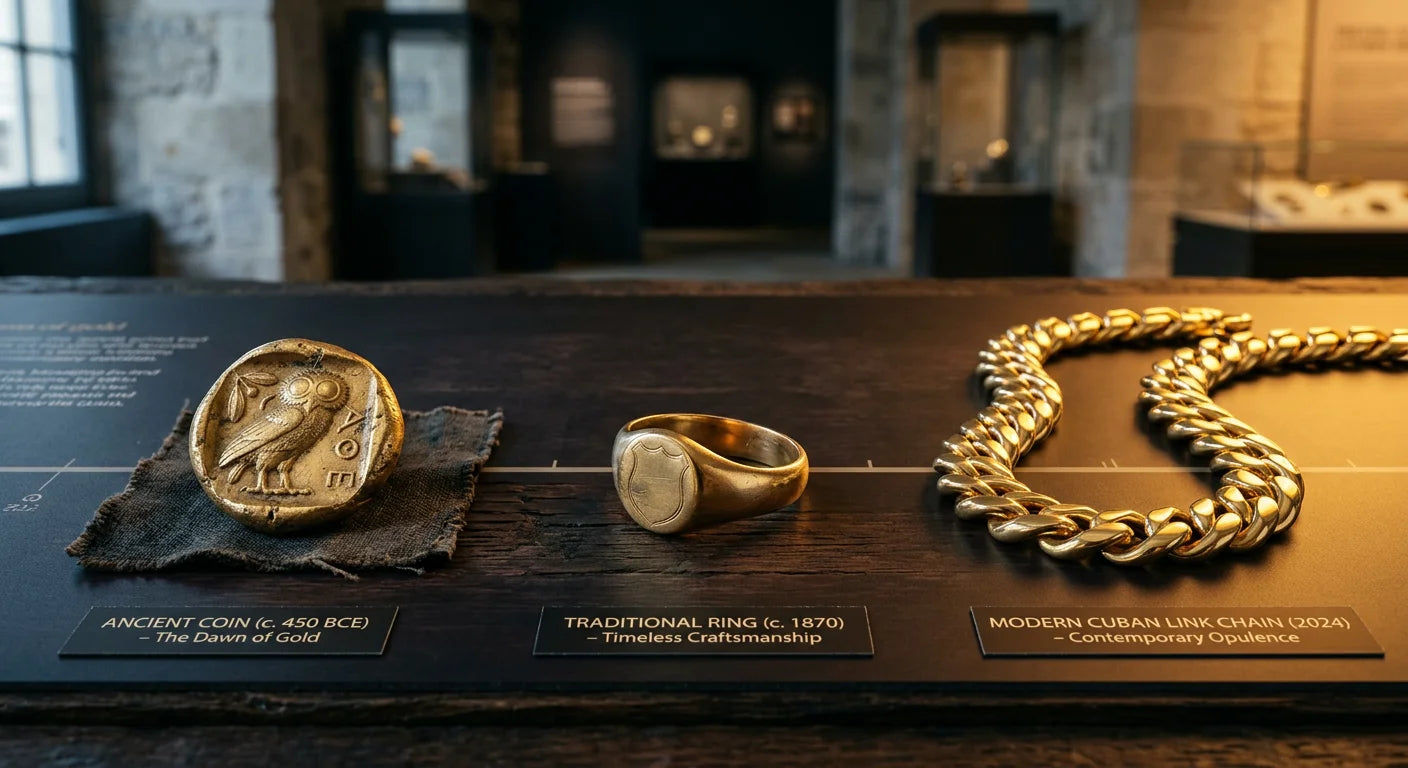
Ancient civilizations: The oldest known gold artifacts date to approximately 4,600 BCE, discovered in the Varna Necropolis in present-day Bulgaria. Ancient Egyptians considered gold "the flesh of the gods" and used it extensively in royal burial practices -- Tutankhamun's death mask alone contains 24 pounds of solid gold. The Incas called gold "the sweat of the sun." The Romans mined gold across their empire to fund military expansion and mint currency.
Gold as currency: Gold's rarity, divisibility, and resistance to corrosion made it the natural foundation for currency systems worldwide. The first gold coins were minted by King Croesus of Lydia around 550 BCE. The gold standard -- tying a nation's currency to a fixed amount of gold -- dominated global economics from the 19th century through 1971, when the United States abandoned it. Today, central banks still hold over 35,000 metric tons of gold in reserve, underscoring its continuing role as the world's ultimate store of value.
Cultural symbolism: Across virtually every culture on Earth, gold symbolizes wealth, power, purity, and achievement. Wedding bands are gold. Olympic first-place medals are gold. Religious artifacts -- from Buddhist statues to Christian chalices to Hindu temple ornaments -- are gold. The phrase "gold standard" has entered everyday language as a synonym for the highest quality achievable. This universal cultural weight adds an intangible layer of value to every piece of gold jewelry.
Gold in Different Cultures
Gold's significance varies across cultures, but its status as the most prized metal is universal.
South Asian traditions: In India, gold is central to wedding ceremonies, religious festivals, and family wealth. India is one of the world's largest gold consumers, with households holding an estimated 25,000 tons of gold -- more than the reserves of the United States, Germany, and Switzerland combined. Gold jewelry is both adornment and financial security, passed down through generations.
Latin American heritage: Pre-Columbian civilizations including the Aztec, Maya, and Inca cultures crafted gold into elaborate ceremonial objects, jewelry, and architectural elements. The legend of El Dorado -- a city of gold -- drew European explorers to the Americas and shaped the colonial history of an entire continent. In modern Latin American culture, gold chains remain a powerful symbol of achievement and personal identity.
Hip-hop and urban culture: Starting in the 1970s and 1980s in New York and Miami, gold chains -- particularly the Cuban link -- became central to hip-hop's visual identity. Artists wore heavy gold as a statement of success against systemic barriers. This cultural movement elevated the gold chain from simple jewelry to a symbol of self-made achievement, a meaning that resonates strongly with GOLDZENN's brand philosophy: "Gold is earned. Not given."
Middle Eastern and Mediterranean traditions: Gold souks in Dubai, Istanbul, and Cairo represent some of the world's largest gold markets. In many Middle Eastern cultures, gold jewelry serves as a portable store of wealth, wedding dowry, and social signifier. The tradition of gifting gold at births, weddings, and religious milestones remains deeply embedded in daily life.
Scarcity and Mining: Why Gold Will Always Be Rare
Gold's rarity is not a marketing concept -- it is a geological fact with profound implications for value.
How rare is gold? Gold constitutes approximately 0.004 parts per million of the Earth's crust. For comparison, aluminum is 80,000 parts per million -- twenty million times more common. All the gold ever mined in human history totals roughly 210,000 metric tons, which would fit into a cube measuring approximately 22 meters (72 feet) on each side -- about three Olympic swimming pools.
Where gold comes from: Gold is literally extraterrestrial. Scientists believe that virtually all of Earth's gold was deposited by asteroid impacts approximately 3.9 billion years ago, during a period called the Late Heavy Bombardment. The gold that was present during Earth's formation sank to the planet's iron core due to its density, making it inaccessible. The gold we mine today sits in the crust only because asteroids delivered it after the core had already formed.
Mining challenges: Modern gold mining is extraordinarily resource-intensive. Producing a single ounce of gold requires processing roughly 20 tons of ore. Mines operate at depths of up to 4 kilometers (2.5 miles) below the surface. Production costs average $1,200-$1,400 per ounce at major mines, creating a price floor below which extraction is not economically viable. New gold discoveries are declining -- most easily accessible deposits have already been found.
Finite supply: Unlike renewable resources, gold cannot be manufactured or grown. The total amount of gold on Earth is fixed. As surface deposits are exhausted and mining becomes more difficult, the remaining supply becomes progressively harder and more expensive to extract. This fundamental scarcity underpins gold's long-term value trajectory. For a deeper analysis of how supply and demand affect pricing, read our gold pricing guide.
The Karat System: Understanding Gold Purity
Pure gold (24K) is too soft for most jewelry applications, so it is alloyed with other metals to create varying levels of hardness and color. The karat system measures the proportion of pure gold in an alloy.
| Karat | Gold Purity | Other Metals | Key Characteristics |
|---|---|---|---|
| 24K | 99.9% | 0.1% | Richest yellow color, softest, most valuable per gram. Used in investment bars and select jewelry. |
| 22K | 91.7% | 8.3% | Deep yellow, slightly harder than 24K. Popular in South Asian and Middle Eastern jewelry. |
| 18K | 75.0% | 25.0% | Rich warm color with improved hardness. Luxury benchmark for fine jewelry worldwide. |
| 14K | 58.3% | 41.7% | The most popular karat in the US. Excellent balance of color, durability, and value. |
| 10K | 41.7% | 58.3% | Most durable karat. Slightly paler yellow. Most affordable solid gold option. |
At GOLDZENN, our most popular offerings span 10K through 18K solid gold, with each karat serving a specific purpose. Our Cuban link chains in 10K provide maximum durability for daily wear, while 14K delivers the ideal balance of color and strength. For the complete breakdown of how each karat performs, review our 10K vs 14K vs 18K comparison guide.
Gold Alloys and Color Variations
By varying the metals mixed with pure gold, jewelers create a spectrum of gold colors that expand design possibilities.
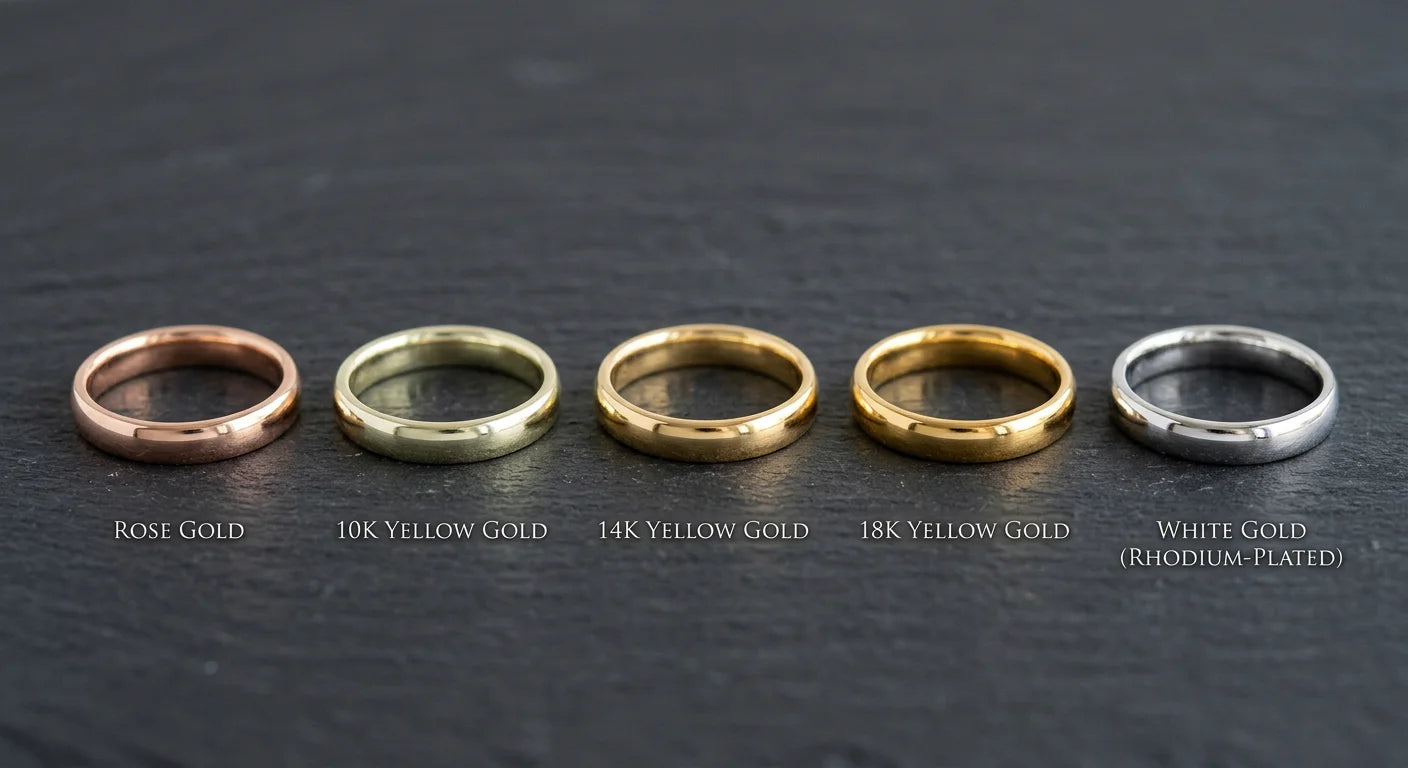
Yellow gold: The classic. Created by alloying gold with silver and copper in balanced proportions. Yellow gold preserves the natural warm hue that gold is known for. It is the most traditional choice for gold chains, wedding bands, and statement pieces. GOLDZENN's yellow gold chains are our most popular category.
White gold: Created by alloying gold with nickel, palladium, or zinc. The result is a cool, silvery-white metal that is often rhodium-plated for extra brilliance. White gold offers the prestige and durability of gold with the aesthetic of platinum at a lower price point. Popular for engagement rings, moissanite settings, and tennis chains.
Rose gold: Created by increasing the copper content in the alloy. The higher copper ratio produces a warm, pinkish hue that has surged in popularity. Rose gold has a slightly warmer, more romantic tone than yellow gold and tends to complement a wider range of skin tones. GOLDZENN carries select rose gold pieces for customers seeking this distinctive look.
Green gold (Electrum): A naturally occurring alloy of gold and silver. Electrum has a subtle greenish-yellow tint and was actually the first gold alloy used in ancient coinage. While less common in modern jewelry, it represents the natural state of many gold deposits.
Gold as an Investment: Store of Value Through Millennia
Gold is not just beautiful -- it is one of the most reliable financial assets in human history.
Inflation hedge: Over the long term, gold has consistently maintained its purchasing power. An ounce of gold in 1920 bought roughly the same amount of goods as an ounce of gold today, even as the dollar has lost over 95% of its purchasing power during the same period. This makes gold a hedge against currency devaluation and monetary policy uncertainty.
Crisis performance: During periods of economic turmoil -- recessions, financial crises, geopolitical instability -- gold prices typically rise as investors seek safe-haven assets. Gold is one of the few assets that tends to move independently of stock markets, providing portfolio diversification. For an in-depth look at gold's price behavior and investment thesis, see our gold investment guide.
Universal liquidity: Gold can be sold anywhere on Earth for cash. Unlike stocks, bonds, real estate, or cryptocurrency, gold requires no intermediary, no electricity, and no counterparty to hold value. A gold chain purchased in Miami can be sold in Dubai, Tokyo, London, or any city on the planet. This universal liquidity is unmatched by any other asset class.
Jewelry as wearable investment: Solid gold jewelry occupies a unique position as both a personal luxury and a tangible asset. A solid 14K Cuban link chain from GOLDZENN is simultaneously a style statement and a store of intrinsic metal value. Unlike fashion accessories that depreciate to zero, solid gold jewelry always retains its melt value -- and well-crafted pieces from reputable jewelers often appreciate above melt due to craftsmanship premiums. To understand how gold spot prices affect jewelry value, visit our gold pricing breakdown.
Gold in Modern Jewelry: Why It Remains the Standard
Despite centuries of metallurgical advancement and the introduction of new materials like titanium, tungsten, and lab-grown diamonds, gold remains the dominant material in fine jewelry worldwide. Here is why.
Workability: Gold's combination of malleability and ductility makes it the ideal metal for complex jewelry designs. Intricate chain patterns like the Cuban link, rope chain, Byzantine weave, and Figaro pattern all depend on gold's ability to be shaped precisely without fracturing. No other metal offers the same combination of formability and finished beauty.
Skin compatibility: Gold is hypoallergenic in its pure form and well-tolerated by the vast majority of people even in lower-karat alloys. This biocompatibility means gold jewelry can be worn continuously -- sleeping, showering, exercising -- without causing skin reactions for most wearers.
Emotional resonance: Gold carries emotional weight that no alternative material can replicate. A gold wedding band signifies permanence. A gold chain gifted by a parent carries generational meaning. Gold trophies and medals represent the highest achievement. These cultural associations are embedded so deeply that they transcend trends and fashion cycles.
Resale and legacy: Unlike fashion jewelry made from base metals or plated materials, solid gold jewelry has a guaranteed floor value based on its gold content. This means every solid gold piece is simultaneously wearable art and a portable asset. At GOLDZENN, we craft pieces designed to be worn for decades and passed down through generations -- backed by GOLDZENN's limited lifetime craftsmanship warranty on handmade Cuban chains and bracelets (includes two free repairs; 1-year limited warranty on all other pieces).
Gold vs. Platinum vs. Silver: How Gold Compares
To fully appreciate what makes gold unique, it helps to compare it directly against the other major precious metals used in jewelry.
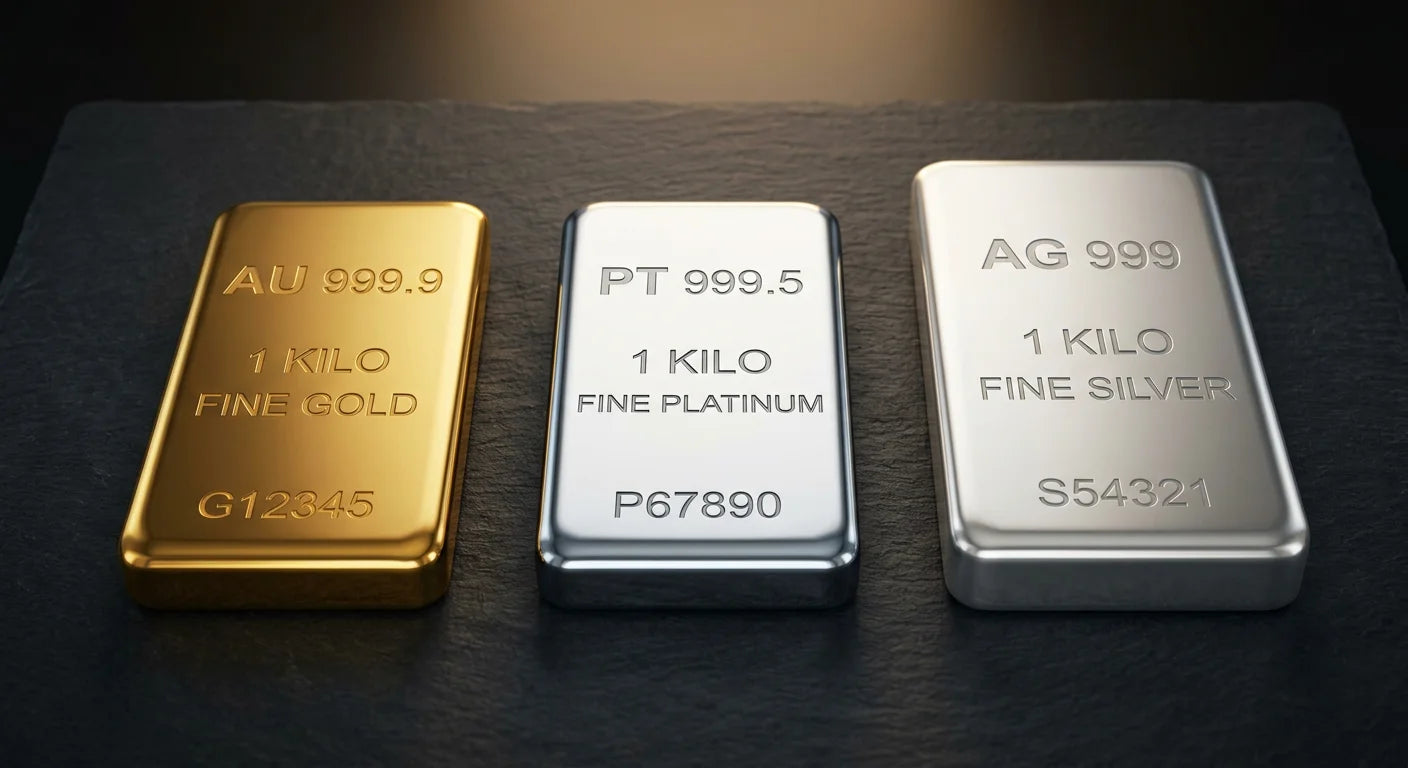
| Property | Gold (14K) | Platinum (950) | Silver (925) |
|---|---|---|---|
| Tarnish resistance | Does not tarnish | Does not tarnish | Tarnishes readily |
| Hardness (Vickers) | 120-180 | 56-65 (softer than 14K gold) | 60-100 |
| Density (g/cm3) | 13.1 (14K) | 21.4 | 10.5 |
| Color | Warm yellow (or white/rose) | Cool gray-white | Bright white (when polished) |
| Price per ounce | Based on gold spot (~$2,900+) | ~$950-1,100 | ~$30-35 |
| Scratch resistance | Good (14K) | Moderate (develops patina) | Fair |
| Maintenance | Minimal | Low | Regular polishing required |
| Cultural significance | 6,000+ years | ~200 years in jewelry | ~5,000 years |
Gold's advantage is clear: it combines the tarnish resistance of platinum with superior hardness (in 14K), a warmer color palette, stronger cultural significance, and higher investment value. Silver offers accessibility but requires constant maintenance. Platinum is excellent but lacks gold's warmth and carries a shorter history in jewelry. For a deeper comparison of gold purities, see our 14K vs 18K guide.
GOLDZENN's Relationship with Gold
At GOLDZENN, gold is not just a material -- it is the foundation of everything we create. Our Miami workshop, backed by over 50 years of combined craftsmanship experience, transforms raw gold into wearable art that honors this metal's extraordinary properties.
Handcrafted tradition: Our master jewelers work with gold daily, understanding its behavior at every temperature and stage of the crafting process. From melting and alloying to drawing wire, shaping links, assembling chains, and final polishing, every step is performed with an intimate knowledge of how gold responds to heat, pressure, and tooling. Watch the process on YouTube @GOLDZENNJWL.
Material selection: GOLDZENN offers solid gold in 10K, 14K, and select 18K, plus hollow gold options for lightweight wear and gold vermeil and plated pieces for accessible entry points. Every material is represented honestly for what it is -- solid is solid, hollow is hollow, plated is plated. No misleading claims.
The GOLDZENN collection: Our catalog spans the full range of gold chain styles -- Cuban links, rope chains, Figaro chains, curb chains, Byzantine weaves, tennis chains, and pendants. Each piece is crafted to showcase gold's unique properties: its warm color, its satisfying weight, its resistance to time. Browse our full collection at goldzenn.com.
Quality assurance: Every GOLDZENN piece is covered by our written warranty — limited lifetime craftsmanship warranty on handmade Cuban chains and bracelets, 1-year limited on all other pieces. With 347+ Google reviews at 4.9 stars and 3,920+ verified product reviews, our commitment to quality is backed by thousands of satisfied customers. For questions about specific pieces, materials, or custom orders, contact us at contact@goldzenn.com or call 321-521-4651.
Gold is earned. Not given. And when you wear GOLDZENN, you wear a piece of the most remarkable metal on Earth -- crafted by hands that understand its value down to the atomic level. Explore our men's gold chain style guide to find the piece that matches your identity, or learn how to protect your investment with our gold jewelry care guide.
Frequently Asked Questions About Gold's Unique Properties
Why is gold so valuable?
Gold's value comes from a combination of extreme rarity, unique physical properties, and thousands of years of cultural significance. Gold makes up only about 0.004 parts per million of the Earth's crust, making it one of the rarest elements. Unlike most metals, gold does not corrode, rust, or tarnish — it maintains its beauty indefinitely. Its combination of scarcity, durability, beauty, and universal recognition makes it the world's most trusted store of value across civilizations and centuries.
Does gold tarnish or rust?
No. Gold is one of the least reactive chemical elements, which means it does not tarnish, rust, corrode, or oxidize when exposed to air, water, or most chemicals. This is why ancient gold artifacts recovered from tombs and shipwrecks still shine as brightly as the day they were made. Lower-karat gold alloys (10K, 14K) may show slight surface changes from the non-gold metals in the alloy, but the gold content itself remains permanently unchanged.
What makes gold different from other precious metals?
Gold is uniquely malleable (can be hammered into sheets as thin as a few atoms), ductile (a single ounce can be drawn into a wire over 50 miles long), and virtually indestructible under normal conditions. Unlike silver, it does not tarnish. Unlike platinum, it has a warm, distinctive yellow color that no other naturally occurring metal shares. Gold is also an excellent conductor of electricity, which is why it is used in electronics and aerospace applications beyond jewelry.
Is gold rare?
Yes, gold is extremely rare. All the gold ever mined in human history would fit into approximately three Olympic-sized swimming pools — roughly 210,000 metric tons. Gold makes up just 0.004 parts per million of the Earth's crust, and new gold deposits are increasingly difficult and expensive to discover and extract. Unlike synthetic materials, gold cannot be manufactured or created artificially in meaningful quantities, which permanently limits supply.
Why does gold not corrode?
Gold's resistance to corrosion comes from its electron configuration, which makes it extremely stable and non-reactive with oxygen, water, and most acids. Only a few powerful chemical combinations — such as aqua regia (a mixture of nitric and hydrochloric acid) — can dissolve gold. This chemical stability is what allows gold jewelry to be passed down through generations, and why gold is the preferred metal for heirloom pieces like Cuban link chains and fine jewelry.
Why is gold yellow?
Gold's distinctive yellow color is caused by the way its electrons absorb and reflect light at the atomic level. Due to relativistic effects on gold's inner electrons, the metal absorbs blue wavelengths of light more than other metals do, reflecting back the yellow-to-orange portion of the visible spectrum. This is a property unique to gold among all metals — no other naturally occurring metal has this warm, rich yellow hue, which is why pure 24K gold is prized for its color alone.
What is the difference between 10K, 14K, 18K, and 24K gold?
The karat number indicates what fraction of the alloy is pure gold. 10K is 41.7% gold (most durable, most affordable), 14K is 58.3% gold (the most popular balance of durability and purity), 18K is 75% gold (richer color, softer), and 24K is 99.9% pure gold (softest, richest yellow). Higher karat means more gold content, warmer color, and higher price. GOLDZENN offers solid gold jewelry across all these karats — learn more in our karat comparison guide.
Is gold a good investment?
Gold has been one of the most reliable stores of value throughout human history. It has outperformed inflation over the long term, serves as a hedge during economic uncertainty, and is universally liquid — meaning it can be sold anywhere in the world. Gold jewelry combines investment value with wearable utility. Solid gold pieces from reputable jewelers retain their intrinsic metal value regardless of fashion trends. For an in-depth analysis, read our gold investment guide.
Can gold be destroyed?
Gold is virtually indestructible under normal conditions. It cannot be destroyed by fire, water, time, or exposure to the elements. Gold melts at 1,064 degrees Celsius (1,947 degrees Fahrenheit) but does not burn or evaporate under those conditions — it simply changes state. The only way to dissolve gold chemically is with specific acid combinations like aqua regia. This permanence is a fundamental reason gold has served as a store of value for over 5,000 years.
Why has gold been valued throughout history?
Gold's enduring value across civilizations stems from its unique combination of beauty, rarity, and permanence. Ancient Egyptians called gold "the flesh of the gods." Every major civilization — from the Roman Empire to the Aztecs to modern nations — has independently recognized gold as the ultimate symbol of wealth. Gold's inability to corrode, combined with its warm luster and workability, made it ideal for both currency and adornment. Today, central banks hold over 35,000 tons of gold reserves, continuing a tradition that spans millennia.