How to Purchase Gold Jewelry Without Getting Scammed: The Complete Buyer's Protection Guide
Gold jewelry is much more than a fashion statement. It is an investment in quality, durability, and often sentimental value that can last for generations. But where there is demand for gold, counterfeit products follow. The global counterfeit jewelry market costs buyers billions every year, with fake gold flooding online marketplaces, street vendors, and even some retail stores. One common area for deception is mislabeled vermeil — read our gold vermeil guide to know what to look for.
Whether you are purchasing your first Cuban link chain, a pair of gold earrings, or a custom piece for a special occasion, knowing how to identify authentic gold is essential. This guide covers everything you need to protect your investment, from at-home testing methods to professional verification, red flags to watch for, and what to look for in a trustworthy jeweler.
What Is Fake Gold and Why Does It Exist?
Fake gold refers to any material designed to look like gold without containing real gold content. The most common forms include:
- Gold-plated base metals — A thin layer of gold (typically 0.5 to 2.5 microns) applied over copper, brass, or zinc. The gold wears off within months of regular use. Learn more in our gold plated jewelry guide.
- Gold-filled metals — A thicker layer of gold bonded to a base metal core, longer-lasting than plating but still not solid gold.
- Brass or copper alloys — Polished to mimic gold's color, often sold at flea markets or from unverified online sellers.
- Tungsten replicas — Tungsten matches gold's density closely, making weight-based detection difficult. This is why professional XRF testing is critical.
Counterfeit gold exists because the profit margins are enormous. A base metal chain that costs a few dollars to produce can be sold as "solid gold" for hundreds or even thousands. Understanding the difference protects both your wallet and your health.
Health Risks of Wearing Fake Gold
Beyond financial loss, fake gold jewelry poses genuine health risks. Counterfeit pieces often contain toxic metals including:
- Lead — A known neurotoxin, especially dangerous for children. Some imported costume jewelry has tested positive for lead content exceeding safety thresholds.
- Nickel — One of the most common contact allergens, causing dermatitis, redness, itching, and blistering in sensitive individuals.
- Cadmium — A carcinogenic heavy metal found in some low-quality imported jewelry.
- Zinc and copper — Can cause green or black skin discoloration and allergic reactions when they interact with sweat and moisture.
Genuine solid gold (10K and above) is hypoallergenic and safe for extended wear. This is one of the most important reasons to invest in authentic gold from a reputable source.
Understanding Karat Purity: What the Numbers Mean
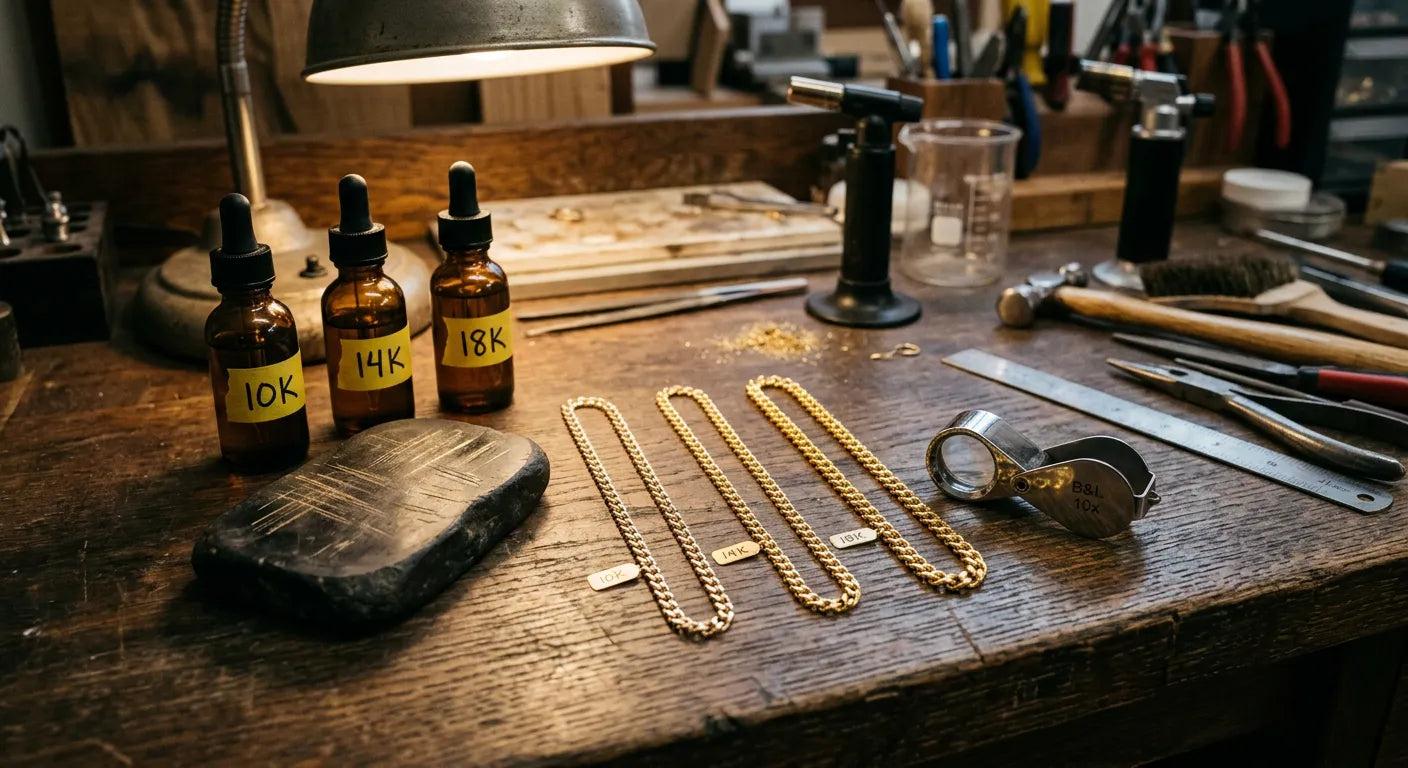
The karat system measures the proportion of pure gold in an alloy. Higher karat numbers mean more gold content, richer color, and higher intrinsic value. Here is the breakdown:
| Karat | Gold Purity | Alloy Metals | Best For |
|---|---|---|---|
| 10K | 41.7% | Silver, copper, zinc | Everyday wear, maximum durability |
| 14K | 58.3% | Silver, copper, zinc | Balance of durability and richness |
| 18K | 75.0% | Silver, copper | Premium color, special occasions |
| 22K | 91.7% | Silver, copper | Rich gold tone, cultural jewelry |
| 24K | 99.9% | None | Maximum purity, investment pieces |
Each karat serves a purpose. For daily-wear chains and bracelets, 10K and 14K offer the best combination of durability and gold content. For pieces where color richness and purity matter most, 18K and above deliver that deep, warm gold hue. Understanding these differences helps you match your purchase to your lifestyle and goals.
Seven Proven Methods to Test Gold Authenticity
1. Hallmark and Purity Stamp Inspection
Authentic gold jewelry carries a hallmark stamped by the manufacturer, indicating the karat (10K, 14K, 18K, 22K, 24K) or fineness (417, 585, 750, 916, 999). Use a jeweler's loupe (10x magnification) to inspect stamps carefully. Legitimate stamps are clean, evenly pressed, and consistent in depth.
However, stamps alone are not conclusive. Sophisticated counterfeits can carry fake stamps, which is why physical testing is always necessary for valuable purchases.
2. The Magnet Test
Gold is not magnetic. Hold a strong neodymium magnet near your jewelry piece. If it is attracted to the magnet, the piece contains ferromagnetic base metals like iron or steel and is not genuine gold. This test is quick and easy but not foolproof, as some non-magnetic metals (copper, brass, tungsten) are also used in counterfeits. Consider it a first screening step, not a final verdict.
3. The Acid Test
The acid test is one of the oldest and most reliable methods for verifying gold. A jeweler scratches the piece on a testing stone and applies nitric acid to the mark. Real gold does not react to nitric acid, while base metals dissolve or change color. Different acid strengths test different karats:
- 10K acid dissolves anything below 10K purity
- 14K acid dissolves anything below 14K purity
- 18K acid dissolves anything below 18K purity
This test should be performed by a professional jeweler, as the acids are corrosive and require proper handling.
4. XRF (X-Ray Fluorescence) Analysis
XRF testing is the gold standard of authentication. The device shoots X-rays at the metal and analyzes the fluorescent response to determine exact elemental composition. It is non-destructive, highly accurate, and provides a precise readout of gold percentage along with all other metals present. At GOLDZENN, we use XRF analysis to verify every piece in our workshop.
5. The Density and Water Displacement Test
Gold has a specific gravity of 19.3 g/cm3, making it one of the densest metals. To test at home:
- Weigh the piece on a precision scale (in grams)
- Fill a graduated cylinder with water and note the level
- Submerge the piece and note the new water level
- Divide the weight by the volume displaced
If the density falls significantly below the expected range for the claimed karat, the piece is likely not authentic. Pure 24K gold should measure close to 19.3 g/cm3, while 14K gold should measure approximately 12.9-14.6 g/cm3 depending on the alloy composition.
6. The Ceramic Scratch Test
Drag the gold piece across an unglazed ceramic tile. Real gold leaves a gold-colored streak. Fake gold or pyrite (fool's gold) leaves a black or greenish streak. This test can scratch your jewelry, so use it only on inconspicuous areas or pieces you are willing to mark.
7. The Skin Discoloration Test
Wear the piece for several hours during normal activity. Genuine solid gold will not leave any marks on your skin. If the metal leaves green, black, or dark marks, it contains base metals that react with your body's chemistry. This is a clear indicator of gold-plated or costume jewelry, not solid gold.
Red Flags When Buying Gold Jewelry
Knowing what to avoid is just as important as knowing what to look for. Watch for these warning signs:
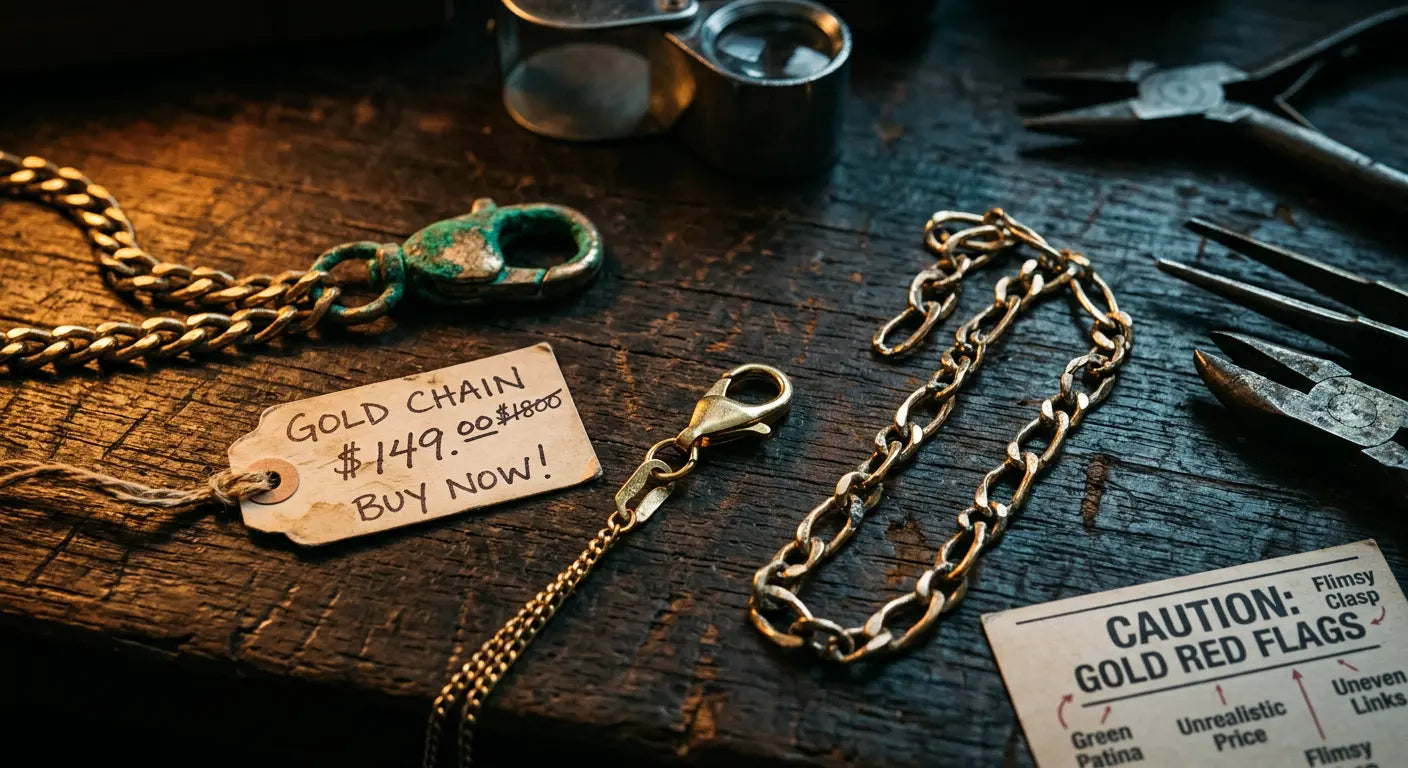
Price Too Good to Be True
Gold has a market value based on weight and purity. If someone offers you a "solid 14K gold chain" for a fraction of what the gold content alone would cost at melt value, something is wrong. Check current gold prices per gram before shopping so you have a baseline for what real gold should cost.
Missing or Suspicious Hallmarks
Legitimate gold jewelry carries clear, professionally stamped karat markings. Blurry, crooked, or unusually placed stamps suggest counterfeiting. Some sellers also use misleading stamps like "GP" (gold plated), "GF" (gold filled), or "HGE" (heavy gold electroplate), which are not solid gold.
No Return Policy or Warranty
Reputable jewelers stand behind their products. If a seller refuses to offer a return window, provides no warranty, or cannot produce documentation of the piece's gold content, walk away. GOLDZENN backs every piece with a written warranty (limited lifetime craftsmanship warranty on handmade Cubans; 1-year limited on all other pieces) and provides full transparency on metal purity and weight.
High-Pressure Sales Tactics
Phrases like "last one in stock," "price going up tomorrow," or "special deal just for you" are designed to prevent you from doing due diligence. A legitimate jeweler will never pressure you into an immediate decision on a significant purchase.
No Physical Address or Verifiable Reviews
Before buying online, verify that the seller has a physical business address, a working phone number, and genuine customer reviews on independent platforms. GOLDZENN operates from our Miami workshop at 1056 SW 67th Ave, Miami, FL 33144, backed by 347+ Google reviews at 4.9 stars and 3,920+ verified product reviews.
Where to Buy Gold Jewelry Safely
Authorized Jewelers and Direct-to-Consumer Brands
The safest option is purchasing from established jewelers who specialize in gold. Look for businesses with:
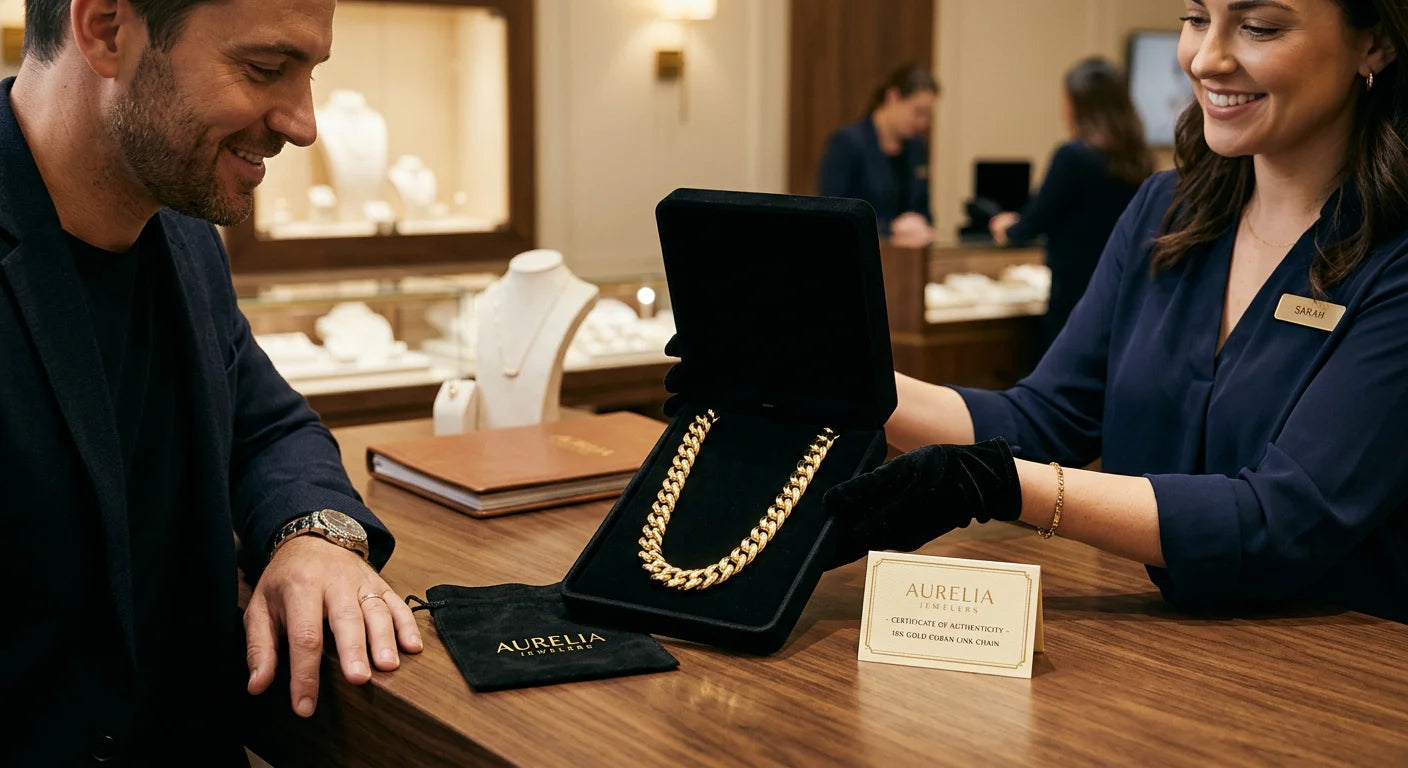
- A physical workshop or retail location
- Verifiable industry credentials (Jewelers of America membership, BBB accreditation)
- Transparent product specifications (karat, weight, dimensions)
- Clear return and warranty policies
- Professional product photography showing hallmarks
GOLDZENN is a Jewelers of America member (ID: 81868590) with a Miami-based workshop staffed by a team with 50+ years of combined experience in gold craftsmanship.
Online Shopping: What to Verify
Buying gold online is safe when you take the right precautions:
- SSL encryption — The website URL should start with "https://" and display a lock icon
- Detailed specifications — Karat, weight in grams, dimensions, and metal composition should be listed for every piece
- Customer reviews — Check reviews on Google, Trustpilot, and the seller's own product pages
- Return policy — A minimum 7-day return window is standard for reputable jewelers
- Contact information — A real phone number and email address you can reach a human at
If a website only accepts cryptocurrency, wire transfers, or non-reversible payment methods, that is a significant red flag.
Places to Avoid
Exercise extreme caution when buying gold from:
- Street vendors and flea markets
- Unverified social media sellers
- Auction sites with no buyer protection
- Pawn shops (unless you can verify authenticity independently)
- Tourism-district jewelry shops in foreign countries without proper documentation
Gold Plated vs Solid Gold: Know What You Are Buying
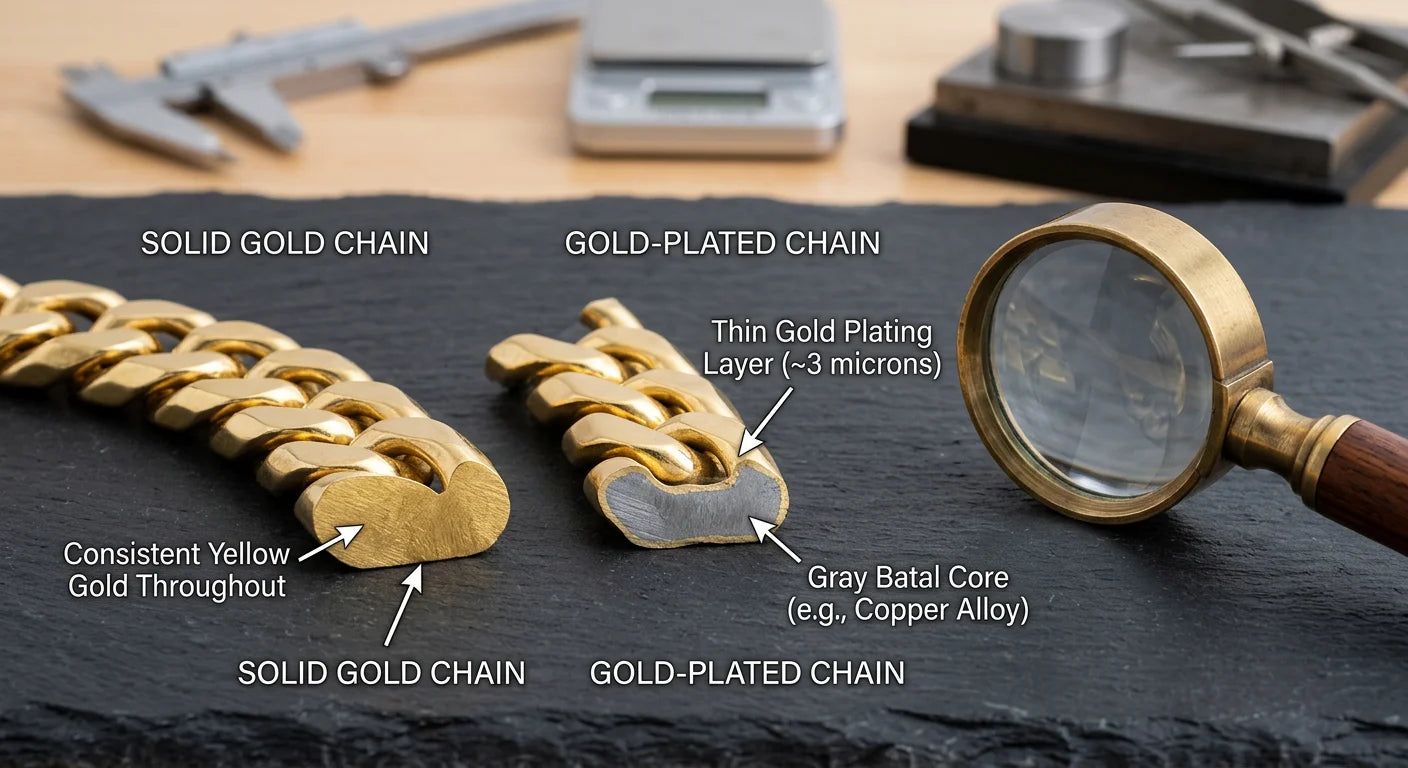
One of the most common sources of confusion is the difference between solid gold and gold-plated jewelry. Understanding this distinction can save you thousands.
| Feature | Solid Gold | Gold Plated |
|---|---|---|
| Gold content | 41.7% to 99.9% (10K-24K) | Less than 0.05% by weight |
| Durability | Lasts generations | Plating wears off in months |
| Tarnishing | Does not tarnish | Base metal tarnishes when exposed |
| Skin safety | Hypoallergenic | May cause reactions |
| Resale value | Retains significant value | Minimal resale value |
| Price | Higher upfront investment | Low initial cost |
For a deeper comparison, read our complete gold plated vs solid gold guide. GOLDZENN offers solid gold jewelry from 10K through 22K, along with select plated and hollow options for those who want the gold look at different price points. We represent each product honestly for what it is.
How to Calculate Fair Pricing for Gold Jewelry
Understanding gold pricing helps you spot deals that are too good to be true. Gold jewelry pricing consists of three components:
- Metal value — Based on the current spot price of gold, the karat purity, and the total weight of the piece
- Craftsmanship premium — The labor cost of designing, casting, finishing, and quality-checking the piece. Handmade pieces carry a higher premium than machine-made.
- Retail markup — Business overhead, warranty support, and customer service
As a rule of thumb, the retail price of a solid gold chain should never be less than its melt value (the value of the gold content alone at current market prices). If it is, the piece is almost certainly not what it claims to be. Check our gold prices guide for current pricing benchmarks and a calculator to estimate what gold should cost per gram by karat.
Common Gold Scams and How They Work
Awareness of specific scam tactics helps you recognize them before falling victim. Here are the most prevalent gold jewelry scams operating today:
The "Below Melt Value" Online Listing
Sellers list "solid 14K gold chains" at prices that would not even cover the raw gold content. These pieces are invariably gold-plated or gold-filled base metals. Always calculate the melt value of a piece based on its stated karat and weight before purchasing. If the asking price is below melt value, the listing is deceptive.
The Bait and Switch
A seller shows you a genuine gold sample or photograph but ships a different, lower-quality piece. This is common with online sellers who use stock photos or photographs of a single authentic piece to sell many counterfeits. Always verify the piece you receive matches the specifications listed.
The Fake Certification
Some counterfeiters include official-looking certificates of authenticity with their products. These documents are worthless unless they come from a recognized gemological laboratory or an established jeweler with verifiable credentials. If you are unsure about a certificate, take the piece to an independent jeweler for XRF testing.
The "Italian Gold" Markup
Some sellers claim their gold is "Italian gold" or "Dubai gold" to justify higher prices, implying superior quality. Gold is gold regardless of origin. What matters is the karat purity, the weight, and the quality of the craftsmanship. Do not pay a premium based solely on a claimed country of origin.
Protecting Your Gold Investment After Purchase
Proper Storage
Store gold jewelry in a fabric-lined box or individual soft pouches to prevent scratching. Keep pieces separated so chains do not tangle and harder stones do not scratch softer metals. Avoid storing gold in humid environments like bathrooms.
Regular Cleaning
Clean your gold jewelry periodically to maintain its luster. Warm water, mild dish soap, and a soft-bristled brush are all you need. Avoid harsh chemicals, chlorine, and abrasive cleaners. For step-by-step instructions, see our gold jewelry cleaning guide.
Insurance and Documentation
For valuable pieces, get a professional appraisal and consider adding them to your homeowner's or renter's insurance policy. Keep receipts, certificates of authenticity, and appraisal documents in a safe location. This documentation is essential for both insurance claims and resale value.
Professional Inspection
Have your gold jewelry inspected by a professional jeweler at least once a year. They will check for loose settings, worn clasps, and any structural issues before they become problems. This is especially important for Cuban link chains and pieces with stone settings.
Why GOLDZENN Is Your Trusted Source for Authentic Gold
At GOLDZENN, authenticity is not a selling point. It is a baseline. Every piece in our collection is crafted or curated with the same standard of quality that has earned us the trust of thousands of customers nationwide. Here is what sets us apart:
- Miami-based workshop — Our team has 50+ years of combined experience in gold craftsmanship. We handcraft custom pieces from raw gold to finished product.
- XRF-verified authenticity — Every piece is tested to confirm exact gold content before it reaches you.
- Written warranty — limited lifetime craftsmanship warranty on handmade Cuban chains and bracelets; 1-year limited warranty on all other pieces.
- Transparent specifications — Karat, weight, dimensions, and metal composition are listed for every product.
- 347+ Google reviews at 4.9 stars — Real feedback from real customers, plus 3,920+ verified product reviews.
- Jewelers of America member — Industry-recognized credentials that verify our commitment to ethical practices.
Whether you are shopping for a solid gold Cuban link, a rope chain, a gold pendant, or a tennis chain, GOLDZENN provides the transparency and expertise you deserve.
Your Gold Buying Checklist
Before completing any gold jewelry purchase, run through this checklist:
- Verify the karat stamp with a loupe — is it clear and professionally stamped?
- Ask about the piece's exact weight in grams
- Compare the price to current gold melt value for that karat — does the math work?
- Confirm the seller has a physical address and verifiable reviews
- Ask about the return policy and warranty terms
- Request documentation of authenticity (certificate, appraisal, or XRF results)
- Perform a magnet test if possible
- Check the seller's payment options — legitimate businesses accept standard payment methods
Armed with this knowledge, you can shop for gold jewelry with confidence. Whether buying in person or online, understanding what makes gold real, knowing the red flags, and choosing a reputable seller are your best protections against scams.
Ready to invest in authentic gold jewelry? Browse the GOLDZENN collection or contact our team directly at 321-521-4651 or contact@goldzenn.com for personalized guidance. Watch our craftsmanship process on YouTube @GOLDZENNJWL to see the quality behind every piece.
Frequently Asked Questions About Buying Real Gold Jewelry
How can I tell if gold jewelry is real or fake?
Authentic gold jewelry carries a karat stamp (10K, 14K, 18K, 22K, or 24K) indicating its purity level. You can also perform simple tests at home: real gold does not react to a magnet, will not leave a green or black mark on your skin, and maintains its color when rubbed against unglazed ceramic. For definitive results, visit a trusted jeweler like GOLDZENN who can perform professional XRF testing to verify exact gold content without damaging the piece.
What does the karat stamp on gold jewelry mean?
The karat stamp indicates the percentage of pure gold in the piece. 10K contains 41.7% gold, 14K contains 58.3%, 18K contains 75%, 22K contains 91.7%, and 24K is 99.9% pure gold. Higher karat numbers mean more gold content, richer color, and higher value. At GOLDZENN, we offer solid gold jewelry from 10K through 22K to suit different preferences and budgets.
Can fake gold jewelry cause health problems?
Yes. Counterfeit gold jewelry often contains base metals like nickel, lead, copper, and zinc that can cause allergic reactions, skin discoloration, rashes, and in some cases more serious health concerns from prolonged contact with toxic metals. Genuine solid gold is hypoallergenic and safe for extended wear, which is one of the key reasons to invest in authentic pieces from a reputable jeweler.
What is the magnet test for gold?
The magnet test is a simple at-home method to screen for fake gold. Hold a strong magnet near your gold piece — genuine gold is not magnetic and will not be attracted to the magnet. If the jewelry sticks or is pulled toward the magnet, it likely contains iron or other ferromagnetic base metals. Keep in mind that this test alone is not conclusive, since some non-magnetic metals are also used in counterfeits. Professional testing provides definitive results.
Why is buying gold from a trusted jeweler important?
A trusted jeweler provides verified karat purity, transparent pricing based on actual gold weight, proper documentation, and after-sale support including cleaning and repairs. Purchasing from unverified sources — especially online marketplaces, street vendors, or pawn shops — increases the risk of receiving counterfeit, plated, or misrepresented pieces. GOLDZENN backs every piece with a written warranty (limited lifetime craftsmanship warranty on handmade Cubans; 1-year limited on all other pieces) and provides full transparency on metal purity and weight.
What is gold-plated jewelry and how is it different from solid gold?
Gold-plated jewelry has a thin layer of gold (typically 0.5 to 2.5 microns) deposited over a base metal core. While it looks like gold initially, the plating wears off over time, exposing the base metal underneath. Solid gold jewelry is the same material throughout — no base metal core, no plating to wear away. Solid gold maintains its value, color, and integrity for generations, making it a true investment.
How much should real gold jewelry cost?
Real gold jewelry pricing depends on karat purity, total gold weight, craftsmanship complexity, and current gold market prices. If a "solid gold" piece is priced significantly below the current melt value of its gold content, that is a major red flag for counterfeits. Reputable jewelers like GOLDZENN price based on actual gold weight plus craftsmanship — never dramatically below market value. Contact us at 321-521-4651 or contact@goldzenn.com for current pricing.
What is the acid test for gold?
The acid test uses nitric acid applied to a small scratch made by the jewelry on a testing stone. Genuine gold will not react to nitric acid, while fake gold or gold-plated items will dissolve or change color at the scratch point. This test is performed by professional jewelers and is one of the most reliable traditional methods for verifying gold authenticity, along with XRF (X-ray fluorescence) analysis.
Is it safe to buy gold jewelry online?
Buying gold online is safe when you purchase from established, reputable jewelers with verifiable reviews, transparent return policies, and clear product specifications including karat, weight, and dimensions. Look for sellers with professional product photography showing hallmarks, detailed descriptions, and responsive customer service. GOLDZENN provides detailed specifications for every piece, backed by 347+ Google reviews at 4.9 stars and 3,920+ product reviews.
What are the signs of a gold jewelry scam?
Common warning signs include prices far below market value for the stated karat weight, missing or suspicious hallmark stamps, sellers who refuse to provide documentation or receipts, high-pressure sales tactics, and pieces that feel unusually light for their size. Other red flags include tarnishing or discoloration after short-term wear, green marks left on skin, and sellers who cannot answer basic questions about gold purity, weight, or sourcing.