The Italian Horn Pendant: A Timeless Symbol of Luck and Protection
The Italian horn pendant, known as the cornicello or cornetto, is one of the most culturally significant amulets in the history of jewelry. For over 2,500 years, this slender, curved talisman has been worn across the Mediterranean as a shield against misfortune and a beacon of good luck. At GOLDZENN, our solid gold Italian horn pendants honor this ancient tradition with the precision and quality of Miami-made craftsmanship, backed by a workshop with 50+ years of combined experience.
Whether you wear it for its deep cultural roots, its striking silhouette, or the quiet confidence it brings, the Italian horn remains one of the most meaningful gold pendants a person can own. This guide covers the cornicello's full history, its symbolism, how to choose the right metal and size, and how to style it with the right chain.
The Ancient Origins of the Italian Horn
The cornicello's history stretches back to the pre-Roman cultures of the Italian peninsula and the broader Mediterranean basin. Ancient Italic peoples, long before the rise of Rome, associated the horn shape with divine power. The twisted, tapered form of the horn was connected to the moon goddess, whose crescent shape the cornicello mirrors, and to agricultural fertility, since the horn evoked the power of bulls and oxen that were central to ancient farming life.
In ancient Rome, the fascinum and various horn-shaped amulets were common protective charms. Roman soldiers wore small horn talismans beneath their armor, believing the pointed shape could deflect curses and hostile magic during battle. Merchants hung horns above doorways. Mothers placed them in cribs. The horn was not decorative — it was a spiritual necessity.
After the fall of Rome, the tradition survived most strongly in Southern Italy, particularly in the Campania region around Naples. The Neapolitan cornicello became the definitive form: a gently twisted, elongated horn shape, always curved and never straight, since the twist was believed to "catch" and redirect negative energy. By the 18th and 19th centuries, Neapolitan artisans were crafting cornicelli in coral, silver, and gold. The red coral versions were especially prized because the color red was itself considered protective.
When millions of Southern Italians emigrated to the Americas in the late 1800s and early 1900s, they carried the cornicello tradition with them. Italian-American communities in New York, Philadelphia, Boston, and across the country maintained the practice of wearing and gifting the Italian horn, making it one of the most enduring pieces of immigrant cultural heritage in American jewelry.
What the Italian Horn Symbolizes
The cornicello carries multiple layers of meaning, each rooted in centuries of Mediterranean belief:
Protection from the Evil Eye (Malocchio)
The malocchio, or evil eye, is a curse believed to be caused by an envious or malicious glare. In Italian folk tradition, the evil eye can cause illness, bad luck, financial loss, and general misfortune. The cornicello's pointed shape is believed to pierce and deflect this negative energy, sending it back toward its source. The horn acts as a spiritual shield — a constant, wearable form of protection that requires no ritual, only faith in its meaning.
The evil eye belief is not unique to Italy. Variations exist across Greece, Turkey, the Middle East, North Africa, and South Asia. What makes the Italian horn distinctive is its specific form and the depth of the cultural infrastructure surrounding it — prayers, hand gestures (the mano cornuta), and diagnostic rituals all exist alongside the physical amulet.
Good Fortune and Prosperity
Beyond protection, the cornicello is a magnet for good luck. In Neapolitan tradition, wearing the horn draws positive outcomes in business, relationships, and daily life. Many Italian-American business owners keep a cornicello at their workplace or wear one during important negotiations and decisions. The horn's association with abundance traces back to its connection to fertile cattle and bountiful harvests in ancient agricultural societies.
Strength, Vitality, and Fertility
The horn's phallic shape connects it to masculine strength and virility in ancient Mediterranean symbolism. In broader terms, it represents life force, resilience, and physical vitality. Both men and women wear the cornicello, and its meaning has evolved beyond strictly gendered interpretations into a universal symbol of inner strength and life energy.
Connection to Heritage
For Italian-Americans and people of Mediterranean descent, the cornicello is a tangible link to ancestral traditions. Wearing it is an act of cultural remembrance — a way of carrying forward the beliefs and values of previous generations. At GOLDZENN, we see this same impulse in many of our customers: jewelry that means something beyond appearance. Our men's pendant collection is built around that principle.
Cornicello vs. Cornetto: Understanding the Terms
You will see both "cornicello" and "cornetto" used to describe the Italian horn pendant, and both are correct. Cornicello translates to "little horn" and is the more formal, traditional term favored in Southern Italy and among Italian-American communities. Cornetto is more common in everyday Italian conversation and in Northern Italy. Some jewelers also use the term corno, which simply means "horn."
Regardless of which term you use, the amulet's design and meaning remain the same: a slender, curved horn shape, always twisted (never straight), intended to deflect negative energy and attract good fortune.
Traditional vs. Modern Italian Horn Designs
The Italian horn pendant has evolved through centuries of craftsmanship while maintaining its essential form. Understanding the different styles helps you choose the right piece for your collection.
Classic Neapolitan Style
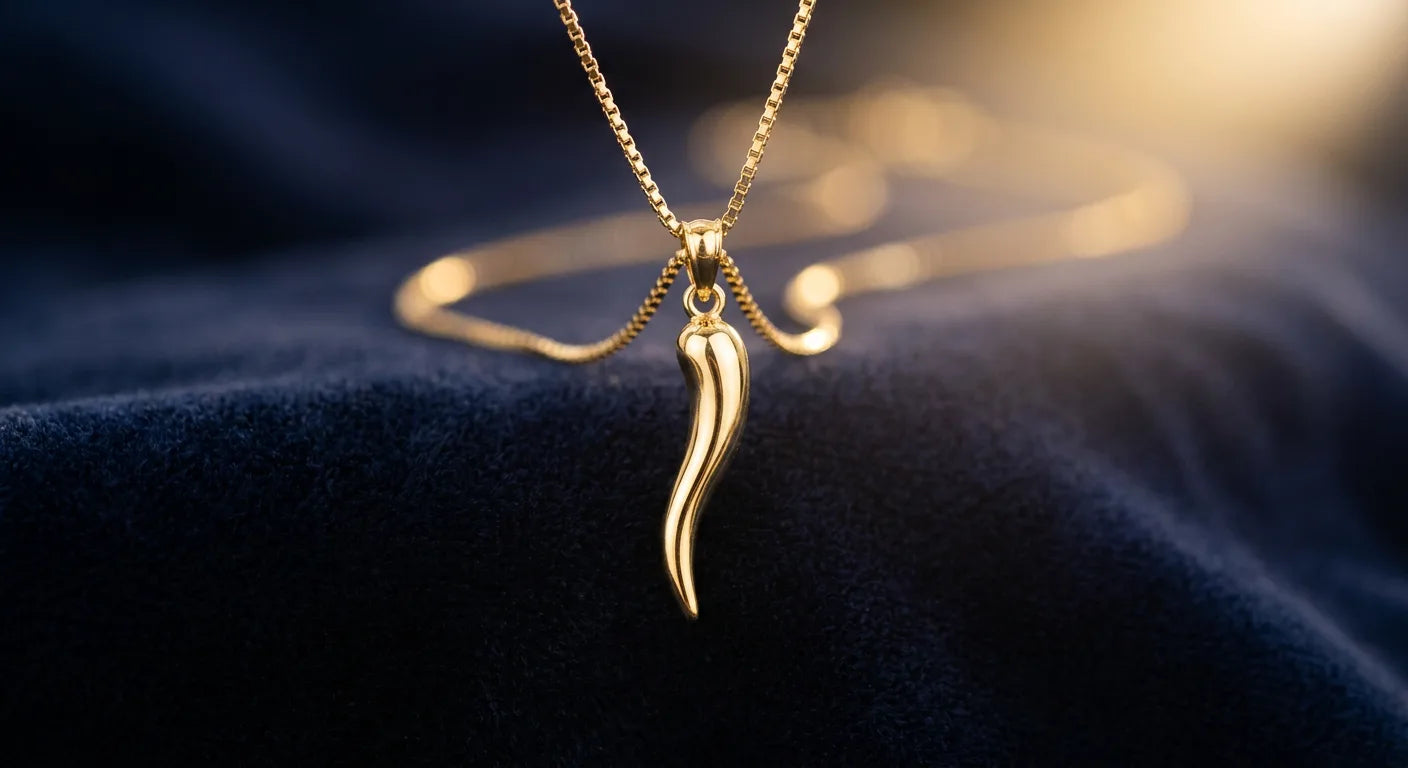
The traditional Neapolitan cornicello is an elongated, gently twisted horn with a smooth, polished surface. It tapers to a sharp point at the bottom and features a small bail or loop at the top for the chain. This is the purest expression of the design — no embellishments, no stones, just the clean power of the horn form in precious metal. GOLDZENN's classic Italian horn pendant follows this time-honored silhouette in solid 14K gold.
Diamond-Accented Italian Horn
For those who want to elevate the traditional design, diamond-accented cornicelli set brilliant-cut or pave diamonds along the horn's curve. The contrast between polished gold and sparkling stones creates a piece that honors tradition while making a modern luxury statement. This style is popular for special occasions, milestone gifts, and diamond-accented jewelry collectors.
Two-Tone and Multi-Metal
Contemporary Italian horn pendants may combine yellow gold with white gold or rose gold for a two-tone effect. These designs appeal to customers who want versatility — a two-tone horn coordinates with multiple chain metals and works across different outfits and settings.
Oversized Statement Pieces
While standard cornicelli measure approximately 1 to 1.5 inches in length, oversized versions (2 to 3 inches) make a bold fashion statement. These larger pieces work best on thicker chains at longer lengths, positioned at mid-chest or lower. They carry the same symbolism but with unmistakable visual presence.
Choosing the Right Gold Karat for Your Italian Horn
The metal quality of your cornicello affects its color, durability, weight, and long-term value. Here is how the most common gold karats compare for Italian horn pendants:
| Karat | Gold Content | Color | Durability | Best For |
|---|---|---|---|---|
| 10K | 41.7% | Pale warm yellow | Highest scratch resistance | Everyday wear, active lifestyles |
| 14K | 58.3% | Classic warm gold | Excellent balance | Daily wear with rich color |
| 18K | 75.0% | Deep, rich yellow | Softer, requires more care | Luxury pieces, special occasions |
| 22K | 91.7% | Vivid, saturated gold | Softest, most delicate | Collector and heirloom pieces |
For most customers, 14K gold is the ideal choice for an Italian horn pendant. It delivers the warm, unmistakable gold color that complements the horn's traditional meaning, while providing the durability needed for daily wear. The pendant will resist scratches, maintain its shape on the chain, and hold its luster for decades with basic care. For a deeper gold tone and a more luxurious feel, 18K gold is the step up. Read our full 14K vs 18K comparison for detailed guidance.
Italian Horn Pendant Sizing Guide
The size of your cornicello affects both its visual impact and how it interacts with your chain and outfit:
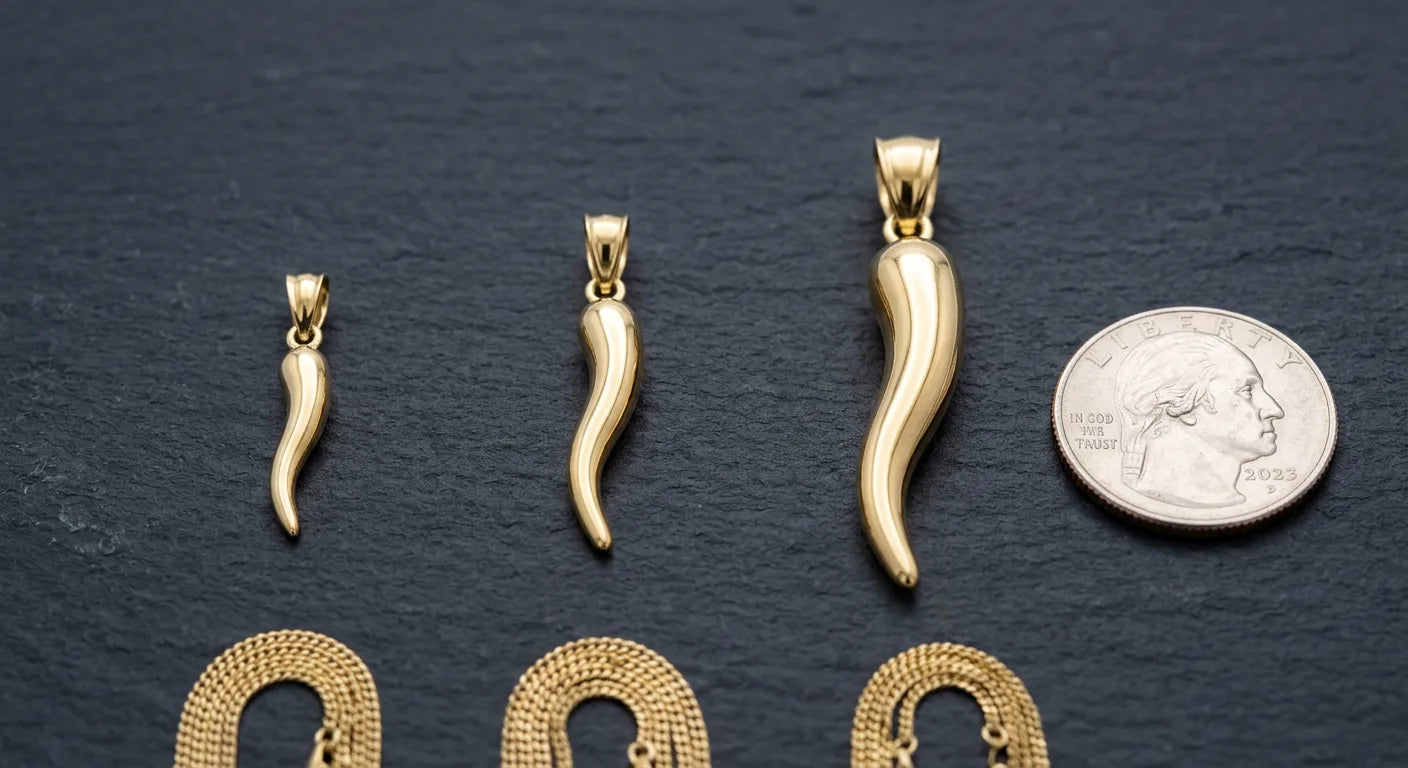
- Small (under 1 inch): Subtle and understated. Ideal for layering with other pendants or wearing as a discreet personal talisman. Works on thin chains (1.5mm-2.5mm).
- Standard (1 to 1.5 inches): The most popular and versatile size. Visible without being overpowering. Pairs well with chains from 2mm to 4mm in width. This is the classic cornicello proportion.
- Large (1.5 to 2 inches): A confident, noticeable piece that becomes the focal point of any outfit. Requires a chain of at least 3mm width to maintain visual balance.
- Oversized (2+ inches): A true statement piece. Best worn on heavier chains (4mm+) at longer lengths (22-26 inches). Commands attention and works best with simple outfits that let the pendant speak.
When selecting a size, consider your frame and personal style. A broader chest and shoulders can support a larger horn without it looking disproportionate. For a more refined look, the standard 1 to 1.5 inch size is universally flattering.
Chain Pairing Guide for Italian Horn Pendants
The chain you choose for your cornicello matters as much as the pendant itself. The right chain complements the horn's shape and weight, while the wrong chain can make the pendant sit awkwardly or look unbalanced. Here are the top chain pairings:
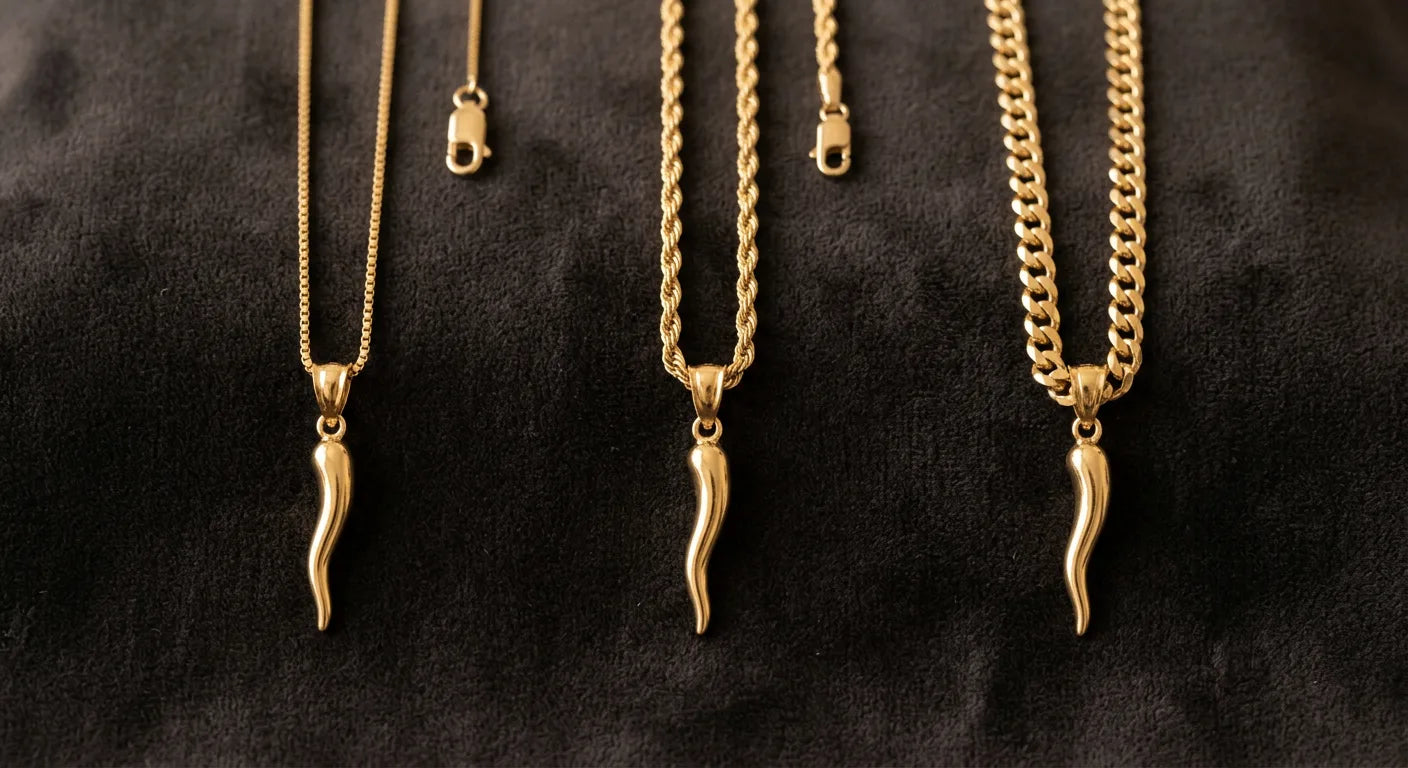
Rope Chain (Recommended)
A rope chain in 2mm to 3mm width is the classic pairing for an Italian horn pendant. The twisted texture of the rope complements the twisted form of the horn, creating a cohesive, harmonious look. GOLDZENN rope chains in matching 14K gold create a seamless, elegant combination.
Franco Chain
A Franco chain in 2mm to 3mm provides a sleek, refined backdrop that lets the pendant take center stage. The tight, square-profile weave of the Franco is understated enough to support the horn without competing with it. This pairing works especially well for formal and business settings.
Figaro Chain
The alternating short-and-long link pattern of a Figaro chain adds visual rhythm that pairs nicely with the horn's organic curves. A 2.5mm to 3.5mm Figaro in matching gold creates an Italian-inspired combination — both the Figaro design and the cornicello trace their roots to Italian jewelry tradition.
Cuban Link Chain
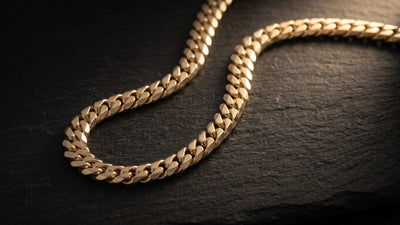
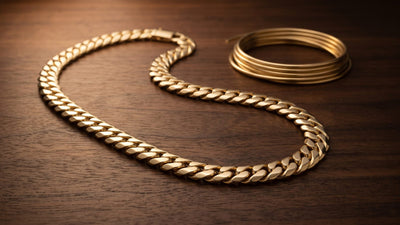
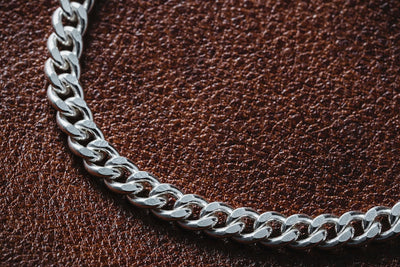
For a bolder pairing, a slim Cuban link chain (3mm to 5mm) adds structural weight to the pendant. This combination works well for streetwear styling and casual looks where you want the horn to make a statement. GOLDZENN Cuban links in 3mm to 5mm provide the right balance of presence and proportion for a standard-size horn.
Box Chain
A fine box chain (1.5mm to 2mm) is the most minimalist option, keeping all visual focus on the pendant. This pairing is ideal for small cornicelli and for customers who want the horn to be the only design element at the neck.
Chain Length Recommendations
For an Italian horn pendant, the ideal chain length positions the horn at mid-chest level:
- 20 inches: Sits just below the collarbone. Best for smaller horns and a refined look. Works well under collared shirts with just the chain visible.
- 22 inches: The most popular pendant length. Positions the horn at the center of the chest, fully visible over a T-shirt or open collar.
- 24 inches: Sits at the sternum. Ideal for larger horns and for chain stacking, where the pendant hangs as the lowest focal point. See our width guide for pairing proportions.
Layering the Italian Horn with Other Pendants
The cornicello is a natural layering piece. Its slender profile sits flat against the chest and does not compete with adjacent chains or pendants. Here are proven layering combinations, each following the principles in our chain necklace layering guide:
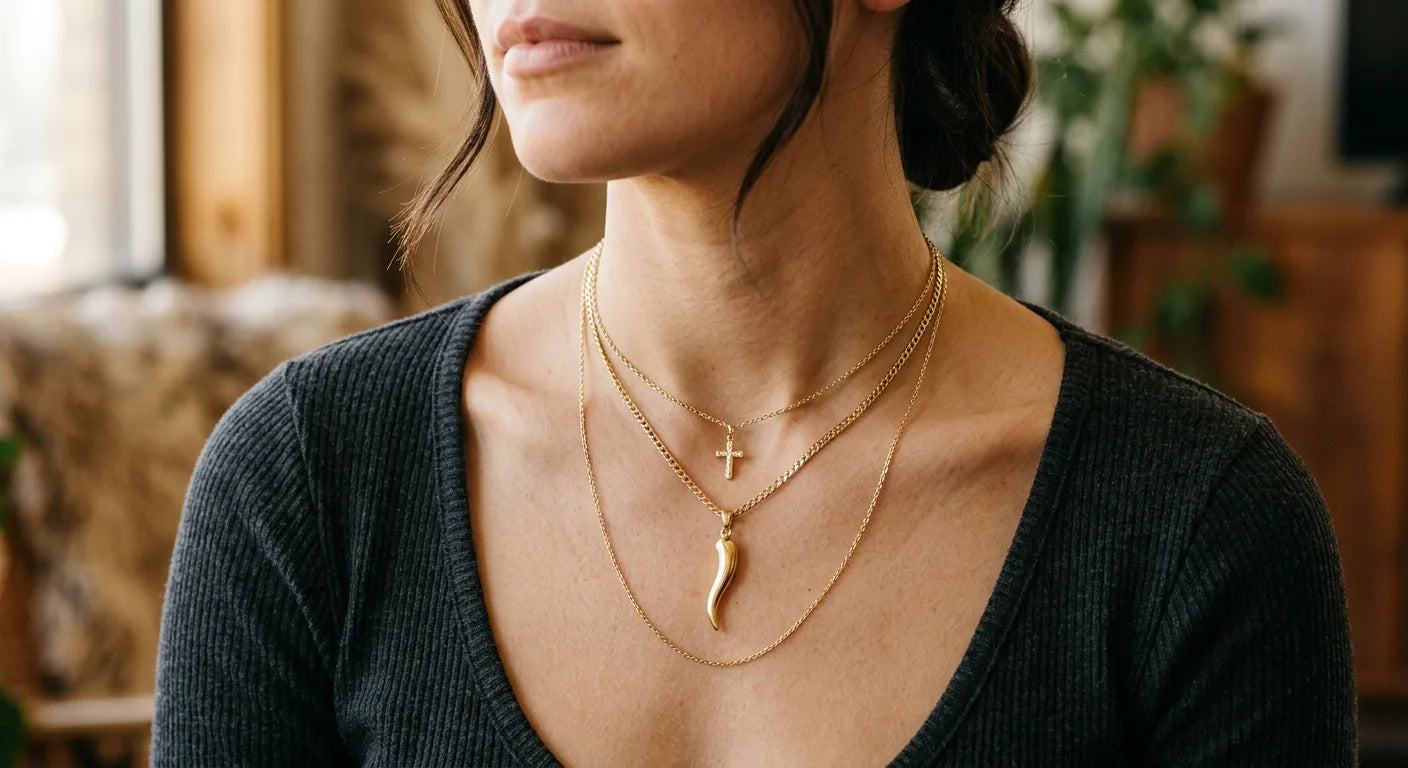
Italian Horn + Cross Pendant
One of the most popular combinations in Italian-American jewelry culture. The cross represents faith, while the horn provides protection. Wear the cross on a shorter chain (18-20 inches) and the horn on a longer chain (22-24 inches) so both pendants are visible and separated.
Italian Horn + Saint Medal
Saint medals (St. Christopher for travelers, St. Michael for protection, Our Lady of Mount Carmel for Neapolitan heritage) pair naturally with the cornicello. Both carry protective and spiritual significance. Layer the medal at 18-20 inches and the horn at 22-24 inches.
Italian Horn + Dog Tag
A gold dog tag pendant with the horn creates a layered look that blends personal identity (engraved dog tag) with cultural heritage (cornicello). The rectangular dog tag and curved horn create complementary geometric contrast. Wear the dog tag at 20-22 inches and the horn at 24 inches.
Italian Horn + Plain Chain
The simplest layering approach: one plain chain at 18 inches (no pendant) with the cornicello on a second chain at 22 inches. The plain chain frames the neckline while the horn provides the focal point below. This two-piece combination is clean, balanced, and works with every outfit.
The Gift-Giving Tradition
In Italian culture, there is a long-standing tradition that the cornicello is most powerful when received as a gift. The belief holds that the giver's positive intentions — their love, concern, and desire for your well-being — imbue the horn with stronger protective energy than one purchased for yourself.
This tradition makes the Italian horn pendant one of the most meaningful gifts in men's jewelry. It communicates care and protection without words. Common occasions for gifting a cornicello include:
- Birthdays and milestones: A coming-of-age gift, especially for young men entering adulthood
- Graduations: A protective talisman for the next chapter of life
- New business ventures: A wish for prosperity and protection from adversity
- Weddings and engagements: A blessing for the couple's future together
- Father's Day: Honoring a father's role as protector
That said, purchasing your own cornicello is equally valid. Many people choose their own horn precisely because the act of selecting it — picking the right gold karat, the right size, the right chain — is itself an expression of intentionality and self-protection. The horn's power comes from the wearer's belief in its meaning, regardless of how it was acquired.
Caring for Your Gold Italian Horn Pendant
Solid gold Italian horn pendants require minimal maintenance to maintain their beauty for a lifetime. Follow these guidelines, consistent with our full gold jewelry cleaning guide:
Regular Cleaning
- Soak the pendant in warm water with a drop of mild dish soap for 10 to 15 minutes
- Use a soft-bristle brush (a baby toothbrush works well) to gently clean the curves and crevices of the horn shape, where dust and skin oils accumulate
- Rinse thoroughly under clean warm water
- Pat dry with a soft, lint-free cloth
What to Avoid
- Harsh chemicals, bleach, and chlorine (remove before swimming or cleaning)
- Abrasive cloths or scouring pads that can scratch polished surfaces
- Ultrasonic cleaners for diamond-accented horns (can loosen small stones)
- Spraying perfume or cologne directly on the pendant
Storage
Store your cornicello in a soft pouch or individual compartment in a jewelry box. Keep it separated from other jewelry to prevent scratching. Hang the chain rather than coiling it to maintain the chain's shape and prevent kinking.
Solid gold does not tarnish, fade, or corrode. A well-maintained 14K or 18K gold Italian horn will look the same in 30 years as it does today. This permanence is part of what makes gold the traditional and preferred metal for the cornicello — the protection it symbolizes is meant to last a lifetime, and the metal matches that promise.
Why Solid Gold Matters for a Cornicello
The Italian horn is a piece of jewelry where material integrity matters beyond aesthetics. Here is why solid gold — not plated, not filled, not vermeil — is the right choice for a cornicello:
- Permanence: Solid gold will never flake, peel, or reveal a base metal underneath. The horn's symbolism of enduring protection is matched by a material that endures.
- Skin safety: Authentic solid gold is hypoallergenic and safe for daily wear against the skin, even in heat and humidity.
- Value retention: Solid gold holds its intrinsic metal value and can be passed down through generations. A gold cornicello is not just jewelry — it is a tangible asset. For more on gold's investment value, read our gold prices guide.
- Cultural authenticity: Traditional Neapolitan cornicelli were made from coral, silver, and gold. Solid gold is the most valued material in the tradition, carrying its own symbolism of purity, warmth, and divine favor.
The GOLDZENN Italian Horn Collection
At GOLDZENN, every pendant is handcrafted in our Miami workshop by a team with 50+ years of combined jewelry-making experience. Our Italian horn pendants are crafted from solid gold — no plating, no hollow construction. Each piece comes with a 1-year limited warranty against manufacturing defects (handmade Cuban chains carry a limited lifetime craftsmanship warranty), because we stand behind the quality of every item that leaves our bench.
Our collection includes:
- Classic Polished Italian Horn in 14K and 18K solid gold — the traditional Neapolitan silhouette with a mirror-polished finish
- Diamond-Accented Italian Horn — brilliant-cut diamonds along the horn's curve for added luxury
- Two-Tone Italian Horn — combining yellow gold with white gold accents for a modern, versatile look
Pair any of our horns with a matching rope chain, Franco chain, or Cuban link chain to complete the look. Every chain in our catalog is available in lengths from 18 to 26 inches, so you can choose the exact positioning for your pendant.
Wearing the Italian Horn with Confidence
The cornicello is one of the few pieces of jewelry that carries equal weight whether you are Italian, Italian-American, or simply drawn to its powerful symbolism. The tradition of the protective horn transcends any single culture — similar horn-shaped amulets appear across Greek, Turkish, North African, and South Asian traditions. Wearing an Italian horn is a respectful acknowledgment of a deep cultural practice, and its meaning — protection, luck, and strength — is universal.
At GOLDZENN, we craft jewelry for people who want more than decoration. Our customers wear gold because it means something — because the weight on their chest is a reminder of who they are, where they come from, and what they stand for. The Italian horn pendant embodies that philosophy perfectly.
Ready to find your cornicello? Explore GOLDZENN's pendant collection or call us at 321-521-4651 to speak with our team. You can also reach us at contact@goldzenn.com.
Follow our craftsmanship process on YouTube at @GOLDZENNJWL, where we share behind-the-scenes looks at how every piece is made by hand in Miami.
Frequently Asked Questions About Italian Horn Pendants
What does the Italian horn pendant symbolize?
The Italian horn pendant (cornicello) is an ancient Italian amulet symbolizing protection from the evil eye (malocchio), good luck, prosperity, and vitality. Its twisted horn shape is believed to ward off negative energy and bad intentions. The tradition dates back to ancient Italy and Southern Mediterranean cultures where the horn was associated with strength, fertility, and divine protection. Today, it remains one of the most meaningful pieces in Italian-heritage jewelry.
What is the difference between a cornicello and a cornetto?
Cornicello and cornetto both refer to the Italian horn charm, but the terms have slightly different regional usage. "Cornicello" (meaning "little horn") is the more formal, traditional Italian term used in Southern Italy and among Italian-Americans. "Cornetto" is commonly used in Northern Italy and in everyday conversation. Both refer to the same twisted horn-shaped amulet — there is no difference in meaning, symbolism, or design between the two terms.
Should I buy my own Italian horn or receive it as a gift?
Italian tradition holds that an Italian horn is most powerful when received as a gift from someone who cares about your well-being, as the giver's good intentions add to its protective energy. However, this is a cultural tradition, not a rule — many people purchase their own cornicello and wear it with full confidence in its meaning. At GOLDZENN, our solid gold Italian horn pendants make a thoughtful gift, but they are equally meaningful when chosen for yourself.
What is the evil eye (malocchio) and how does the Italian horn protect against it?
The malocchio, or evil eye, is a curse believed to be caused by a malevolent or envious glare from another person, bringing bad luck, illness, or misfortune to the recipient. The Italian horn's pointed shape is traditionally believed to deflect and redirect this negative energy away from the wearer. The cornicello acts as a spiritual shield — its form symbolizes strength and resistance against harm. This belief system is deeply rooted in Southern Italian, Greek, and Mediterranean cultures.
What metal is best for an Italian horn pendant?
Solid gold (14K or 18K) is the traditional and most valued choice for an Italian horn pendant. Gold carries its own symbolism of purity and permanence, which complements the horn's protective meaning. 14K gold offers the best balance of durability and gold content for everyday wear, while 18K delivers a richer, warmer yellow for a more luxurious look. GOLDZENN's Italian horn pendants are crafted in solid 14K and 18K gold for lasting quality and authentic symbolism.
What chain should I wear with an Italian horn pendant?
The Italian horn pendant pairs beautifully with several chain styles. A slim rope chain (2mm-3mm) in matching gold offers classic, understated elegance. A figaro chain adds subtle visual texture. A sleek Franco chain complements the pendant's brilliance for a more refined look. Choose a chain length of 20 to 24 inches so the horn sits at mid-chest level. The chain width should be proportional to the pendant size — avoid pairing a small horn with an oversized chain.
Can you wear an Italian horn pendant if you are not Italian?
Yes. While the cornicello originates from Italian culture, it has been embraced worldwide as a universal symbol of protection, luck, and positive energy. Many cultures share similar horn-shaped or eye-related protective amulets. Wearing an Italian horn is a respectful way to connect with its cultural meaning and protective symbolism, regardless of your heritage. The pendant's beauty and significance transcend any single culture.
How do I care for a gold Italian horn pendant?
Clean your gold Italian horn with warm water, a drop of mild soap, and a soft cloth or brush. Pay attention to the curved details where dust can accumulate. Rinse thoroughly and pat dry. Avoid exposing the pendant to harsh chemicals, chlorine, or abrasive cleaners. Store it in a soft pouch or separate jewelry compartment to prevent scratching. Solid gold will maintain its luster for a lifetime with basic care. For detailed instructions, read our gold cleaning guide.