Looking for our complete, updated chain layering guide? Visit our Chain Necklace Layering Guide for 8 proven combinations with width pairing rules and length diagrams.
How to Stack Different Types of Gold Chains: Your Guide to Unmatched Style
Stacking gold chains is one of the most effective ways to build a personal style that commands attention. A single chain makes a statement. Two or three chains, carefully chosen, create a signature look that is entirely your own. But stacking is not random — the difference between a polished, intentional stack and a cluttered mess comes down to understanding how lengths, widths, textures, and metals interact on the body.
This guide covers everything you need to know about stacking gold chains: the foundational rules, the specific chain combinations that work, how to integrate pendants, and the common mistakes that even experienced collectors make. At GOLDZENN, our Miami workshop has 50+ years of combined experience crafting the solid gold chains that form the backbone of any serious stack.
Note: This article focuses on stacking — wearing multiple chains in the same neckline zone to create a dense, textured look. For a broader discussion of layering with strategic length separation and pendant placement, see our dedicated chain necklace layering guide.
The Fundamental Rules of Chain Stacking
Before selecting specific chains, understand the principles that separate a curated stack from a random pile of necklaces:
Rule 1: Vary Your Lengths by at Least 2 Inches
Every chain in your stack should sit at a different height on your chest. If two chains are the same length, they overlap, tangle, and visually cancel each other out. The minimum separation between chains is 2 inches — 3 inches is even better for clarity. A standard three-chain stack uses 18, 20, and 24 inches. A two-chain stack works best at 18 and 22 inches. For detailed length-to-body positioning, use our width and length guide.
Rule 2: Graduate Your Widths — Thin on Top, Thick on Bottom
Your shortest chain should be your thinnest. Your longest chain should be your thickest. This creates a natural visual hierarchy that draws the eye downward and gives the stack depth. A 2mm chain at 18 inches, a 4mm chain at 20 inches, and an 8mm chain at 24 inches creates a clean, graduated silhouette.
Reversing this — putting a heavy chain on top and thin chains below — makes the stack look top-heavy and unbalanced. The exception is if your top chain is a statement piece (like an iced-out tennis chain) that is intentionally the focal point.
Rule 3: Mix Textures, Not Just Sizes
A stack of three chains in the same link style, even at different sizes, can look monotonous. The magic of a great stack is textural contrast: the smooth, tight weave of a Franco chain next to the bold, interlocking ovals of a Cuban link next to the twisted brilliance of a rope chain. Each chain brings a different visual texture, and together they create depth that a single chain type cannot achieve.
Rule 4: Odd Numbers Look Better
In design theory, odd numbers create more visually interesting compositions than even numbers. A stack of 3 chains tends to look more dynamic and intentional than a stack of 2 or 4. This is not a hard rule — two chains can look sharp, and four can work with careful planning — but when in doubt, go odd.
The 3-Chain Rule: Building a Perfect Stack
The three-chain stack is the foundation of chain styling. Each layer serves a distinct purpose:

Layer 1: The Choker (16-18 inches)
The top layer sits at or just below the collarbone. This should be your thinnest chain — 2mm to 3mm. Its role is to define the neckline and create a starting point for the eye. A thin rope chain, a slim Figaro, or a delicate curb chain all work as top layers. If you are wearing a crew-neck or V-neck shirt, this chain peeks out at the collar line and signals that there is more below.
Layer 2: The Accent (20-22 inches)
The middle layer is the bridge between the subtle top and the bold bottom. Choose a 3mm to 5mm chain in a link style that contrasts with both your top and bottom chains. This is often the best layer for a pendant — a cornicello, a small medallion, or a custom initial. The accent layer creates visual interest in the center of the stack.
Layer 3: The Anchor (24-26 inches)
The bottom layer is the heaviest and widest chain in the stack. This is the chain that frames the entire composition and gives it weight. A 5mm to 10mm Cuban link at 24 inches is the most popular anchor chain because of its flat-laying profile, substantial weight, and unmistakable presence. Other strong anchors include wide Byzantine chains and thick Franco chains.
Chain Type Combinations That Work
Not all chain styles pair equally well. Here are field-tested combinations that create balanced, striking stacks:
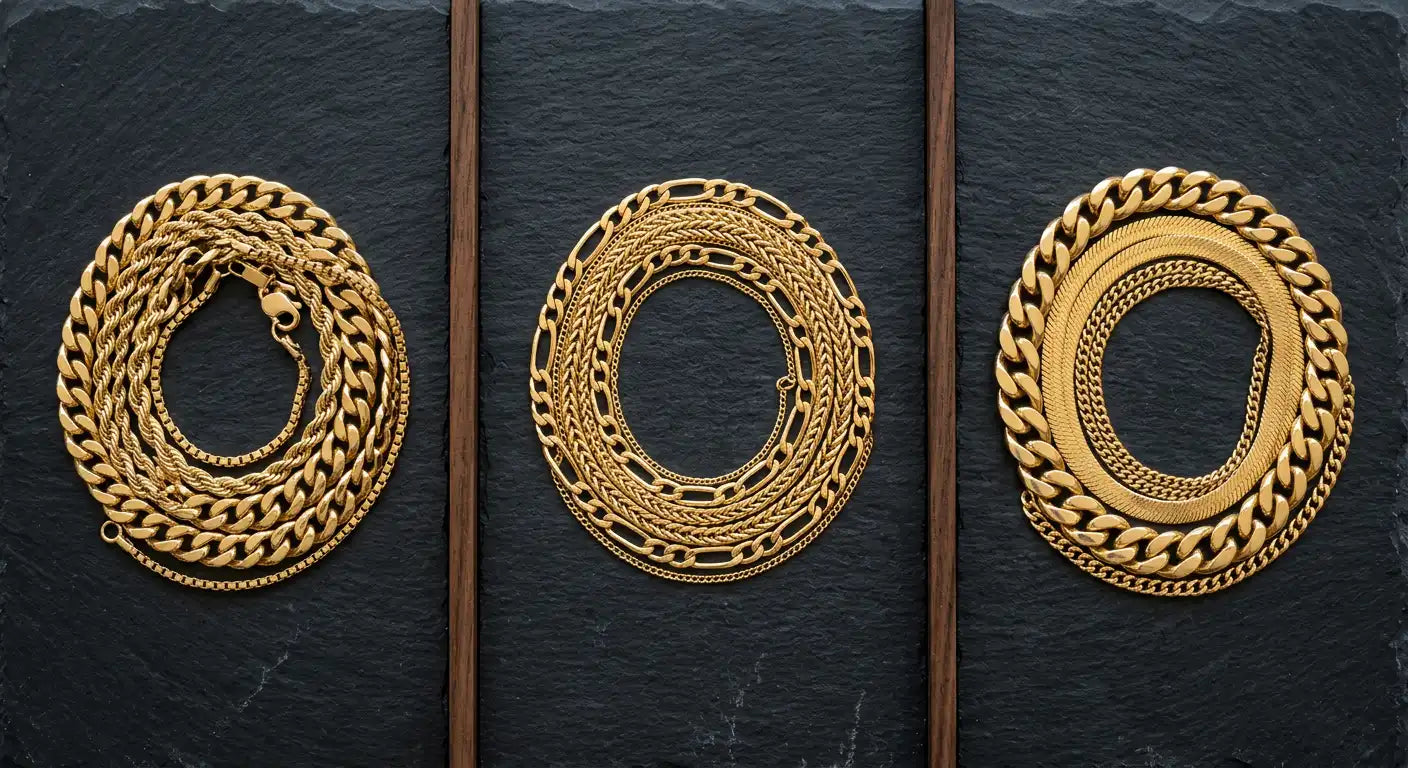
| Stack Name | Layer 1 (Top) | Layer 2 (Middle) | Layer 3 (Bottom) | Vibe |
|---|---|---|---|---|
| The Classic | 2mm Rope, 18" | 4mm Figaro, 20" | 7mm Cuban, 24" | Timeless, balanced |
| The Miami | 3mm Franco, 18" | 5mm Cuban, 20" | 8mm Cuban, 24" | Bold, street-luxe |
| The Gentleman | 2mm Box, 18" | 3mm Rope, 20" | 5mm Franco, 22" | Refined, subtle |
| The Iced Stack | 3mm Tennis, 18" | 5mm Cuban, 20" | 8mm Cuban, 24" | High-impact, nightlife |
| The Italian | 2mm Curb, 18" | 3mm Figaro + Horn Pendant, 22" | 6mm Rope, 24" | Heritage, cultural |
| The Minimal | 1.5mm Box, 18" | 2.5mm Rope, 20" | — | Clean, everyday |
These combinations work because they follow the principles: graduated widths, varied textures, separated lengths. Use them as starting points and adjust based on your personal style and the chains you own.
Length Combinations by Number of Chains
The number of chains in your stack determines which lengths to use. Here are the most effective combinations:
Two-Chain Stack
- 18" + 22": Four inches of separation creates a clean, uncluttered two-layer look. Best for everyday wear and under collared shirts.
- 18" + 24": Six inches of separation makes each chain distinctly visible. Works well when one chain has a pendant.
- 20" + 24": Both chains hang below the collarbone. A bold, visible combination for open-neck shirts and T-shirts.
Three-Chain Stack
- 18" + 20" + 24": The gold standard. The 18 and 20 create a tight pair at the top, with the 24 anchoring below. Most versatile for all outfits.
- 16" + 20" + 24": Wider spread. The 16" choker sits at the base of the neck, creating a visible gap to the middle and bottom chains. More dramatic, works best with V-necks.
- 18" + 22" + 26": Extended stack. Each chain has 4 inches of separation. The 26" hangs below the sternum — bold and eye-catching under open shirts.
Four-Chain Stack
- 16" + 18" + 20" + 24": The top three chains create a dense cluster, with the fourth dropping down as a standalone anchor. This requires careful width graduation to avoid a cluttered look — keep the top three chains under 3mm each.
Width Mixing: The Proportion Table
Width is the most overlooked aspect of stacking. Two chains of the same width at different lengths look redundant. Use this table to guide your width selections:
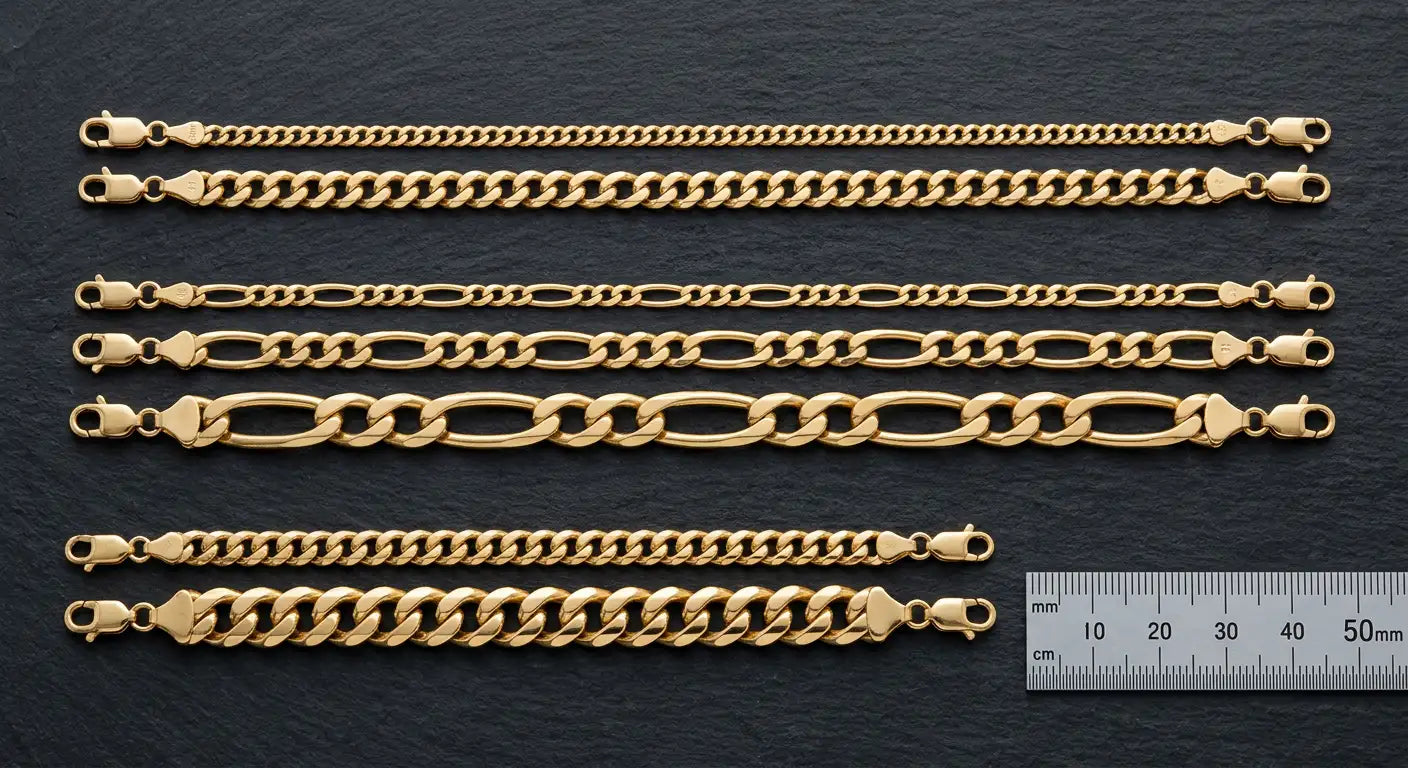
| Chain Position | Recommended Width | Chain Types That Work |
|---|---|---|
| Top (shortest) | 1.5mm - 3mm | Box, thin rope, thin curb, thin figaro |
| Middle | 3mm - 5mm | Rope, figaro, slim Cuban, franco, tennis |
| Bottom (longest) | 5mm - 10mm | Cuban, wide franco, thick rope, Byzantine |
The key insight: your bottom chain should be at least 2x the width of your top chain. A 2mm top + 8mm bottom (4x ratio) creates bold contrast. A 3mm top + 5mm bottom (1.7x ratio) is more subtle. Both work — it depends on how dramatic you want the stack to be.
Mixing Karats: Can You Stack 10K with 14K?
Yes. Mixing different gold karats in a stack is perfectly acceptable and more common than most people realize. Here is what you should know:
- 10K and 14K together: The color difference is subtle — 10K is slightly paler, 14K is warmer. Most people cannot tell the difference when the chains are on the body, especially in different widths and link styles. This is the easiest karat mix.
- 14K and 18K together: The color difference is more noticeable — 18K has a richer, deeper yellow. This can actually enhance the stack by creating a gradient effect from lighter gold on top to deeper gold on the bottom.
- 10K and 18K together: The widest color gap. If color consistency matters to you, avoid this combination or separate them with a 14K chain in the middle to bridge the tones.
The durability difference between karats can actually be strategic: put your higher-karat (softer) chain on the bottom where it has less friction against your skin and clothes, and your lower-karat (harder) chain on top where it takes more daily contact.
Integrating Pendants into Your Stack
Pendants add a focal point and personal meaning to a chain stack. But placement matters:
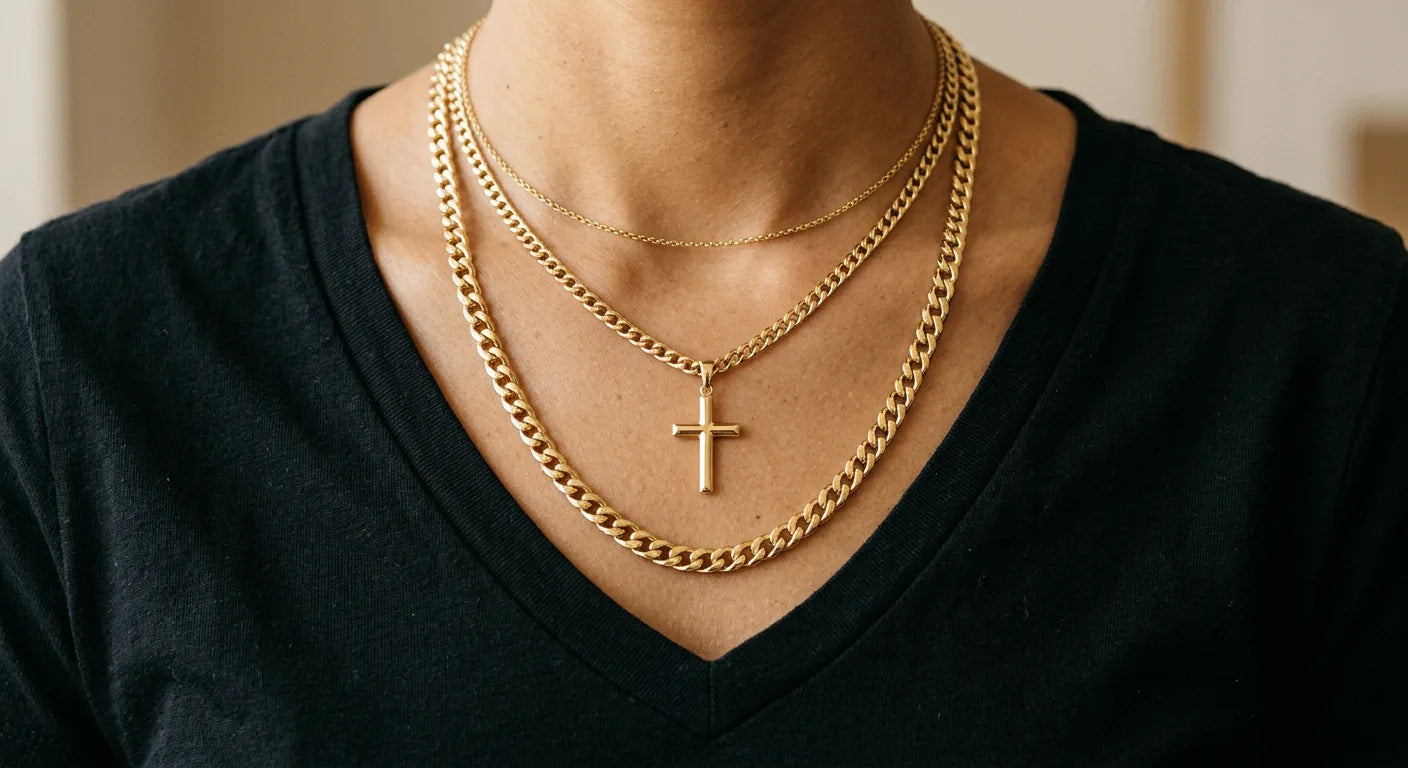
One Pendant Rule
In most stacks, limit yourself to one pendant. Multiple pendants compete for attention and can tangle against each other. Choose one chain to carry the pendant and let the others be plain.
Best Pendant Positions
- Middle chain (20-22"): The pendant becomes the visual center of the stack, framed by the chains above and below. Best for medium-size pendants (1-1.5 inches).
- Bottom chain (24-26"): The pendant hangs below the stack as the final focal point, drawing the eye downward. Best for larger pendants (1.5-2+ inches) and dog tags.
- Top chain (16-18"): Works only with very small pendants or charms. A small Italian horn at the choker level can look sharp, but anything larger will crowd the neckline.
Pendant-to-Chain Proportion
Match the pendant weight and size to the chain that carries it. A heavy pendant on a thin chain causes the chain to slide and bunch at the clasp. A small pendant on a thick chain looks lost. General rule: the pendant should weigh no more than the chain itself. For gold pendant styling guidance, including weight and proportion recommendations, see our full pendant buying guide.
Stacking by Occasion
The best stack is the one that matches the setting. Here is how to adjust your chains for different contexts:
Everyday / Casual
Keep it simple. Two chains — one thin (18"), one medium (22") — in matching gold. This is the "set and forget" stack that works with T-shirts, henleys, and casual button-downs. Choose durable link styles that can handle daily wear: curb, franco, or rope. Total investment in this stack can start with just two quality pieces from GOLDZENN's chain collection.
Business / Professional
Subtlety is key. One or two chains, maximum, both under 3mm width. A 2mm box chain at 18" tucked under the collar, with just a hint of gold showing at the neckline. Or a single 2.5mm rope chain with a small pendant visible above the first button. The goal is to suggest refinement, not demand attention. Avoid iced chains in professional settings.
Going Out / Nightlife
This is where stacking shines. Three chains with bold width progression: thin tennis or rope at 18", medium Cuban at 20", thick Cuban or Byzantine at 24". Open the top buttons of your shirt and let the full stack breathe. This is also the setting for iced chains — a tennis chain at the choker level adds sparkle that catches light in dim environments.
Formal Events
Less is more. A single high-quality chain — 14K or 18K, 2-3mm, 20 inches — worn under a dress shirt with just the gold visible at the collar. Or a stack of two ultra-thin chains (1.5mm and 2mm) that create a glint of gold without competing with a suit, tie, or formal attire. The chain is an accent, not the outfit.
Beach / Active
Choose your most durable pieces. Solid gold (any karat) handles saltwater and sun, but avoid wearing your best pieces during high-impact activities where chains can catch, stretch, or break. A single solid chain in 10K gold — the hardest and most scratch-resistant karat — is the safest choice for active settings.
Common Stacking Mistakes to Avoid
Even experienced chain wearers make these errors. Avoid them to keep your stack looking intentional:
- Same-length chains: This is the most common mistake. Two chains of the same length overlap, tangle, and look like one messy chain instead of two distinct pieces. Always maintain at least 2 inches of separation.
- No width variation: Three 4mm chains at different lengths look uniform and flat. Mix widths to create depth and hierarchy.
- Too many chains: Unless every chain is deliberately thin (under 2mm), more than 4 chains starts to look chaotic. Quality over quantity. Three carefully chosen chains outperform six random ones every time.
- Ignoring weight distribution: Heavy chains on top pull at the neck and cause discomfort. Keep your heaviest chain at the bottom of the stack.
- Mismatched bail sizes: If a pendant's bail (the loop that attaches to the chain) is too small for the chain's width, the pendant will hang crooked or the chain will not slide freely. Check that pendant bails accommodate the chain width.
- All one texture: A stack of three Cuban links, even at different sizes, reads as "the same chain three times." Introduce at least one chain in a different link style for textural contrast.
- Clasps bunching at the nape: Multiple clasps concentrated at the same spot on your neck can be uncomfortable and cause chains to twist. Stagger your clasps slightly left and right to distribute weight evenly.
Color Coordination: Yellow, White, and Rose Gold
While yellow gold is the most popular choice for chain stacking, mixing metals can create striking visual effects:
All Yellow Gold
The safest and most traditional approach. A full yellow gold stack is warm, cohesive, and timeless. It works across all outfits and skin tones, and there is zero risk of clashing. This is the stack for someone who wants their chains to blend into a unified look.
Yellow + White Gold
White gold adds a cool, modern contrast to warm yellow. A white gold tennis chain at the top with yellow gold chains below creates a striking two-tone effect. This combination works especially well at night, where the white gold catches light differently than the yellow. For more on diamond and ice pairings, white gold is the natural base metal.
Yellow + Rose Gold
Rose gold's warm pinkish hue blends naturally with yellow gold for a subtle, sophisticated contrast. This combination reads as intentional and fashion-forward without being jarring. Works best when both metals are the same width or when the rose gold is the thinner accent chain.
Tri-Metal Stack
Yellow + white + rose gold in a single stack is bold and fashion-forward. This works best when each chain is the same width (creating a color gradient) or when one metal dominates and the other two serve as accents. Not for every day, but impactful for events and going out.
GOLDZENN Stacking Recommendations
Based on our most popular customer combinations and what we see working in the real world, here are our recommended stacks using GOLDZENN chains:
The Starter Stack (2 chains)
18" rope chain in 2mm + 22" Cuban link in 5mm. Both in 14K gold. Clean, versatile, works with everything. This is the stack for someone building their first collection.
The Signature Stack (3 chains)
18" rope chain 2.5mm + 20" Figaro chain 3.5mm + 24" Cuban link 7mm. The rope provides texture, the Figaro adds rhythm with its alternating links, and the Cuban anchors the whole look with weight and presence.
The Statement Stack (3 chains + pendant)
18" tennis chain 3mm + 20" Franco chain 3mm with an Italian horn pendant + 24" Cuban link 8mm. The iced tennis chain catches light, the pendant adds personal meaning, and the Cuban grounds everything. This is GOLDZENN's signature look for going out.
The Heritage Stack (2 chains + pendant)
20" Figaro 3mm with a cross or saint medal + 24" rope chain 5mm. A culturally rooted combination that pairs Italian chain design with meaningful pendants. Understated but deeply personal.
Building Your Stack Over Time
You do not need to buy your entire stack at once. Many GOLDZENN customers build their collection piece by piece over months or years:
- Start with one quality chain. A 20" or 22" Cuban link in 5mm-7mm, 14K gold. This is your anchor piece — the chain you will wear most and build around.
- Add a contrasting second chain. An 18" rope or Figaro in 2-3mm. Now you have a two-chain stack with different textures and lengths.
- Introduce a pendant chain. A 20" or 22" Franco chain with a pendant that means something to you. Now you have three pieces, each serving a different purpose.
- Swap and rotate. As your collection grows, you will have chains that you rotate in and out depending on the occasion. Building a wardrobe of 5-6 chains gives you dozens of possible stack combinations.
Every chain in our catalog is crafted in solid gold — 10K, 14K, or 18K — so each piece retains its value and beauty indefinitely. A chain you buy today is a chain you can still wear, stack, and enjoy 20 years from now.
Anti-Tangle Tips for Multi-Chain Stacks
Tangling is the number one frustration with chain stacking. These techniques minimize it:
- Different weights solve most tangling. A heavy chain (5mm+ Cuban) at the bottom and a light chain (2mm rope) at the top rarely tangle because gravity keeps them separated.
- Different link styles tangle less. A flat Cuban and a round rope do not interlock the way two round chains might.
- Put chains on one at a time, longest first. Clasp the longest chain, then add the next longest, then the shortest on top. This prevents overlap at the clasp.
- Remove chains one at a time, shortest first. Reverse the order when taking them off.
- Store chains hanging, not piled. A simple jewelry tree or individual hooks prevent overnight tangling. Each chain should have its own hook or pouch.
- Pendants act as anchors. A pendant on the longest chain adds weight that keeps that chain hanging straight and pulling away from shorter chains above it.
For full care and storage guidance, read our gold jewelry cleaning and maintenance guide.
Why GOLDZENN Chains Stack Better
Not all chains are built for stacking. Plated chains develop wear marks where they rub against each other, revealing the base metal underneath. Hollow chains dent and deform under the pressure of adjacent pieces. At GOLDZENN, every chain is solid gold — handcrafted in our Miami workshop with the structural integrity to handle daily stacking without degradation.
Our chains feature secure lobster clasps, consistent link sizing for smooth drape, and precise length options (18", 20", 22", 24", 26") so you can build stacks with exact separation. With 347+ Google reviews at 4.9 stars and 3,920+ verified product reviews, our customers trust GOLDZENN chains to perform as daily-wear staples that last a lifetime. Handmade Cubans carry a limited lifetime craftsmanship warranty; all other chains carry a 1-year limited warranty.
Ready to build your stack? Browse GOLDZENN's complete chain collection or call us at 321-521-4651 to get personalized stacking recommendations from our team. Email us at contact@goldzenn.com with photos of your current collection and we will suggest the next piece to add.
Watch how GOLDZENN chains are handcrafted in Miami on our YouTube channel @GOLDZENNJWL, with 335+ videos showing the craftsmanship behind every link.
For more stacking inspiration and chain education, explore these guides:
- Cuban Link Chains as an Investment
- Understanding Gold Prices
- Gold Chains for Men: The Complete Style Guide
- Moissanite Cuban Link Chains
- Gold Pendants for Men: Complete Buying Guide
Frequently Asked Questions About Stacking Gold Chains
How many chains should you stack at once?
For most people, 2 to 4 chains create an ideal layered look — enough for visual impact without looking cluttered. Start with 2 chains of different lengths and styles, then add a third if you want more dimension. Going beyond 4 chains risks tangling and can look overwhelming unless the chains are deliberately thin. The key is graduating lengths so each chain is visible: typically 18, 20, 22, and 24 inches. GOLDZENN carries chains in all standard lengths to build your perfect stack.
Can you mix gold and silver chains when stacking?
Mixed-metal stacking has become increasingly popular and is considered a modern styling choice rather than a faux pas. The key to pulling it off is intentionality — choose pieces with complementary widths and designs rather than randomly mixing metals. A common approach is using one dominant metal (gold) with one accent piece (silver) for contrast. For a curated mixed-metal look, see our chain layering guide with proven combinations.
What chain lengths work best for stacking?
The most effective stacking lengths create 2 to 3 inches of separation between each chain. A classic three-chain stack uses 18, 20, and 24 inches. For a two-chain look, 18 and 22 inches provides clean separation. The shortest chain should sit at or just below the collarbone, with each subsequent chain falling progressively lower. Avoid chains of the same length — they will overlap, tangle, and compete visually instead of creating a layered effect.
Should I stack chains of the same karat?
You do not have to match karats when stacking. Mixing 10K, 14K, and even sterling silver chains together is perfectly acceptable and common. However, be aware that different karats have slightly different gold tones — 10K has a paler yellow, 14K is warm gold, and 18K is richer and deeper. If color consistency matters to you, stick to the same karat or adjacent karats (like 10K and 14K, which are visually very close). For more on karat differences, read our karat comparison guide.
How do I prevent my chains from tangling when stacked?
Tangling is the most common stacking frustration. To minimize it: use chains of distinctly different lengths (at least 2 inches apart), avoid pairing two chains of the same link style, and choose heavier chains for longer lengths since weight helps them hang straight. A chain with a pendant at the longest length acts as an anchor. Remove stacked chains one at a time rather than pulling them off together. Store them hanging or in separate compartments, never piled together.
What is the best chain to use as a base layer?
The base layer — your longest, most substantial chain — sets the foundation for your stack. A Cuban link chain in 5mm to 8mm width at 22 to 24 inches is the most popular base layer because of its weight, visual presence, and flat-laying profile. Franco chains and flat figaro chains also make excellent base layers. The base should be your heaviest and widest chain, with thinner, lighter chains layered above it at shorter lengths.
Can you stack chains with a pendant?
Yes, and a pendant adds a focal point to your chain stack. The most effective approach is wearing the pendant on the longest chain (usually 22-24 inches) so it hangs below the shorter layered chains and draws the eye downward. Keep the pendant proportional to the chain — a bold pendant on a thin chain looks unbalanced. Popular pendant options for stacking include gold pendants, religious medallions, and Italian horn charms.
Is it okay to stack gold chains with a watch?
Stacking gold chains pairs naturally with a gold-tone watch to create a cohesive, intentional look. The watch serves as a wrist complement to your neck layers. Match the metal tone roughly — yellow gold chains with a gold-tone watch, white gold or silver chains with a silver-tone watch. Avoid placing chain bracelets on the same wrist as your watch where they may scratch the watch crystal. Chain necklaces and a watch occupy different zones and coordinate without competing.