Across GOLDZENN's 386 lab-grown diamond engagement ring listings, a complete ring in 14K gold with a VS1 F–G center starts at $1,395 for 1 carat, $1,795 for 2 carats and $2,195 for 3 carats. The typical (median) 2 ct ring is $2,395 and the typical 3 ct ring is $2,850. Those are whole-ring prices: setting, gold and an IGI-reported lab-grown center stone. Each extra carat of center stone adds about $433 to the same ring, so the price per carat falls as the stone grows. These are our regular listed prices on November 3, 2026; any promotion running when you buy comes off at checkout.
- Carat is the center stone only. Side and accent stones are not counted in the carat and are not on the IGI report.
- Bigger costs less per carat. A typical 1 ct ring works out to $1,950 per carat; a typical 3 ct ring to $950 per carat.
- Quality is a small step. Going from VS1 F–G to VVS1 D adds a typical $255 on a 2 ct ring.
- 18K is the bigger step. It adds a typical $545 to $600, more on heavier designs.
- Shape barely matters. At 2 ct, all 8 main shapes start at $1,795.
Lab-Grown Diamond Engagement Ring Prices by Carat
The table lists the whole-ring price of every lab-grown engagement ring in our catalog, grouped by center-stone carat. We held the gold (14K) and the stone grade (VS1 clarity, F–G color) fixed so each step up the table is the carat alone. "From" is the lowest-priced design, "typical" is the median across all designs, and "up to" is the most elaborate setting. Yellow, white and rose gold cost the same.

Prices from our live listings on November 3, 2026. Gold moves the setting price; the current price is on each ring's page. “Typical” is the median of 386 listings (5 ct: the 192 listings that offer it). Carat is the center stone only.
Read it this way: the "from" column is a simple, low-profile setting; the typical ring adds pavé, a hidden halo or side stones; the top of the range is a full halo or bezel with more gold and more accent stones. Fewer designs come in 5 ct, so the 5 ct range is narrower than the 4 ct one.
See the Jump From 1 to 5 Carats on the Same Hand
Price tables don't show you what a carat looks like. These renders show one design, the Melina oval solitaire in 14K yellow gold, on the same hand at each center size. The price under each one is the full ring at VS1 F–G.


Renders, not photos: the same Melina oval design at each center size, from the on-hand size preview on its product page. Prices from our live listings on November 3, 2026. Gold moves the setting price; the current price is on each ring's page.
On this ring, going from 1 ct to 2 ct costs $400 and going from 1 ct to 3 ct costs $800, while the stone gets visibly longer and wider on the finger. The size jump is large; the price jump is small. Melina comes in eight shapes at the same price: round, emerald, pear, marquise, radiant, cushion and princess, plus the oval above.
Price Per Carat: The Math Behind a Whole Ring
"Price per carat" is how the diamond trade quotes loose stones. You can apply it to a finished ring too: divide the ring price by the center carat. Here is that math on our listings.

Prices from our live listings on November 3, 2026. Gold moves the setting price; the current price is on each ring's page.
The number falls because a ring has two parts. The setting (gold, side stones, labor) costs about the same whether it holds 1 carat or 4. The center stone is the part that grows. Across our catalog, each extra carat of center stone adds a typical $433 to the same ring at VS1 F–G. Going from 1 ct to 2 ct adds a typical $445; going from 1 ct to 3 ct adds $855. The setting is spread over more carats, so the per-carat figure drops.
Why Loose-Stone Price Trackers Show Lower Numbers
If you searched "lab grown diamond price per carat," you probably saw daily price trackers. They're useful, but they price the loose stone only. On November 3, 2026, one daily index (StoneAlgo) put the average 2 ct round lab-grown stone, across color grades D to K and clarity grades FL to SI2, at about $1,030. That figure leaves out everything that turns a stone into a ring:
- The setting in solid 14K or 18K gold, which is priced by weight and moves with the gold market.
- Side, pavé or halo stones, which many designs carry along the band or around the center.
- Setting the stone, finishing and polishing the ring.
- The grading report. Every GOLDZENN center stone ships with an IGI report; a tracker's price may be for a stone with a different lab's report or none.
To compare fairly, add a setting price to any loose-stone quote, or compare whole ring to whole ring at the same carat, color, clarity and gold. That's what the tables on this page do.
What Moves the Price: Carat, Quality, Gold and Style
1. Carat (the biggest lever)
Carat changes price more than anything else, and the step is steady: about $433 per added carat at VS1 F–G in 14K. Half-carat steps (1.5 ct, 2.5 ct) sit in between.
2. Quality tier (a small step)
We offer three center grades: VS1 clarity with F–G color, VVS1 with F–G, and VVS1 with D color. Clarity is graded under 10x magnification: VS1 inclusions are minor, VVS1 inclusions are very hard to find. D is the top of the color scale, and F–G is near-colorless. The upgrade costs more as the stone gets bigger:
Prices from our live listings on November 3, 2026. Gold moves the setting price; the current price is on each ring's page. Medians across all 386 listings; the 18K step depends on how much gold the design uses.
3. 14K vs 18K gold (the step that follows gold)
18K gold has more pure gold in every gram, so the same design costs more. The premium tracks how much gold the design uses: across our rings it ranges from $255 on a slim band to $1,500 on the heaviest settings. This is also why the setting price moves when the gold market moves. If you want the top grade in everything, here is 18K with a VVS1 D center:
Prices from our live listings on November 3, 2026. Gold moves the setting price; the current price is on each ring's page.
4. Setting style (side stones and gold)
At the same 2 ct center, style is the second-biggest lever after carat. Twist and hidden-halo designs start lowest; halo and bezel designs use more gold or more accent stones.
Prices from our live listings on November 3, 2026. Gold moves the setting price; the current price is on each ring's page. Halo includes double-halo and halo split-shank designs; bezel includes the bezel solitaire; 2 split-shank listings are not shown.
Shape is not a big lever in our catalog. At 2 ct, all 8 main shapes (oval, round, emerald, pear, marquise, princess, radiant and cushion) start at $1,795, and their typical prices sit between $2,350 and $2,495. Pick the shape you love; the design and the carat set the price. Our guide to engagement ring shapes on the hand shows how each shape wears.
What a 2 Carat and a 3 Carat Lab-Grown Ring Cost
2 carat ring: from $1,795, typically $2,395, up to $4,095 in 14K with a VS1 F–G center. The top grade (18K, VVS1 D) is typically $3,195.
2.5 carat ring: from $1,995, typically $2,595.
3 carat ring: from $2,195, typically $2,850, up to $4,595 in 14K VS1 F–G. The top grade is typically $3,850.
Prices from our live listings on November 3, 2026. Gold moves the setting price; the current price is on each ring's page.
Two things to check on any 2 ct or 3 ct quote: whether "2 carat" means the center stone or the total of all stones (ours is always the center), and whether the price includes the setting. A "2 carat total weight" ring has a smaller center than a 2 ct center ring.
What Your Budget Buys
Work backward from a number. This table shows the largest center you can get at each budget in 14K with a VS1 F–G stone, and how many designs at that size fit.
Prices from our live listings on November 3, 2026. Gold moves the setting price; the current price is on each ring's page. Largest center carat offered at or under the budget, and how many listings at that carat come in at or under it.
One way to shop: set the carat first, then pick the design that fits what's left. Dropping from a halo to a hidden halo or a solitaire often frees enough to go up half a carat. Pay over time with Affirm, Klarna or Afterpay: 0% APR plans for those who qualify, subject to approval. See financing options.
Buying a Lab-Grown Engagement Ring in Miami
Our store is at 1056 SW 67th Ave, Miami, FL 33144. You can build a ring online in the engagement ring builder (shape, carat, gold and quality, with the price updating as you choose), or call (321) 521-4651 to talk to a jeweler before you order. What is the same either way:
- Made to order in about 3 weeks. If you have a proposal date, order with that in mind.
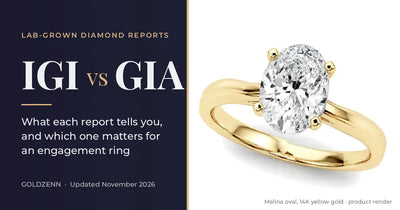
- A printed IGI report with every center stone, plus a GOLDZENN certificate of authenticity for the ring. The report covers the center only, not the side or accent stones. Our IGI vs GIA guide explains what the report shows.
- Returns. Rings from our engagement ring collection have their own section in the return policy: "30-day returns from delivery," with "100% store credit, or a refund to your original payment method minus a 10% restocking fee (maximum $400)." Condition: "unworn, unresized and unengraved, in the original box, with the IGI certificate and GOLDZENN appraisal." The 30 days also apply to rings bought during a promotion. Custom designs and engraved rings are final sale.
- Sizing. The policy includes "one free resize within 60 days of delivery." Once a ring is resized, it can no longer be returned. Use our ring size guide to get close the first time.
Still deciding between stone types? Our comparison of moissanite, lab-grown and natural diamonds covers the trade-offs, and how lab-grown diamonds are made explains where they come from.
Method, Data and Last Updated
- Source: every active lab-grown engagement ring listing in the GOLDZENN catalog, read from Shopify on November 3, 2026: 386 listings across 60 designs and 45,144 carat, quality and gold combinations. Every listing's center stone is lab-grown with an IGI report.
- What a price includes: the complete ring (setting in solid 14K or 18K gold, side stones where the design has them, and the center stone). Carat always means the center stone. Prices are the regular listed price before any temporary promotion, shipping or tax.
- How we summarize: "from" is the lowest-priced listing, "typical" is the median, "up to" is the highest. Upgrade costs are medians of the difference on the same listing. Price per added carat is a straight-line fit of each listing's price from 1 ct to 4 ct, then the median. 5 ct figures cover only the 192 listings that offer 5 ct.
- Gold: setting prices depend partly on the gold weight of each design, so prices move with the gold market. Yellow, white and rose gold are priced the same. The product page always shows the current price.
- Last updated: November 2026. We refresh the tables from live listings when ring prices change.
Frequently Asked Questions
How much is a 2 carat lab-grown diamond engagement ring?
In our catalog, a complete 2 ct ring in 14K gold with a VS1 F–G center starts at $1,795 and is typically $2,395. With 18K gold and a VVS1 D center it is typically $3,195.
How much is a 3 carat lab-grown diamond ring?
A complete 3 ct ring starts at $2,195 and is typically $2,850 in 14K with a VS1 F–G center. Elaborate halo and bezel designs reach $4,595.
What is the price per carat of a lab-grown diamond ring?
Divide the ring price by the center carat. Our typical ring works out to $1,950 per carat at 1 ct, $1,198 at 2 ct and $950 at 3 ct, because the setting costs about the same at every size.
What size lab-grown diamond can I get for $2,000?
In 14K with a VS1 F–G center, up to 2.5 ct in our lowest-priced design, and 27 of our 2 ct listings come in at or under $2,000.
Can you get a 2 carat ring for $5,000?
Yes, with room to spare. Every 2 ct ring we list is under $5,000 in 14K VS1 F–G, and 383 of our 4 ct listings also fit that budget.
Is VVS1 D worth it over VS1 F–G?
VS1 inclusions are minor and VVS1 inclusions are very hard to find, even under 10x magnification. D is the top color grade. The upgrade is small: a typical $255 on a 2 ct ring. If budget is tight, carat or design changes the look more.
Does 18K cost much more than 14K?
A typical $545 to $600 more on the same ring, and more on heavy settings, because 18K contains more pure gold per gram.
Does "2 carat" mean the center stone or the total?
On GOLDZENN rings it always means the center stone. Side and accent stones are listed separately and are not covered by the center stone's IGI report.
Why do loose-diamond price trackers show lower prices?
They price the stone alone. A ring adds the gold setting, side stones, setting work and the grading report. Compare whole ring to whole ring.
How long does a lab-grown engagement ring take?
Our rings are made to order in about 3 weeks.
Related Guides and Collections
- Lab-grown diamond engagement rings — Build yours by shape, carat, gold and quality
- Engagement ring shapes on the hand — How each shape looks at real size
- IGI vs GIA for lab-grown diamonds — What the grading report tells you
- Moissanite vs lab-grown vs natural diamonds — Which stone fits your budget
- Financing — Affirm, Klarna and Afterpay plans
Choose the shape, carat, gold and quality, and the builder shows the full price. Want help choosing? Call (321) 521-4651 to talk to a jeweler.
Build your ring →Call (321) 521-4651