Los colgantes vikingos se encuentran entre los símbolos más poderosos en la historia de la joyería. Durante más de mil años, guerreros, reyes y exploradores llevaron amuletos de oro grabados con símbolos nórdicos — no como decoración, sino como declaraciones de identidad, protección y creencia. Hoy en día, esa tradición perdura en colgantes de oro macizo que llevan el mismo peso de significado, forjados con precisión moderna e inspiración antigua.
Esta guía cubre todo lo que necesita saber sobre los colgantes vikingos de oro: la historia detrás de la joyería nórdica, el significado de cada símbolo principal, cómo se compara la metalistería vikinga con la orfebrería moderna, y cómo elegir, estilizar y cuidar un colgante vikingo de oro macizo que dure generaciones. Ya sea que le atraiga el colgante de hacha vikinga o el colgante vikingo Vegvisir, esta es la única guía que necesita.
Tabla de Contenidos
- La historia de la joyería vikinga (793–1066 d. C.)
- Principales descubrimientos arqueológicos
- Símbolos nórdicos y sus significados
- Metalistería vikinga vs. orfebrería moderna
- Tipos de colgantes vikingos
- La colección vikinga de GOLDZENN
- Oro macizo vs. chapado: por qué importa el material
- Cómo elegir el colgante vikingo adecuado
- Cómo combinar y superponer colgantes vikingos
- Las mejores cadenas para combinar con colgantes vikingos
- Guía de cuidado para colgantes vikingos de oro
- Colgantes vikingos como inversión
- Opciones de colgantes vikingos personalizados
- Preguntas frecuentes
La historia de la joyería vikinga (793–1066 d. C.)
La Era Vikinga abarcó aproximadamente desde el 793 hasta el 1066 d. C., originándose en Escandinavia —las actuales Dinamarca, Noruega y Suecia. Durante esta época, los nórdicos exploraron, comerciaron y saquearon a través de Europa, el Mediterráneo y tan al este como el Imperio Bizantino y los califatos islámicos. Su joyería era mucho más que un adorno. Funcionaba como moneda, marcadores de estatus social, amuletos religiosos y símbolos políticos, todo al mismo tiempo.
Joyería como moneda y estatus
En una sociedad sin acuñación estandarizada durante gran parte de su historia, las joyas de oro y plata servían como riqueza portátil. Los brazaletes y collares podían cortarse en piezas —llamadas "hack silver" o "hack gold"— y pesarse en balanzas para transacciones individuales. La generosidad de un cacique se medía por los brazaletes de oro y plata que distribuía a los guerreros leales. Cuanto más oro se llevaba, mayor era el estatus en la jerarquía social.
Materiales del mundo vikingo
El oro estaba reservado para la realeza, los caudillos y los guerreros más ricos. Se obtenía a través del comercio, las incursiones y el tributo del Imperio Bizantino y los califatos islámicos. La plata era el metal más popular para la joyería vikinga, a menudo obtenida como dirhams árabes fundidos y reelaborados en diseños escandinavos. El bronce servía a la clase media para el uso diario, mientras que el ámbar —llamado "el oro del Norte"— se obtenía de los depósitos del Mar Báltico y era muy apreciado para colgantes y cuentas. El hierro se utilizaba para piezas más sencillas, a veces combinado con incrustaciones de plata u oro para crear contraste.
Tipos de joyería vikinga
La joyería vikinga se dividía en varias categorías distintas:
- Brazaletes y pulseras — El principal símbolo de estatus y riqueza portátil del mundo vikingo. Los guerreros los recibían como recompensa de sus caudillos.
- Collares (torcs) — Piezas de alto estatus; los torques de oro estaban reservados para la realeza y los líderes más poderosos.
- Colgantes — La categoría más variada. Los amuletos del martillo de Thor (Mjolnir) eran los más comunes, seguidos de armas en miniatura (hachas, puntas de flecha), monedas perforadas, símbolos de Valknut y motivos del árbol de la vida.
- Broches (fíbulas) — Los broches ovalados sujetaban las prendas de las mujeres; los broches penanulares eran usados tanto por hombres como por mujeres.
- Collares de cuentas — Las cuentas de vidrio se producían en masa en centros comerciales como Birka y Hedeby, mientras que las cuentas de ámbar alcanzaban precios premium.
- Anillos de dedo — Menos comunes que los brazaletes, pero encontrados en tumbas ricas, a menudo con nudos o inscripciones rúnicas.
De todas estas formas, los colgantes tienen el peso simbólico más profundo. Eran talismanes personales que se llevaban cerca del corazón —elegidos para invocar la protección de dioses específicos, conmemorar ancestros o declarar lealtad a un sistema de creencias.
Principales descubrimientos arqueológicos
El registro arqueológico nos proporciona pruebas directas de cómo los vikingos elaboraban, usaban y valoraban las joyas de oro. Estos descubrimientos no son especulaciones, son artefactos físicos extraídos de la tierra, datados, analizados y conservados en museos. Comprenderlos profundiza su aprecio por lo que un colgante vikingo de oro realmente representa.
El tesoro de Hiddensee (Alemania, 1872–1874)
Después de que severas mareas de tormenta azotaran la isla de Hiddensee en el Mar Báltico, 16 piezas de joyería vikinga de oro puro emergieron de la arena. El tesoro incluye un collar de 44 cm de longitud (hecho de cuatro hilos de oro entrelazados), un broche de fíbula (8 cm de diámetro), seis colgantes en forma de cruz más grandes (aproximadamente 7 cm cada uno), cuatro colgantes en cruz más pequeños (aproximadamente 5 cm) y cuatro colgantes intermedios (aproximadamente 2 cm). El peso total supera los 600 gramos y la pureza del oro oscila entre el 93% y el 97%.
La artesanía presenta un magistral trabajo de filigrana y granulación, datado en la segunda mitad del siglo X. Los eruditos atribuyen el tesoro a la familia del rey danés Harald Gormsson, más conocido como Harald Blåtand (fallecido c. 980 d. C.). La mezcla de motivos cristianos y paganos en los colgantes refleja el período de transición en el que Escandinavia se estaba convirtiendo al cristianismo. Hoy, el Tesoro de Hiddensee se encuentra en el Museo de Stralsund, Alemania, y sigue siendo el mayor descubrimiento de joyería vikinga en el país.
El tesoro de Galloway (Escocia, 2014)
Descubierto en septiembre de 2014 en Dumfries y Galloway, Escocia, este tesoro contiene más de 100 objetos de oro, plata, vidrio, cristal, piedra y cerámica de la Era Vikinga, datados aproximadamente en el año 900 d. C. La colección pesa más de 5 kilogramos e incluye una cruz anglosajona, brazaletes de plata elaboradamente decorados, una piedra de toque con incrustaciones de oro y un recipiente de plata dorada con tapa repleto de objetos cuidadosamente envueltos. Es la colección más grande y variada de objetos de oro de la Era Vikinga jamás encontrada en Gran Bretaña e Irlanda. El Museo Nacional de Escocia en Edimburgo adquirió el tesoro en 2017.
El tesoro de Hoen (Noruega)
Con más de 200 objetos, incluyendo joyas de oro, monedas y cuentas de vidrio, el Tesoro de Hoen es uno de los hallazgos de oro vikingos más ricos de toda Escandinavia. Demuestra el enorme volumen de oro que circulaba por la sociedad nórdica en su apogeo: oro que habría adornado a los jefes, sido regalado a guerreros leales y, en última instancia, enterrado como ofrendas o reservas de emergencia.
El tesoro de Cuerdale (Inglaterra, 1840)
Descubierto cerca de Preston, Lancashire, el Tesoro de Cuerdale es uno de los mayores tesoros de plata vikinga jamás encontrados. Se recuperaron más de 8.600 artículos con un peso aproximado de 40 kilogramos, datados a principios del siglo X. La colección se divide entre el Museo Británico y el Museo Ashmolean, e ilustra cómo la plata y el oro fluían a través de las redes comerciales vikingas que se extendían desde Escandinavia hasta las Islas Británicas.
El Hacha de Mammen (Dinamarca, c. 970–971 d. C.)
Excavada de un túmulo funerario en Mammen, cerca de Viborg, Jutlandia, esta pequeña hacha de hierro está ricamente adornada con grabados incrustados con plata, niello y lámina de oro. Un lado presenta zarcillos que pueden representar a Yggdrasil (el Árbol de la Vida), mientras que el otro muestra una criatura con forma de pájaro —posiblemente un fénix o Gullinkambi, el gallo que se posa en la cima de Yggdrasil. El Hacha de Mammen dio nombre a un estilo artístico vikingo completo (el estilo Mammen, c. 950–1030 d. C.) y ejemplifica el doble simbolismo cristiano-pagano del arte de finales de la Era Vikinga. Reside en el Museo Nacional de Dinamarca, Copenhague.
Estos hallazgos demuestran que las joyas de oro vikingas no eran toscas o primitivas. Eran sofisticadas, técnicamente avanzadas y cargadas de significado simbólico —cualidades que los colgantes de oro modernos siguen honrando.
Símbolos nórdicos y sus significados
Cada símbolo tallado en un colgante vikingo tenía un significado específico. No eran patrones aleatorios, sino invocaciones de dioses, mapas del cosmos y declaraciones de identidad. Cuando hoy llevas un símbolo nórdico, estás llevando una tradición que se remonta a más de mil años.
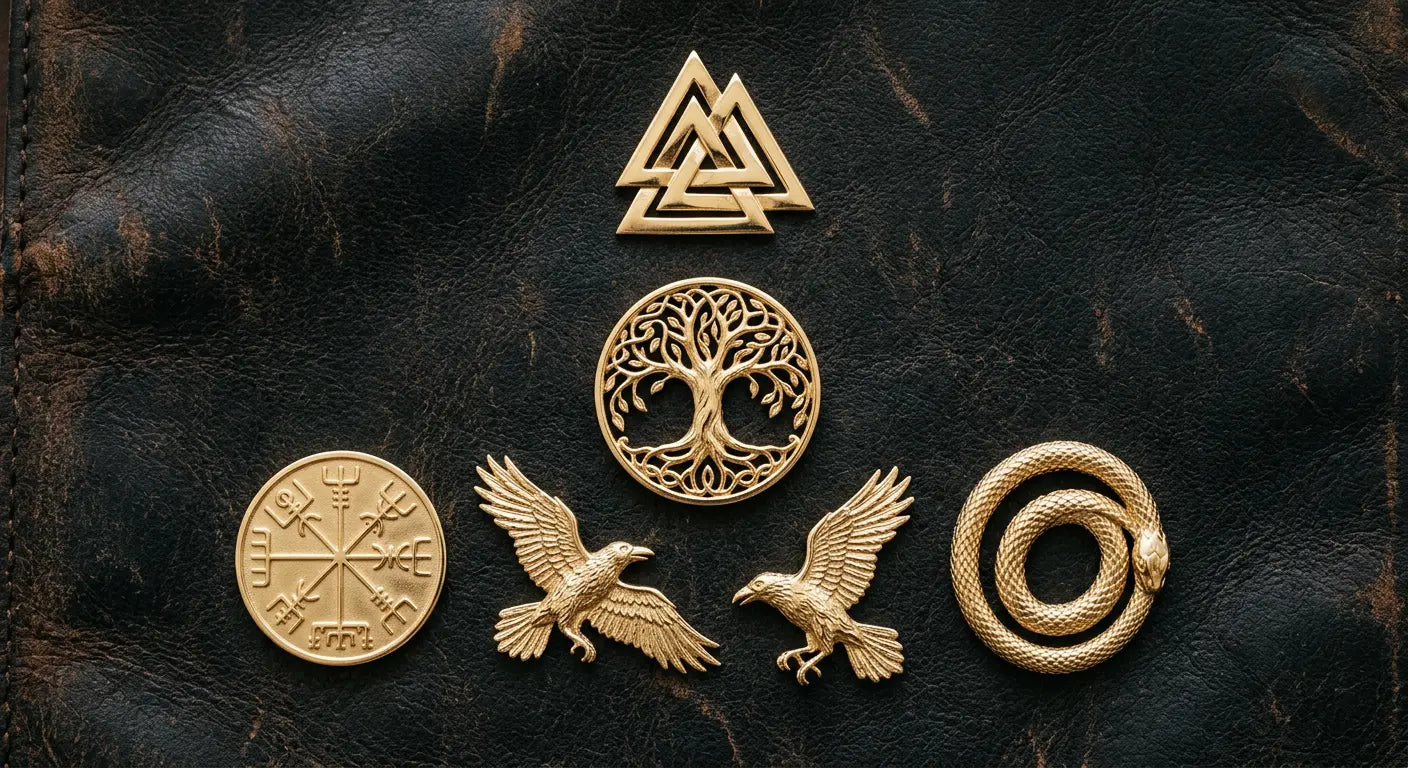
Mjolnir (Martillo de Thor)
Significado: "Triturador" o "Molino"
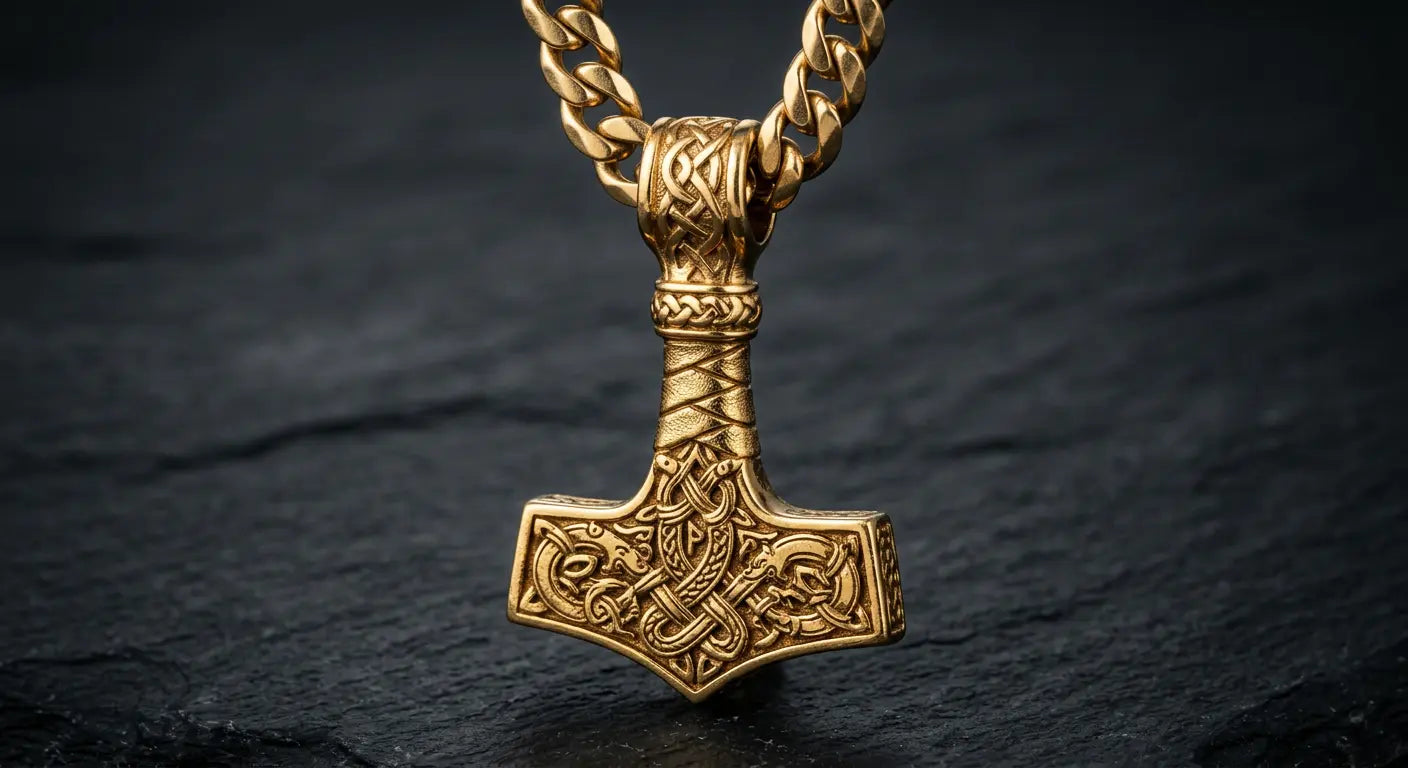
Mjolnir fue el colgante más usado en toda la Era Vikinga. Cientos de amuletos del martillo de Thor han sido recuperados de sitios arqueológicos en Escandinavia, las Islas Británicas y Europa del Este. Thor era el dios del trueno, protector tanto de Asgard (el reino de los dioses) como de Midgard (el mundo de los humanos). Su martillo simbolizaba protección, fuerza y consagración —se usaba para bendecir matrimonios, nacimientos y funerales.
Lo que hace a Mjolnir históricamente notable es que los vikingos continuaron usando colgantes de martillo incluso después de convertirse al cristianismo. Existen colgantes de doble fe que muestran tanto el martillo como la cruz en la misma pieza, lo que refleja un enfoque pragmático de la transición espiritual. Hoy en día, un colgante de Mjolnir de oro representa protección, fuerza interior y resiliencia ante la adversidad.
Vegvisir (La Brújula Vikinga)
Significado: "Guía" o "Indicador de camino"
El Vegvisir es un báculo mágico islandés documentado en el Manuscrito Huld (1860, compilado a partir de fuentes anteriores). Su inscripción reza: "Si se lleva este signo, uno nunca perderá el camino en tormentas o mal tiempo, incluso cuando el camino sea desconocido." Si bien el Vegvisir proviene técnicamente de una tradición mágica islandesa posterior y no de la Era Vikinga misma, se basa directamente en la tradición rúnica y es culturalmente inseparable de la herencia nórdica.
El colgante vikingo de oro de 14 quilates GOLDZENN presenta un motivo central de brújula Vegvisir rodeado de runas nórdicas en el borde —un medallón de oro macizo de 19,0 gramos que captura este símbolo de guía y navegación en su máxima expresión.
Valknut (Nudo de los Caídos)
Significado: Del nórdico antiguo "valr" (guerrero caído) + "knut" (nudo)
Tres triángulos entrelazados que representan la conexión entre la Tierra, Hel (el inframundo) y Asgard (el reino de los dioses). El Valknut se asocia con Odín, el Padre de todo, y específicamente con los guerreros caídos y la transición entre la vida y la muerte. Aparece en la piedra de Stora Hammars I en Gotland, Suecia, y en el entierro del barco de Oseberg en Noruega, casi siempre en contextos funerarios. Usar el Valknut significa valor ante la muerte e interconexión espiritual entre los reinos.
Yggdrasil (El Árbol del Mundo)
Significado: "Caballo de Odín" (de Yggr = Odín + drasill = caballo)
Yggdrasil es el gran fresno cósmico en el centro de la cosmología nórdica, que conecta los Nueve Mundos. Representa el ciclo de la vida, la muerte y el renacimiento; la interconexión de toda la existencia; y el orden subyacente del cosmos. El Árbol del Mundo está representado en el Hacha de Mammen (c. 970 d. C.) y es fundamental para la mitología de la creación nórdica tal como se registra en la Edda en prosa y la Edda poética. Un colgante de Yggdrasil simboliza el crecimiento, la resiliencia y la comprensión de que todas las cosas están conectadas.
Fenrir (El Gran Lobo)
Hijo del dios tramposo Loki y de la giganta Angrboda, Fenrir es el lobo monstruoso atado por los dioses con la cadena mágica Gleipnir. Se profetiza que se liberará durante el Ragnarok —el fin del mundo— y devorará al propio Odín. Como se describe en la Edda en prosa (Gylfaginning), Fenrir representa el poder crudo e indomable y el desafío del destino. Llevar a Fenrir simboliza la transformación, liberarse de las limitaciones y abrazar la propia fuerza.
Huginn y Muninn (Los Cuervos de Odín)
Significado: Huginn = "Pensamiento"; Muninn = "Memoria"
Cada amanecer, Odín envía a sus dos cuervos a volar por los Nueve Mundos para reunir información. Regresan al anochecer para posarse en sus hombros y susurrar todo lo que han visto y oído. Por eso Odín también es llamado Hrafnagud —el "Dios Cuervo". Atestiguado en la Edda poética (siglo XIII, de una tradición oral anterior), la Edda en prosa y la Heimskringla, el motivo del cuervo también se conecta con el estandarte del cuervo nórdico que llevaban los ejércitos vikingos a la batalla. Un colgante de cuervo representa sabiduría, conocimiento, conciencia y la búsqueda intelectual.
Jormungandr (La Serpiente del Mundo)
Significado: "Monstruo enorme" o "Gran Bestia"
Jormungandr es otro hijo de Loki y Angrboda, y el archienemigo de Thor. Esta enorme serpiente rodea todo el mundo de Midgard, mordiéndose la cola en una formación de uróboros. Representa el límite entre el mundo conocido y el caos, y la naturaleza cíclica de la destrucción y la renovación. Durante el Ragnarok, Thor y Jormungandr están destinados a matarse mutuamente. Los colgantes de serpiente simbolizan la resistencia, la naturaleza cíclica de la vida y la superación de desafíos que parecen imposibles.
Comprender estos símbolos es esencial al seleccionar un colgante vikingo. Cada uno lo conecta con un aspecto específico de la cosmología nórdica y un conjunto distinto de valores. Para obtener más información sobre el simbolismo y la selección de colgantes, consulte nuestra guía completa de compra de colgantes.
Metalistería vikinga vs. orfebrería moderna
Los vikingos no eran metalúrgicos primitivos. Sus técnicas eran sofisticadas, refinadas a través de siglos de práctica, e influenciadas por el contacto con artesanos bizantinos, islámicos y anglosajones. Comprender cómo trabajaban el oro ayuda a apreciar el linaje que hereda la joyería moderna hecha a mano.
Técnicas de fundición antiguas
La fundición a la cera perdida fue el método principal para producir elaborados colgantes vikingos. El proceso implicaba cinco pasos: (1) esculpir un modelo de cera del diseño, (2) revestirlo con arcilla o material de inversión, (3) calentar para derretir la cera, (4) verter metal fundido en la cavidad y (5) romper el molde para revelar la pieza terminada. Esta técnica produjo las intrincadas formas tridimensionales vistas en los amuletos de Mjolnir, los broches de estilo animal y los colgantes figurativos.
La fundición en molde de esteatita permitió a los joyeros vikingos crear moldes reutilizables —una forma temprana de producción en masa. Especialmente común para los colgantes del martillo de Thor, esta técnica permitió a los talleres en centros comerciales como Hedeby y Birka producir cientos de amuletos estandarizados de manera eficiente.
Maestría en la decoración de superficies
La filigrana —soldar pequeños hilos de metal retorcidos sobre superficies para construir patrones complejos— alcanzó su máxima complejidad en la Escandinavia del siglo X, fuertemente influenciada por las tradiciones metalúrgicas bizantinas e islámicas. La granulación implicaba unir minúsculas esferas de metal a las superficies para obtener efectos texturizados, una técnica adoptada de los artesanos anglosajones y refinada a través de contactos comerciales orientales.
El repujado (martillar desde la parte posterior de láminas de metal para crear diseños en relieve) y el cincelado (refinar los detalles con punzones desde el frente) se utilizaban juntos para crear los diseños en relieve que se veían en los escudetes, las placas de los cascos y los objetos ceremoniales. La incrustación de niello —rellenar las líneas grabadas con un compuesto negro de sulfuro de plata— creaba el dramático contraste visible en el Hacha de Mammen.
Orfebrería moderna: El legado continúa
La orfebrería actual se basa directamente en estos fundamentos. La fundición a la cera perdida sigue siendo el estándar de la industria para producir colgantes de oro detallados. La diferencia es la precisión: los joyeros modernos utilizan diseño CAD, máquinas de fundición en atmósfera controlada y soldadura láser junto con técnicas tradicionales de acabado a mano. Una pieza como el colgante de hacha vikinga GOLDZENN se funde en oro macizo de 14K utilizando técnicas que un joyero de la era vikinga reconocería, pero con tolerancias y calidad de acabado que la tecnología antigua no podía lograr.
Los paralelismos entre los talleres vikingos y los estudios de joyería modernos son sorprendentes. Ambos requieren dominio de la metalurgia, visión artística y la paciencia para refinar cada pieza a mano. En GOLDZENN, cada colgante se fabrica a mano en nuestro taller de Miami por un equipo con más de 50 años de experiencia combinada, una continuación directa de la tradición orfebre que los artesanos nórdicos establecieron hace más de un milenio. Si desea una pieza diseñada específicamente para usted, explore nuestra página de proyectos de joyería personalizada.
| Técnica | Era Vikinga (800–1066 d. C.) | Orfebrería Moderna |
|---|---|---|
| Fundición | Cera perdida con moldes de arcilla; moldes de esteatita para producción en masa | Cera perdida con fundición de inversión; máquinas de vacío/centrífugas |
| Diseño | Modelos de cera tallados a mano; piezas de prueba en hueso/piedra | Software CAD + tallado a mano; modelos de cera impresos en 3D |
| Detalle de superficie | Filigrana, granulación, incrustación de niello, repujado | Filigrana, grabado a mano, grabado láser, acabados con corte de diamante |
| Unión | Soldadura con aleaciones de bajo punto de fusión | Soldadura láser + soldadura tradicional |
| Acabado | Pulido a mano con piedras abrasivas | Pulido a máquina + acabado a mano; chapado en rodio para oro blanco |
| Control de calidad | Inspección visual; verificación de peso | Sellado, pruebas XRF, pesaje de precisión |
Tipos de colgantes vikingos
Los colgantes vikingos abarcan una variedad de diseños, cada uno arraigado en aspectos específicos de la cultura nórdica. Aquí están las categorías más significativas, desde formas históricamente documentadas hasta interpretaciones modernas que mantienen vivo el espíritu vikingo.
Colgantes de Mjolnir (Martillo de Thor)
El colgante vikingo más icónico e históricamente común. Los yacimientos arqueológicos han producido cientos de amuletos de Mjolnir en plata, bronce y oro en todo el mundo vikingo. Las versiones modernas de oro van desde martillos geométricos minimalistas hasta piezas muy detalladas con mangos de nudos e inscripciones rúnicas. Un Mjolnir de oro macizo es la pieza de declaración por excelencia para cualquiera que se sienta atraído por el simbolismo de protección nórdico.
Colgantes de Hacha Vikinga
El hacha era el arma vikinga más común, más barata y versátil que una espada, utilizada tanto para la batalla como para el trabajo diario. Los colgantes de hacha en miniatura honraban tanto la ética guerrera como la autosuficiencia práctica de la cultura nórdica. El Colgante de Hacha Vikinga GOLDZENN captura esta tradición en oro macizo de 14K: un hacha de guerra de doble cabeza con detalles grabados ornamentados, que pesa 5.1 gramos y mide 35.12mm de alto por 16.82mm de ancho. Por $762.99, es una entrada accesible a la joyería nórdica de oro macizo.

Colgante de Hacha Vikinga GOLDZENN — Oro macizo de 14K, 5.1g, $762.99 | Comprar ahora
Colgantes de Brújula y Rúnicos
La brújula Vegvisir y varios diseños de círculos rúnicos representan guía, sabiduría y conexión con las tradiciones místicas del mundo nórdico. Suelen ser colgantes tipo medallón: redondos, sustanciales y detallados. El Colgante Vikingo de Oro de 14K GOLDZENN es un excelente ejemplo: un llamativo medallón redondo de 19.0 gramos con una brújula Vegvisir central rodeada de runas nórdicas a lo largo del borde, con un precio de $2,407.24 en oro macizo de 14K.

Colgante Vikingo GOLDZENN de Oro de 14K — Brújula Vegvisir, 19.0g, $2,407.24 | Comprar ahora
Colgantes de Lobo y Bestias
Fenrir, los osos y otros animales eran centrales en la iconografía vikinga. El arte de estilo animal, donde las criaturas son estilizadas en patrones entrelazados de extremidades, colas y dientes, es una de las características distintivas del arte decorativo nórdico. Los colgantes de lobo en particular simbolizan el poder puro, la lealtad a la manada y el coraje para enfrentar probabilidades abrumadoras.
Colgantes de Cuervo
Los cuervos de Odín, Huginn y Muninn, aparecían en todo, desde joyas hasta estandartes de guerra. Los ejércitos vikingos marchaban bajo banderas de cuervos, creyendo que el comportamiento del ave podía predecir el resultado de la batalla. Un colgante de cuervo de oro conecta al portador con la búsqueda de conocimiento de Odín y la idea de que la sabiduría es el arma definitiva.
Colgantes de Serpientes y Dragones
La Serpiente del Mundo Jörmungandr, junto con varios motivos de dragones del arte nórdico, representaba la existencia cíclica y la frontera entre el orden y el caos. Los diseños de Ouroboros, la serpiente que se muerde la cola, eran particularmente populares y siguen siendo impactantes en la joyería de oro moderna.
Colgantes Transculturales
Durante la Baja Edad Vikinga (950–1066 d.C.), surgieron colgantes de doble fe que combinaban cruces cristianas con motivos nórdicos. Los colgantes en forma de cruz del Tesoro de Hiddensee, que presentan técnicas de filigrana distintivamente paganas en formas cristianas, son la evidencia arqueológica más clara de esta mezcla cultural. Los colgantes vikingos modernos a veces hacen eco de esta tradición combinando múltiples tradiciones simbólicas en una sola pieza.
Para más estilos de colgantes más allá de los temas nórdicos, explore nuestra guía de colgantes de identificación militar de oro o navegue por la colección completa de colgantes.
La Colección Vikinga de GOLDZENN
GOLDZENN ofrece dos distintos colgantes vikingos de oro macizo, cada uno representando un aspecto diferente de la herencia nórdica. Ambos están hechos a mano en nuestro taller de Miami en oro macizo de 14K, sin chapado, sin construcción hueca, sin atajos.
Colgante de Hacha Vikinga — Oro Macizo de 14K
| Especificación | Detalle |
|---|---|
| Material | Oro amarillo macizo de 14K (58.3% oro puro) |
| Peso | 5.1 gramos |
| Dimensiones | 35.12mm de alto × 16.82mm de ancho |
| Diseño | Hacha de guerra de doble cabeza con detalles grabados ornamentados |
| Precio | $762.99 (comparar con $953.99) |
| Envío | Listo para enviar (3–5 días hábiles) |
El Colgante de Hacha Vikinga es la más accesible de las dos piezas. Su diseño de hacha de doble cabeza se inspira directamente en la cultura guerrera vikinga: el hacha era el arma distintiva de los guerreros nórdicos, más prevalente que la espada y mucho más versátil. El grabado ornamentado en las caras de la hoja hace eco de la tradición decorativa vista en hachas ceremoniales como el Hacha de Mammen. Con 5.1 gramos, es lo suficientemente sustancial como para sentirse significativo en una cadena sin ser lo suficientemente pesado como para abrumarte durante el uso diario.
Este colgante funciona mejor con una cadena de oro de peso medio en el rango de 20 a 24 pulgadas. Una cadena de eslabones cubanos de 3mm a 4mm complementa perfectamente las líneas angulares del diseño del hacha, mientras que una cadena Figaro añade un toque europeo a la estética nórdica.
Colgante Vikingo de Oro de 14K — Brújula Vegvisir
| Especificación | Detalle |
|---|---|
| Material | Oro amarillo macizo de 14K (58.3% oro puro) |
| Peso | 19.0 gramos |
| Diseño | Medallón redondo con brújula Vegvisir central y borde de runas nórdicas |
| Precio | $2,407.24 (comparar con $3,610.86) |
| Producción | Hecho por encargo |
El Colgante Vikingo de Oro de 14K es la pieza nórdica insignia de la colección GOLDZENN. Con 19.0 gramos de oro macizo de 14K, es un medallón sustancial que llama la atención. El motivo central de la brújula Vegvisir está rodeado de runas nórdicas a lo largo del borde, creando una pieza que es a la vez artísticamente rica y simbólicamente cargada. Las fotos del producto lo muestran combinado con una cadena de oro retorcida, demostrando el tipo de estilo audaz que hace justicia a este colgante.
Con casi cuatro veces el peso del Colgante de Hacha, el Vegvisir requiere una cadena más pesada; una cadena de eslabones cubanos de 5mm o 6mm es ideal, proporcionando el equilibrio visual y físico necesario para un colgante de 19 gramos. Esta es una pieza de declaración diseñada para alguien que quiere que sus joyas transmitan un peso y un significado inconfundibles.
Ambas piezas están cubiertas por la garantía de por vida de GOLDZENN contra defectos de fabricación. Las opciones de financiación están disponibles a través de múltiples proveedores, incluyendo Shop Pay Installments, Affirm y Klarna, para los clientes que prefieren distribuir los pagos a lo largo del tiempo.
Oro Macizo vs. Chapado: Por qué el material importa en la joyería vikinga
El mercado de la joyería con temática vikinga está inundado de opciones chapadas, rellenas y de acero inoxidable con precios entre $15 y $150. Comprender la diferencia entre estos materiales y el oro macizo es esencial para realizar una compra de la que no te arrepentirás.
Qué significa realmente "Chapado en Oro"
La joyería chapada en oro tiene una capa de oro extremadamente delgada (típicamente de 0.5 a 2.5 micras) electrochapada sobre un metal base, generalmente latón o acero inoxidable. El contenido de oro es insignificante, a menudo menos del 0.05% de la pieza total. El chapado se desgasta con la fricción, el sudor y la exposición al agua, típicamente dentro de los 6 a 12 meses de uso regular. Una vez que el chapado se desgasta, el metal base subyacente queda expuesto, lo que provoca deslustre, decoloración verde de la piel y una apariencia visiblemente degradada.
Oro Macizo: Construido para durar generaciones
El oro macizo de 14K es 58.3% oro puro aleado con metales como cobre, plata y zinc para mayor durabilidad. No se desprende porque el oro no es un recubrimiento superficial, sino que atraviesa toda la pieza. El oro macizo puede pulirse, repararse y restaurarse indefinidamente. Mantiene su color, brillo y valor durante décadas y generaciones. El Colgante Vikingo Vegvisir de GOLDZENN contiene 19.0 gramos de este material, casi 11.1 gramos de oro puro en peso.
Por qué es importante específicamente para la joyería vikinga
Los colgantes vikingos tienen un significado cultural y simbólico. Una brújula Vegvisir o un martillo Mjolnir no son solo decoración, son un talismán personal. Usar una versión chapada que se degrada en un año contradice la misma permanencia y fuerza que estos símbolos representan. Los vikingos valoraban el oro específicamente porque era incorruptible: no se oxida, no se deslustra ni se deteriora. Un colgante vikingo de oro macizo honra ese principio de una manera que las alternativas chapadas simplemente no pueden.
| Característica | Chapado en Oro ($15–$150) | Oro Macizo de 14K ($700–$2,500+) |
|---|---|---|
| Contenido de Oro | <0.05% en peso | 58.3% en peso |
| Vida útil | 6–12 meses antes de que se desgaste el chapado | Generaciones (indefinido) |
| Reacción cutánea | Decoloración verde común | Hipoalergénico para la mayoría de las personas |
| Reparabilidad | No se puede volver a chapar con la calidad original | Totalmente restaurable por cualquier joyero |
| Valor de Reventa | Esencialmente cero | Conserva el valor de fusión del oro como mínimo |
| Resistencia al Agua | El chapado acelera el desgaste al contacto con el agua | Totalmente impermeable; el oro no se corroe |
| Sensación de Peso | Ligero, sensación hueca | Sustancial, peso premium |
Para una mirada más profunda a cómo se comparan los niveles de pureza del oro, lea nuestra guía completa de oro de 10K vs. 14K vs. 18K. Y para una comprensión exhaustiva de los precios del mercado del oro, consulte nuestra guía de precios del oro.
Cómo Elegir el Colgante Vikingo Adecuado
Elegir un colgante vikingo implica más que seleccionar un diseño que te guste. El tamaño, el peso, el simbolismo y la compatibilidad con la cadena son factores que influyen en encontrar la pieza que se siente adecuada para tu cuerpo, tu estilo y tu intención.
Tamaño y Escala
El tamaño del colgante debe ser proporcional a tu complexión y a la cadena con la que planeas usarlo. Como guía general:
- Colgantes pequeños (menos de 10g): Funcionan bien en cadenas más finas (2mm–4mm). Sutiles, para uso diario. El Colgante de Hacha Vikinga de 5.1g entra en este rango.
- Colgantes medianos (10g–20g): Requieren cadenas de peso medio (4mm–6mm). Notorios pero no abrumadores. El Colgante Vikingo Vegvisir de 19.0g se sitúa en el extremo superior de este rango.
- Colgantes grandes (20g+): Demandan cadenas pesadas (6mm+) y una complexión más grande para llevarlos proporcionalmente.
Simbolismo e Intención
Elige el símbolo que resuene con el momento de tu vida o las cualidades que deseas encarnar:
- ¿Comenzando algo nuevo? El Vegvisir (brújula) te guía por territorio inexplorado.
- ¿Enfrentando la adversidad? Mjolnir (Martillo de Thor) proporciona protección y fuerza contra el caos.
- ¿Buscando sabiduría? Huginn y Muninn (los Cuervos de Odín) representan el pensamiento, la memoria y la búsqueda del conocimiento.
- ¿Abrazando la transformación? Fenrir (el Gran Lobo) simboliza la liberación de las restricciones.
- ¿Honrando la conexión? Yggdrasil (el Árbol del Mundo) representa la interconexión de todas las cosas.
- ¿Construyendo tu legado? El hacha vikinga representa la autosuficiencia, la artesanía y la herramienta elegida por el guerrero.
Selección de Quilates de Oro
Para los colgantes vikingos específicamente, el oro de 14K es la elección óptima. Ofrece el mejor equilibrio entre durabilidad, riqueza de color y valor. Los quilates más altos (18K, 22K) producen un color amarillo más rico pero son más blandos y propensos a los arañazos, una preocupación para un colgante con detalles grabados que deseas preservar. El oro de 10K es el más duradero pero tiene un color más pálido que no hace justicia a los intrincados diseños nórdicos. Por esta razón, ambos colgantes vikingos de GOLDZENN están elaborados en oro de 14K.
Consideraciones Presupuestarias
Los colgantes vikingos de oro macizo oscilan entre aproximadamente $700 para piezas más ligeras (5–7 gramos) y más de $2,500 para medallones más pesados (15–20+ gramos). Recuerda que el oro conserva un valor intrínseco de fundición, por lo que un colgante de oro macizo nunca es un coste irrecuperable como lo es una pieza chapada. GOLDZENN ofrece opciones de financiación a través de múltiples proveedores, incluyendo Shop Pay Installments, Affirm, Klarna y Afterpay, para los clientes que desean distribuir la inversión a lo largo del tiempo.
Cómo Combinar y Superponer Colgantes Vikingos
Los colgantes vikingos son piezas inherentemente llamativas. Combinarlos eficazmente significa equilibrar su impacto visual con el resto de tu atuendo y accesorios.
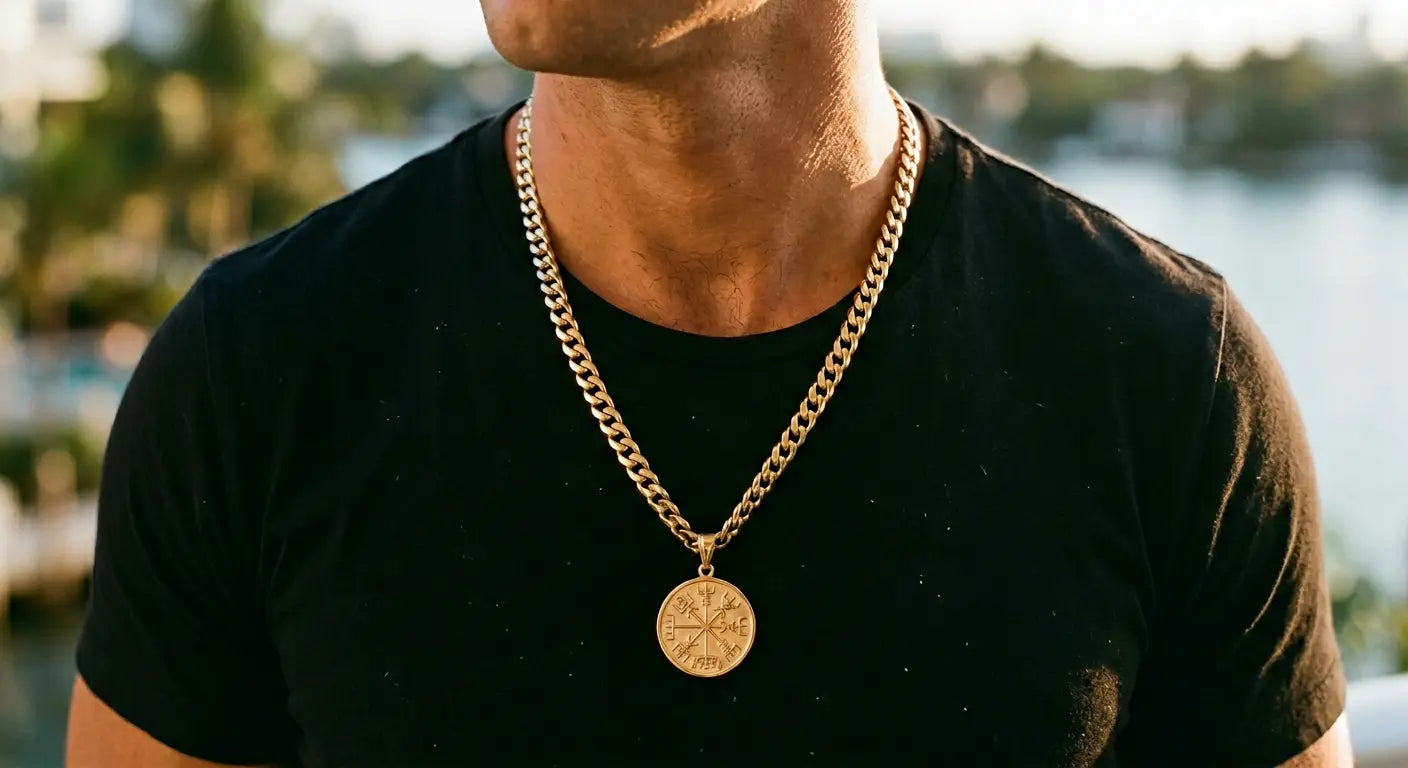
Estilo de Declaración Solitario
El enfoque más simple y a menudo más potente: un colgante en una sola cadena, usado sobre la piel desnuda o sobre una camiseta de cuello redondo oscura. Esto funciona especialmente bien con el Colgante Vikingo Vegvisir en una cadena de 22 a 24 pulgadas, donde el medallón descansa a la mitad del pecho y atrae la mirada de inmediato. La ropa oscura (negro, gris carbón, azul marino intenso) crea el contraste más fuerte contra el oro amarillo.
Pila Vikinga en Capas
La superposición de cadenas es una de las mayores tendencias en joyería masculina, y los colgantes vikingos se integran perfectamente en una configuración en capas. La clave es variar las longitudes de las cadenas en 2 a 3 pulgadas entre capas:
- Capa 1 (18–20 pulgadas): Una cadena delgada (2mm–3mm) que se asienta en la base del cuello. Una simple Figaro o cadena de caja funciona como base.
- Capa 2 (22–24 pulgadas): Tu colgante vikingo en una cadena de peso medio (3mm–5mm). Este es el punto focal de la pila.
- Capa 3 (26+ pulgadas, opcional): Una cadena de eslabones cubanos más pesada usada como la capa más baja, añadiendo peso y anclaje visual a la composición.
Combinación con Otros Colgantes
Si usas varios colgantes, mantén el mismo metal (oro amarillo con oro amarillo) y varía el tamaño. Nunca combines dos medallones grandes de la misma longitud, ya que chocarán y se rayarán entre sí. El Colgante de Hacha Vikinga (5.1g) en una cadena más corta combina perfectamente con una pieza más pesada en una cadena más larga, como el Colgante de Casco Espartano para una pila temática de guerrero.
Integración del Atuendo
- Informal: Camiseta con cuello en V o camisa con cuello abierto que permite que el colgante se asiente sobre la piel. El tono cálido del oro amarillo de 14K destaca contra las camisetas oscuras.
- Semi-formal: Colgante metido debajo de una camisa de vestir para un significado personal sin exhibirlo, o usado sobre un cuello alto oscuro para un look más atrevido.
- Streetwear: Los colgantes vikingos con ropa exterior extragrande y cadenas de oro pesadas crean una estética urbana con toques de herencia que destaca.
Para la guía completa de superposición con combinaciones de productos específicos y recomendaciones de longitud de cadena, consulte nuestra guía de superposición de collares de cadena.
Las Mejores Cadenas para Combinar con Colgantes Vikingos
La cadena que elijas es la mitad de la ecuación. Un gran colgante en la cadena equivocada se ve mal; una pieza vikinga de oro macizo merece una cadena que coincida con su calidad, peso y estética.
Recomendaciones de Tipo de Cadena
| Tipo de Cadena | Ideal Para | Rango de Ancho | Por Qué Funciona |
|---|---|---|---|
| Eslabón Cubano | Colgante Vegvisir (19g) | 5mm–7mm | Eslabones atrevidos y planos complementan la forma redonda y el peso sustancial del medallón |
| Figaro | Hacha Vikinga (5.1g) | 3mm–4mm | El patrón de eslabones alternos añade interés visual sin competir con el colgante |
| Cuerda | Ambos colgantes | 3mm–5mm | El diseño retorcido evoca las técnicas de torsión de alambre de los orfebres vikingos |
| Caja | Hacha Vikinga (5.1g) | 2mm–3mm | Eslabones limpios y geométricos permiten que los detalles del colgante destaquen |
| Franco | Colgante Vegvisir (19g) | 4mm–6mm | El tejido en forma de V añade textura; lo suficientemente fuerte para colgantes más pesados |
Guía de Longitud de Cadenas
- 18 pulgadas: Queda en la base del cuello. Ideal para colgantes pequeños o para usar en capas como la cadena superior.
- 20 pulgadas: Reposa a la altura de la clavícula. Funciona bien para el Colgante Hacha Vikinga para un look sutil y cercano al cuerpo.
- 22 pulgadas: Cae justo debajo de la clavícula. La longitud más versátil para colgantes, visible sobre la mayoría de los escotes.
- 24 pulgadas: Llega a la mitad del pecho. Ideal para el medallón Vegvisir como pieza destacada sobre la ropa.
- 26–30 pulgadas: Para usar en capas como la cadena más larga, o para llevar un colgante bajo las camisas.
Explora la gama completa de tipos de cadenas de oro para encontrar la combinación adecuada, o navega por nuestra colección de cadenas de eslabones cubanos para la opción de combinación más popular.
Guía de Cuidado para Colgantes Vikingos de Oro
El oro macizo es intrínsecamente duradero, pero un cuidado adecuado preserva los finos grabados y el acabado pulido que hacen que un colgante vikingo sea especial. Sigue estas pautas para mantener tu pieza con un aspecto impecable durante décadas.
Pautas para el Uso Diario
- Quítatelo antes de nadar. El cloro de las piscinas y la sal del agua de mar no dañarán el oro, pero pueden opacar el acabado con el tiempo y potencialmente debilitar el mecanismo del cierre de tu cadena.
- Quítatelo antes de hacer ejercicio. El sudor es ligeramente ácido y puede acumularse en los detalles grabados de un colgante vikingo, lo que lleva a la opacidad. Limpia el colgante si se moja con sudor.
- Evita el contacto con productos químicos. El perfume, la colonia, el protector solar y los productos de limpieza no deben tocar las joyas de oro. Aplica la fragancia en tus muñecas y cuello antes de ponerte el colgante.
Limpieza en Casa
Para un mantenimiento regular, el proceso es sencillo:
- Llena un cuenco con agua tibia (no caliente) y unas gotas de jabón lavavajillas suave.
- Remoja el colgante durante 15–20 minutos.
- Usa un cepillo de dientes de cerdas suaves para frotar suavemente las áreas grabadas donde se acumula la suciedad.
- Enjuaga bajo agua tibia corriente.
- Seca con golpecitos con un paño sin pelusa. No dejes secar al aire, ya que pueden formarse manchas de agua.
Para obtener instrucciones de limpieza detalladas y lo que debes y no debes hacer, consulta nuestra guía completa de limpieza de joyas de oro.
Almacenamiento
- Guarda cada pieza por separado en una bolsa suave o en un joyero forrado para evitar arañazos.
- Nunca guardes joyas de oro sueltas en un cajón con otros objetos metálicos.
- Mantén alejadas de la luz solar directa durante períodos prolongados: aunque el oro en sí no se ve afectado, los materiales de almacenamiento pueden degradarse.
Mantenimiento Profesional
Haz limpiar e inspeccionar profesionalmente tu colgante vikingo una vez al año. Un joyero puede pulir pequeños arañazos superficiales, verificar el argollado (el lazo que conecta el colgante a la cadena) por desgaste y limpiar con ultrasonidos los detalles grabados para restaurar su brillo completo. Esto está incluido en el servicio de garantía de por vida de GOLDZENN contra defectos de fabricación.
Colgantes Vikingos como Inversión
Un colgante vikingo de oro macizo es tanto una pieza de arte portátil como un activo tangible. A diferencia de las joyas chapadas, que no tienen valor de reventa una vez que el revestimiento se desgasta, el oro macizo conserva un valor intrínseco de fusión que sigue el mercado global del oro.
Valor Intrínseco del Oro
El Colgante Vikingo Vegvisir de GOLDZENN de oro de 14 quilates pesa 19,0 gramos de oro de 14 quilates. Con una pureza del 58,3%, eso equivale aproximadamente a 11,1 gramos de oro puro. A medida que los precios del oro fluctúan, ese valor intrínseco se mueve con el mercado, pero nunca llega a cero. En las últimas dos décadas, el oro se ha apreciado significativamente, lo que significa que el contenido de oro por sí solo en un colgante sólido tiende a aumentar de valor con el tiempo.
Prima de Artesanía
Más allá del valor de fusión, las joyas hechas a mano de marcas establecidas conllevan una prima de artesanía. Un colgante estampado a máquina y una pieza acabada a mano pueden contener el mismo peso de oro, pero la versión hecha a mano tiene una mayor reventa debido a su calidad artística, la procedencia de la marca y la producción limitada. Las piezas de GOLDZENN están hechas a mano en nuestro taller de Miami, no son de producción masiva en el extranjero.
El Mercado de Colgantes Vikingos
Las joyas con temática nórdica han mostrado un crecimiento constante de la demanda durante la última década, impulsado por los medios culturales, la tendencia de las joyas para hombres y la apreciación general por el diseño inspirado en el patrimonio. Las piezas vikingas de oro macizo son raras en el mercado (la mayoría de las ofertas son chapadas o de plata), lo que otorga a las joyas nórdicas auténticas de oro macizo una ventaja por su escasez.
Para un análisis más profundo del oro como un activo a largo plazo, lee nuestra guía de joyas de oro como inversión.
Opciones de Colgantes Vikingos Personalizados
Si los símbolos de nuestra colección actual no coinciden con tu visión, el taller de joyería personalizada de GOLDZENN puede hacer realidad tu diseño. Nuestro equipo tiene más de 50 años de experiencia combinada en orfebrería y se especializa en traducir conceptos complejos en realidad de oro macizo.
Lo que Podemos Crear
- Símbolos nórdicos personalizados — Mjolnir, Valknut, Yggdrasil, Fenrir, cuervos, serpientes, o cualquier combinación en tu quilate de oro preferido
- Inscripciones rúnicas personalizadas — Tu nombre, iniciales o una frase significativa grabada en runas Futhark Antiguo alrededor del borde de un colgante
- Integración de escudos familiares — Motivos nórdicos combinados con heráldica familiar o símbolos personales
- Modificaciones de escala — Diseños existentes ampliados o reducidos para que coincidan con tu peso y dimensiones preferidos
- Adiciones de diamantes o piedras preciosas — Piedras de acento engastadas en diseños nórdicos para un impacto visual adicional
El Proceso Personalizado
Nuestro proceso de joyería personalizada generalmente sigue estos pasos: consulta (discute tu concepto y especificaciones), diseño CAD (crea representaciones digitales para tu aprobación), modelo de cera (prototipo físico para la revisión final), fundición y acabado (hecho a mano en el quilate de oro elegido) y entrega. Los colgantes vikingos personalizados suelen tardar de 3 a 5 semanas desde la aprobación hasta la finalización.
Para los clientes interesados en añadir acentos de diamante a un diseño vikingo, como un cuervo con ojos de diamante o un Vegvisir con una piedra central, nuestro equipo puede obtener y engastar piedras según tus especificaciones.
Preguntas Frecuentes
¿Qué simboliza un colgante vikingo?
Los colgantes vikingos simbolizan cosas diferentes según el motivo nórdico específico. Mjolnir (el martillo de Thor) representa protección y fuerza. La brújula Vegvisir simboliza la guía en tiempos difíciles. El Valknut representa el coraje y la conexión entre la vida y la muerte. Yggdrasil (el Árbol del Mundo) simboliza la interconexión y el orden cósmico. Los colgantes de hacha vikinga honran la ética guerrera y la autosuficiencia que definieron la cultura nórdica. Cada símbolo conecta al portador con un aspecto específico de la mitología nórdica y valores que han perdurado durante más de mil años.
¿Vale la pena invertir en un colgante vikingo de oro?
Un colgante vikingo de oro macizo conserva un valor intrínseco porque el contenido de oro en sí tiene valor de mercado. Por ejemplo, el Colgante Vikingo de Oro de 14K de GOLDZENN contiene 19,0 gramos de oro de 14K, aproximadamente 11,1 gramos de oro puro. A diferencia de las alternativas chapadas en oro que no tienen valor de reventa una vez que el chapado se desgasta (normalmente en 6-12 meses), el oro macizo se puede pulir, reparar y transmitir de generación en generación, manteniendo o aumentando su valor a medida que los precios del oro suben con el tiempo.
¿Cuál es la diferencia entre una joya vikinga chapada en oro y una de oro macizo?
Las joyas vikingas chapadas en oro tienen una capa extremadamente delgada de oro (0,5-2,5 micras) sobre un metal base como el latón o el acero inoxidable, que comprende menos del 0,05% de oro en peso. El chapado se desgasta en cuestión de meses con el uso regular, exponiendo el metal base. Las joyas vikingas de oro macizo, como las piezas de 14K de GOLDZENN, son 58,3% de oro puro en toda su extensión. Nunca se deschapará, es hipoalergénico para la mayoría de las personas y se puede restaurar a su estado original indefinidamente. Para una pieza destinada a llevar un profundo significado simbólico, el oro macizo es el único material que coincide con la permanencia del mensaje.
¿Qué cadena debo usar con un colgante vikingo?
La cadena ideal depende del peso de tu colgante. Para colgantes más ligeros como el Colgante Hacha Vikinga (5,1 g), una cadena Figaro, de caja o de cuerda de 3 mm a 4 mm y de 20 a 22 pulgadas funciona bien. Para medallones más pesados como el Colgante Vikingo Vegvisir (19,0 g), una cadena de eslabones cubanos o Franco de 5 mm a 7 mm y de 22 a 24 pulgadas proporciona la resistencia y el equilibrio visual necesarios. Siempre combina el metal de la cadena con el metal del colgante: colgante de oro amarillo de 14K con una cadena de oro amarillo de 14K.
¿Puedo ducharme o nadar con un colgante vikingo de oro?
El oro macizo de 14K es resistente al agua y no se corroe, oxida ni empaña con la exposición al agua. Sin embargo, el cloro de las piscinas y la sal del agua de mar pueden opacar el acabado pulido con el tiempo, y los residuos de jabón pueden acumularse en los detalles grabados de los diseños vikingos. Para obtener los mejores resultados, quítate el colgante antes de nadar y ducharte, y límpialo periódicamente con agua tibia y jabón suave. Consulta nuestra guía de limpieza de oro para obtener instrucciones detalladas de cuidado.
¿Qué es el símbolo Vegvisir en el colgante vikingo de GOLDZENN?
El Vegvisir (pronunciado "VEGG-vi-seer") es un bastón mágico islandés que significa "indicador de camino" o "señal". Fue documentado en el Manuscrito Huld de 1860, compilado a partir de fuentes mágicas islandesas anteriores. Su inscripción dice: "Si se lleva este signo, uno nunca perderá el camino en tormentas o mal tiempo, incluso cuando el camino no sea conocido". Aunque técnicamente proviene de la tradición islandesa posterior a la época vikinga, el Vegvisir se basa en la herencia rúnica y nórdica y se ha convertido en uno de los símbolos más reconocidos asociados con la cultura vikinga. El Colgante Vikingo Vegvisir de Oro de 14K de GOLDZENN presenta una brújula Vegvisir central rodeada de runas nórdicas.
¿Qué tan pesado debe ser un colgante vikingo de oro?
El peso del colgante es una cuestión de preferencia personal y proporcionalidad a tu complexión. Para el uso diario, 5-10 gramos proporcionan sustancia sin fatiga por el peso. Para una pieza destacada, más de 15-20 gramos ofrecen el tipo de peso que se siente durante todo el día. El Colgante Hacha Vikinga GOLDZENN de 5,1 gramos está diseñado para un uso diario cómodo, mientras que el Colgante Vegvisir de 19,0 gramos está diseñado para causar una impresión. Como regla general, tu cadena debe ser al menos igual o más pesada que tu colgante para que cuelgue correctamente.
¿Los colgantes vikingos son solo para hombres?
En absoluto. Históricamente, las mujeres vikingas usaban joyas elaboradas, incluidos colgantes, broches y collares de cuentas. Los broches ovalados eran específicamente artículos de mujer, y muchos estilos de colgantes eran usados por ambos sexos. Hoy en día, los colgantes vikingos más pequeños (menos de 10 gramos) funcionan bien en el estilo de collares para mujeres, especialmente los diseños Yggdrasil, Vegvisir y Mjolnir en cadenas delicadas. El simbolismo es universal: protección, guía, fuerza y sabiduría no tienen restricción de género.
¿Puedo encargar un colgante vikingo personalizado?
Sí. El taller de joyería personalizada de GOLDZENN en Miami puede crear colgantes vikingos a medida en cualquier quilate de oro (10K, 14K, 18K o 22K) con símbolos nórdicos personalizados, inscripciones rúnicas, engastes de piedras preciosas o diseños únicos. El proceso incluye consulta, diseño CAD, revisión de modelos de cera y producción artesanal, lo que suele tardar de 3 a 5 semanas desde la aprobación hasta la entrega. Lee nuestra guía completa de joyas personalizadas para obtener detalles sobre el proceso, los factores de precio y qué esperar en cada etapa.
¿Por qué el oro de 14K es la mejor opción para un colgante vikingo?
El oro de 14K (58,3% de oro puro) ofrece el equilibrio óptimo entre durabilidad, riqueza de color y valor para trabajos de colgantes detallados. Los quilates más altos, como 18K y 22K, producen un color amarillo más intenso pero son más blandos, lo que significa que los intrincados grabados de un colgante vikingo son más susceptibles a los arañazos y al desgaste. El oro de 10K (41,7% puro) es más duro pero tiene un color más pálido que no muestra los diseños nórdicos con la misma eficacia. Con 14K, obtienes un tono dorado cálido y rico que resiste el desgaste diario mientras mantiene el trabajo de detalle que hace que los colgantes vikingos sean distintivos. Por esta razón, ambos colgantes vikingos de GOLDZENN están elaborados en oro de 14K. Obtén más información en nuestra guía completa de comparación de quilates.
Los colgantes vikingos de oro tienen un linaje que se remonta a más de mil años, desde los talleres de filigrana de Hedeby hasta los modernos estudios de orfebrería de Miami. Los símbolos perduran porque los valores que representan perduran: fuerza, guía, sabiduría, resistencia y la creencia de que lo que se lleva debe significar algo. Ya sea que elijas el Colgante Hacha Vikinga por su herencia guerrera o el Colgante Vikingo Vegvisir por su simbolismo de navegación, estás usando una pieza que te conecta con una de las culturas más fascinantes de la historia, forjada en oro macizo que perdurará más que cualquier otra cosa en tu colección.
Explora la colección completa de colgantes GOLDZENN o inicia un proyecto personalizado para crear algo completamente tuyo.